
Quick Take
- Polymarket World Cup contracts have topped $3.3 billion in volume, outpacing this year’s Super Bowl prediction-market trading.
- France and Argentina now lead winner and finalist markets, signaling traders are bracing for a possible 2022 final rematch.
- But $1.6 billion remains traded on 1% longshots, while the CFTC’s reported Polymarket probe adds regulatory uncertainty.


Prediction markets are drawing one of their largest sports audiences yet from the World Cup, but the surge is creating an unusual picture beneath the headline numbers.
World Cup-linked contracts on Polymarket have generated more than $3.3 billion in trading volume, a level that puts the tournament well ahead of this year’s Super Bowl, which drew about $1.4 billion in prediction-market trading.
The comparison reflects how quickly event-based trading has moved into major sports, with soccer’s global reach giving platforms a much larger and longer runway than a single championship game.
Meanwhile, the boom is not limited to Polymarket. Kalshi and other prediction-market venues are also seeing heavy activity tied to match results, tournament outcomes, and related soccer contracts.
Yet the trading activity is not flowing cleanly toward the teams most likely to win. As the tournament moves into the Round of 32, prediction markets are showing two stories at once: a narrow race between the top contenders and a large amount of capital still attached to teams priced as extreme longshots.
France and Argentina set the pace
France has become the market’s narrow favorite to win the 2026 FIFA World Cup, with Argentina close behind.
On Polymarket, France is priced at a 23% chance of winning the tournament. Argentina follows at 21%, leaving the two finalists from the 2022 World Cup almost level at the top of the board. Spain is third at 11%, England is fourth at 10%, and Brazil is fifth at 6%.
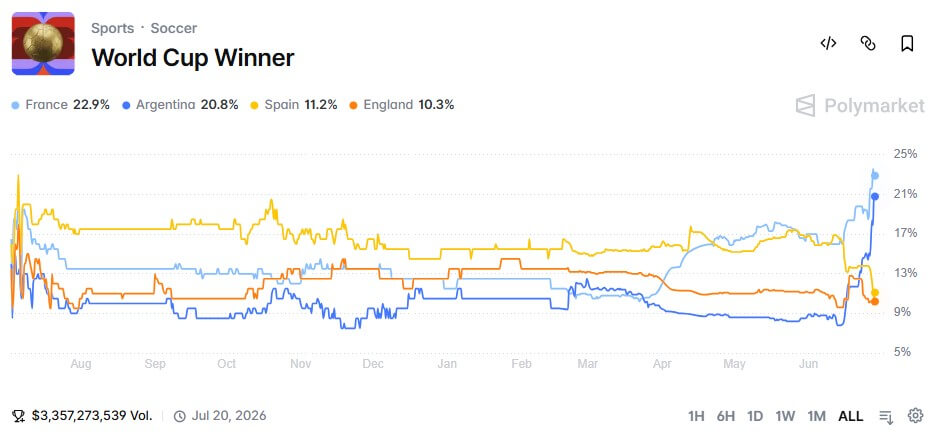
World Cup Winner Bets on Polymarket (Source: Polymarket)The same pattern is visible in the market for teams to reach the final. France leads that contract with a 39% implied chance, while Argentina is second at 38%. Spain follows at 23%.
That positioning suggests traders are increasingly preparing for the possibility of another France-Argentina final, four years after the Messi-led Argentine team lifted the trophy in Qatar.
The volume around the leading teams also reflects that concentration of attention. Argentina has drawn about $81 million in winner-market trading, while France has attracted about $77 million. Portugal has seen roughly $76 million, Spain about $68 million, and England about $61 million.
Those numbers show a clear demand for the favorites, but they do not explain the largest imbalance on the board.
Longshots carry billions in volume
About $1.6 billion has been traded on teams with an implied winning probability of 1% or less. That figure accounts for roughly two-thirds of the trading on the winner market, even though those teams are priced as having little realistic path to the title.
Several of the heavily traded longshots still show large historical volume. Ivory Coast has drawn about $101 million. Mexico has moved about $97 million. Egypt has attracted roughly $90 million. Cape Verde is near $87 million, while Morocco has seen about $82 million.
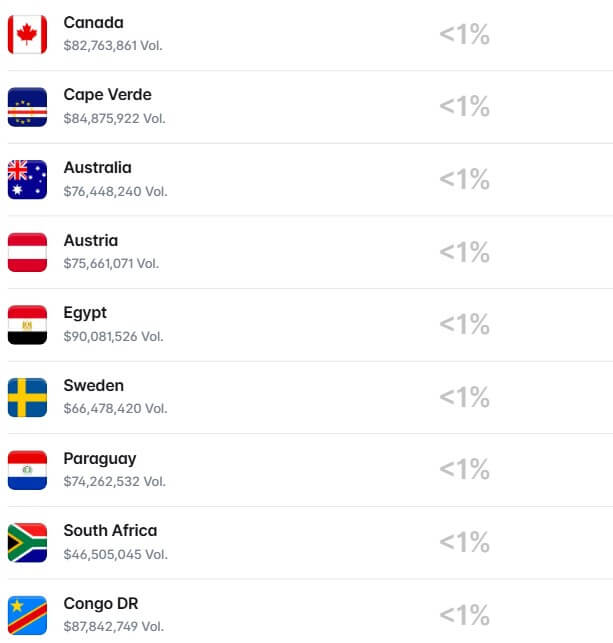
The gap between volume and probability points to a quirk of prediction markets. A high-volume contract does not always mean traders currently believe an outcome is likely. It may simply mean many trades occurred earlier in the tournament, before odds shifted sharply.
Additionally, some positions may also be tied to longshot speculation, fan-driven buying, hedges, parlays, or trades that users have not closed.
That leaves some markets looking more active than the current probabilities suggest.
This is because Money can remain attached to teams even after the market has largely moved on from them. Unlike a sportsbook, where odds can reset around new betting lines, prediction-market contracts continue trading until settlement or until users exit their positions.
The effect is especially clear when compared with the leading group of contenders. A basket of France, Argentina, Spain, England, and Portugal costs about 72 cents combined at current prices. If any one of those five wins the tournament, the position pays $1.
That trade reflects how concentrated the market’s confidence has become, even as billions in historical volume remain scattered across outsiders.
In that sense, the World Cup board is not just a ranking of who is most likely to win. It is also a record of how traders moved through the tournament, where they entered early, which tickets became stale, and where liquidity has failed to unwind fully.
A wider prediction market surge
The intense activity surrounding the global soccer tournament is driving broader institutional adoption and user acquisition across the prediction market sector.
Wall Street brokerage firm Bernstein projects that World Cup-related trading could ultimately surpass $10 billion in total wagers before the tournament concludes on July 19.
This sporting catalyst is also having a measurable spillover effect on non-sporting contracts.
Last week, venture capital firm Andreessen Horowitz published data indicating that non-sports trading volume, encompassing geopolitical events, macroeconomic data releases, and elections, reached $3.6 billion across Kalshi and Polymarket combined.
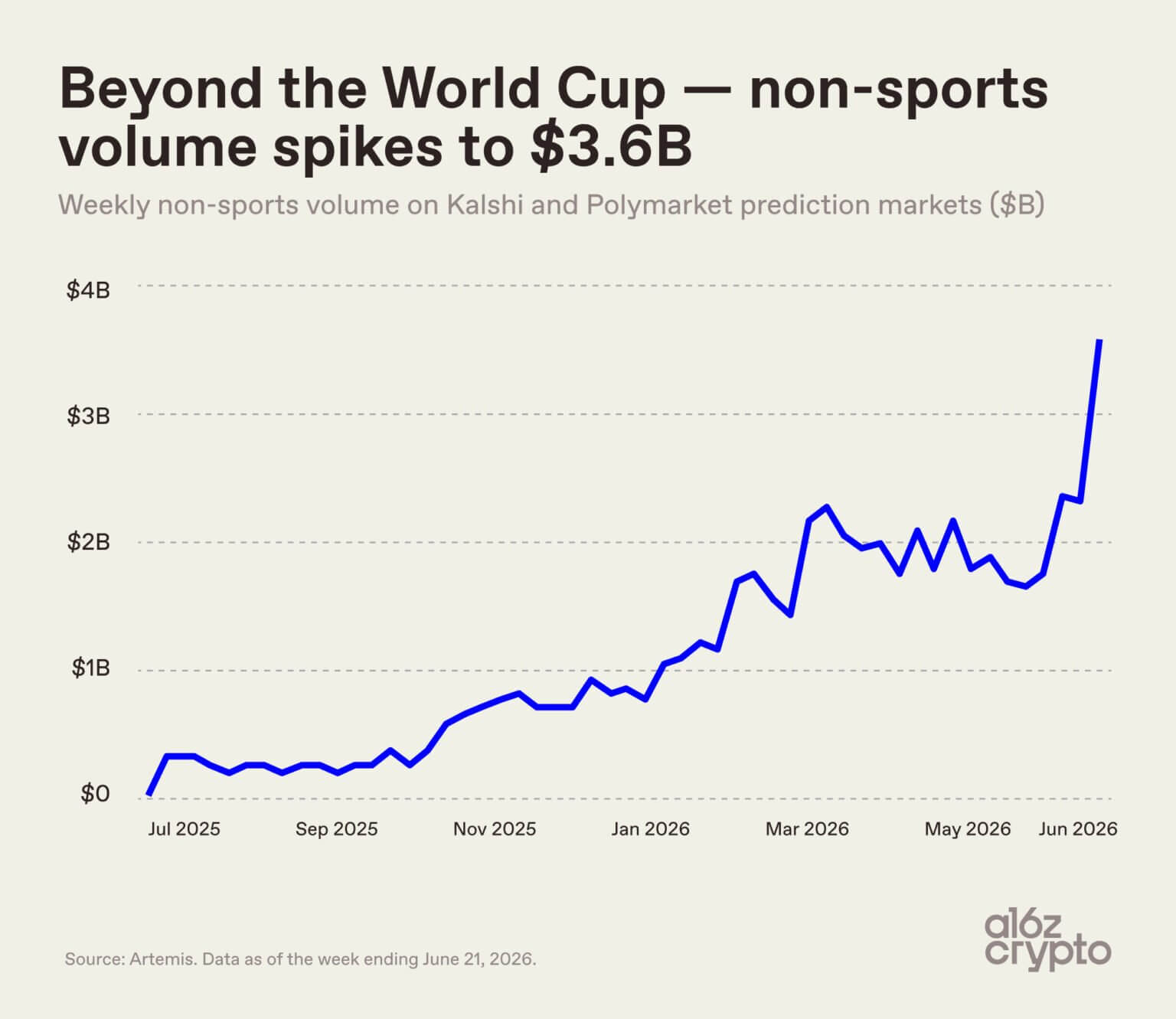
According to the firm, this non-sports volume alone is now larger than the total aggregate volume of all prediction markets recorded just one year ago. In July 2025, weekly non-sports volume hovered near the $200 million mark, representing an 18-fold increase over the past 12 months.
Overall, the venture capital group noted that weekly trading volumes across the prediction market ecosystem reached an unprecedented $14.5 billion last week, with outstanding open interest at a record $1.6 billion for the third consecutive week.
Oversight questions grow louder
The commercial success of the World Cup markets arrives alongside renewed legal scrutiny for the sector.
The Commodity Futures Trading Commission (CFTC) has reportedly opened an investigation into Polymarket.
The probe, first reported by The Wall Street Journal, comes as consumer protection advocates and some states push for closer oversight of prediction-market platforms. Polymarket and Kalshi have grown rapidly as users bet on everything from sports and elections to crypto prices and financial-market outcomes.
For Polymarket, the investigation adds uncertainty after the platform resumed limited US operations last year. The company had previously been barred from serving US customers following a 2022 enforcement action.
The timing is notable because it comes as prediction markets are posting record volumes, just as regulators are taking a closer look at how the sector operates, how consumers are protected, and where the line should be drawn between regulated event contracts and gambling.
Mentioned in this article



Editorial credits