
Overview
Introduction
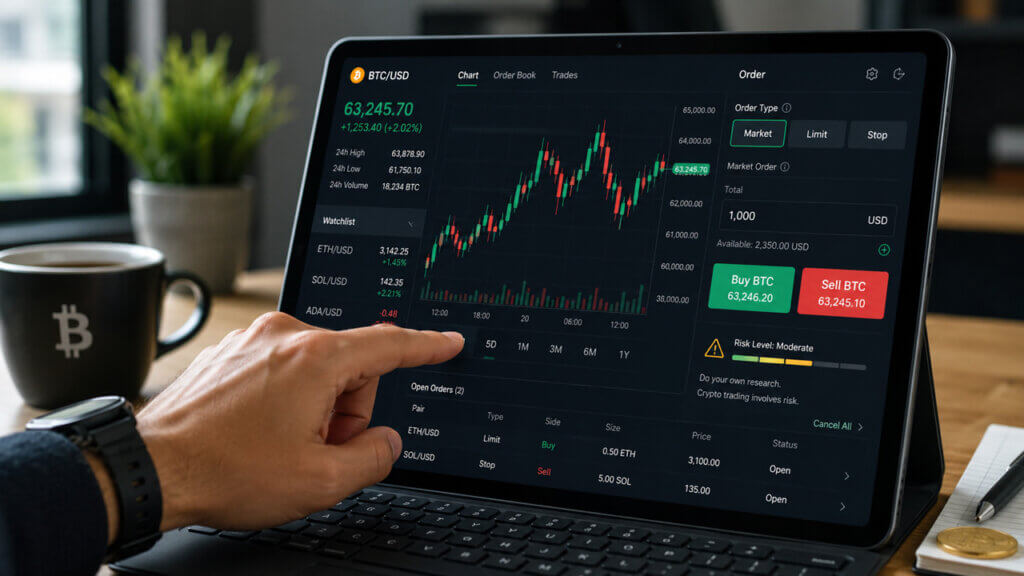
Crypto markets never close, and a new account on an exchange app can buy Bitcoin (BTC) as soon as it's verified and funded. The price on the buy button is only where the trade starts, though. The fill can land somewhere else, and trading fees, the spread, and withdrawal charges come out of the result on different screens.
Trading also asks for more decisions than buying to hold. You pick the pair, the order type, the position size, and the price at which the trade idea has failed, all before the order goes in.
Many early losses trace back to poor fills, uncounted costs, oversized positions, and fake platforms. Each one can be checked with a small test trade and a written plan before larger sums move.
What Is Cryptocurrency Trading?
Crypto trading is buying, selling, or swapping cryptocurrency to profit from price changes or to manage exposure to the market. Many people start after watching a price move and assuming the next one will be easy to call, and it rarely is.
Every trade puts together an asset or contract, a pair that prices it, an order type that controls how and when it fills, and a platform that routes, fills, records, and settles the order. Fees come on top of all four.
Trading differs from long-term investing in what the person is watching. A buyer may hold Bitcoin for years and judge the result by the sale price. A trader may buy BTC during a pullback and sell within days, so entry price, exit price, timing, and fill quality decide the outcome.
A trade can fail at any of those points. The price moves before the order fills, only part of the order matches, the app charges more than expected, the platform freezes withdrawals, or borrowed exposure triggers a liquidation the trader never planned for.
How a Crypto Trade Works
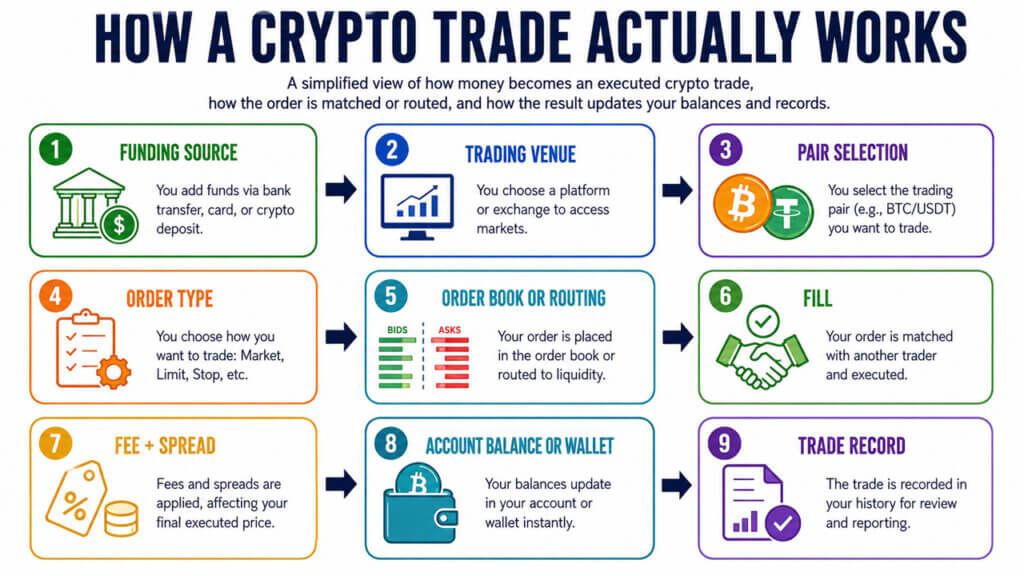
A crypto trade either matches a buyer with a seller on an exchange's order book, routes an app order to outside liquidity, or swaps against an on-chain pool. In each case you choose a pair, submit an order, receive a fill, pay the fees, and end up with an exchange balance, a wallet balance, or a contract position.
Trading Pairs and Quote Assets
Every pair has a base asset, the one you buy or sell, and a quote asset that prices it. In BTC/USDT, Bitcoin is the base and Tether (USDT) is the quote, while in ETH/USD, Ether (ETH) is priced in dollars.
Stablecoins often serve as the quote asset, and many pairs are quoted in USDT or USD Coin (USDC). Selling into a dollar-pegged token keeps the proceeds on the exchange, so you skip a bank transfer after every trade.
Order Books and Matching
An order book lists the open buy and sell orders at each price. Your order either matches right away against orders already resting there or waits on the book until the market reaches your price.
Each action on an order screen, on the left below, leads to the result on the right.
- Select BTC/USDT
Bitcoin priced in USDT
- Place a market order
Fills at once against resting sell orders
- Place a limit order
Waits for the set price or better
- Receive a partial fill
Only part of the order matched
- Review trade history
A record for cost basis and taxes
Bitcoin pairs on major exchanges usually hold enough liquidity at each price to keep the fill close to the quoted price on small orders. Ether pairs behave much the same on centralized exchanges.
Fills, Fees, and Settlement
A fill is the executed part of an order. One order can fill in full, in pieces, or not at all if the price never reaches your limit.
The cost of that fill comes from several places at once. Exchanges charge maker or taker fees, apps add their own charges or build a spread into the quoted price, and moving coins off the platform adds a network withdrawal fee.
Where the Crypto Sits After the Trade
Once a spot trade settles, the asset shows up as a balance in your exchange account. From there you can leave it, withdraw it to a personal wallet, or use it for the next order.
Spot, Futures, Options, OTC, and P2P
Spot trading buys or sells the asset itself. Futures, options, over-the-counter (OTC) desks, and peer-to-peer (P2P) trades change the counterparty, the settlement path, and the risks that sit outside the chart.
Each product type on the left below gives you the exposure on the right.
- Spot trading
The asset itself, or a platform balance in it
- Futures and perpetuals
A contract that tracks the price, with or without an expiry
- Options
A right to buy or sell at a strike price until expiry, with no obligation
- OTC trading
A negotiated block trade with a desk
- P2P trading
A direct trade between users, with payment and release risk between them
Spot is the easier place to begin, with no liquidation price to calculate and no contract expiry to track. Futures, options, borrowed exposure, trading bots, and copy trading each add a layer of risk on top of spot.
Spot Trading in Cryptocurrency
A spot trade settles at or near the current market price. Depending on the side you took, it ends with a crypto balance, a fiat balance, or a stablecoin balance.
Spot trades still go wrong when the platform is unreliable, the pair trades thinly, or the price moves fast before your order fills. Trading without borrowed money removes none of those risks.
Futures and Perpetuals
Crypto futures give you price exposure through a contract, so you never hold the coin itself. Perpetual futures have no expiry date. They charge or pay funding at set intervals, and liquidation rules can close the position automatically if the price moves against you.
Before opening one, check the liquidation price, funding rate, margin requirement, and fees. Those terms differ across crypto futures exchanges, and each one changes how far the price can move before the position closes.
Options and Contracts
A crypto option gives the buyer the right to buy or sell at a strike price until an expiry date. Traders use options to hedge a position or bet on direction, but the pricing depends on inputs such as implied volatility that take experience to read.
Options make more sense once fills, spreads, and position sizing are familiar from spot trades. At that stage, crypto options exchanges can be compared on contract terms, expiries, and fees.
OTC and P2P Trading
OTC trading handles large block trades, with a desk sourcing liquidity away from the public order book. A crypto OTC trading desk can reduce the visible price impact of a large order, though it adds counterparty, settlement, and paperwork questions that a standard exchange order never raises.
P2P trading connects users directly, usually with escrow or platform mediation holding the crypto until payment clears. Payment disputes, fake receipts, and regional rules make it a poor first route for beginners.
On-chain swaps through decentralized exchanges are a separate path again, with no desk or other user on the far side and custody and contract risks of their own.
Crypto Market Orders, Limit Orders, Spreads, and Slippage
Order type sets the balance between speed and price control. A market order asks for a fast fill, a limit order sets a price boundary, and either can cost more than expected when the spread is wide or liquidity is thin.
Market Orders and Fast Fills
A market order buys or sells immediately against whatever liquidity is available. You choose the direction and the size, and the market sets the final price.
In liquid pairs and at small sizes, that works well. In thinly traded pairs or fast markets, the order uses up the liquidity at the best price and keeps filling at each worse level until it's complete.
Limit Orders and Price Control
A limit order sets the highest price you'll pay as a buyer or the lowest you'll accept as a seller. You gain control over the cost of the fill and accept the chance that the order never fills if the price doesn't reach your level.
So the choice between the two depends on which outcome you'd regret more, missing the trade or overpaying for it.
Spread, Slippage, and Thin Order Books
The spread is the gap between the best price a buyer is bidding and the best price a seller is asking at any moment. Buy and immediately sell the same asset, and you lose the spread before paying any stated fee.
Slippage is the difference between the price on screen when you click and the price you receive. It grows when the book holds little volume at each price, or when the market moves between the click and the fill.
The costs on the left below tend to surface only after the trade, in the way shown on the right.
- Spread
Buy price above sell price at the same moment
- Slippage
Fill price away from the price shown before the click
- Taker fee
Higher rate for an order that fills immediately
- Withdrawal fee
Network or platform charge to move funds off the exchange
Why Low Fees Can Still Be Expensive
A low advertised fee can sit next to a wide spread, routing charges, and minimum order sizes. App platforms may also charge differently depending on which screen or route places the order, so check the full fee schedule beyond the maker and taker rates.
A cheap trade on a thin order book can end up costing more than a slightly higher fee on a busy one. Over short holding periods those costs can absorb most of a winning move, which leaves day trading crypto little room for error.
Stop-Loss Orders and Slippage
Market and limit orders are two of the three common order types. The third, a stop-loss order, waits until the price reaches a level you set, called the stop price, and then becomes a market order. A sell stop sits below the current price to limit the loss on a coin you hold.
Stops aren't guaranteed to fill at their price. In a fast drop, the best bid can already be well under the stop when it triggers, so the sell fills lower. That gap is slippage, and a thin order book makes it wider.
Three orders, one price path, and how each one fills
On one hypothetical Bitcoin price path, a market buy fills at once at the ask, a limit buy fills only when the price reaches it, and a stop-loss sell fills $800 under its stop in a fast drop.
A market order fills now at the ask, a limit order fills only at its price or better, and a stop becomes a market order, so a fast drop can fill it below the stop.
Fictional prices and timing. A limit buy that only touches its price may not fill if other bids at that price are ahead in the queue. Live stop fills depend on the exchange, order type, and bids on the book, so the gap can be smaller or larger than the $800 shown.
Sources and evidence
Sources
Supporting facts
- Investor.gov, the SEC's investor education site, names market orders, limit orders, and stop-loss orders as the most common types of orders. [1]
- Investor.gov says a market order is executed immediately and guarantees execution but not the execution price, and that a buy market order generally executes at or near the current ask. [1]
- Investor.gov says a buy limit order can only be executed at the limit price or lower. [1]
- Investor.gov says a stop order, also called a stop-loss order, becomes a market order when the stop price is reached, and that a sell stop order is entered below the current market price to limit a loss. [1]
- In a hypothetical example, with the last trade at $100,000 and the best ask at $100,050, a market buy fills at $100,050, a limit buy at $98,000 fills when the price later reaches $98,000, and a sell stop at $95,000 fills at $94,200 in a fast drop, $800 below the stop. [1]
Method
Hypothetical path, checked in Python. Market buy fills at the 100,050 ask, 100,050 - 100,000 = 50 above the last trade. The path first reaches 98,000 at the low before the rally, where the limit buy fills. The only downward cross of 95,000 is the fast drop from 99,600 to 94,000, where the stop fills at the 94,200 bid, 95,000 - 94,200 = 800 lower, about 0.84% of the stop. Price axis is linear from 93,000 to 102,000. Fees excluded.
Scope
Fictional prices and timing. A limit buy that only touches its price may not fill if other bids at that price are ahead in the queue. Live stop fills depend on the exchange, order type, and bids on the book, so the gap can be smaller or larger than the $800 shown.
 CryptoSlate
How to Start Trading Cryptocurrency
Set up in this order, with account security and a test withdrawal ahead of any trade.
- Learn what you're buying. Know the asset, the pair you'll trade it in, and the platform's rules before funding anything.
- Choose a reputable exchange with clear fees and withdrawal support. Check that the platform serves your region, lists its full fee schedule, and allows withdrawals to an external wallet. A shortlist of exchanges for beginners narrows the choice.
- Secure your account before depositing. Turn on app-based two-factor authentication (2FA), set a unique password, and activate withdrawal allowlists if the platform offers them. With an allowlist on, the account can only send funds to wallet addresses you saved earlier.
- Start with a test deposit and a small withdrawal. Send a small amount, then withdraw part of it. A platform that delays or blocks that first withdrawal has failed the test, so stop there.
- Practice market and limit orders with a small amount. Place one market order and one limit order with an amount you're comfortable losing. The goal at this stage is to watch how fills, fees, and balances behave, and any profit is incidental.
- Record every trade from the start. Log the entry price, exit price, fee, reason for the trade, and result. That log becomes your only reliable record of what's working.
- Review mistakes before adding size. After 10 to 20 trades, go through the log and find where the money went, whether to fees, bad fills, or emotional decisions. Fix that pattern before increasing position size.
Once that routine holds, learn how beginner crypto wallets handle private keys and recovery phrases before moving larger balances off the exchange. Self-custody brings its own ways to lose funds.
Cryptocurrency Trading Indicators Explained for Beginners
Charts and indicators organize past market data, and none of them predicts the next move. They help you ask sharper questions about price, volume, trend, and momentum, and they work best as one input among several.
Price, Volume, and Timeframes
A crypto trading chart plots price over time, usually with volume below it. The same move can look like a major trend on a five-minute chart and like noise on a daily one.
Beginners often read short spikes, including low-liquidity wicks and news-driven moves, as lasting changes in direction. Checking at least two timeframes before acting cuts that risk.
Moving Averages, RSI, MACD, and Support Levels
The indicators beginners meet first are moving averages, the relative strength index (RSI), moving average convergence divergence (MACD), and support and resistance zones.
- Moving averages show trend direction and lag behind price.
- RSI measures whether momentum is stretched up or down, and a stretched reading doesn't guarantee a reversal.
- MACD tracks the gap between two moving averages and flags when momentum shifts.
- Support and resistance mark price levels where traders have bought or sold heavily before.
No fixed set of indicators works in every market and timeframe. Knowing what each one measures helps more than stacking several on one chart.
False Signals and Confirmation
A false signal points toward a move that quickly fails. False signals show up most in choppy, sideways markets, quiet low-liquidity hours, news events, and cascading liquidations that cause sharp, temporary moves.
Confirmation means checking whether price action, volume, and the wider trend all point the same way before acting. It leaves the risk in place and lowers the odds of trading on one misleading reading.
Why Indicators Don't Replace Risk Management
An indicator can support a plan, but it can't set how much to risk, where the stop goes, or the largest loss you'll accept. Those rules come first.
A valid setup can still lose money through fees, slippage, or a brief wick that hits the stop before the market moves as expected. An oversized position turns that ordinary loss into a large one.
Crypto Trading Platforms, Apps, and Robinhood-Style Brokers
A crypto trading platform receives your order, holds or routes your funds, records your trades, and decides which products you can use. The choice affects custody, available assets, order types, withdrawal rules, uptime, and tax exports.
Centralized Exchanges
Centralized exchanges offer account-based trading, order books, bank and card funding, and customer support. Funding, orders, balances, and trade history all sit in one account, which makes them the simplest place to start comparing.
The platform also holds any balance you leave there, the same arrangement as custodial wallets, where someone else controls the private key.
Before you deposit, compare crypto exchanges by type, product range, and regional access.
Brokerage and App-Based Crypto Trading
Broker-style crypto apps simplify the screen. That simpler screen often comes with fewer order types, different fee routing, limited withdrawals, or rules that don't show on the main page.
Before funding one, check the withdrawal rules, fee structure, how orders are routed, and whether the app serves your region. The order screen shows a price, and the terms behind that price sit in the fee schedule and user agreement.
Decentralized Exchanges
Decentralized exchanges let you trade from your own wallet through smart contracts or liquidity pools, so no company holds your funds. That removes platform custody risk and adds others, including wallet mistakes, gas fees, maximal extractable value (MEV) exposure, and smart contract bugs.
Self-custody wallets give you full control of the keys and full responsibility for them. Before connecting one to a decentralized exchange, compare crypto wallets on recovery options and supported networks.
Trading Apps, APIs, and Software
Around the platform itself, traders add charting tools, price alerts, portfolio trackers, tax export tools, journals, and trading bots that connect through an application programming interface (API). More tools won't fix a weak process.
For a beginner, the platform's basics come first, meaning clear fee previews, reliable withdrawals, 2FA and allowlist controls, and downloadable trade records.
Risk Management, Leverage, and Beginner Mistakes
Risk management caps how much one wrong trade can take from your account. It covers borrowed exposure, behavior after a loss, platform reliability, and records, and it rests on two numbers set before every entry, the position size and the stop.
Position Sizing and Stop Rules
Position sizing decides how much of your capital goes into one trade, and the stop marks the point where the trade idea no longer holds. Divide the most you'll accept losing by the distance to the stop to get the position size, then hold that loss limit steady across the crypto trading strategies you test.
Margin and Liquidation
Crypto leverage means opening a position larger than your deposit by borrowing exposure through margin. A small price move then produces a proportionally larger gain or loss. Liquidation follows when the exchange closes the position because your margin no longer covers it.
In a customer advisory, the Commodity Futures Trading Commission (CFTC) warns that gains and losses from price swings are amplified in margined futures contracts and that traders may lose more than their initial investment. If you can't state the liquidation price before the position opens, stay with spot.
FOMO, Revenge Trading, and Overtrading
Fear of missing out (FOMO) pushes a trader to buy after a move has already happened. Revenge trading raises the size after a loss to win it back. Overtrading turns fees and decision fatigue into a steady drain, even in stretches when most trades go roughly right.
A written checklist catches these habits before they cost money.
- Write down the trade idea before entering.
- Set the largest acceptable loss before thinking about profit.
- Keep position size the same after a loss.
- Stop for the day after breaking your own rules repeatedly.
- Count fees and slippage in every trade result.
Exchange Reliability and Tax Records
Exchange outages, withdrawal holds, asset delistings, and account reviews can all block an exit when you need one. Those platform risks exist however well the trade itself was planned.
In the US, the Internal Revenue Service (IRS) treats digital assets as property. Income from them is taxable, and you must report digital asset transactions whether or not they produce a taxable gain or loss.
So keep fee records, cost basis data, wallet transfer logs, and exchange exports organized from the first trade. Rebuilding a year of records later takes far more work.
Scams, Fake Platforms, and Account Security Checks
Fake crypto trading websites copy the look of legitimate exchanges, show made-up account balances, and block withdrawals until the victim pays a release fee. Lists of fake sites go stale quickly, so knowing how the scam behaves protects you better than any blacklist.
Before sending any funds, look for these warning signs.
- A stranger moved the conversation to WhatsApp, Telegram, or a private group.
- A professor, assistant, mentor, or romantic contact pointed you to a specific platform.
- The platform shows growing profits and demands a tax, release, or verification fee before any withdrawal.
- The domain is new, misspells a known exchange's name, or differs from the official domain.
- Customer support discourages or delays test withdrawals.
- A recovery service appeared after the funds got stuck and wants crypto upfront to retrieve them.
In an Apr. 24, 2019 investor alert, the Securities and Exchange Commission (SEC) and the CFTC warned about digital asset trading websites that promise high guaranteed returns with little or no risk. In some cases, the fraudsters behind them told investors to pay extra costs, such as supposed taxes, before they could withdraw fake profits.
On top of the account controls from step three of the setup routine, bookmark the exchange's verified domain and log in only from that bookmark.
Once those habits are in place, compare the safest crypto exchanges on cold storage, insurance coverage, and audit history. No ranking replaces checking the URL, the withdrawal behavior, and the support channel yourself.
FAQs
Is crypto trading profitable?
It can be for some skilled, disciplined traders, and there’s no reliable promise of profit. Fees, spread, slippage, borrowed exposure, taxes, scams, and emotional decisions can each wipe out gains, and a lucky streak says little about whether the process works.
Can you trade cryptocurrency 24/7?
Crypto markets trade around the clock every day of the year, but individual platforms can pause trading, go down for maintenance, restrict withdrawals, or suffer outages. Liquidity also thins out in quiet hours, when fewer traders are active, which can widen spreads.
Is Robinhood cryptocurrency trading the same as a crypto exchange?
Not automatically. Robinhood’s crypto trading sits inside a broker-style app that also handles stocks, so compare its coin list, order types, and transfer options with a crypto exchange’s before treating the two as interchangeable.
What is the difference between spot and futures crypto trading?
With spot, you own the coin or an exchange balance in it, and the most you can lose is what you paid. Futures and perpetuals are contracts on the price, usually traded on margin, so they add funding payments, margin calls, and liquidation.
What is the safest way for beginners to practice crypto trading?
Start with education, then a trading simulator or paper trading, then tiny live orders logged in a journal before any meaningful capital goes in. Include fees, mistakes, and a withdrawal test in that practice, because paper trading skips the withdrawal step entirely.
How can you tell if a crypto trading website is fake?
Treat a site as fake if it reached you through a private message, promises guaranteed returns, or blocks withdrawals until you pay a fee. Stop sending funds, report the site to the SEC, the CFTC, or your local regulator, and don’t pay further fees to regain access.
