
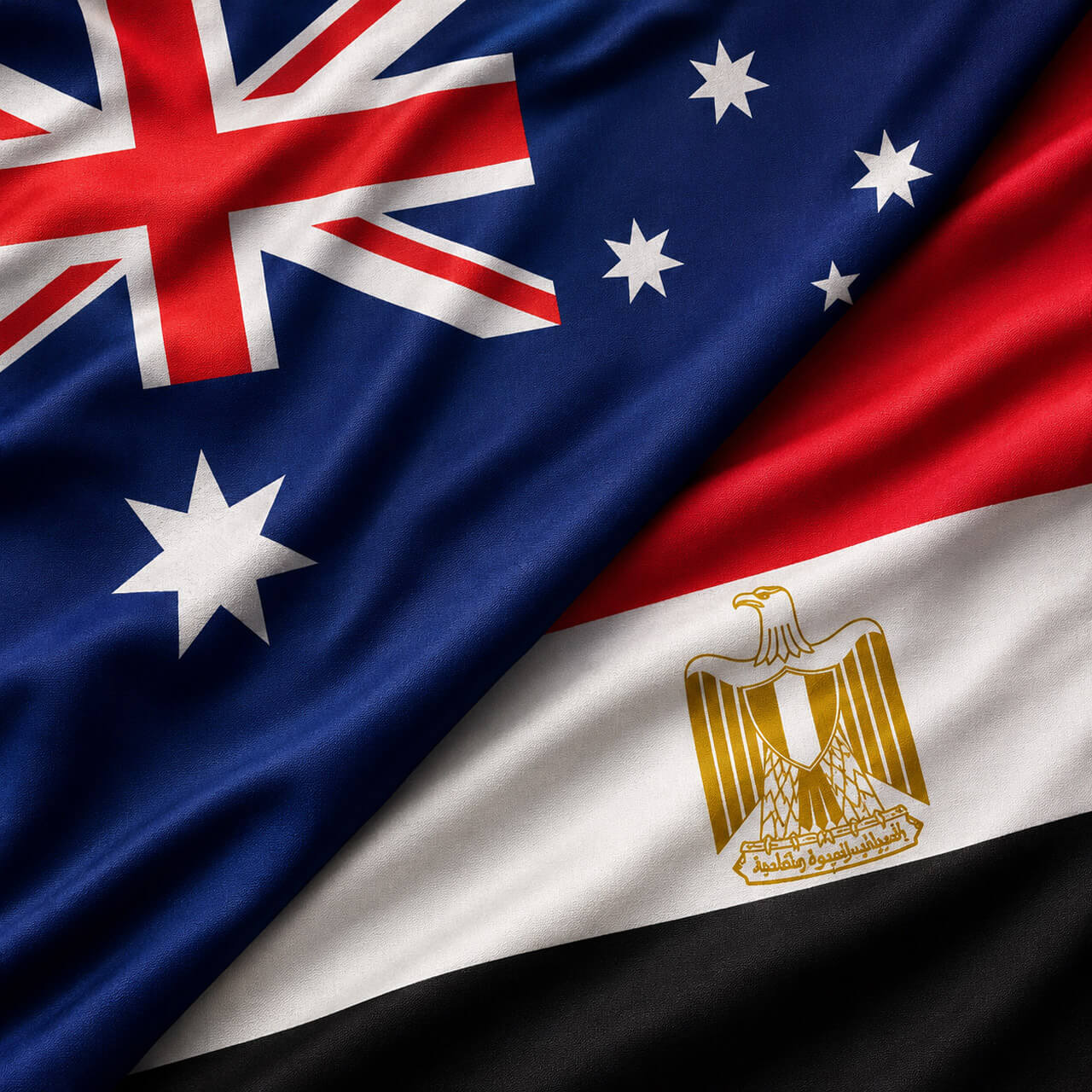
Australia vs. Egypt
Final Results
Scheduled deadline: Jul 3, 2026, 18:00 UTC
Market Resolution
Polymarket reports Draw as the winning outcome for the Australia vs. Egypt prediction market with a final probability of 100%. Scheduled deadline: Jul 3, 2026, 18:00 UTC. Final reported trading volume was $25.37M.
Polymarket · Final sync
Market Analysis
Egypt Leads Australia as Draw Risk Shapes World Cup Pricing

A narrow Egypt lean sits beside a sizeable draw outcome, suggesting the market is balancing team-strength perceptions against the mechanics of a low-margin World Cup match. The settlement interpretation and distant close date leave room for meaningful repricing before July 2026.

The pricing carries a clear thesis: Egypt is the preferred winner, yet the market gives the draw enough weight to block a simple favorite-versus-outsider reading. Egypt’s 38.5% sits only five points above the 33.5% draw, while Australia’s 28.5% remains close enough to matter. That distribution matters because the result is being shaped by a low-margin match script and a limited appetite to separate the teams.
Egypt’s slim lead depends on the draw staying large
The market-implied story is a modest Egypt advantage. In a three-outcome football market, a draw sitting between the two teams absorbs much of the uncertainty that would otherwise widen the gap between national sides. Egypt being five points above the draw suggests a lean toward Egypt on perceived matchup strength, while the draw’s proximity says the market has kept distance from a decisive-win script.
This matters for later repricing because the source of any move would carry information. An Egypt increase funded mainly by the draw would imply rising conviction that the match produces a winner. An Egypt increase funded mainly by Australia would imply a relative reassessment of the teams while the low-margin match script remains intact.
Liquidity gives the screen weight before match facts arrive
The $1.09 million liquidity figure gives the market a deeper screen than the $72,240 traded volume alone would imply. Displayed depth can keep small orders from moving the headline probabilities while also allowing early prices to rest on broad priors. With $60,710 in open interest and a close set for July 3, 2026, the market has a long period in which specific match information can overtake the opening assumptions.
The current split may therefore be reading future uncertainty through generic football structure: three outcomes, a live draw, and only a modest favorite. The practical consequence is that catalysts need to change either team separation or the expected decisiveness of the match. Routine attention without new information may have limited effect when the book already carries substantial displayed liquidity.
Three inputs explain why the middle outcome matters
| Market input | Why it matters |
|---|---|
| Draw at 33.5% | The market is giving the non-win path enough weight to constrain both team prices. |
| Egypt at 38.5% versus Australia at 28.5% | The implied advantage is modest, so matchup confidence has left draw risk intact. |
| $1.09M liquidity against $72.24K volume | The visible book can look stable before wider participation tests the early assumptions. |
| Close on July 3, 2026 | There is enough runway for rules clarity, squad news, and official match context to alter the distribution. |
The draw price carries a rules assumption as much as a football assumption
The supplied rules say this is a multi-outcome Polymarket event, with each listed option represented by its Yes price, and FIFA’s World Cup page is the settlement source. The large draw price therefore carries a technical assumption: the price relies on a shared view of what official result convention the market will use when the match is settled.
That point matters because roughly a third of the probability is tied to Draw. If a later clarification from the provider or settlement source changes how users understand official full-time reporting, extra-time treatment, or any other resolution detail, the draw could move even without new information about either team. The rule channel is a catalyst separate from football form.
Confirming evidence needs to change the game script
Because the market already allows for a close contest, generic team optimism would have limited explanatory force. The strongest confirming evidence for Egypt’s lead would be a hypothetical development that affects chance creation, defensive stability, or squad availability in Egypt’s favor. A starting-lineup surprise, a late injury report, a suspension, or a venue-related condition could matter if it shifts the probability of a decisive Egypt result.
Evidence that weakens the Egypt-implied story would look different. Australia gaining while the draw holds steady would point to a relative team reassessment. The draw gaining at the expense of both teams would point to a lower-scoring or more cautious match script. Those distinctions matter because the market’s three outcomes encode different explanations: team strength, game tempo, and settlement interpretation.
The cleanest counter-signal would be draw compression
The main failure mode for the current structure is a decisive-outcome repricing. If the draw compresses while both team-win outcomes rise, the market would be moving away from the low-margin script that currently anchors the board. That would challenge the idea that Egypt’s lead is constrained primarily by football’s draw risk.
A second counter-signal would be heavier volume that leaves the top-line order unchanged. With liquidity high relative to volume, broader turnover that keeps Egypt ahead, the draw second, and Australia third would support the existing hierarchy as more than a thin early quote. Concentrated activity around a rule clarification or official pre-match information would matter for a different reason: either can reallocate probability before the teams provide a result on the field.
Sources
Market Details
- Resolution criteria
- This event is for the upcoming FIFA World Cup game, scheduled for Friday, July 3, 2026 between Australia and Egypt.
- Platform
-


- Category
- Sports
- Scheduled deadline
- July 3, 2026, 6:00 PM UTC
- Settlement source
- fifa.com
- Market rules summary
- Multi-outcome Polymarket event. Each listed option is represented by its Yes price on the underlying market. View full rules
Frequently Asked Questions
What was the final result of the Australia vs. Egypt prediction market?
Polymarket reports Draw as the winning outcome for the Australia vs. Egypt prediction market with a final probability of 100%. The final market snapshot includes $25.37M volume and $12.22M open interest. CryptoSlate last synced the final market data at Jul 3, 2026, 21:27 UTC.
How does the Australia vs. Egypt prediction market resolve?
This event is for the upcoming FIFA World Cup game, scheduled for Friday, July 3, 2026 between Australia and Egypt. Multi-outcome Polymarket event. Each listed option is represented by its Yes price on the underlying market. The settlement source listed for this market is fifa.com.
Related Markets
 Spain vs. Argentina
 France vs. England
 England vs. Argentina