
Overview
Introduction
Dogecoin (DOGE) launched in December 2013 as a parody of the altcoin boom, with the Shiba Inu “Doge” meme as its mascot. More than a decade later, it is a proof-of-work cryptocurrency with its own blockchain, used for peer-to-peer payments, online tips, trading, and community activity.
A new block arrives about once a minute, and developers have maintained the network without a break since 2013. DOGE can't be staked, its supply has no cap, and the chain hosts no smart contracts. What it has instead is liquidity, a long operating history, and a community that treats the coin as a shared internet identity.

What Is Dogecoin in Plain English?
Dogecoin, shortened to DOGE, lets people send value without a bank or payment processor. It is a peer-to-peer digital currency, and a distributed network of computers called nodes keeps a copy of every transaction on a public blockchain.
Dogecoin's software comes from the same family of early proof-of-work coins as Bitcoin and Litecoin, so its culture did more than its code to set it apart. The coin's community built an identity on humor, tipping, and approachability, with no white paper promising to transform finance.
DOGE is a meme coin and a working blockchain asset at the same time, which can confuse newcomers. You can spend it where merchants accept it, hold it in a wallet, trade it on exchanges, or mine it with proof-of-work hardware. Even so, it is no copy of Bitcoin. The supply rules, the security model, and the reasons people buy each coin all differ.
Dogecoin at a Glance
Dogecoin's mining, block-time, and reward rules come from the code of Dogecoin Core, the network's reference software. The table pairs each property on the left with Dogecoin's value for it on the right.
- Ticker
DOGE
- Asset type
Proof-of-work cryptocurrency and meme coin
- Launch
December 2013
- Creators
Billy Markus and Jackson Palmer
- Consensus
Proof of work
- Mining algorithm
Scrypt, merge-mined with Litecoin
- Target block time
One minute
- Block reward
10,000 DOGE since block 600,000
- Supply cap
None
- Main uses
Payments, tips, trading, and meme-coin exposure
How Dogecoin Went From Joke to Network
Billy Markus and Jackson Palmer created Dogecoin in late 2013, both convinced that cryptocurrency was being taken too seriously. Palmer set up Dogecoin.com, and Markus wrote the first four software releases on his own.
So Dogecoin started with no corporate issuer, no token sale, and no roadmap. It began as a parody of the crowded altcoin market of 2013, and the Doge meme made it instantly recognizable. A low unit price helped too, because early users could send tips that looked large.
Many early altcoins faded once their technical novelty wore off, while Dogecoin kept a community that used the coin socially and organized charity drives. The financial risk never went away, yet DOGE outlasted projects that took themselves far more seriously.
Dogecoin has since reached traditional markets. On Sep. 18, 2025, REX-Osprey announced the first U.S.-listed exchange-traded funds (ETFs) offering exposure to spot Dogecoin and spot XRP. On Apr. 10, 2026, Deutsche Börse listed a 21Shares Dogecoin exchange-traded product (ETP) on its Xetra market. Both products give you DOGE price exposure on a stock exchange, though you never hold the coins or keys yourself.
How the Dogecoin Network Works
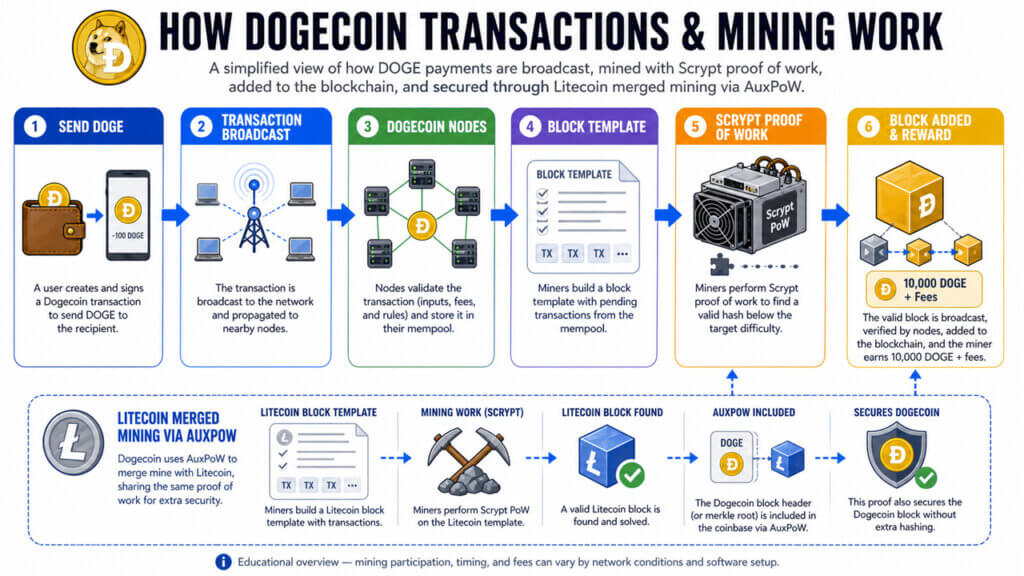
Dogecoin keeps its records on a blockchain, a shared ledger of transactions. Each transaction moves DOGE from one address to another. Miners collect valid transactions into blocks, and once the network accepts a block, its transactions become a permanent part of Dogecoin's history.
Mining is what secures that ledger. Dogecoin's proof of work uses a simplified version of the Scrypt key derivation function, and the network targets one block a minute. Since block 145,000, it has adjusted mining difficulty after every block. From block 600,000, mined on Feb. 25, 2015, the block subsidy has stayed fixed, so a miner knows it in advance at any height.
Dogecoin also shares mining work with Litecoin (LTC) through merged mining, known as auxiliary proof of work (AuxPoW). The same Scrypt work can count toward more than one compatible chain at once. Merged mining went live at block 371,337 on Sep. 11, 2014, and Dogecoin Core still contains the AuxPoW code that checks merge-mined blocks. In practice, Dogecoin's security depends on the wider Scrypt mining economy as well as on miners who mine DOGE alone.
Everyday users meet DOGE through exchanges, wallets, and on-chain transfers, and mining is left to specialist hardware. Anyone can still operate a full node with Dogecoin Core. As of Nov. 18, 2026, the latest release is version 1.14.9, out since Dec. 1, 2024, which fixed bugs inherited from upstream Bitcoin and Namecoin code. Dogecoin adds features slowly, though its core client is still maintained.
What Dogecoin Is Used for Today
Dogecoin's plainest use is moving value. DOGE goes from one wallet address to another, pays tips in communities that support it, and settles purchases with merchants that choose to accept it. A one-minute block target gives it a faster block cadence than Bitcoin's 10 minutes, though the service handling a payment still decides when an exchange deposit or a merchant sale counts as final.
DOGE is also a trading asset, and many users first meet it in an exchange app before they ever make an on-chain payment. If you buy DOGE on an exchange, the coins stay in its custody until you withdraw them to a personal wallet, where the keys and the risk of losing access become yours.
Beyond payments and trading, Dogecoin works as a cultural asset. Holding it can signal community membership, a stake in meme-driven market stories, or simple exposure to the meme-coin sector. None of those roles pays holders any revenue or cash flow.
How to Earn Dogecoin
You can earn DOGE in several ways, and the risk changes from one route to the next. The protocol itself pays only miners, through the block subsidy. Profitable Dogecoin mining today generally requires Scrypt application-specific integrated circuits (ASICs) and a mining pool, so desktop hardware is out of the picture.
| Route | Paid by | Type | Main risk |
|---|---|---|---|
| Solo mining | Block subsidy and fees | Native | Hardware, power costs, and rare blocks |
| Pool mining | Pool payouts | Third-party pool, native chain | Pool fees and payout rules |
| Merged mining with Litecoin | DOGE and LTC from the same work | Native design, pool support | Scrypt hardware and DOGE/LTC prices |
| Exchange earn or lending | The provider | Third-party | Custody, counterparty, and lockups |
| Tips and payments | Other people | Native transfer, third-party tools | No chargebacks and price swings |
| Faucets | The faucet site | Third-party | Tiny payouts, phishing, and non-payment |
Earn products, tips, merchant payments, and faucets all sit outside Dogecoin's protocol, so their terms can change without any Dogecoin software update. A centralized earn product, such as Binance DOGE Earn or Nexo DOGE Savings with its flexible and fixed-term options, is a financial product from that provider. Earn eligibility can vary by region on Binance, and Nexo's rates can vary by loyalty tier and product terms. Faucets pay tiny amounts, so check payout proof, terms, and withdrawal minimums before you spend time on one.
Can You Stake Dogecoin?
No. Dogecoin is a proof-of-work network, so miners produce blocks and secure consensus, and holding DOGE earns nothing from the protocol. Dogecoin's code has no staking function at all.
When an app advertises “DOGE staking,” it is using the word loosely. The label usually covers a custodial earn account, a lending account, an exchange promotion, or a decentralized finance (DeFi) position that uses wrapped DOGE. Coinbase's cbDOGE, for example, is a wrapped token on Base, backed 1:1 by DOGE, that lets the coin be used in Base applications. Binance Simple Earn, by comparison, pays daily rewards on assets deposited for flexible or locked terms.
Each of those routes adds risks that mining doesn't have. Custodial products bring custody and counterparty risk, rewards can change, fixed terms lock up your coins, and wrapped DOGE or DeFi positions add smart-contract and wrapper risk. Calling any of them “staking” leaves the underlying setup unchanged.
Why Dogecoin Has No Fixed Supply Cap
Bitcoin's supply stops at 21 million coins. Dogecoin has no hard cap of that kind. Since block 600,000, each new block has paid a flat 10,000 DOGE, and the code sets no end date for that subsidy.
So the total supply keeps rising, by a fixed amount in DOGE terms. At the one-minute target, 525,600 blocks a year add about 5.256 billion DOGE. Blocks have arrived a little slower than that, about 63 seconds apart on average since block 600,000, so actual issuance has come to roughly 5 billion DOGE a year.
As of Nov. 18, 2026, the dogechain.info block explorer put the total supply at about 156.8 billion DOGE at block 6,462,510, so a year of issuance at the target equals about 3.35% of supply. When fixed rewards began, supply stood near 98.2 billion, and the same 5.256 billion came to about 5.35%. The percentage keeps falling as supply grows.
Supporters say predictable issuance keeps miners paid and helps DOGE work as a spending currency. Critics say the lack of a cap makes long-term value harder to judge, because new coins enter circulation every year.
Dogecoin's monetary policy is transparent, and DOGE is also far from scarce in Bitcoin's sense, so both views hold up. If you compare DOGE with Bitcoin price data or Litecoin market data, treat supply design as a core difference between the coins.
Dogecoin adds the same 10,000 DOGE every block, so its yearly inflation rate keeps falling
Since block 600,000, each Dogecoin block pays a flat 10,000 DOGE, about 5.256 billion a year at the one-minute target. The yearly amount stays the same while its share of a growing supply falls.
Dogecoin's new supply is flat in coins, so its inflation rate falls every year even though the supply never stops growing.
Yearly amounts assume one block a minute. Actual block times vary, so yearly issuance differs slightly. The 200 and 250 billion levels are hypothetical supply points with no forecast date. Explorer supply can differ slightly between data providers.
Sources and evidence
Sources
Supporting facts
- Dogecoin Core's GetDogecoinBlockSubsidy pays a constant 10,000 DOGE per block once the block height reaches six subsidy halving intervals. [1]
- Dogecoin Core's main network parameters set the subsidy halving interval at 100,000 blocks, so the constant reward begins at block 600,000, and set a target block spacing of 60 seconds, or one minute. [2] [1]
- At the one-minute target, 525,600 blocks a year at 10,000 DOGE each add 5.256 billion DOGE a year. [1] [2]
- As of Nov. 18, 2026, the dogechain.info explorer reported a total Dogecoin supply of about 156.8 billion DOGE, and the BlockCypher API put the chain tip at block 6,462,510. [3] [4]
- Subtracting 10,000 DOGE for each of the 5,862,511 blocks from 600,000 to 6,462,510 leaves about 98.2 billion DOGE issued before the fixed reward began. [1] [3] [4]
- One year of issuance at the target, 5.256 billion DOGE, is about 5.35% of a 98.2 billion supply, 3.35% of 156.8 billion, 2.63% of a hypothetical 200 billion, and 2.10% of a hypothetical 250 billion. [1] [2] [3]
Method
10,000 DOGE x 525,600 blocks a year at one block a minute = 5,256,000,000 DOGE. Supply 156,797,602,860 DOGE at block 6,462,510, Nov. 18, 2026. Supply before block 600,000 = that total minus 10,000 x 5,862,511 fixed-reward blocks = about 98.2 billion. Share = 5.256 billion / supply, 5.35%, 3.35%, 2.63%, 2.10%. Linear scale 0 to 260 billion. Arithmetic asserted in gen.py.
Scope
Yearly amounts assume one block a minute. Actual block times vary, so yearly issuance differs slightly. The 200 and 250 billion levels are hypothetical supply points with no forecast date. Explorer supply can differ slightly between data providers.
 CryptoSlate
Dogecoin vs. Bitcoin, Litecoin, and Newer Meme Coins
Dogecoin often gets compared with Bitcoin because both are proof-of-work cryptocurrencies, though the comparison only goes so far. Bitcoin centers on a fixed supply and a role as crypto's benchmark reserve asset, and Dogecoin on faster blocks, ongoing issuance, and a community payment culture. The two share a technical lineage and serve different purposes for the people who hold them.
Litecoin is the closer technical peer. The two share code lineage and Scrypt mining, and AuxPoW lets the same hash power secure both chains, so Litecoin is the better yardstick for Dogecoin's network security.
Newer meme coins belong to a different category. Many are tokens issued on existing smart-contract networks such as Ethereum or Solana. They have no proof-of-work chain of their own and depend on the host chain for settlement. Dogecoin has older infrastructure and adds features slowly, but it also has a longer public record and its own native blockchain.
Each asset Dogecoin gets measured against sits in the left column of the table, with Dogecoin's main difference from it on the right.
- Bitcoin
No supply cap, one-minute target blocks, and a payment-and-meme culture
- Litecoin
Same Scrypt mining, different supply policy and community
- Shiba Inu
Own blockchain, while SHIB is an Ethereum token
- Newer meme tokens
Older network and longer record, slower to follow chain-specific trends
How Dogecoin Mining, Issuance, and Transactions Fit Together
Dogecoin's mining flow joins a transaction path, which takes a payment from broadcast to a mined block inside the Dogecoin network, with a merged-mining path that connects the same Scrypt work to Litecoin.
Main Risks Before Using DOGE
- Price swings. DOGE trades on crypto liquidity, attention cycles, exchange access, and social narratives. A recognizable meme brings visibility, and that visibility can reverse quickly when risk appetite fades.
- Ongoing supply. Dogecoin's issuance is predictable and uncapped, so the supply keeps expanding by design. DOGE can still rise in price when demand grows faster than the new coins.
- Custody. DOGE on an exchange depends on that exchange's controls, solvency, account policies, and withdrawal support. DOGE in self-custody depends on your wallet security and recovery habits, so the choice weighs convenience against control.
- Few applications. Dogecoin handles payments and lacks the native application layer of smart-contract networks. Its valuation can lean more on liquidity, recognition, community, and market sentiment than on protocol revenue or app usage.
- Lookalike names. Dogecoin means DOGE on the Dogecoin network. Projects with similar names, bridges, or “Dogechain” labels may be separate products, so check network names, wallet addresses, and exchange tickers before you send funds.
Where to Start With DOGE
You don't need to mine Dogecoin to understand or use it. Research, buying, storage, and a small test transfer can each come as a separate step before any larger sum goes in.
CryptoSlate's Dogecoin market data tracks DOGE's price, market context, exchange listings, and news, so you can check liquidity and recent moves before you decide anything.
Many first DOGE purchases happen on a centralized exchange, which takes bank deposits, offers account recovery, and matches orders on an order book. When you compare crypto exchanges, look at fees, supported regions, security controls, and funding methods.
If this is your first account, a shortlist of exchanges for beginners narrows the field. After buying, decide where the coins live. A small trading balance can stay on an exchange for convenience, and longer-term holdings usually belong in a personal wallet.
Before you handle private keys, compare crypto wallets by who holds the keys and how recovery works, and if self-custody is new to you, start with wallets for beginners.
If you already hold DOGE, keep records from the first transaction. Moving DOGE between wallets, selling it, spending it, and swapping it for another asset can each get different tax treatment depending on where you live, and clean records are easier than rebuilding a transaction history later.
Dogecoin FAQ
Can you stake Dogecoin?
Not on the Dogecoin network itself. Any yield offered on DOGE comes from a company’s lending or promotion budget, or from a DeFi contract that holds wrapped DOGE. Before you deposit, ask who pays the reward and what happens to your coins while they earn it.
How can you earn Dogecoin?
Through mining, payments and tips, or a provider’s earn product. If you mine through a pool, it splits each block’s subsidy and fees among members in proportion to the work they contribute, after taking its own fee. Merged-mining pools can pay out in both DOGE and LTC from the same work.
Can you mine DOGE?
Yes, with Scrypt mining hardware. A solo miner gets paid only when they find a whole block, so with a small share of the network’s hash power, long stretches can pass with no reward at all. Pools smooth that out with smaller, regular payouts.
Is merged mining important for Dogecoin?
Yes. Litecoin miners can mine Dogecoin with the same work at no extra hashing cost, so the hash power protecting DOGE includes miners whose main target is LTC. If merged-mining pools dropped Dogecoin, its security would rest on fewer miners.
Can you get free DOGE from faucets?
Sometimes, in very small amounts. A faucet that asks for a fee, a deposit, or your wallet’s seed phrase before it pays out is a scam.