
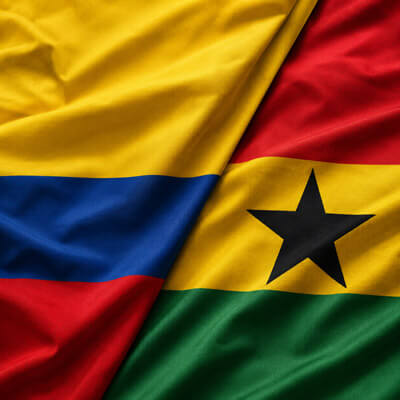
Colombia vs. Ghana
Final Results
Scheduled deadline: Jul 4, 2026, 01:30 UTC
Market Resolution
Polymarket reports Colombia as the winning outcome for the Colombia vs. Ghana prediction market with a final probability of 100%. Scheduled deadline: Jul 4, 2026, 01:30 UTC. Final reported trading volume was $12.97M.
Polymarket · Final sync
Market Analysis
Colombia’s favored price faces Ghana and the World Cup draw problem
The market gives Colombia the cleaner path, yet the draw sits large enough to signal respect for tournament-game friction. The useful question is whether Ghana’s route runs through sustained superiority or through the kind of compressed match state that keeps the favorite from separating.

Colombia’s 63.5% share, against a 24.5% draw and 12.5% Ghana win, tells a story of favorite separation constrained by football’s third outcome. The market is giving Colombia a clear baseline advantage, while still reserving nearly a quarter of the distribution for a match that fails to produce a winner under the listed event. That balance matters because Ghana can affect Colombia’s price without being viewed as an equal side; a disciplined or low-event game can pull probability into the draw without validating a Ghana win thesis.
Colombia’s edge carries a visible draw burden
The strongest inference from the outcome split is that Colombia is being treated as the side with the cleaner route to a positive result, even though the market has left meaningful room for stalemate. In a three-way market, a majority favorite has to beat both the opponent and the draw. The 63.5% Colombia price therefore implies confidence in superiority that is strong enough to overcome normal match volatility, yet restrained by the 24.5% draw leg. That matters for interpretation: the market-implied story requires Colombia to convert its presumed advantage often enough to separate from a result that ends level.
The draw share implies respect for a low-margin script
The draw is the second-largest outcome by a wide margin, which gives the match a particular shape. The market is effectively saying Ghana’s most credible way to compress Colombia’s advantage may be to keep the game within one scoring event for long stretches. That is an inference from the pricing, since team form, rankings, injuries, venue conditions, and tactical matchups are absent from the supplied context. The so what is important: information that points to caution, slow tempo, or limited chance volume could strengthen the draw outcome even if it says little about Ghana winning outright.
| Market cue | Pricing inference |
|---|---|
| Colombia at 63.5% | Baseline advantage is strong enough to command a majority of the three-way distribution. |
| Draw at 24.5% | Low-margin game states remain central to the market’s expected script. |
| Ghana at 12.5% | The outright upset path is present, yet treated as the least common route. |
Ghana’s win case depends on disruption turning into control
Ghana’s 12.5% price suggests the market is separating resistance from victory. A team can slow a favorite, defend deep, or create transitional anxiety and still feed the draw outcome more than its own win probability. For Ghana’s leg to gain share, the market would likely need evidence pointing to repeatable scoring routes, beyond evidence that Colombia can be frustrated. This distinction matters because Ghana-positive news can split across legs. A hypothetical report about Colombia missing a creator could help the draw if it lowers expected chance volume; a hypothetical report pointing to Ghana’s attacking availability or a Colombia defensive absence would speak more directly to the win leg.
Long runway gives lineup news unusual power
The market remains open ahead of a July 4, 2026 1:30 AM UTC close for a World Cup match scheduled on July 3, 2026. That long horizon explains why the current distribution may lean on broad priors instead of match-specific facts. With $157.76K in volume, $695.32K in liquidity, and $142.99K in open interest, the market has enough displayed depth to resist small, unsupported narrative shifts, while still leaving room for sharper movement when concrete information arrives. The catalysts with the strongest mechanical link to repricing are official lineups, late injury or suspension information, goalkeeper availability, and any confirmed tactical setup that changes the expected chance profile.
Weather, venue, and referee-related developments would matter only if they plausibly change scoring conditions or discipline risk. Since those details are absent from the market context, they should be treated as hypothetical catalysts. Their relevance flows through the three-outcome structure: anything reducing open-play volume tends to help the draw; anything increasing transition frequency can widen both teams’ win paths; anything damaging one side’s defensive structure can shift probability toward the opponent without moving the draw in the same direction.
Rules clarity is the failure mode hiding in plain sight
The market rules state that this is a multi-outcome Polymarket event and that each listed option is represented by its Yes price. The settlement source is FIFA, and the event is described as Colombia vs. Ghana at the upcoming FIFA World Cup. Because a draw is explicitly listed, the market is treating a level result as settlement-relevant. Any provider clarification about the treatment of regulation time, extra time, penalties, postponement, or abandoned-match handling would matter because it could change how much weight the draw deserves in the three-way distribution.
The main counter-signal to the current hierarchy would be evidence that Colombia’s assumed route to separation is weaker than the raw favorite status implies. That could come through hypothetical team news that weakens finishing, ball progression, or defensive recovery, or through verified Ghana information that raises the probability of sustained pressure instead of isolated resistance. Until such evidence appears, the market-implied thesis is coherent: Colombia owns the preferred path, the draw absorbs much of the caution, and Ghana’s win leg needs catalysts that convert disruption into a credible route to three-way victory.
Sources
Market Details
- Resolution criteria
- This event is for the upcoming FIFA World Cup game, scheduled for Friday, July 3, 2026 between Colombia and Ghana.
- Platform
-


- Category
- Sports
- Scheduled deadline
- July 4, 2026, 1:30 AM UTC
- Settlement source
- fifa.com
- Market rules summary
- Multi-outcome Polymarket event. Each listed option is represented by its Yes price on the underlying market. View full rules
Frequently Asked Questions
What was the final result of the Colombia vs. Ghana prediction market?
Polymarket reports Colombia as the winning outcome for the Colombia vs. Ghana prediction market with a final probability of 100%. The final market snapshot includes $12.97M volume and $8.91M open interest. CryptoSlate last synced the final market data at Jul 4, 2026, 03:52 UTC.
How does the Colombia vs. Ghana prediction market resolve?
This event is for the upcoming FIFA World Cup game, scheduled for Friday, July 3, 2026 between Colombia and Ghana. Multi-outcome Polymarket event. Each listed option is represented by its Yes price on the underlying market. The settlement source listed for this market is fifa.com.
Related Markets
 Spain vs. Argentina
 France vs. England
 England vs. Argentina