

Clarity Act signed into law in 2026?
Current Odds
Odds Summary
Polymarket reports 4.9% for Yes and 95.1% for No.
Polymarket · Last synced
Market Analysis
A Senate Vote, Not House Support, Defines CLARITY’s 2026 Path
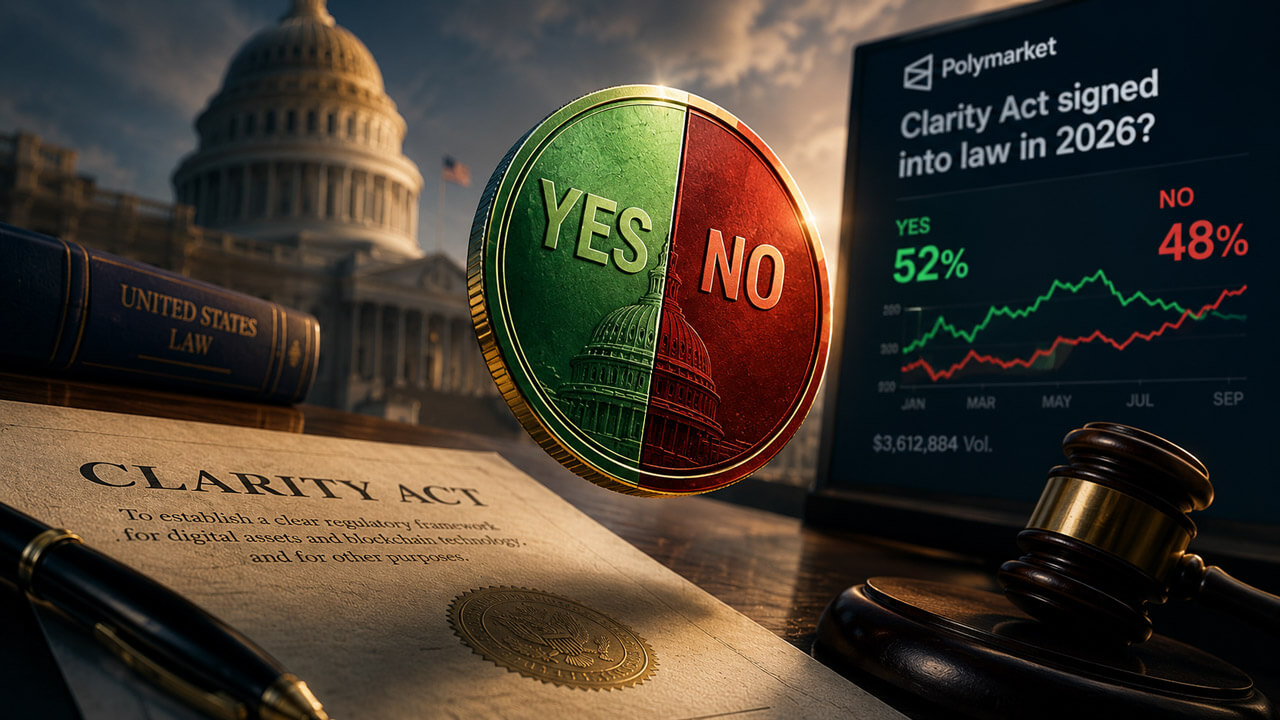
The wide gap between the two outcomes centers on a compressed sequence of Senate procedure and presidential action. House passage and committee support establish political viability, while the resolution rule leaves little value in viability without completed legislative execution before year-end.

The market’s 15.5% Yes probability assigns limited weight to CLARITY’s demonstrated bipartisan support because its remaining obstacles are sequential and deadline-bound. H.R. 3633 has already passed the House, and the supplied research says the Senate Banking Committee approved it. The contract, however, requires passage by both chambers and a presidential signature by December 31, 2026. That turns a potentially supportive Senate vote into an intermediate milestone, not the event that settles the question.
House passage establishes a base, while enactment requires a separate Senate finish
The House passed the Digital Asset Market Clarity Act of 2025 on July 17, 2025, by 294 votes to 134, according to the House Clerk’s Roll Call 199. That margin is meaningful evidence that the legislation has support extending beyond a narrow majority. It also removes one of the contract’s formal conditions.
The supplied Senate research adds a second positive development: the Senate Banking, Housing, and Urban Affairs Committee passed the bill 15-9 on a bipartisan basis in May 2026. Committee approval puts a bill closer to floor consideration and gives supporters a recorded vote count that can inform expectations about momentum.
Yet neither vote supplies the Senate’s final approval or a signature. The 84.5% No outcome can therefore be read as an execution-risk assessment: each remaining step must occur in time, and the resolution date does not reward partial progress. The market’s small one-day move toward No, up one percentage point, is consistent with that distinction, though the move alone does not identify its cause.
September 15 is the immediate procedural test
The Senate Daily Press states that a cloture motion on H.R. 3633 will ripen at 2:15 p.m. on September 15, 2026. It also says the Senate is out of business until September 14, apart from pro forma sessions on September 8 and September 10. Those scheduling facts concentrate the nearest meaningful evidence into a defined event after a period with limited scope for unexpected floor action.
Inference: a successful cloture vote would likely cause a material reassessment because it would show the measure clearing a procedural barrier on the way to Senate consideration. It would not establish the contract’s Yes condition. Subsequent Senate passage and presidential signature would still be required. A failed cloture vote, postponement, or withdrawal would weaken the near-term enactment case because it would remove the identified route to floor action while the year-end deadline continues to approach.
The price embeds several assumptions beyond vote counting
The Yes case depends on more than the premise that senators who supported committee action will support the bill at later stages. It assumes the Senate completes its work promptly, that the final legislative path satisfies the contract’s requirement for H.R. 3633 to pass both chambers, and that the bill reaches the president with enough calendar time for signature.
It also assumes that the broad policy scope does not create further delay. GovInfo describes H.R. 3633 as a framework for digital commodities and related amendments. The supplied research characterizes it as a market-structure measure involving broad regulatory questions. That scope can create opportunities for negotiations, revisions, or objections that are irrelevant to a narrow technical bill but consequential when enactment must occur before a fixed date.
Public legislative records create a second evidentiary tension
The supplied record contains a timing discrepancy that matters for evaluating claims of progress. Congress.gov and GovInfo list the bill’s last action as September 18, 2025, when it was received in the Senate, read twice, and referred to the Banking Committee. Separately, the supplied Lummis release reports the committee’s 15-9 approval in May 2026, and the Senate Daily Press lists a September 15 cloture event.
The committee release and Senate schedule support the view that activity has advanced beyond the older public bill-history entry. Still, the discrepancy means a durable repricing case would benefit from matching official floor documentation: a recorded cloture result, a Senate roll call on final passage, and updated congressional bill status. Those records would narrow the gap between reported momentum and the public legislative trail used for settlement.
The main counter-signal is that passage momentum can outrun the clock
The strongest counterargument to the low Yes probability is the combination of a 294-134 House vote, a reported 15-9 Senate Banking vote, and a scheduled cloture motion. Together, those facts show the measure has moved farther than a bill with no cross-chamber support or scheduled Senate action. The market has also drawn $14.28 million in volume and $5.74 million in open interest, indicating that the contract’s defined legislative outcome has attracted sustained attention.
Still, attention and prior votes do not compress the remaining statutory sequence. Hypothetical repricing catalysts include a successful September 15 cloture vote followed by a final Senate passage date, official congressional records confirming that outcome, and a public signature event before the deadline. Evidence pointing the other way would include an unsuccessful cloture motion, a delayed floor schedule, procedural changes that require additional congressional action, or the absence of final passage as the calendar narrows. Each event matters because the contract resolves on enacted law, not on committee approval, stated support, or expected legislative intent.
Sources
What Could Move the Odds?
Market-Implied Thesis
The 5% Yes price implies enactment of H.R. 3633 by year-end is unlikely after the Senate failed to invoke cloture.
The claim is not simply that negotiations are difficult: resolution requires Senate and House passage plus a signature by December 31. The failed September 15 cloture vote left the bill short of Senate floor consideration.
What Could Reprice It
The clearest repricing catalyst is a new Senate procedural vote that clears the failed cloture hurdle and enables floor consideration.
No dated future vote is supported in the record. A successful procedural breakthrough would directly alter the main obstacle identified by the September 15 Senate vote and reopen a path to final passage before the deadline.
Where the Market May Be Weak
Reported turnover is large, but available liquidity is far smaller, so the 5% price may not reflect equally deep two-sided conviction.
The $376.61K liquidity figure is modest relative to $23.46M in volume and $5.61M in open interest. That gap can make a visible probability more sensitive to marginal orders than aggregate attention suggests.
Counter-Signal
The low-probability thesis could fail because H.R. 3633 already advanced through a bipartisan Senate Banking Committee markup.
Committee advancement and previously released Senate bill text show the legislation is beyond an initial proposal. If negotiations produce sufficient support for another procedural attempt, the September setback need not be.
Market Details
- Resolution criteria
- This market will resolve to "Yes" if the Digital Asset Market Clarity Act of 2025 (H.R.3633) is passed by both chambers of the U.S. Congress and signed into law by December 31, 2026, 11:59 PM ET. Otherwise, this market will resolve to "No".
- Platform
-


- Category
- Crypto › Policy
- Scheduled deadline
- January 1, 2027, 5:00 AM UTC
- Settlement source
- congress.gov
- Market rules summary
- Binary market. Payout is 1 USDC for a winning outcome, 0 USDC for a losing outcome. View full rules
Market News

Frequently Asked Questions
What are the current Clarity Act signed into law in 2026 odds?
Polymarket reports Clarity Act signed into law in 2026 odds with No at 95.1% and Yes at 4.9%. These probabilities are market-implied and can change as liquidity and trading activity update. The latest market snapshot includes $23.89M volume, $459.21K liquidity, and $5.25M open interest. CryptoSlate last synced this market data at Oct 10, 2026, 04:17 UTC.
What could move the Clarity Act signed into law in 2026 prediction market odds?
The 5% Yes price implies enactment of H.R. 3633 by year-end is unlikely after the Senate failed to invoke cloture. The claim is not simply that negotiations are difficult: resolution requires Senate and House passage plus a signature by December 31. The failed September 15 cloture vote left the bill short of Senate floor consideration. Catalysts to watch include A renewed Senate motion to proceed or cloture vote, Senate reconsideration of H.R. 3633, and Changes in displayed market depth.
How does the Clarity Act signed into law in 2026 prediction market resolve?
This market will resolve to "Yes" if the Digital Asset Market Clarity Act of 2025 (H.R.3633) is passed by both chambers of the U.S. Congress and signed into law by December 31, 2026, 11:59 PM ET. Otherwise, this market will resolve to "No". Binary market. Payout is 1 USDC for a winning outcome, 0 USDC for a losing outcome. The settlement source listed for this market is congress.gov.
Related Policy Markets
 Will the Senate vote on the CLARITY Act before the August recess?
  Billionaire one-time wealth tax passes in California election 2026?
  What price will Solana hit October 5–11, 2026?