Crypto prediction markets don't all solve the same problem. Some are built for fast BTC and ETH trades. Others work better for crypto-native users who already live in wallets. A platform can look clean and cheap on the first trade, then fall apart on slippage, weak exits, or awkward off-ramps once you size up or try a thinner market. This page matches each platform to the kind of trader it actually fits, based on market depth, funding, cash-out flow, and how much friction you're willing to accept.
Top Crypto Prediction Markets
- Funding
- USD
- Min. deposit
- $10 ($1,000 by wire)
- KYC
- Full
- $72,580 median depth near the price
- Resting limit orders free on most markets
- Market data API needs no key to read
- Funding
- USD
- Min. deposit
- $10 ($1 ACH, $1,000 wire)
- KYC
- Full
- CFTC-regulated U.S. sports contracts via CDNA
- Sports-focused with chat, leaderboard, parlays
- Easy USD funding: bank, card, PayPal, wallets
- Funding
- USD,
 USDC
USDC - Min. deposit
- No minimum
- KYC
- Full
- Every order goes to Kalshi's order book
- 2-hour payout sweeps on business days
- Buy with USDC as well as dollars
- Funding
- USD
- Min. deposit
- No minimum
- KYC
- Full
- Commission capped at 1¢ per contract
- 4,175 events across 28 category pages
- Payouts withdrawable 1 business day after settling
- Funding
- pUSD (crypto)
- Min. deposit
- $2 on most networks ($3 on Ethereum, $3.60 on Bitcoin)
- KYC
- None
- $63,871 median depth near the price
- Geopolitics markets trade fee-free
- London server hosting for market makers
CryptoSlate may earn a commission when you visit partner sites through links on this page, at no extra cost to you. Our rankings and reviews remain editorially independent and based on our published methodology. Read disclosure
Disclaimer: CryptoSlate may receive a commission when you click links on our site and make a purchase or complete an action with a third party. This does not influence our editorial independence, reviews, or ratings, and we always aim to provide accurate, transparent information to our readers.Polymarket stands out because it feels closest to a real crypto market workflow. It is better for wallet users, faster-moving traders, and those who care about short-dated BTC and ETH contracts. Coinbase, Kalshi, Robinhood, and OG By Crypto.com are easier to trust and easier to fund with familiar rails, but they do not solve the same problem. Some make onboarding easier by cutting back on market range. Others look simple until payout timing, spread costs, or order flexibility start to matter.
Comparison Table
| Name | Minimum deposit | KYC | Liquidity model | Early exit | Core categories | Position limit | API access |
|---|---|---|---|---|---|---|---|
 Kalshi Kalshi | $10 ($1,000 by wire) | Full KYC | Order Book | Yes | Elections, sports, entertainment, politics, financials, economics, science and technology, climate and weather, companies, mentions, crypto, commodities | Yes | Yes |
 OG OG | $10 ($1 ACH, $1,000 wire) | Full KYC | Order Book | Yes | Sports, Politics, Economics, Culture, Crypto, Companies, and Climate. | Yes | Yes |
 Coinbase Prediction Markets Coinbase Prediction Markets | No minimum | Full KYC | Broker / Routed | Yes | Sports, crypto, elections, politics, entertainment, mentions, commodities, economics, financials, weather, science and technology, companies, social | Yes | No |
 Robinhood Robinhood | No minimum | Full KYC | Broker / Routed | Yes | Pro football, college football, midterms, elections, baseball, basketball, hockey, soccer, tennis, golf, combat sports, esports, economics, financials, crypto, climate, metals, entertainment, technology | Yes | No |
 Polymarket Polymarket | $2 on most networks ($3 on Ethereum, $3.60 on Bitcoin) | No KYC | Order Book | Yes | Sports, crypto, politics, geopolitics, finance, economy, culture, weather, tech, mentions, esports | No | Yes |
Polymarket is the best fit for active crypto traders because it gives them the broadest crypto-native flow, the best short-term coverage, and the strongest tooling. Coinbase, Robinhood, and OG are easier for casual users because funding feels familiar and setup is lighter. Kalshi sits in the middle. It is not crypto-native, but it is easier to trust than most and stronger than most once rule clarity and execution quality start to matter. The hidden trap in this category is mistaking easy onboarding for a better trading experience. Some platforms feel simple only because they narrow the workflow, the market menu, or the ways you can move money.
Crypto Prediction Markets Reviews
Kalshi
- Funding
- USD
- Min. deposit
- $10 ($1,000 by wire)
- KYC
- Full
Pros
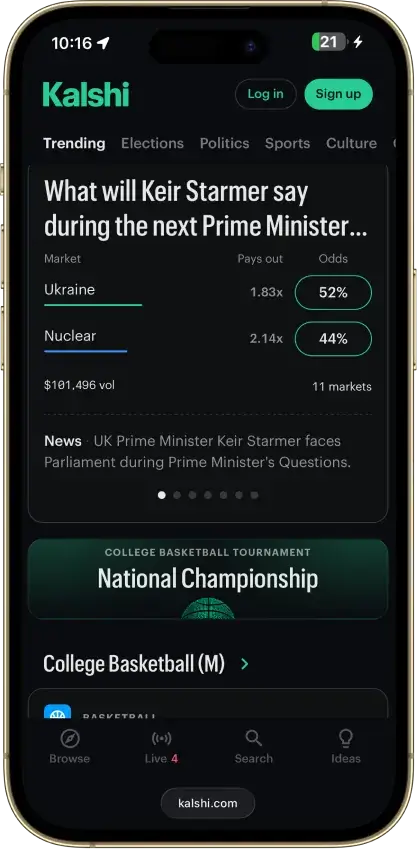
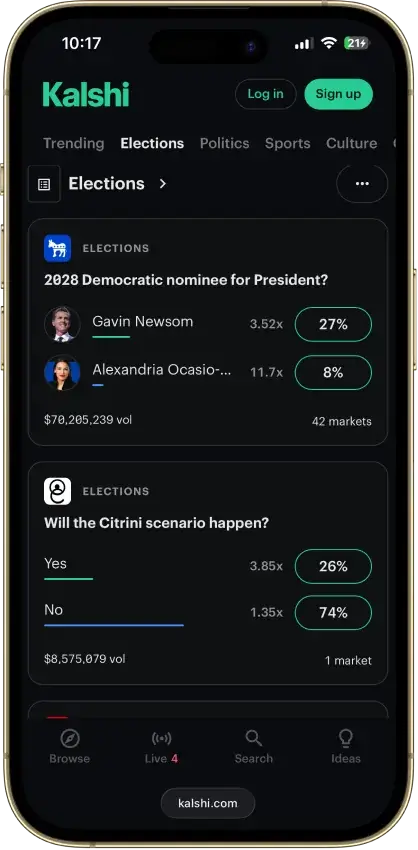
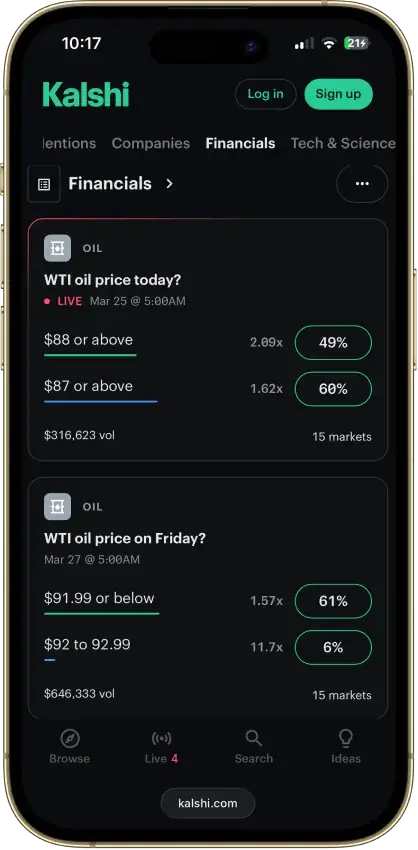
- 1¢ spreads on top election and sports markets
- 8,000+ open events across 17 categories
- Free ACH, wire and RTP deposits
- Debit withdrawals land within hours
- Full API with WebSocket and FIX
Cons
- Court orders block contracts in 3 states
- Disputed outcomes can't be appealed
- Card deposits can cost up to 2%
- No phone support, AI chat first
- No tax form named for trading gains
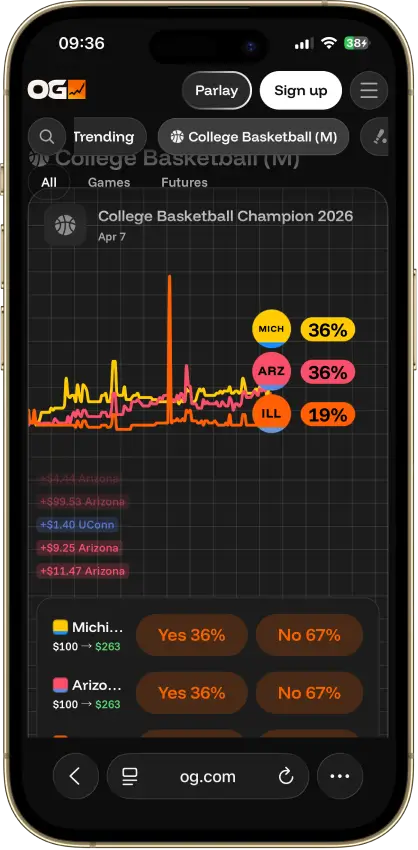
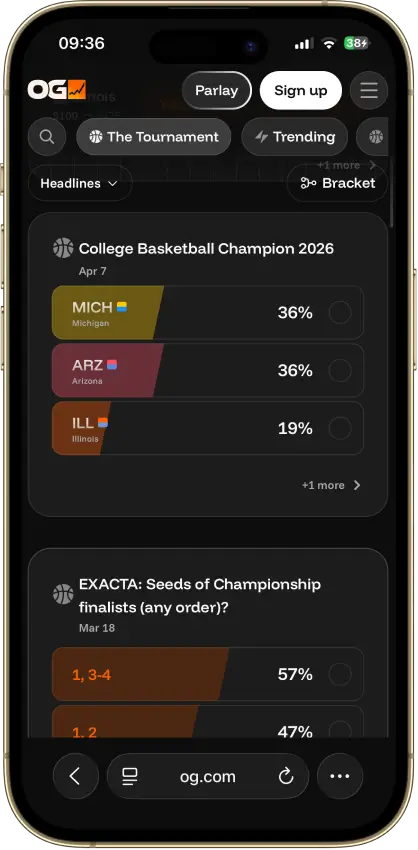
OG
- Funding
- USD
- Min. deposit
- $10 ($1 ACH, $1,000 wire)
- KYC
- Full
Pros
- Multiple USD rails: ACH, wire, PayPal, cards
- Early exits available before settlement
- Sports coverage: spreads, totals, props, parlays
- Trade cost/payout visible before confirmation
- iOS, Android, web with chat and leaderboard
Cons
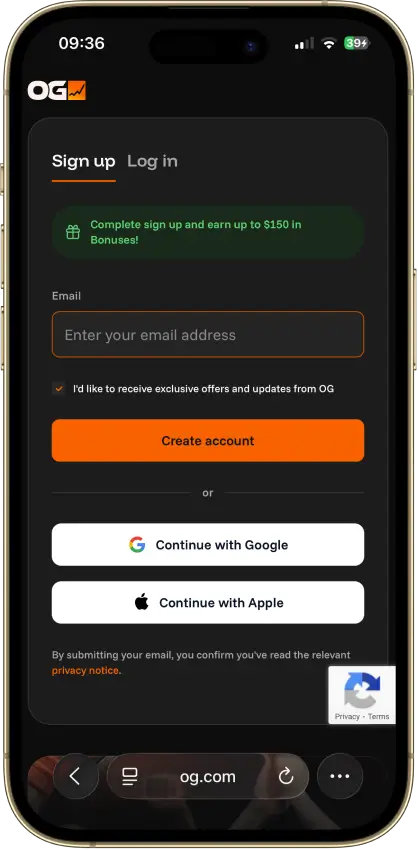
- Full KYC and U.S.-only access add signup friction
- Early exits depend on opposing liquidity
- IOC orders can leave large trades partly filled
- Cash withdrawals are ACH-only
- No public API or historical data access
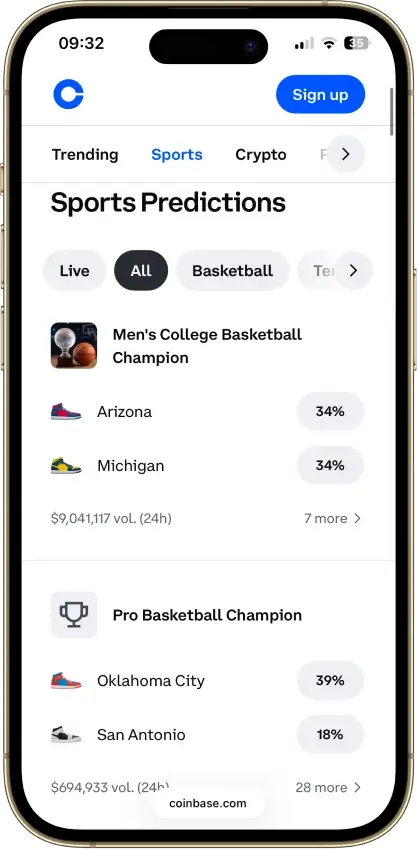
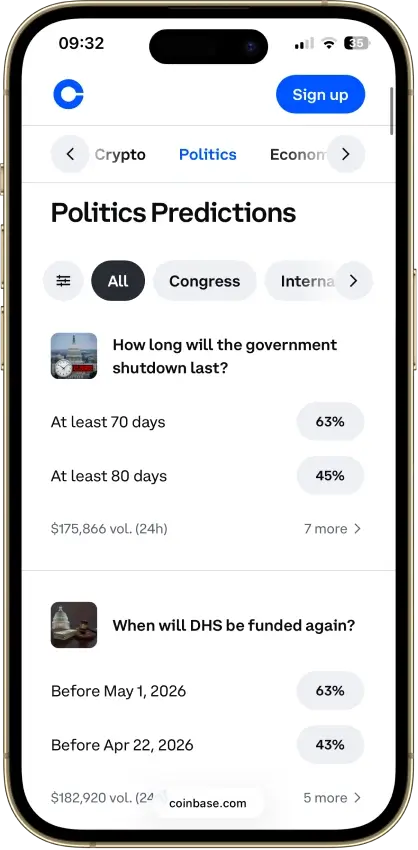
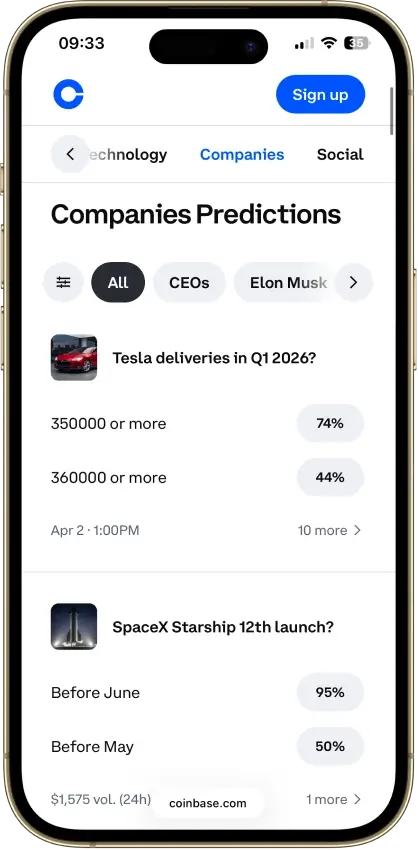
Coinbase Prediction Markets
- Funding
- USD, USDC
- Min. deposit
- No minimum
- KYC
- Full
Pros
- Sampled Kalshi markets: 1¢ median spread
- Winnings tradeable the moment they settle
- Trade on the web as well as the app
- Underpaid Michigan winners made whole
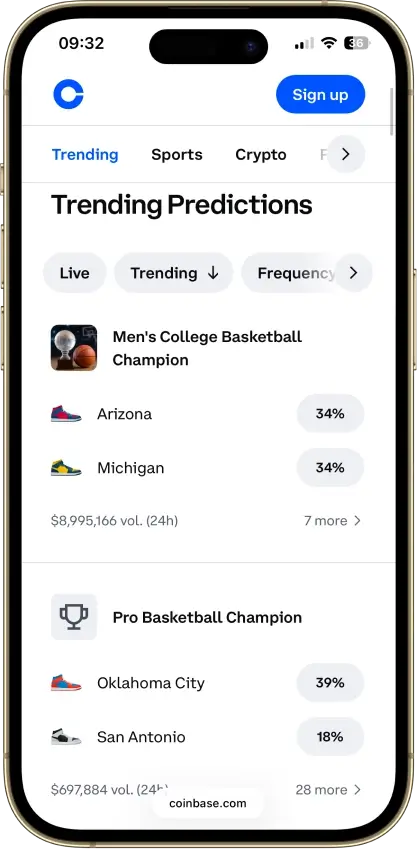
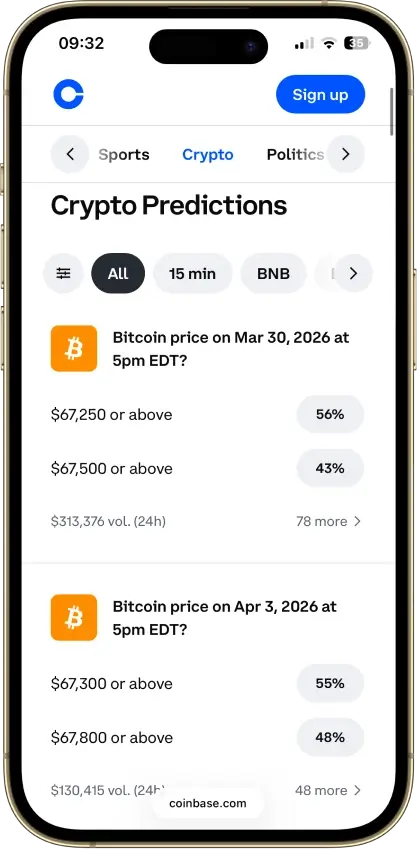
- 15-minute BTC and ETH price markets
Cons
- Fee amount shown only at checkout
- Income and net-worth review to join
- Unavailable anywhere in Nevada
- No API or data download
- Help pages contradict each other
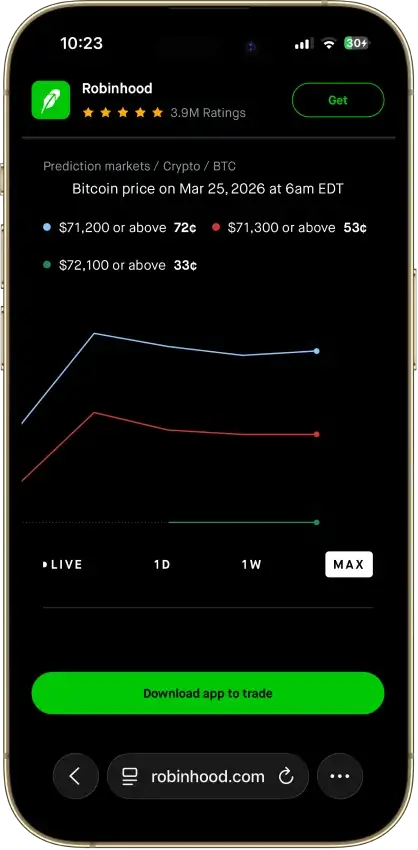
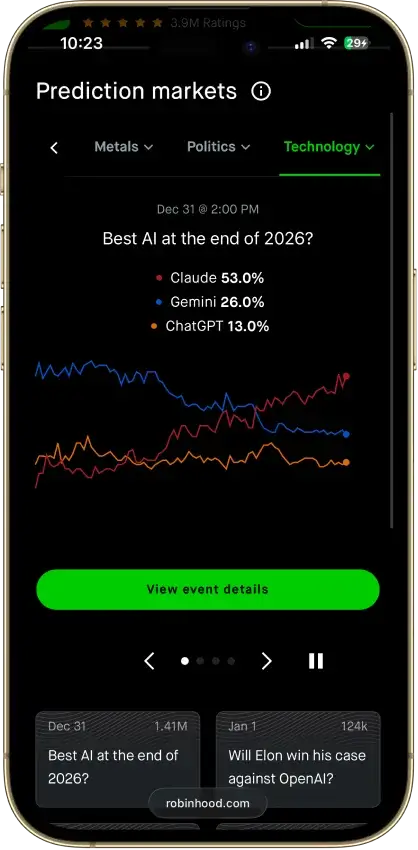
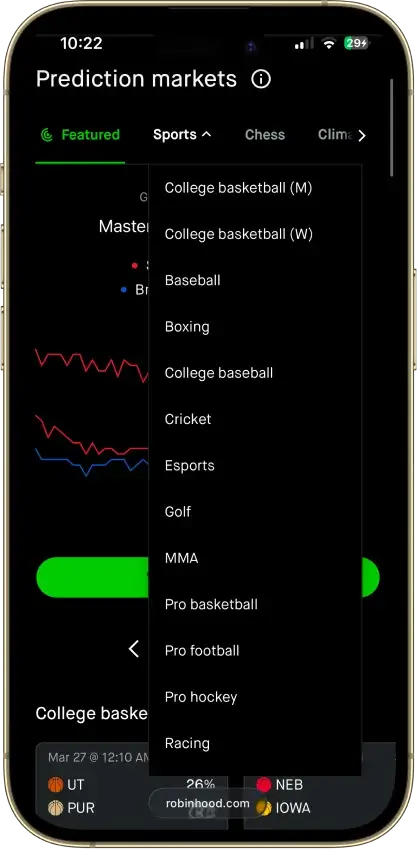
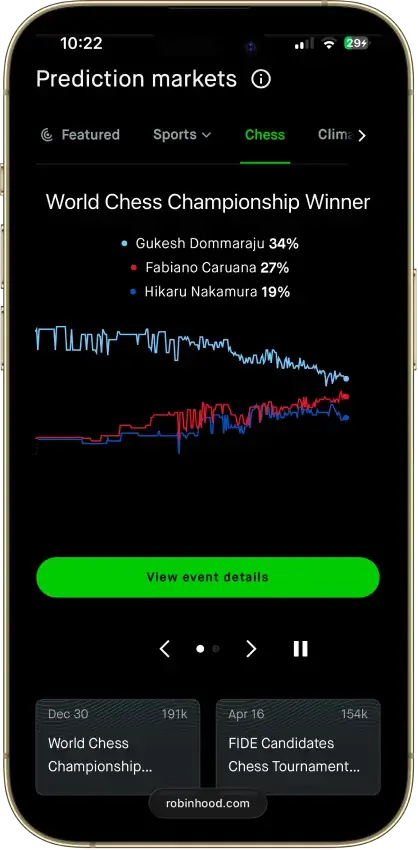
Robinhood
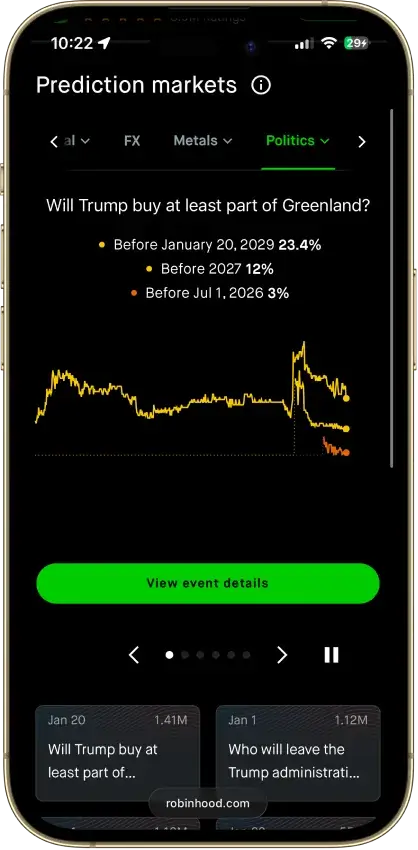
- Funding
- USD
- Min. deposit
- No minimum
- KYC
- Full
Pros
- Gold halves the commission on long shots
- Custom football combos up to 10 legs
- Free ACH deposits and withdrawals
- 24/7 chat plus phone callbacks
- Collateral held in a segregated account
Cons
- Needs a separate derivatives approval
- Trading only in the phone app
- No API or historical data download
- No sports contracts in NV, MD or MI
- Robinhood can't change a settlement

Polymarket
- Funding
- pUSD (crypto)
- Min. deposit
- $2 on most networks ($3 on Ethereum, $3.60 on Bitcoin)
- KYC
- None
Pros
- 1¢ spreads on top politics and sports markets
- Makers pay no trading fees
- Taker fee 0–1.25¢ at 50¢ outside crypto
- Instant withdrawals, no Polymarket fee
- No ID needed to sign up
Cons
- Not licensed by any regulator
- Disputes can end in a UMA token-holder vote
- Crypto only, no card or bank deposits
- Blocked or close-only in 41 countries
- Web only, and no tax statements
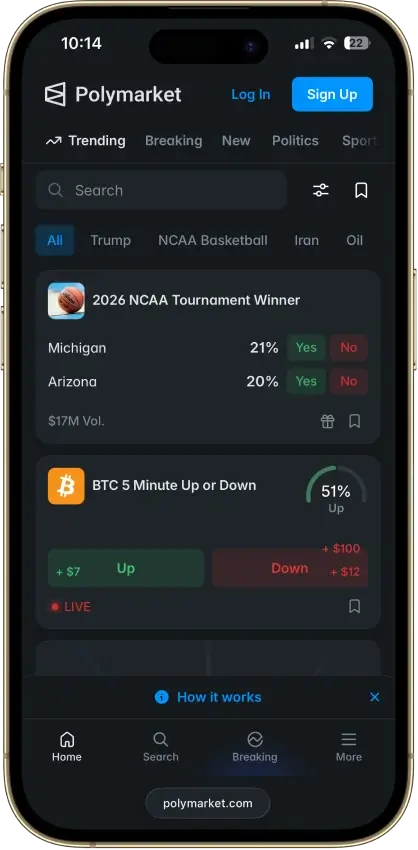
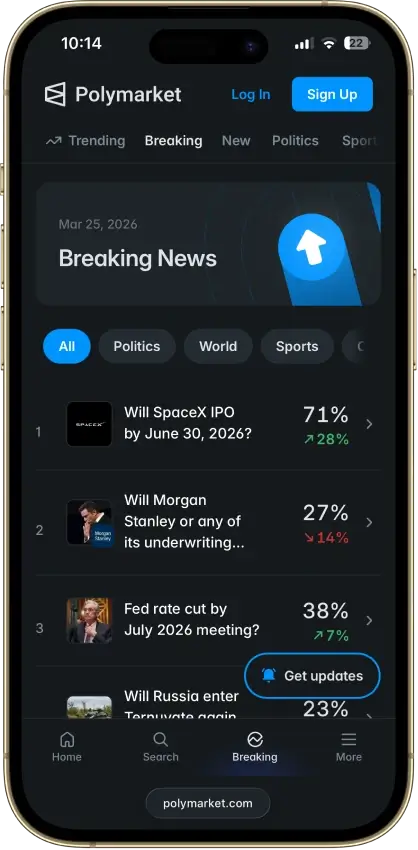
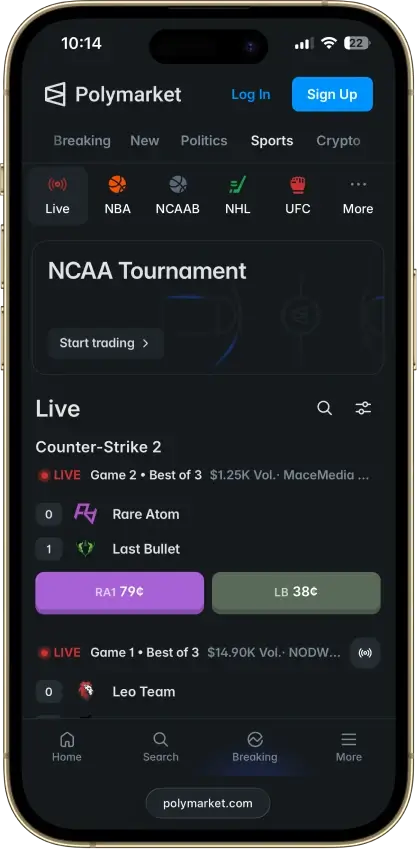
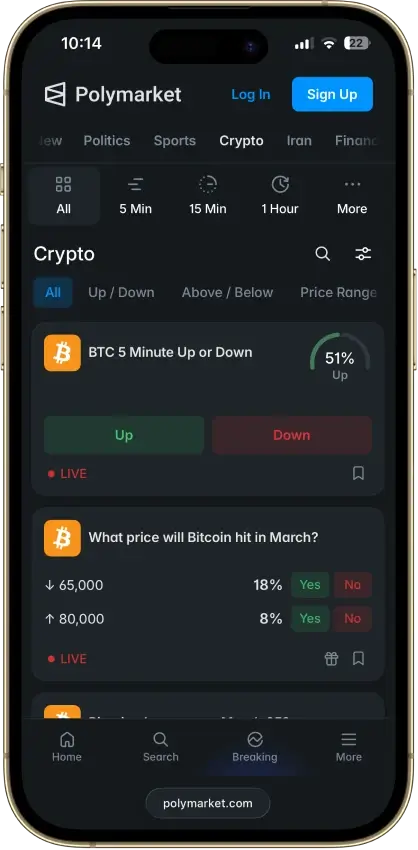
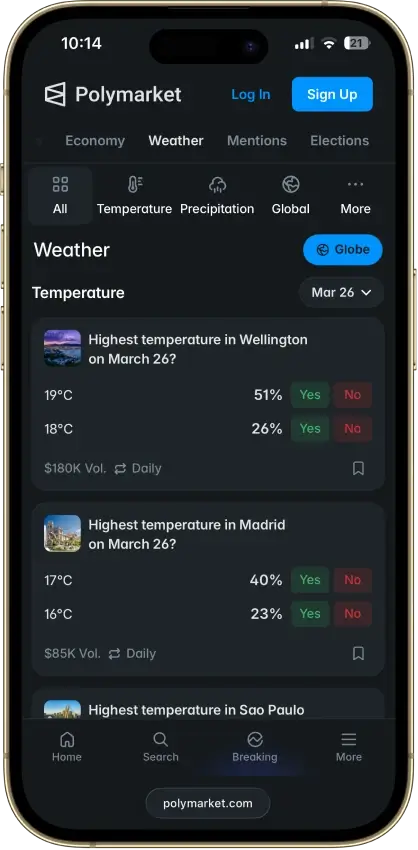
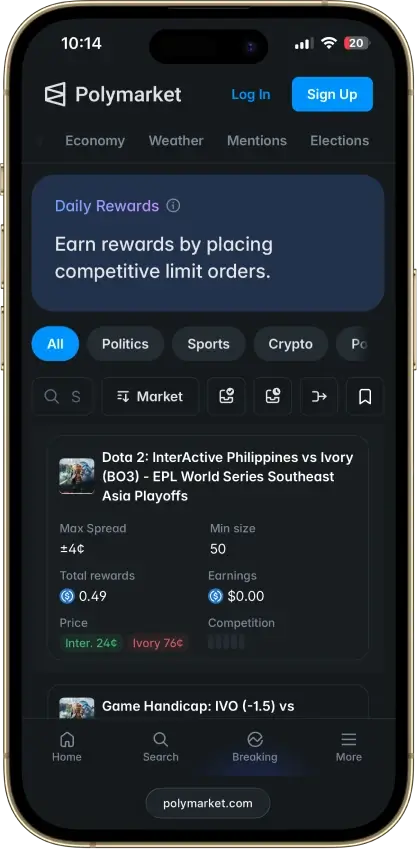
Polymarket and Kalshi are still the strongest options here, but they separate for very different reasons. Polymarket is better for crypto-native users, active traders, and those who care about wallet flow, short-term market coverage, and data access. Kalshi is better for users who want cleaner rules, stronger trust, and a more controlled trading environment. Coinbase and Robinhood are better as low-friction starting points. OG works best for those who want a crypto-branded experience without going fully onchain.
How We Ranked These Crypto Prediction Markets
These rankings focus on real trading conditions, not branding, promos, or raw market count. We looked at what it takes to get from signup to first trade, how easy it is to fund and cash out, how well the crypto markets actually trade, and how much trust the user can place in the rules, settlement flow, and platform design.
In practice, that means checking each platform across the core decision points below.
- Setup friction and account readiness, including how hard it is to get approved, verified, funded, and ready to trade
- Funding rails and deposit friction, including whether the platform gives users a practical path to usable buying power without awkward wallet, bank, or transfer steps
- Cash-out flow and payout reality, including how easy it is to turn a winning position into withdrawable cash or usable onchain funds
- Liquidity and execution quality, including spreads, slippage, order control, and whether exits still work outside the biggest contracts
- Fees and hidden cost drag, including trading fees, spread costs, gas, bridge costs, conversion costs, and withdrawal friction where relevant
- Market depth and contract usefulness, including whether the crypto markets are broad enough, active enough, and useful enough to matter in real use
- Rule clarity and resolution trust, including price-source clarity, edge-case handling, and how understandable the dispute path is if something goes wrong
- Trust model, custody, and security clarity, including whether users can clearly understand who controls funds, how settlement works, and where the main risks sit
- UX, apps, and data tooling, especially for users who care about app flow, exports, APIs, tracking, or more active monitoring
- Transparency, support, and reporting readiness, including how easy it is to verify key details, get help, and keep usable records
The rankings reward platforms that are easier to use correctly from the first deposit to the final withdrawal. A platform loses ground when the workflow is hard to verify, the money path gets messy, or the market looks better on the surface than it does once you actually try to trade it.
What's a Crypto Prediction Market?
Not every crypto prediction product is a prediction market. Some are forecast tools, dashboards, sentiment products, or AI-driven price models. A crypto prediction market is where you actually buy or sell a contract tied to an outcome and make or lose money based on how it resolves. That outcome might be a BTC price move, an ETF event, a token launch, or a broader crypto narrative.
The key difference: a forecast tool gives you a view. A prediction market gives you tradable exposure. Once money is on the line, the platform has to handle liquidity, spreads, funding, settlement, payouts, and rules. A signal product can be useful and still tell you nothing about whether a market is easy to trade or easy to exit.
That's why platform choice should start with market quality, not with who publishes the best-looking charts. Judge these platforms on execution, liquidity, funding flow, payout reality, and rule clarity. A platform that publishes no forecasts at all can still be the better trading venue if the contracts are easier to trust and easier to trade.
How These Platforms Differ In Practice
These five names above sit in the same category, but they don't feel the same once you actually use them. The real split shows up in funding, trust, order flow, and how much work you have to do outside the trade itself.
Regulated and Broker-Led Platforms
Regulated and broker-led platforms do the basics better for most users. Funding is cleaner, the trust model is easier to follow, wallet friction is low, and cashing out feels closer to a normal finance app. That matters if you want to move money in from a bank, place a trade, and get back to cash without touching a wallet, bridge, or separate off-ramp.
But that cleaner setup usually comes with trade-offs. The crypto market menu tends to be narrower, the trading flow less flexible, and the whole product less native to how crypto users actually move funds or react to fast-moving narratives. Kalshi shows the strengths of this model well. Coinbase, Robinhood, and OG borrow a lot from it too, even when they're trying to feel more consumer-friendly or crypto-branded.
Crypto-Native Platforms
Crypto-native platforms do a better job matching how active crypto users already operate. Wallet connection feels natural, the market mix is more flexible, and the platform can react faster to crypto-specific narratives, launches, and sentiment shifts. That matters most when you want short-term markets, faster discovery, or a workflow that fits onchain habits.
The downside is that more of the burden shifts to you. Funding and off-ramping take more work, rule-reading matters more, and trust depends heavily on how clearly each market is structured and resolved. Polymarket is the clearest example. It gives you more freedom, but it also asks you to do more of the setup and filtering yourself.
Hybrid and Lighter-Weight Models
Hybrid and lighter-weight models sit between those two poles. Funding and onboarding stay simple, but they borrow enough from crypto or event trading to feel more targeted than a plain finance app. That can make them easier to approach if you want crypto-linked contracts without taking on full wallet friction.
The catch is these products can feel better at the first trade than at the tenth. They often give up market range, order flexibility, or post-trade control in exchange for convenience. Robinhood, Coinbase, and OG all sit somewhere in this middle ground, though each leans in a different direction.
The best platform depends on the use case. If you want flexibility, smooth crypto wallet flow, and faster reaction to crypto narratives, a crypto-native venue will usually fit better. If you want cleaner trust, easier funding, and a simpler money path, a regulated or lighter-weight model probably makes more sense. The mistake is assuming they all deliver the same kind of trading experience.
What You Can Actually Trade On These Platforms
“Supports crypto markets” can mean very different things. One platform may be strong on BTC and ETH price moves every few minutes. Another may be better for range markets, listing questions, or macro events that shape crypto sentiment. The events menu matters, but the depth behind the menu matters more.
| Market Type | Best Platform | Other Good Fits | Why It Matters | Main Limitation |
|---|---|---|---|---|
| BTC / ETH Short-Term Markets | Polymarket | Kalshi, Robinhood Prediction Markets | Best fit for users who want fast-moving crypto trades instead of waiting on longer contracts | Quality drops faster outside the busiest contracts |
| Price Target / Range Markets | Kalshi | Polymarket, Robinhood Prediction Markets | Better for users who want a more specific view than a simple up-or-down contract | Range depth can vary a lot by token and time frame |
| Token Listing Or Launch Markets | Polymarket | Not Available | Better for users who trade crypto narratives, launches, and attention shifts | Harder to find strong depth on regulated platforms |
| Narrative / Macro-Crypto Markets | Polymarket | Kalshi, OG By Crypto.com | Useful when crypto trades are driven by Fed, ETF, policy, or broader market stories | Some markets look broad until you check the actual order flow |
| News-Driven Crypto Markets | Polymarket | Kalshi, Robinhood Prediction Markets | Helps users trade around fast-moving headlines instead of waiting for slower-cycle contracts | Rules and resolution sources matter more when news gets messy |
| Lower-Stakes / Learning-Oriented Markets | Robinhood Prediction Markets | Coinbase Prediction Markets, OG By Crypto.com | Better for users who want a simpler first trade and less setup burden | Simpler flow often means weaker range, thinner menus, or slower payout feel |
The key point is that crypto-market coverage is not one thing. Some platforms are strongest on short-term BTC and ETH trading. Others are better for narrative or launch-driven markets. Some only look broad until you check whether the markets are active enough to enter and exit cleanly. A long market list is not the same as a useful market menu.
Who Each Platform Is Really For
Not every platform is built for the same trader. Some are better if you want deep liquidity on big political markets. Others make more sense if you trade frequently and need fast withdrawals. Here's how to figure out which one fits you.
| User Type | Best Fit Platform | Why It Fits | Main Trade-Off | Who Should Skip It |
|---|---|---|---|---|
| Casual Crypto User | Coinbase Prediction Markets | Clean setup, familiar funding, and less wallet friction | Narrower crypto market range and slower-feeling post-trade money flow | Those who want the widest market menu or a more active trading workflow |
| Active Short-Term Trader | Polymarket | Best mix of short-term crypto coverage, flexibility, and market-native flow | More wallet, off-ramp, and rule-reading burden | Those who want a simple cash account and minimal setup work |
| User Who Wants Regulated Access | Kalshi | Strongest trust model, clearer rules, and cleaner cash-based funding | Less crypto-native flexibility and weaker wallet fit | Those who want token launches, wallet-based flow, or a more onchain experience |
| Crypto-Native Wallet User | Polymarket | Best fit for users already comfortable with wallets, stablecoins, and onchain movement | Cashing out is less simple than on broker-led platforms | Those who want bank-first funding and a more guided product |
| User Who Needs Easier Funding | Coinbase Prediction Markets | Very easy for those who already hold USD or USDC on Coinbase | Convenience comes with narrower coverage and less trading depth | Those who care more about range, speed, or crypto-native flexibility |
| User Who Cares About APIs Or Tracking Data | Polymarket | Strongest fit for users who want API access, tracking, and more advanced monitoring | Still asks more from the user on funding and off-ramp flow | Those who just want a lightweight, app-style experience |
A good fit for one kind of user can be a poor fit for another. Polymarket is the best choice for flexibility, crypto-native flow, and data-heavy use, but it asks more from the user. Coinbase is easier to fund and easier to understand, but it gives up range and flexibility. Kalshi is the cleanest answer for users who care most about regulation and rule trust. This section should help users narrow the shortlist fast instead of comparing five platforms that were never meant to solve the same job.
Wallet, Funding Asset and Chain Fit
This is where crypto users usually separate the real fits from the fake ones. The question is not just how to deposit. It is whether the platform works with the assets and wallet setup you already use, whether chain choice stays simple, and whether profits are easy to move after the trade instead of getting stuck inside a closed account flow.
| Platform | Funding Asset / Currency | Wallet Needed? | Chain Fit | Bridging Needed? | Profit Portability |
|---|---|---|---|---|---|
| Polymarket | USDC / USDC.e and other crypto deposit routes that end up in its trading balance | Yes; wallet or wallet-style account flow is part of the setup | Best if you already use Polygon or EVM-friendly crypto flows | Often, unless your funds already arrive in the right format and chain path | Strong; easiest in this group to move winnings back onchain or route them elsewhere |
| Coinbase Prediction Markets | USD or USDC from your Coinbase account | No | Account-based; best fit if you already keep cash or USDC inside Coinbase | No | Medium; easy inside Coinbase, less direct if you want immediate onchain reuse |
| Kalshi | USD first, with multiple transfer methods including bank, card, and crypto routes | No | Account-based; good for fiat-first users, not a natural wallet-first setup | No for most users | Good for cash-out paths, but still not a wallet-native money loop |
| OG (by CDNA) | Cash or crypto funded through the wider Crypto.com account flow | No | Account-based; chain choice is mostly abstracted away | No for most users | Medium; practical inside Crypto.com, less flexible if you want fast onchain reuse |
| Robinhood Prediction Markets | USD cash in a Robinhood account | No | Account-based only; no real chain fit | No | Weak to medium; simple for bank users, poor fit for users who want onchain portability |
Polymarket feels the most natural for crypto-native users because wallet flow, asset portability, and onchain reuse are part of the experience instead of an afterthought. Coinbase, Kalshi, OG, and Robinhood are easier for fiat-first users because they hide most of the chain complexity. That helps at the start, but it also limits flexibility later. The real friction usually shows up after the trade, when users try to move profits somewhere useful and discover the platform was easy to fund but not especially portable.
Fees, Funding and Payouts
The real cost is not just the contract price. It also includes commissions, exchange fees, gas, bridge costs, withdrawal fees, and the delay between settlement and money you can actually move. This is where platforms that look similar on the buy screen start to separate.
- Polymarket
- Deposit methods: Crypto deposits into a wallet-linked balance; incoming assets are bridged into USDC.e on Polygon.
- Trading cost: Crypto and Sports markets currently have taker fees; $0 Polymarket deposit fee; $0 Polymarket withdrawal fee; no POL gas needed for gasless trades; bridge or swap costs can still apply.
- Settlement to withdrawal time: After settlement, the withdrawal flow itself is instant at the bridge layer.
- Withdrawal methods: Onchain withdrawal to supported wallets and chains.
- Limitations: Cash off-ramp is still external; bridge and token conversion steps can add friction.
- Coinbase Prediction Markets
- Deposit methods: USD or USDC from the main Coinbase account.
- Trading cost: Contract price plus fee shown in the order preview; each winning contract pays $1 minus fees; flat public fee schedule is Not Disclosed.
- Settlement to withdrawal time: Winnings stay in the prediction balance first, then auto-transfer to the primary account every 2 hours from 6 AM to 4 PM ET on business days.
- Withdrawal methods: ACH or wire after funds reach the primary account.
- Limitations: No automatic payouts on weekends, U.S. bank holidays, outside banking hours, or while result confirmation is still pending.
- Kalshi
- Deposit methods: Debit card, Apple Pay, Google Pay, ACH, PayPal, Venmo, Cash App, crypto, or wire.
- Trading cost: Debit card deposits cost 2%; ACH, wire, PayPal, and Venmo deposits cost $0; crypto deposits can add provider or network fees; some resting limit orders avoid trading fees.
- Settlement to withdrawal time: Varies by funding rail; ACH can partially unlock immediately, with the rest typically settling in 1 to 3 business days.
- Withdrawal methods: Bank withdrawal, debit card, or crypto.
- Limitations: Timing is uneven; security holds depend on deposit method, destination, and whether you withdraw back to the same rail.
- OG
- Deposit methods: USD Cash Account funding by ACH direct deposit, wire, eligible instant deposit, or crypto funding converted to USD.
- Trading cost: Contract price plus applicable fees; $1 contracts charge a $0.02 exchange fee to open or close and waive fees at in-the-money settlement; $10 contracts charge a $0.10 exchange fee and $0.10 technology fee to open or close, and a $0.10 exchange fee at in-the-money settlement with the technology fee waived.
- Settlement to withdrawal time: Payouts usually credit within a few hours after the result is confirmed.
- Withdrawal methods: Standard Crypto.com cash-out or crypto withdrawal routes after funds reach account balance.
- Limitations: Money lands in the app first; payout timing is decent, but broader withdrawal speed and fees depend on the wider Crypto.com cash-out flow.
- Robinhood Prediction Markets
- Deposit methods: Robinhood cash via linked bank transfer or instant bank transfer.
- Trading cost: $0.01 Robinhood commission per contract per side; $0.01 exchange fee per contract per side; instant withdrawals cost 1.75%, with a $1 minimum and $150 maximum.
- Settlement to withdrawal time: After sale or resolution, funds hit account cash first; actual withdrawal timing still follows Robinhood cash rules.
- Withdrawal methods: Standard bank withdrawal, instant bank transfer, or external debit card.
- Limitations: Cheap entry can still turn expensive if you need money out fast; there is no onchain reuse path.
Liquidity, Slippage and Why Execution Changes Everything
A crypto prediction market is only as good as the trades it actually fills for you. You might see a clean probability on screen, but that number means nothing if there aren't enough buyers and sellers to match your order, or if getting out costs you more than you made. That's why Polymarket and Kalshi tend to work better for short-term BTC and ETH markets – they have more trading activity behind the prices you see. Robinhood works on the biggest markets but runs dry faster. Coinbase and OG have fewer options and less depth.
This is where a trade that looks good on paper either holds up or falls apart. Small trades are usually fine on most platforms. Bigger trades run into slippage fast – meaning the price moves against you just because of your order size. Getting out early matters too. A market is only useful if you can sell your position before the event resolves without losing most of what you earned. The same event can also show different prices on different platforms because of how the rules are written, where the result gets confirmed, when the market closes, and what fees each platform charges.
If you trade small and stick to the most popular markets, weaker liquidity probably won't hurt you much. If you trade larger amounts or use automated systems, bad fills can wipe out your edge before you even realize it. The quality of liquidity matters just as much as what markets are available.
API Access, Historical Data and Tooling
If you track markets closely, compare venues, backtest ideas, or run automated systems, the gap between a polished app and a real data layer becomes significant fast. The table below breaks down what each platform actually offers on API access, historical data, exports, and bot support.
| Platform | API Access | Historical Data | Exports | Good For Bots? | Biggest Data Limitation |
|---|---|---|---|---|---|
| Polymarket | Strong public APIs | Strong | Limited for simple account-style exports | Yes | Best data stack here, but reporting is still more API-first than casual-user friendly |
| Coinbase Prediction Markets | Not Available for public prediction-market API use | Not Available | Basic account exports through Coinbase, but not strong prediction-market tooling | No | Easy to use, weak for serious tracking or automation |
| Kalshi | Strong public REST, WebSocket, FIX, and SDK support | Strong | Basic to medium | Yes | Strong tooling, but crypto is only one slice of the exchange |
| OG by Crypto.com | Not Disclosed for public retail API use | Not Disclosed | Not Disclosed | No | Consumer-first product with weak public tooling so far |
| Robinhood Prediction Markets | Not Available for public prediction-market API use | Limited public market pages, but weak official tooling | Custom reports and statements are available at the account level | No | Fine for casual account review, weak for backtesting or automation |
Tooling matters most for active traders, systematic users, and those who want to compare pricing, monitor positions, or build their own tracking layer. Casual users can mostly ignore it if they only place a few trades and do not need structured data. But once you want backtesting, automation, or serious market monitoring, the shortlist gets much shorter very fast.
How Crypto Price Markets Are Resolved
Crypto price markets look simple on the surface, but the contract rules decide almost everything. A user may think they are trading the chart they have open, but the market usually settles to a named source, a fixed timestamp, and a specific payout rule that may not match the chart or exchange they were watching.
That is why wording matters so much. A contract based on a single price snapshot is different from one based on a daily close, and both are different from a contract that only needs a level to trade once. The same problem shows up with exchange-source dependence. If the rules point to a different venue, timestamp, or oracle path than the chart you were watching, the contract follows the rules, not your chart. On crypto-native platforms, dispute risk can also sit in the oracle or dispute layer. On more regulated platforms, it usually sits more in rule interpretation and source handling.
A crypto market feels safer to trade when the source, timing, and payout condition are easy to read before you buy. It should make a user cautious when the wording is loose, the source is unclear, or the contract seems to depend on a chart the rules never actually name. In this category, bad assumptions usually come from reading the headline and skipping the settlement details.
Access, Availability and Friction Points
Access usually looks easier than it really is. The main split is simple: some platforms are easy to open but hard to qualify for, while others are easy to reach but harder to use correctly once wallets, location checks, or approval rules start to matter.
The table below shows the part most users should check before funding an account.
| Platform | Availability | KYC Level |
|---|---|---|
| Polymarket | OFAC-sanctioned countries blocked; Ontario blocked; Crimea, Donetsk, and Luhansk blocked; Italy trading restricted; Germany trading prohibited; Singapore, Poland, Thailand, and Taiwan close-only | Low at entry; wallet-first, with compliance and geoblocking controls |
| Coinbase Prediction Markets | U.S. only; Nevada excluded | Full KYC plus suitability review |
| Kalshi | Restricted jurisdictions: Afghanistan, Algeria, Angola, Australia, Belarus, Belgium, Bolivia, Bulgaria, Burkina Faso, Cameroon, Canada, Central African Republic, Côte d’Ivoire, Cuba, Democratic Republic of the Congo, Ethiopia, France, Haiti, Hungary, Iran, Iraq, Italy, Kenya, Laos, Lebanon, Libya, Mali, Monaco, Mozambique, Myanmar, Namibia, New Zealand, Nicaragua, Niger, North Korea, China, Poland, Russia, Singapore, Somalia, South Sudan, Sudan, Switzerland, Syria, Taiwan, Thailand, Ukraine, United Arab Emirates, United Kingdom, Venezuela, Yemen, and Zimbabwe; Nevada sports, elections, and entertainment contracts temporarily blocked | Full KYC |
| OG by Crypto.com | U.S.-only in practice; non-U.S. access not supported for the main prediction product | Full KYC |
| Robinhood Prediction Markets | Maryland residents blocked; Nevada residents cannot trade new sports event contracts; some contracts unavailable in certain states or territories | Full KYC plus Robinhood Derivatives approval |
Coinbase and Robinhood are still the cleanest for casual U.S. users who want familiar account flow. Kalshi is also straightforward, but more approval-heavy. Polymarket feels smoother for crypto-native users and rougher for everyone else. The hidden friction is not always at signup. Sometimes it shows up in location rules, suitability review, or how much setup work the platform pushes back onto the user.