

 Launched in 2012
- 24/7 live phone support for every customer
- Simple Buy and Advanced share one balance
- Pass-through FDIC cover on USD cash
Coinbase Overview
- Crypto Exchange Name
- Coinbase
- Parent Company
- Coinbase Global, Inc.
- Launch Year
- 2012
- KYC
- Yes
- Total Assets
- 270+
- Staking
- Yes
- Copy Trading
- No
- Derivatives
- Yes
- Proof of Reserves
- No
- Trading Fees
- 0.00% - 0.90%
- Maker Fee
- 0.5%
- Payout Time
- Fiat: Instant - 5 days
Additional details
- Languages
- English, Spanish, German, French, Chinese, Russian, Portuguese, Polish, Thai
- Products
- Spot, Futures or Perps, OTC, Simple-buy Broker
- Restricted Countries
- Iran, Iraq, Syria, Cuba, Ukraine, North Korea, Russia, Afghanistan, …Iran, Iraq, Syria, Cuba, Ukraine, North Korea, Russia, Afghanistan, Belarus, Myanmar, Ethiopia, Lebanon, Libya, Mali, Nicaragua, Somalia, Venezuela, Yemen
- Supported Cryptos
- Bitcoin, Ethereum, Litecoin, Bitcoin Cash, XRP, …Bitcoin, Ethereum, Litecoin, Bitcoin Cash, XRP, Chainlink, Stellar, Dash, Ethereum Classic, 0x, Basic Attention Token, Tezos, Cosmos, Dai, Orchid, Zcash, Augur, Compound, Algorand, USDC, OMG Network, Polygon, SKALE Network, Cardano, SushiSwap, Uniswap, Wrapped Bitcoin, Filecoin, Aave, Synthetix, The Graph, Decentraland, UMA, Bancor, yearn.finance, Ren, Celo, Civic, Numeraire, NuCypher, district0x, Band Protocol, Balancer, Loopring, DIA
Coinbase Screenshots

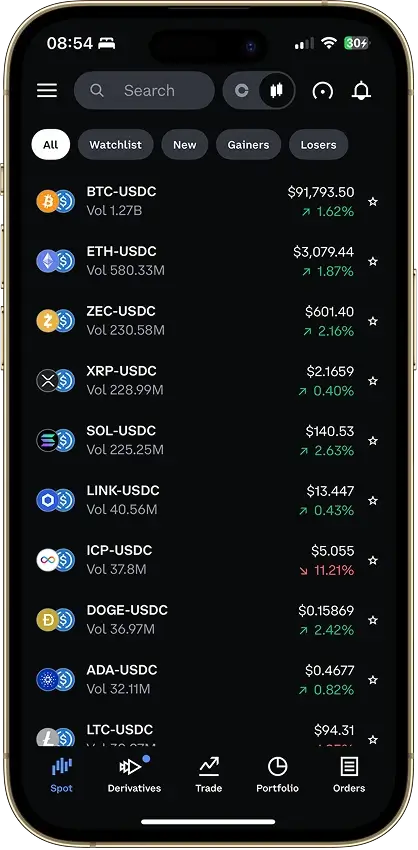
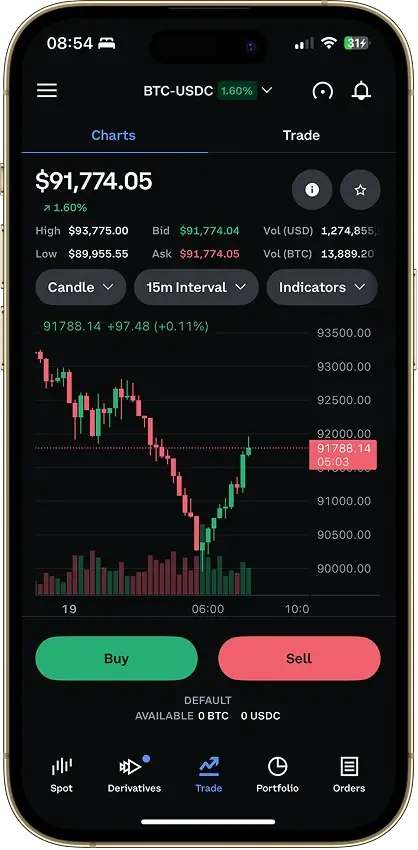
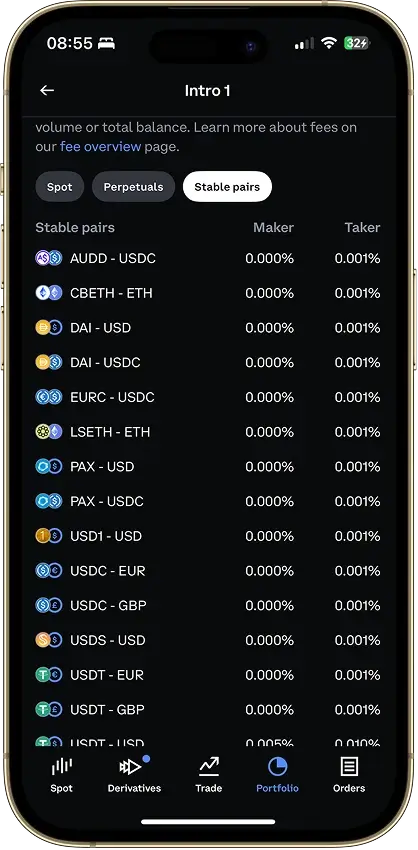
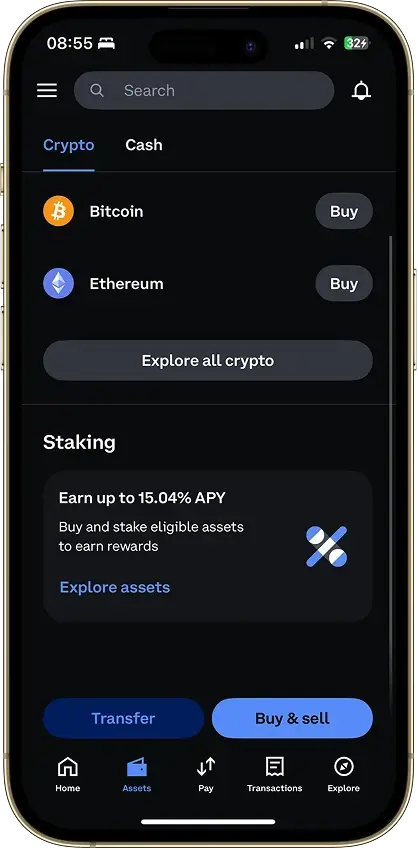
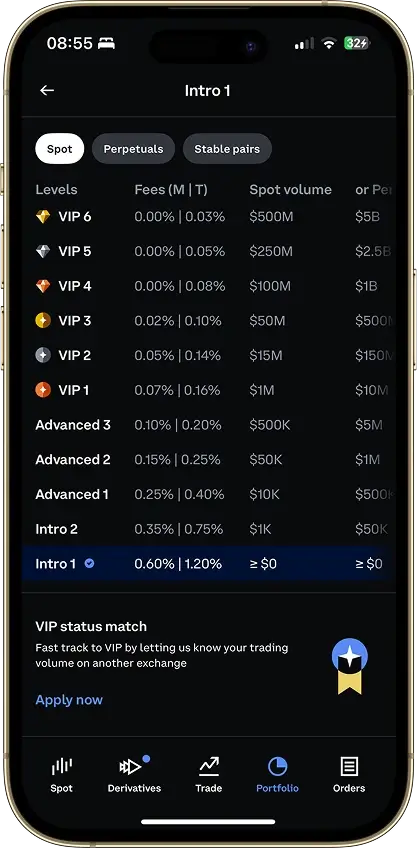
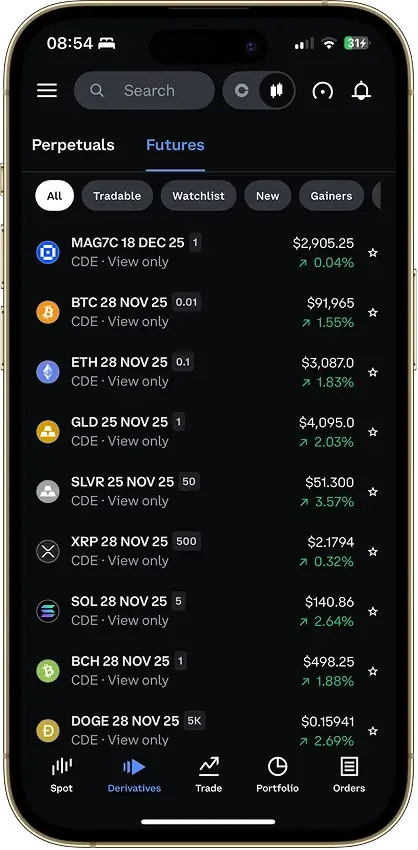
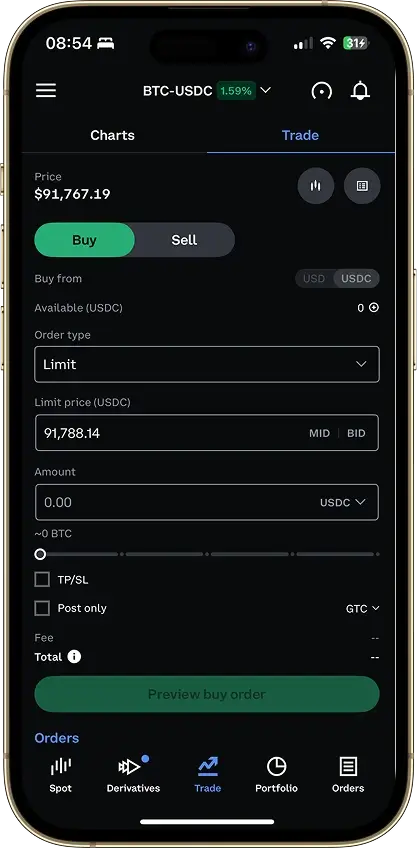
Screenshot 1 of 8
Coinbase Pros and Cons
Pros
- Free U.S. ACH deposits and withdrawals
- SEC filings and annual financial audits
- Spot trading in every U.S. state
- Passkeys, hardware keys and allowlisting
- U.S. futures and perpetual-style contracts
Cons
- Small Simple Buy orders cost up to 3.5%
- No user-verifiable Merkle inclusion
- 35% commission on staking rewards
Quick Decision: Is Coinbase Worth It?
Free U.S. ACH and centralized spot access in every state make Coinbase a practical bank-funded account for users who accept full identity verification. Simple Buy and Advanced share a balance but use different pricing, while audited public-company reporting provides information that a private exchange does not have to publish.
It is a weaker fit for frequent Simple Buy users or anyone who needs the same staking and derivatives menu in every region. A $1,000 U.S. Advanced trade at the entry tier costs $5 as a maker or $9 as a taker before spread and market movement, compared with an estimated $25 to $35 total cost for a small $1,000 simple purchase. Coinbase One changes that calculation only within its plan limits, and spread can remain.
Who Coinbase Is Best For And Who Should Skip It
A U.S. user can fund by ACH at no Coinbase fee and move the same balance from Simple Buy to Advanced. Staking, derivatives, and cards are less consistent because eligibility changes by product and region.
The fit is clearest for U.S. users who value bank access and public-company reporting, then deliberately select Advanced for order-book trades. The shared balance removes the need to fund a separate pro account.
Derivatives, staking, cards, and individual assets can each narrow the account after centralized spot access is approved. Those product-specific limits make Coinbase a poor fit for anyone seeking anonymous access or one worldwide menu.
Features And Services
Coinbase uses one retail balance across its main buy screen and Advanced, but it does not apply one pricing or eligibility rule to every product. Derivatives, cards, and the Base app each add a separate account boundary.
The Advanced order book matters most for cost because users can reach it without moving funds to another account. Separate onboarding or custody terms still control derivatives, cards, and Base.
Supported Assets And Markets
The dated U.S. retail range is roughly 270 to 315 centralized crypto assets and about 460 pairs. Asset access can differ by state and country, and tokens reached through onchain tools or the Base app belong to a different execution and custody model.
Coinbase also offers U.S. stocks and funds plus prediction markets in supported accounts. Those regulated products do not increase the crypto listing count or guarantee that a crypto withdrawal network is available.
Liquidity, Order Types, And Trading Limits
Advanced supports market and limit orders. Stop-limit orders and additional controls are available where the product and market allow them. No matched depth, spread, slippage, or fill-quality test supports an execution-quality claim against another exchange.
The absence of a universal crypto withdrawal cap does not mean withdrawals are unlimited. Region, payment method, verification, account activity, transaction history, and the selected asset can change the available amount or trigger another review. Network choice can add another constraint.
Derivatives And Other Market Products
Coinbase runs U.S. derivatives and international perpetual futures as separate products. Eligible U.S. accounts access regulated contracts through Coinbase derivatives entities. Position size, collateral requirements, and contract specifications depend on the product. U.S. crypto perpetual-style contracts advertise near-continuous trading with up to 10x intraday exposure.
Eligible non-U.S. accounts can use international perpetual futures on the web and mobile app, with API access also available. In Australia, access is limited to qualifying wholesale investors. Coinbase has scheduled the underlying international perpetuals platform to move to Deribit in late September 2026, subject to client readiness and regulatory approval. Eligible non-U.S. options access is planned with that transition. Until the move completes, the current international platform and its rules remain in effect.
Borrowed exposure magnifies losses and can lead to liquidation, so users should understand perpetual-futures funding and collateral before selecting a Coinbase contract.
Staking And Rewards
Coinbase supports staking for major proof-of-stake assets. Availability and payout behavior depend on the protocol and the user's region. New staking principal is paused in California and Maryland, plus New Jersey and Wisconsin. Washington remains eligible under the current state table.
The standard 35% reward commission covers ADA, ATOM, AVAX, DOT, ETH, MATIC, SOL, and XTZ. Coinbase One reduces the commission on ADA, ATOM, DOT, ETH, SOL, and XTZ to 31.75% for Basic, 28.5% for Preferred, and 25.25% for Premium. Those discounts do not extend to AVAX, MATIC, or SUI under the general fee disclosure. Check SUI's in-account commission before staking. Unbonding times and reward schedules remain asset-specific, and current crypto staking data cannot replace the rate and exit terms shown inside the Coinbase account.
Cards
Coinbase has two distinct U.S. card products with different funding and eligibility rules. Its Coinbase Card debit product runs on Visa, while the Coinbase One Card is an Amex-network credit card. Treating them as one product obscures how spending is funded and when crypto may be disposed.
Basic members need the annual plan, starting at $49.99 per year, to qualify for the credit card. The separate Coinbase Card assessment covers the Visa debit product, where USD spending leaves crypto untouched and crypto conversion can create a taxable disposal.
Wallet And Self-Custody Options
Crypto kept in the Coinbase exchange account is custodial. The Base app is a separate self-custody product where the user controls recovery and transaction approvals. The classic Coinbase Wallet experience closed on August 15, 2026.
The current Base app supports Bitcoin and Solana plus Ethereum-compatible networks. Several networks displayed by the classic wallet are no longer shown and may require another compatible wallet, which narrows the Base self-custody setup compared with its predecessor. Exchange-held balances retain custodial wallet risk, including dependence on Coinbase for key management and withdrawals, while Base shifts recovery to the user.
API And Programmatic Trading
Coinbase Advanced provides REST order and product endpoints plus public and private WebSocket feeds. The API supports real trading and market-data workflows, but it does not duplicate every deposit or withdrawal function. Some consumer transaction functions also fall outside its scope.
Static, mocked responses make the sandbox useful for checking request and response handling. They do not show how a strategy fills against a live order book.
Fees And Pricing
Coinbase pricing changes by surface. Advanced publishes maker and taker commissions. Simple Buy presents a quote with a disclosed fee and spread, while Coinbase One changes fees only for qualifying activity.
A $5,000 U.S. Advanced order at the entry tier costs $25 as a maker or $45 as a taker before spread and market movement. Applying the small-order estimate to $1,000 produces a total cost of roughly $25 to $35. That range is not a universal fee schedule, and the executable preview controls the actual simple-purchase price.
Coinbase changed U.S. Advanced entry commissions to 0.50% maker and 0.90% taker on September 16, 2026. The EU and UK entry rates are 0.25% maker and 0.50% taker, and should not be applied to a U.S. account. Advanced volume tiers now start at $10,000 in qualifying volume, while eligible USDC balances offer another route to VIP pricing. Check the account's fee screen for its assigned tier. Coinbase Exchange has a separate institutional schedule.
Hidden Costs To Watch On Coinbase
The Advanced commission is only one part of the total trade. Users should also check the quoted spread or order book and the payment-method fee. Crypto network charges and any margin or funding cost are separate. A plan subscription adds a recurring expense.
- Simple Buy can include a spread in addition to the disclosed transaction fee
- A market order can cross the bid-ask spread and move through available depth
- Crypto withdrawals can use different networks with different charges
- Derivatives can add funding and margin costs, plus liquidation risk
- Coinbase One can remove qualifying transaction fees while leaving a spread
- Crypto-funded debit spending can require a conversion and create a taxable event
The lowest stated U.S. funding path is free ACH followed by an Advanced order. A user who needs immediate funding or cash-out should compare the available instant rail and its in-account terms before confirming.
Coinbase One And Fee Discounts
Coinbase One is a subscription with three U.S. list-price tiers. Its zero-fee benefit applies to qualifying simple trades within the plan's volume rules. It excludes Advanced and derivatives. DEX service fees and some limit-order fees are also excluded, while spread can remain.
The protection benefit is separate from cash insurance and does not turn every account loss into an insured claim. Basic is easiest to justify when eligible simple-trade volume approaches its $500 monthly cap. Preferred requires enough qualifying activity to offset $29.99 per month, and its Advanced rebate stops at 100 USDC.
Deposits, Withdrawals, KYC And Availability
Coinbase's U.S. retail account supports ACH and wire transfers, plus eligible instant RTP cash-out. Cards, PayPal, and crypto transfers can also appear. The exact menu depends on account history, bank support, location, and verification.
Identity verification is required before normal centralized trading and transfers. A government ID and personal information are part of onboarding, while source-of-funds or other checks can appear later based on risk and activity. There is no no-KYC retail route through the centralized exchange.
What U.S. Users Need To Check Before Signing Up
Centralized spot trading is available in all U.S. states, including New York, subject to asset-level rules. Cards and staking use separate maps, as do derivatives.
The platform's availability should not be used as proof that every product is enabled. A user joining for staking or derivatives should verify that exact surface before funding the account. Card access needs its own check.
Payment Rails, Networks, And Limits
Bank rails have named U.S. fees, while crypto transfer pricing changes by asset and network. No universal retail crypto-withdrawal limit applies to every account.
Fiat Rails By Region
Free ACH is the clearest low-cost rail for U.S. users. Bank access elsewhere depends on the Coinbase entity, account currency, and locally supported payment methods.
From July 1, 2026, Australian external crypto transfers require sender and recipient information. Self-hosted transfers of AUD $1,000 or more can also require proof of wallet ownership. These requirements affect transfer processing, not whether Australia is a supported country.
Withdrawal Networks And Fees
Most crypto sends show a route or network charge before confirmation. Several named pricing rules need separate treatment.
Network choice can change both cost and destination compatibility. Before sending, match the receiving network and compare the displayed charge. Review the available amount separately. An onchain transfer cannot be reversed by customer support.
Verification Levels And Withdrawal Limits
Coinbase does not use one public ladder that guarantees the same limit to every verified retail customer. Limits can vary by region, payment method, identity checks, account activity, transaction history, and the chosen asset. Network rules can add another limit.
Account-displayed limits replace any legacy platform-wide number. The $100,000 figure attached to eligible RTP is per transaction and does not describe crypto withdrawals.
Is Coinbase Safe? Security, Custody And Proof Of Reserves
Passkeys, hardware keys, address allowlisting, and session controls reduce account-takeover risk. Offline custody, partial crime insurance, and audited public reporting address different platform risks, without guaranteeing that an individual account or transfer is protected from every loss.
Controls
Coinbase supports app-based two-factor authentication and passkeys, plus hardware security keys and withdrawal-address allowlisting. Device or session management provides another control. These tools can reduce account-takeover risk when configured before funds arrive.
Use a passkey or authenticator app instead of relying only on SMS. A hardware key adds another option. Address allowlisting adds friction to a compromised account, while reviewing active sessions can expose an unfamiliar device.
Custody And Insurance
Coinbase says customer crypto is held 1:1 and is not lent or used without permission. Most customer digital assets are stored offline, but that does not mean every customer's holdings sit at a unique public address.
A crime policy applies to part of Coinbase's digital-asset holdings for specified theft events. It does not cover a loss caused by compromised customer credentials. Crypto is not protected by FDIC insurance.
Qualifying U.S. dollar cash can receive pass-through FDIC or NCUSIF protection up to $250,000 when held at an insured institution and when pass-through conditions are satisfied. That cash coverage is different from Coinbase One account protection and from the crime policy covering specified digital-asset events.
Proof Of Reserves Or Audits
Coinbase Global files quarterly and annual reports with the SEC and receives an annual financial audit. That model covers corporate financial statements and recurring public disclosure. Coinbase does not provide a user-verifiable Merkle tool that lets a customer confirm balance inclusion in a reserve snapshot.
An annual financial audit covers recurring statements, while a Merkle tool would address customer balance inclusion at a point in time. A reserve snapshot would not by itself replace financial statements. Coinbase therefore has audited reporting without proof of individual reserve inclusion.
Two Coinbase disclosures give different assets-on-platform figures for June 30, 2026, at $239 billion and $245.9 billion. The conflict prevents either figure from serving as the current total.
Incidents And Remediation
Coinbase reported infrastructure incidents on May 7 and July 14, 2026. Coinbase said funds were not at risk. Even so, the disruptions affected trading and transfers. Deposit, withdrawal, card, and onchain functions were also affected in different combinations. These were operational interruptions and should not be reduced to volatility-only outages.
The 2025 support-contractor data incident exposed information about some customers. Criminals then deceived some affected users into sending funds. Coinbase said centralized custody was not breached and offered voluntary reimbursement to eligible customers. The event still matters because support access and exposed account data can be used in social-engineering attacks.
App, UX And Customer Support
Coinbase uses a beginner-oriented main app, with Advanced available inside the same account. The app reduces onboarding friction, but users need to recognize when a quote-based purchase is being shown instead of an order book.
UI And Navigation
The main account combines balances and payment methods, plus tax records and rewards. Advanced is available from the same account, so a user does not need to transfer funds elsewhere to place an order. Cards and derivatives can still involve separate terms. The Base app uses separate self-custody onboarding.
The most important navigation choice is between Simple Buy and Advanced. Both can acquire the same asset, but their pricing mechanics differ.
Mobile App
Coinbase provides iOS and Android apps alongside the website, with Advanced available inside the main mobile app for supported accounts. Users can place orders and view charts there. The Base app remains separate because it uses self-custody rather than the exchange account's custodial model.
Reliability And Status Page
Coinbase operates a public status page for exchange and transfer incidents. It also covers payment and card problems, while onchain services have their own entries.
Published status communication does not prevent service disruption. Users who need to trade or withdraw during a fast market should keep that operational risk in mind.
Customer Support
Coinbase advertises 24/7 live phone and chat support for all customers. Complex account cases can still require ticket escalation. Paid support benefits change priority or service level, not whether live help is available.
- Help center for self-service guidance
- 24/7 live phone and chat for account and product questions
- Email and tickets for escalated cases
- Priority support with Coinbase One Preferred and concierge support with Premium
Coinbase does not publish a response-time or resolution SLA. Support also cannot reverse a completed onchain transfer, so users still need to verify the network, address, amount, and destination before confirmation.
Reporting And Account Records
Coinbase provides account history and tax tools, but form eligibility depends on the activity and tax year. Its 2026 materials use different Form 1099-MISC thresholds across reward guidance, which prevents one threshold from applying as a platform-wide rule. The Tax Center and current account notices control the applicable form.
Coinbase Alternatives
Traders leaving Coinbase over cost usually look at Kraken's maker-taker and attestation model, while those weighing custody instead check Gemini's U.S. account disclosures.
The clearest reason to leave Coinbase is a mismatch with its entry Advanced fee or Simple Buy cost. Users can compare those same dimensions across other crypto exchanges without treating a broker quote, order book, and onchain swap as equivalent.
Coinbase Category Scores
These scores highlight how this review performs in specific categories, with each score tailored to the focus of that category.
Final Verdict
Coinbase suits U.S. users who fund by ACH and use Advanced for order-book trading. Full KYC is required. ACH is free, and centralized spot trading is available in all states. Audited public-company reporting adds financial disclosure, but Simple Buy costs and Advanced entry commissions can make regular trading expensive. Compare another exchange if lower entry commissions or user-verifiable reserve inclusion matter more. Derivatives and staking availability depend on the product and region. Coinbase does not publish a support response-time guarantee.
Disclaimer: CryptoSlate may receive a commission when you click links on our site and make a purchase or complete an action with a third party. This does not influence our editorial independence, reviews, or ratings, and we always aim to provide accurate, transparent information to our readers.