



Lending
Hyperliquid opens native lending as HYPE hits new ATH above $90
The rollout gives traders access to more than $400 million of supplied liquidity while expanding HyperCore beyond trading.

$901.76M traded Price signal supported
Trading Activity price-reliability indicator with 100 percent data coverage. Low activity replaces price-derived sentiment because the displayed market price may not be supported by meaningful trading.Target
Peg Health price-stability indicator with 0 percent data coverage. It measures observed market pricing, not reserve quality or redemption safety.30D -1.0% 14.8% below ATH
Price-based current market conditions indicator with 100 percent data coverage. This is not a price forecast.$901,762,957.38 traded over the last 24 hours. The available activity evidence is sufficient to retain the asset’s price-derived signal.
Low activity can make the displayed price sensitive to a handful of trades. Trading Activity assesses price reliability—not project development, legal status, reserves, or solvency.
Price movement Not interpreted while trading support is below the reliability threshold.
What it measures
The model combines reported 24-hour volume, market-cap turnover, valid-pair liquidity, active exchange breadth, and quote freshness. Missing optional evidence lowers coverage; missing volume or a known-stale quote suppresses price-derived interpretation.
Configured model weights
When inputs are missing, these configured weights are renormalized across the available evidence; data coverage records what is missing.
How to read it
Scores of 0–19 are dormant, 20–39 are thin, 40–69 are supported, and 70–100 are active. Scores below 40 withhold price-derived interpretation.
Logarithmic historical position supports it. The available evidence produces a bullish reading rather than a price forecast.
A complete ATL and ATH range is not available for this asset.
What it measures
The model converts price momentum, logarithmic historical position, milestone recency, and short-term volume confirmation into one 0–100 score. Missing evidence lowers data coverage instead of counting as neutral.
Configured model weights
When inputs are missing, these configured weights are renormalized across the available evidence; data coverage records what is missing.
How to read it
50 is the neutral midpoint. Scores of 60 or higher are bullish, 40 or lower are bearish, and 41–59 are neutral.
Showing 10 spot markets sorted by CoinMarketCap exchange rank. Markets excluded from CMC price or volume calculations are hidden.
| Pair | |||||
|---|---|---|---|---|---|
| 1 | HYPE/USDT | $83.43 | $41.99M | 700 | |
| 2 | HYPE/USDC | $83.43 | $22.93M | 698 | |
| 3 | HYPE/USD | $83.40 Best price | $29.92M | 667 | |
| 4 | HYPE/USDT | $83.63 | $28.97M | 700 | |
| 5 | HYPE/USDC | $83.67 | $1.99M | 609 | |
| 6 | HYPE/USDT | $83.99 | $32.03M | 562 | |
| 7 | HYPE/USDT | $83.67 | $15.86M | 717 | |
| 8 | HYPE/USDT | $83.63 | $19.53M | 690 | |
| 9 | HYPE/USDT | $83.69 | $4.84M | 633 | |
| 10 | HYPE/USDC | $83.68 | $182.9K | 470 |
Affiliate Disclaimer: CryptoSlate may receive a commission when you click trading links on this page and complete an action with a third party. This does not influence our editorial independence or coverage.
The rollout gives traders access to more than $400 million of supplied liquidity while expanding HyperCore beyond trading.

Federal prosecutors say the pair turned advance knowledge of token listings into profitable perpetual-futures trades.

HIP-3* adds venue-scoped controls without changing existing permissionless markets.
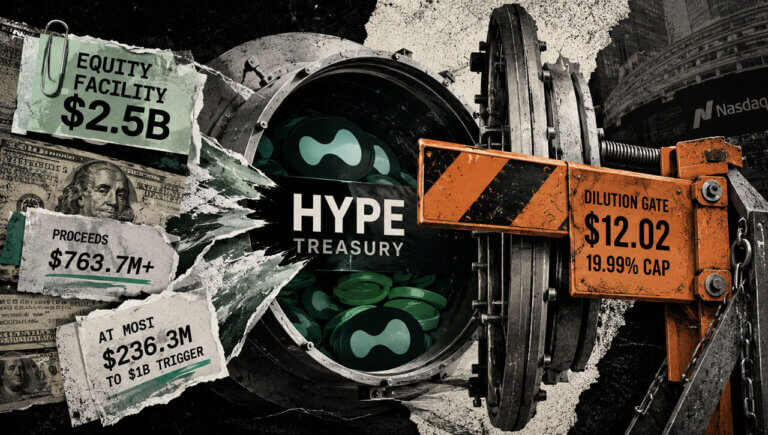
Filings show at least $763.7 million raised, leaving at most $236.3 million before discounted share sales face a Nasdaq cap.
See HYPE across major fiat currencies and swap the active converter instantly.
Quick SelectUsing the live USD market price. Additional fiat rates will appear after the daily sync.
Hyperliquid is a trading-focused Layer 1 blockchain built around onchain perpetual futures, spot order books, and financial applications. Its native asset, HYPE, is used across the network for staking, HyperEVM gas, trading fee discounts, and protocol economics tied to Hyperliquid's exchange activity. Unlike many DeFi derivatives venues, Hyperliquid is designed around a native onchain order book rather than an offchain matching engine.
The network is best understood through two linked components: HyperCore and HyperEVM. HyperCore handles the trading infrastructure, including margin, matching, perpetual futures, and spot order books. HyperEVM adds Ethereum Virtual Machine compatibility inside the same consensus environment, giving developers a way to build applications around Hyperliquid's native liquidity base.
HYPE matters because it is tied to both sides of the ecosystem. It secures the network through delegated proof-of-stake, pays for activity on HyperEVM, and connects protocol activity to fee-driven buybacks and burns through the assistance fund. Its market behavior depends on trading volume, open interest, HyperEVM adoption, staking participation, token unlocks, and the regulatory treatment of perpetual futures.
| Field | Detail |
|---|---|
| Asset | Hyperliquid |
| Ticker | HYPE |
| Asset Type | Native Layer 1 asset, DeFi infrastructure token, derivatives trading network token |
| Launch | HYPE genesis event on Nov. 29, 2024 |
| Project | Hyperliquid |
| Core Contributor | Hyperliquid Labs |
| Consensus | HyperBFT, a custom proof-of-stake consensus algorithm inspired by HotStuff |
| Mineable | No |
| Initial Supply Cap | 1 billion HYPE at genesis |
| Circulating Supply | 254.26M |
| Total Supply | 950.96M |
| Main Use Cases | HyperEVM gas, staking, validator rewards, trading fee discounts, and protocol economics |
| Main Network Components | HyperCore and HyperEVM |
| Main Risk Areas | Perpetual futures regulation, validator decentralization, market intervention, smart contract risk, self-custody risk, and token unlocks |
Hyperliquid Labs is led by Jeff and iliensinc, and the team is self-funded with no external capital. HYPE launched through a Nov. 29, 2024 genesis event with an initial 1 billion token cap.
Hyperliquid uses HyperBFT, a custom consensus algorithm inspired by HotStuff. Blocks are produced by validators in proportion to the HYPE staked to each validator, making HYPE part of the network's security model. HyperCore runs the native trading system, including the margin and matching engine, while HyperEVM allows general-purpose smart contracts to run in the same broader execution environment.
The key design choice is that HyperCore does not rely on offchain order books. Every order, cancel, trade, and liquidation is handled transparently with one-block finality, and mainnet currently supports about 200,000 orders per second. That makes Hyperliquid closer to an exchange-native blockchain than a general-purpose chain with a separate trading app attached.
HyperEVM gives builders an EVM-compatible environment that is secured by the same HyperBFT consensus as HyperCore. HYPE is the native gas token on HyperEVM, and both base fees and priority fees are burned under its EIP-1559-style design.
HYPE has several roles inside the Hyperliquid ecosystem.
| Use Case | How HYPE Is Used |
|---|---|
| Staking | HYPE can be delegated to validators on HyperCore |
| Network Security | Validators produce blocks and receive rewards based on delegated stake |
| HyperEVM Gas | HYPE is the native gas asset for HyperEVM transactions |
| Trading Fee Discounts | Staked HYPE can qualify users for trading fee discounts |
| Protocol Economics | The assistance fund converts trading fees into HYPE and burns HYPE held in the fund |
| Ecosystem Development | HYPE is tied to future emissions, community rewards, grants, and protocol incentives |
Staking happens on HyperCore. Active validators need 10,000 HYPE in self-delegation, locked for one year, and validators can receive rewards proportional to delegated stake. Users who unstake HYPE move through a seven-day return process before HYPE appears back in the spot balance.
Hyperliquid's fee model also gives HYPE a direct role in trading economics. Fees are directed to community mechanisms such as HLP, the assistance fund, and deployers. The assistance fund converts trading fees to HYPE automatically as part of L1 execution, and HYPE in the assistance fund is burned, removing those tokens from circulating and total supply.
HYPE launched with an initial supply cap of 1 billion tokens. The genesis distribution allocated 31% of supply, or 310 million HYPE, to eligible users. Future emissions and community rewards received 38.888%, current and future core contributors received 23.8%, the Hyper Foundation budget received 6%, community grants received 0.3%, and HIP-2 received 0.012%. HYPE had no allocation to private investors, centralized exchanges, or market makers.
| Allocation | Share |
|---|---|
| Future Emissions and Community Rewards | 38.888% |
| Genesis Distribution | 31.0% |
| Current and Future Core Contributors | 23.8% |
| Hyper Foundation Budget | 6.0% |
| Community Grants | 0.3% |
| HIP-2 | 0.012% |
Current supply figures should be read from the live CryptoSlate market module rather than hardcoded in editorial copy. HYPE's live supply data can change as burns remove tokens from supply, and market-data providers may classify circulating, total, and max supply differently. CryptoSlate's live page currently tracks HYPE price, market cap, volume, circulating supply, total supply, max supply, FDV, ATH, and ATL data for the asset.
The supply profile is shaped by three moving parts: the initial community-heavy genesis allocation, future emissions and rewards, and fee-driven burns. For longer-term market context, the main question is whether Hyperliquid can keep trading activity high enough to support fee generation while managing unlocks, validator decentralization, and competition from other trading venues.
Hyperliquid's market context is tied to derivatives liquidity first, but it is no longer just a perps interface. DefiLlama tracks Hyperliquid across TVL, fees, revenue, DEX volume, perpetuals volume, and open interest, which makes protocol activity an important part of HYPE research.
| Context Item | What To Watch |
|---|---|
| Trading Activity | Perpetuals volume, spot volume, open interest, funding rates, and liquidity depth |
| HyperEVM Adoption | DeFi applications, smart contract usage, TVL, and builder activity |
| Security Model | Validator participation, stake distribution, uptime, and decentralization progress |
| Supply Mechanics | Burns, future emissions, contributor unlocks, and foundation activity |
| Protocol Revenue | Fees, assistance fund activity, and builder-deployed market economics |
| Regulation | Rules around perpetual futures, leverage, token listings, and non-U.S. market access |
Recent market developments have pushed Hyperliquid further into the onchain derivatives spotlight. In March 2026, S&P Dow Jones Indices licensed the S&P 500 to Trade[XYZ] for a perpetual contract on Hyperliquid for eligible non-U.S. investors. That development gave Hyperliquid a more visible role in real-world asset and index-linked derivatives, but it also reinforces that HYPE's risk profile is closely tied to leveraged trading markets.
Institutional product filings have also become part of the HYPE narrative. In March 2026, Grayscale filed for a proposed HYPE ETF that would trade on Nasdaq under the ticker GHYP if approved. That filing is not an approval, and it should be treated as market-structure context rather than a confirmed investment product.
HYPE carries risks that are specific to Hyperliquid's design and market role. The first is derivatives risk. Hyperliquid is strongly tied to perpetual futures, a product category that uses leverage and remains under active regulatory discussion in several markets. Major crypto exchanges were preparing for U.S. perpetual futures expansion in April 2026 as regulators worked toward clearer rules.
Validator and governance centralization are also important. In January 2025, Hyperliquid faced criticism over decentralization, validator fairness, and closed-source code. Hyperliquid said it planned to open-source code when safe and improve decentralization over time.
Market intervention risk became more visible during the JELLY incident in March 2025. Hyperliquid validators voted to delist JELLY perpetuals and force-close positions after suspicious market activity. The incident highlighted how emergency decisions can protect some users while raising questions about settlement finality and validator discretion.
Users should also consider self-custody and smart contract risk. Hyperliquid is non-custodial, and only someone with access to a wallet's private key or seed phrase can sign transactions for that address. That puts wallet security, phishing protection, and transaction review at the center of safe use.
Hyperliquid price prediction depends on protocol usage, trading volume, open interest, HyperEVM adoption, staking participation, fee-driven burns, and supply unlocks. HYPE may benefit when Hyperliquid gains market share in onchain derivatives or expands useful applications on HyperEVM. It can also face pressure from lower trading activity, regulatory limits on perps, validator centralization concerns, market-stress incidents, or larger-than-expected emissions.
For price-focused users, the most important signals are the live HYPE chart, perpetuals volume, fee generation, current supply, open interest, and token unlock schedule. For longer-term research, the key question is whether Hyperliquid can maintain exchange-like performance while becoming more decentralized and expanding beyond crypto-native trading.

Hyperliquid is a trading-focused Layer 1 blockchain built around onchain perpetual futures, spot order books, and financial applications. Its main components are HyperCore, which runs native trading infrastructure, and HyperEVM, which supports EVM-compatible smart contracts within the same consensus environment.
HYPE is the native asset of Hyperliquid. It is used for staking, validator rewards, HyperEVM gas, trading fee discounts, and protocol economics tied to the assistance fund. HYPE is also central to Hyperliquid’s supply model because some fee-driven activity can result in HYPE burns.
Hyperliquid uses HyperBFT, a proof-of-stake consensus system inspired by HotStuff. HyperCore handles margin, matching, perps, and spot order books onchain, while HyperEVM lets developers build EVM-compatible applications around the same liquidity system. HYPE supports both the security and gas layers.
HYPE is not only an exchange token. It is the native token of Hyperliquid’s Layer 1 blockchain. Its value is closely linked to Hyperliquid’s trading venue, but its role also includes staking, HyperEVM gas, validator rewards, fee discounts, and broader ecosystem activity.
HYPE launched with an initial supply cap of 1 billion tokens. Current live supply figures can be lower because burned HYPE is removed from supply, and data providers may classify circulating, total, and max supply differently. Use the live CryptoSlate supply module for current figures.
Yes. HYPE can be staked on HyperCore by delegating to validators. Validators need 10,000 HYPE in self-delegation to become active, and that self-delegation is locked for one year. User unstaking involves a return process before HYPE appears back in spot balance.
HYPE is native to Hyperliquid. It can be used on HyperCore and as the native gas token on HyperEVM. Users should confirm the correct environment before transferring funds, because sending assets through the wrong route or to an unsupported address can result in loss.
HYPE carries market, network, derivatives, smart contract, self-custody, and regulatory risk. Hyperliquid is non-custodial, so wallet security matters. Its perps-focused model also exposes users to leverage-driven volatility, market-stress decisions, and changing rules around derivatives in major jurisdictions.
CryptoSlate does not provide investment advice. HYPE may interest users researching onchain derivatives, Layer 1 trading infrastructure, staking, and HyperEVM growth. It also carries risks from token unlocks, regulatory uncertainty, validator centralization concerns, competition, and volatility in leveraged trading markets.
As of Oct 8, 2026, Hyperliquid trades at $83.46.
Hyperliquid has a market capitalization of $21,221,494,033.01.
Hyperliquid has a 24-hour trading volume of $901,762,957.38.
Hyperliquid reached an all-time high of $97.98, recorded on Sep 23, 2026. It is currently 14.81% below its all-time high.
Hyperliquid recorded an all-time low of $3.20, recorded on Nov 29, 2024. It is currently 2.51 thousand percent above its all-time low.
Hyperliquid Labs is the core development group behind Hyperliquid, a blockchain-based trading and finance platform focused on fully onchain execution.