

- $63,871 median depth near the price
- Geopolitics markets trade fee-free
- London server hosting for market makers
Polymarket Overview
- Prediction Market Name
- Polymarket
- Platform Type
- Crypto-Native Market
- Fun Play Mode
- No
- Regulated
- No
- Availability
- International, but blocked or close-only in 41 countries and territories (including the U.S., UK, France, Germany, Brazil and Australia), four Canadian provinces and three regions of Ukraine
- Age Requirement
- 18+
- KYC Level
- No KYC
- Funding Currency
- pUSD (crypto)
- Minimum Deposit
- $2 on most networks ($3 on Ethereum, $3.60 on Bitcoin)
- Core Market Categories
- Sports, crypto, politics, geopolitics, finance, economy, culture, weather, tech, mentions, esports
- Contract Type
- Binary Contracts, Multi-Outcome Contracts, Range Contracts
- Liquidity Model
- Order Book
- Early Exit
- Yes
- Position Limits
- No
- API / Historical Data Access
- Yes
- App Availability
- Web-Based
- Tax Reporting
- No
Polymarket Screenshots
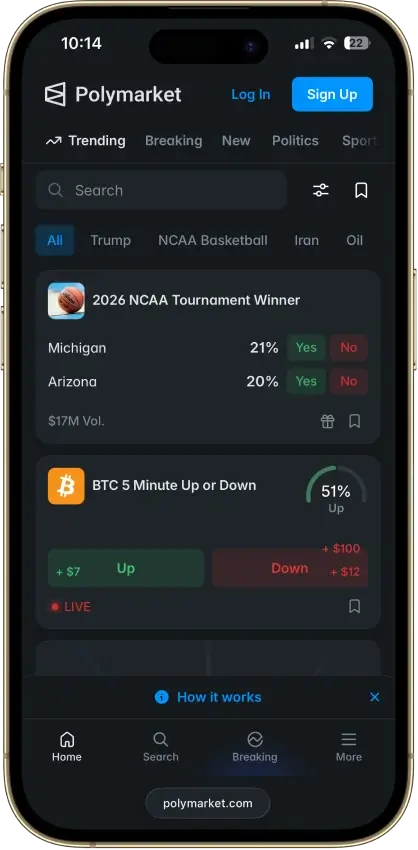
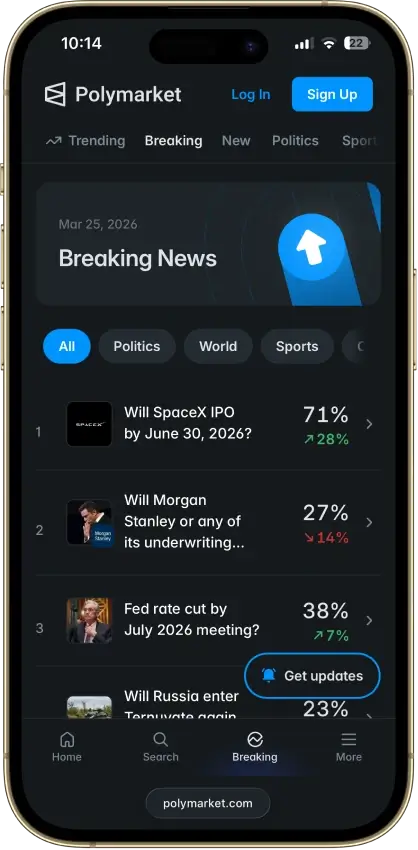
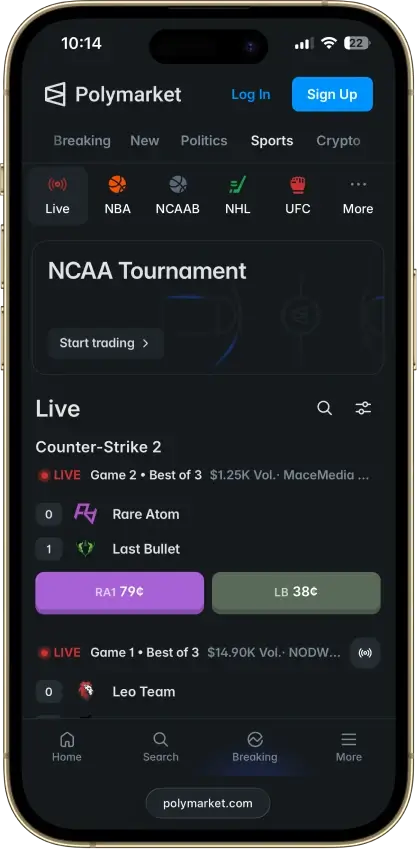
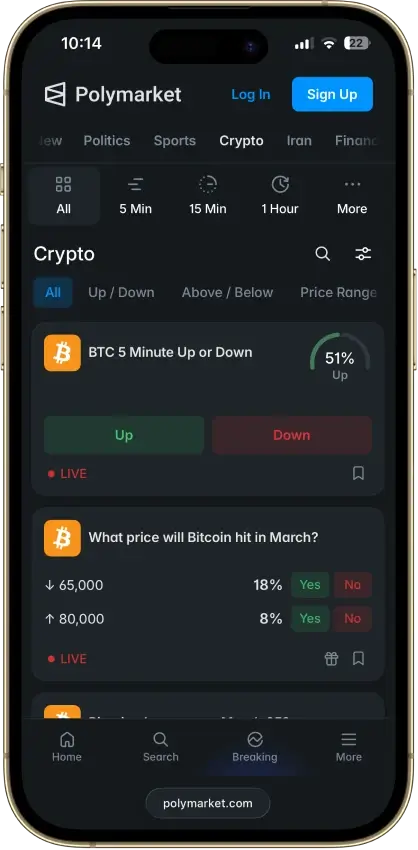
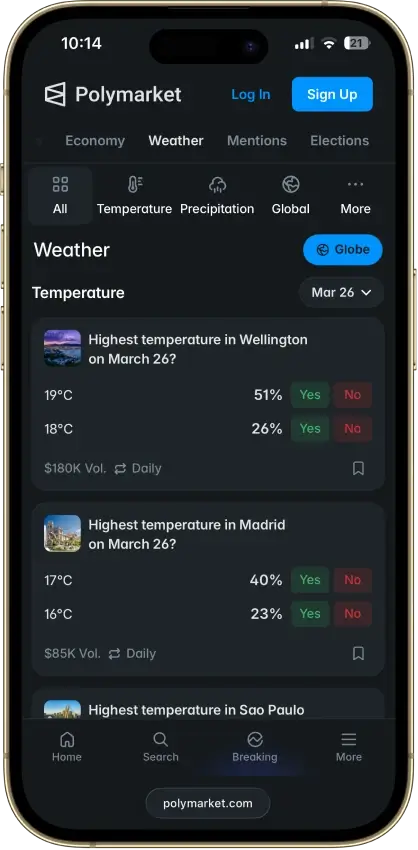
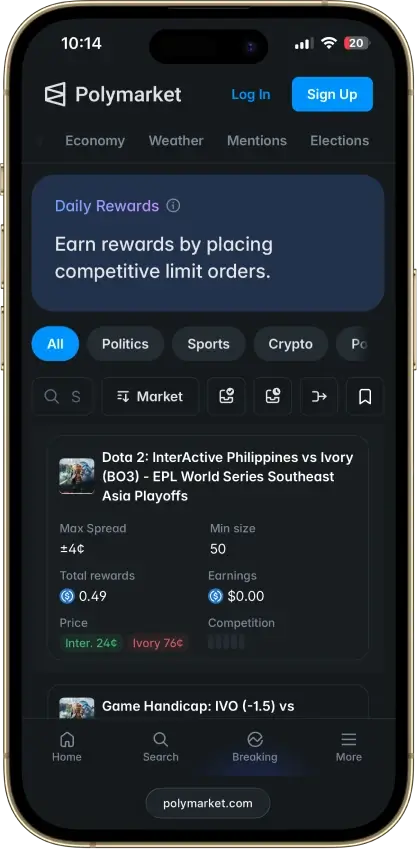
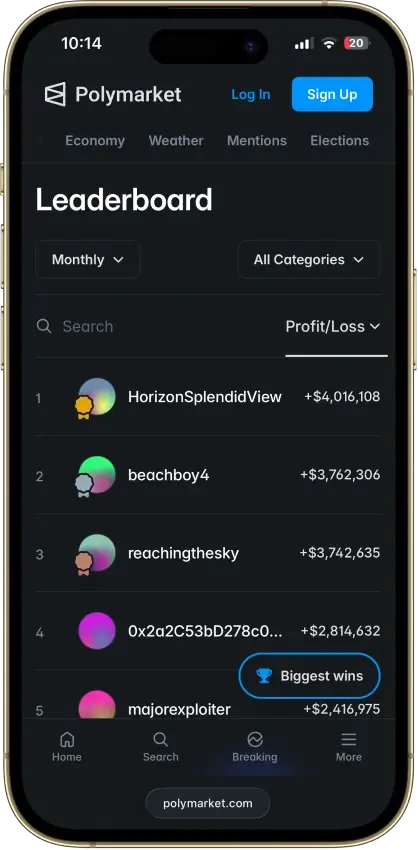
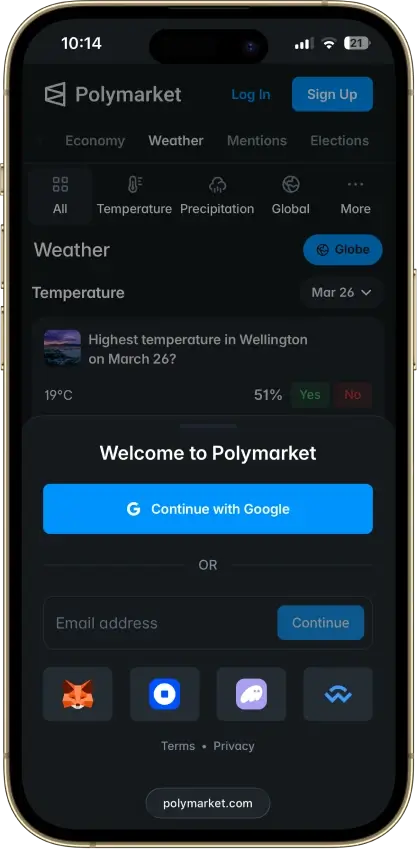
Screenshot 1 of 8
Polymarket Pros and Cons
Pros
- 1¢ spreads on top politics and sports markets
- Makers pay no trading fees
- Taker fee 0–1.25¢ at 50¢ outside crypto
- Instant withdrawals, no Polymarket fee
- No ID needed to sign up
Cons
- Not licensed by any regulator
- Disputes can end in a UMA token-holder vote
- Crypto only, no card or bank deposits
- Blocked or close-only in 41 countries
- Web only, and no tax statements
Who Polymarket Is Best For — And Who Should Skip It
Polymarket.com fits traders who already hold crypto and live outside its restricted list. Its most-traded politics and sports markets quote bids and asks a cent apart, and traders who post resting orders pay no fees at all. News traders get markets on wars and elections worldwide, and developers get a public API with live order-book feeds.
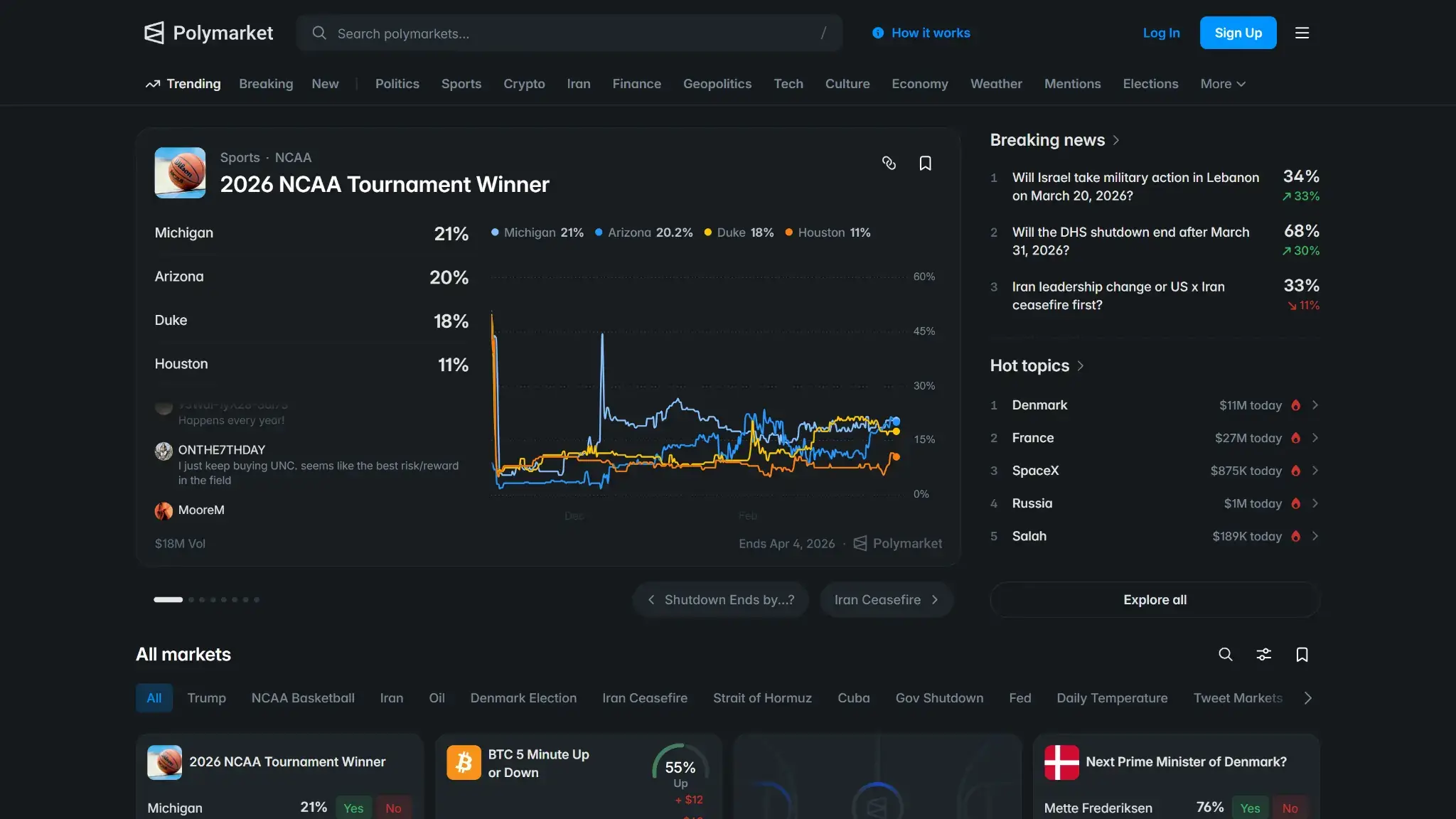
Skip it if you're in the U.S., UK, France, Germany, Brazil, Australia, the Netherlands or Canada's four largest provinces, where trading is blocked or limited to closing positions. Skip it too if you don't hold crypto or want a regulator standing behind your account. A disputed outcome can go to a token-holder vote, and there's no appeal beyond it. Traders who want a CFTC-regulated exchange with bank deposits should look at Kalshi instead.
| Category | Fit | Why |
|---|---|---|
| Casual Events | Medium | $2 minimum, crypto needed |
| Sports | High | 10,666 events, 1¢ spreads |
| Macro Or Economic | Medium | 172 economy events |
| Politics | High | 2,491 events |
| Crypto-Native | High | 15 networks, self-custody |
| API Or Bot | High | Public API and WebSocket |
| Fast Cash-Out | High | Instant to a wallet |
| Low KYC Friction | High | No ID at sign-up |
| Clear Regulation | Low | No license anywhere |
What Is Polymarket And How Does It Work?
Polymarket.com is a crypto platform built around a peer-to-peer order book for event contracts, with trades settling on the Polygon blockchain in pUSD, a dollar token backed by USDC. Each share normally pays $1 if its outcome happens and $0 if it doesn't, so a 62¢ Yes share implies a 62% probability. One pUSD creates one Yes share and one No share, which keeps every pair fully backed.
Trading takes five steps:
- Sign up with Google, an email code or a crypto wallet
- Deposit crypto from one of 15 networks, which converts to pUSD
- Place a market or limit order on the Yes or No side
- Sell before the market resolves, or hold and redeem winning shares for $1
- Withdraw to a crypto wallet on any supported network
Every trade matches you with another user, and Polymarket makes its money from the taker fees it charges on every category except geopolitics. Part of those fees goes back to the traders who post resting orders. Like other onchain prediction markets, it holds positions in your own smart wallet and records every trade on the blockchain. The same site also lists perpetual futures, a separate product outside this review and its score.
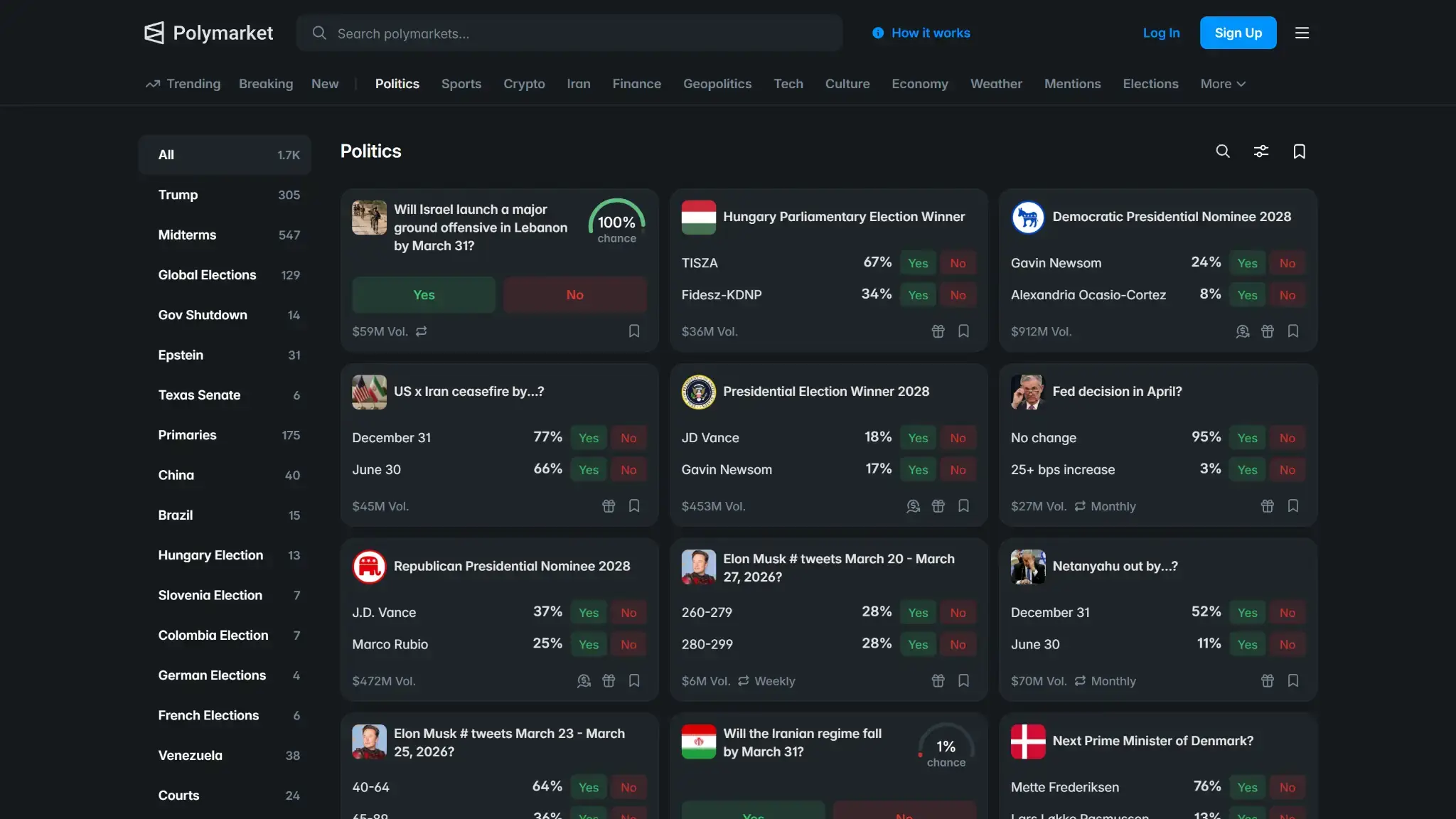
Is Polymarket Legit?
Polymarket.com is a working market that pays winners onchain, but no regulator licenses it. Its terms of use are with Adventure One QSS, Inc., a Panama company, and the software comes from Blockratize Inc. Those terms say neither company operates an exchange or offers trade execution or clearing.
| Role | Entity | Registration |
|---|---|---|
| Company behind the site | Adventure One QSS (Panama) | None |
| Exchange | Polymarket contracts on Polygon | Not registered |
| Clearing house | None, settles onchain | Not applicable |
| Broker | None | Not applicable |
| Collateral / custody | pUSD in your own wallet | Self-custody |
The CFTC fined Blockratize $1.4 million in January 2022 for running an unregistered event-contract market and ordered it to stop offering non-compliant markets. The U.S. has been blocked on the site since. Polymarket later bought a CFTC-licensed exchange and clearing house for its separate U.S. app, but those licenses don't cover Polymarket.com. Gambling regulators in several countries treat prediction markets as unlicensed gambling, and many have acted against Polymarket:
- France: Polymarket geoblocked the country in November 2024 after the national gaming regulator intervened.
- Ontario: a 2025 settlement with the Ontario Securities Commission carried a CAD 200,000 penalty and a permanent block.
- Australia: the media regulator issued a formal warning to Adventure One in July 2025 and had internet providers block the site.
- Netherlands: the gaming regulator imposed a €420,000 penalty for continuing to offer the service, and rejected the company's objection in June 2026.
- Italy: the customs and monopolies agency blocked the site again in July 2026, and a court appeal is pending.
Regulators or courts in Switzerland, Czechia, Bulgaria and Spain have also ordered blocks that Polymarket's own restricted list doesn't include, so access there depends on local internet blocking. U.S. authorities now also bring cases over trading on Polymarket.com. In April 2026 the CFTC and the Justice Department charged a U.S. Army soldier with using classified information to trade a Maduro market for more than $404,000 in profit, and in May 2026 they charged a Google engineer over Year in Search markets.
In June and July 2026, the Wall Street Journal, Politico and Semafor reported that Polymarket paid social-media creators to post staged winning trades, some filmed on a lookalike site. Two U.S. senators asked the CFTC about the reports, and a consumer class action over the promotions was filed in federal court in Washington, D.C., on September 2, 2026.
As for whether Polymarket is safe, the market works and pays out onchain, with your money in your own wallet. The business behind it has no license anywhere, and access depends on your location.
Access, Eligibility and Account Setup
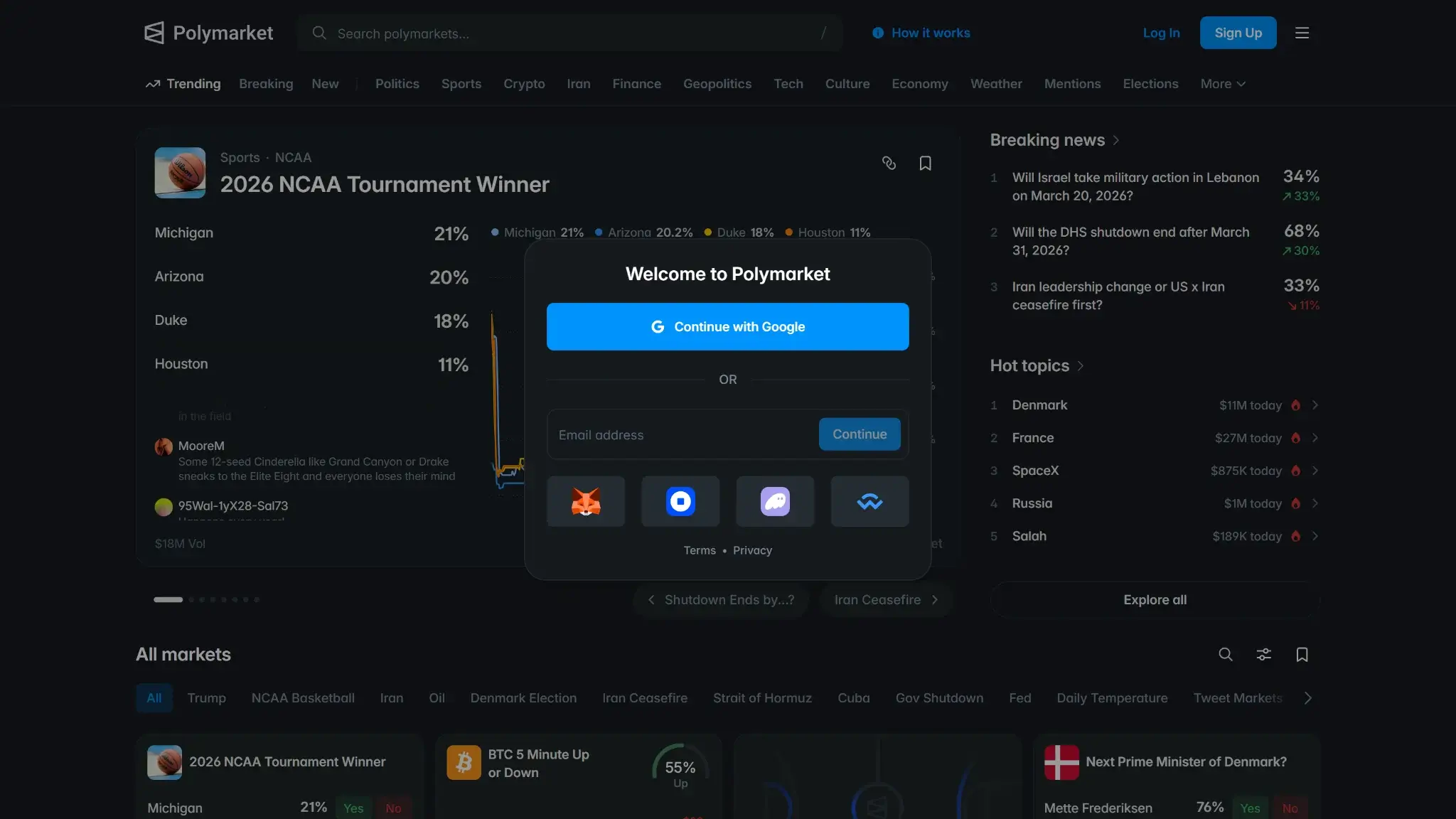
You can sign up with a Google account, an email code or a crypto wallet such as MetaMask, Rabby or Phantom. There's no ID check at sign-up. You confirm you're 18 or older and not in a restricted country, and Polymarket can ask for more information later if it suspects you're in a restricted country. Email sign-ups get a wallet you can export your private key from.
The terms bar anyone who lives in, is a citizen of, or is located in a restricted country from trading, and the site enforces the location rule by limiting trading from those countries, visitors included. The terms ban VPNs, and Polymarket can put a wallet that breaks the rules into close-only mode.
Country Restrictions as of September 2026
Close-only means you can sell existing positions and withdraw, but can't open new ones. The close-only list covers 32 countries and territories, including Australia, Italy, Poland, Singapore, Taiwan and Thailand, plus Alberta, British Columbia, Ontario and Quebec. In Ireland, Japan, the Netherlands and South Korea the limit applies on the website only, and in Malta it covers sports markets on the website. U.S. residents use the separate Polymarket US app.
A trader who already holds crypto on a supported network can sign up and place a first trade within minutes. Someone starting from a bank account first has to buy crypto elsewhere.
Market Coverage and Contract Design
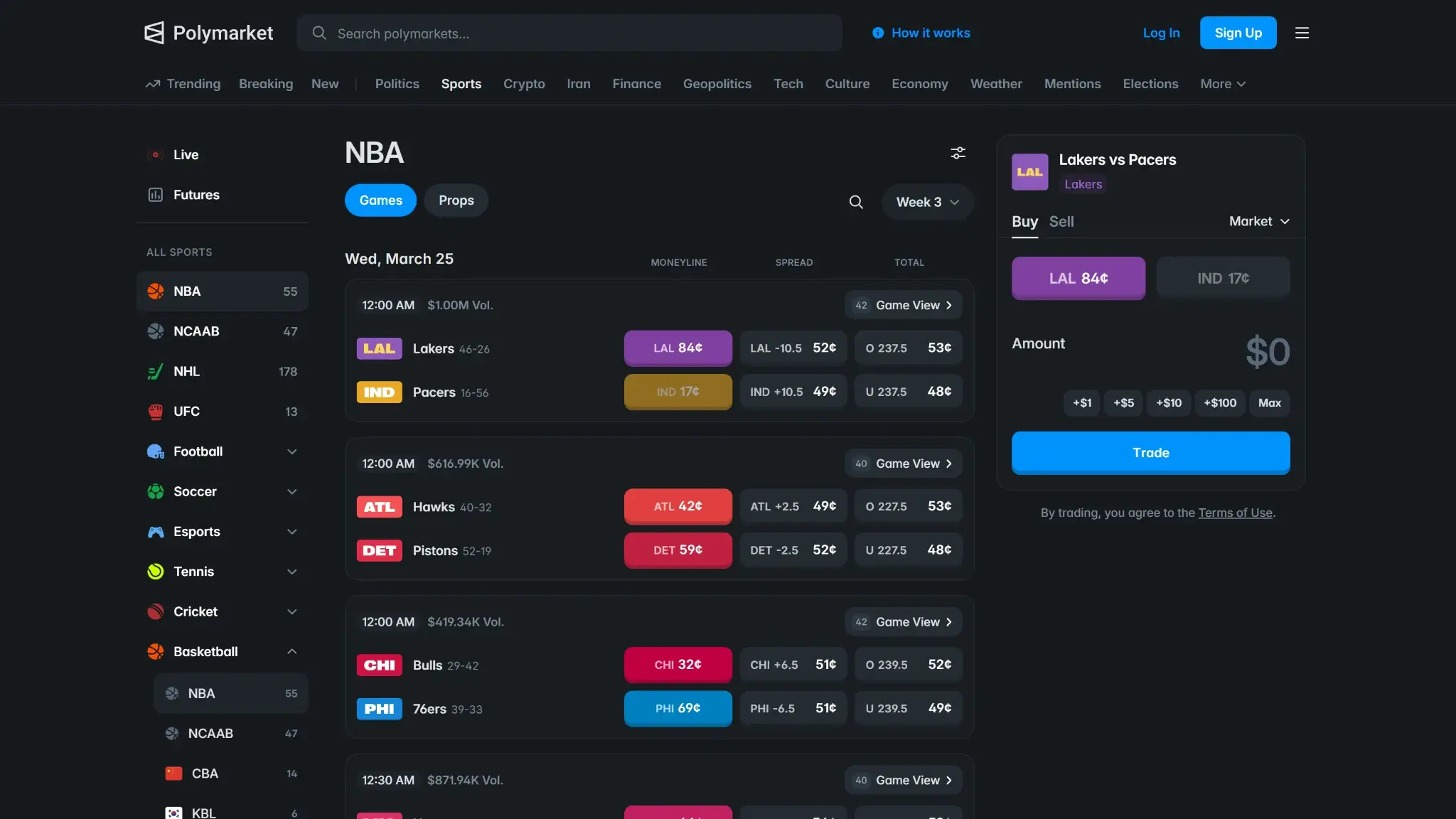
Polymarket.com lists 18,726 open events made up of 252,888 individual markets. Sports is the largest category by event count, then crypto, then politics, and news-driven categories such as geopolitics, finance and weather fill out the rest. Some events carry more than one category tag, so the counts below overlap.
| Category | What Is Covered | How Deep It Is | Gaps |
|---|---|---|---|
| Sports | Soccer, NFL, MLB, esports | 10,666 events | 3-second order delay |
| Crypto | Price ladders, 5-minute moves | 3,975 events | Highest fee rate |
| Politics | Elections, leaders, policy | 2,491 events | Uneven depth |
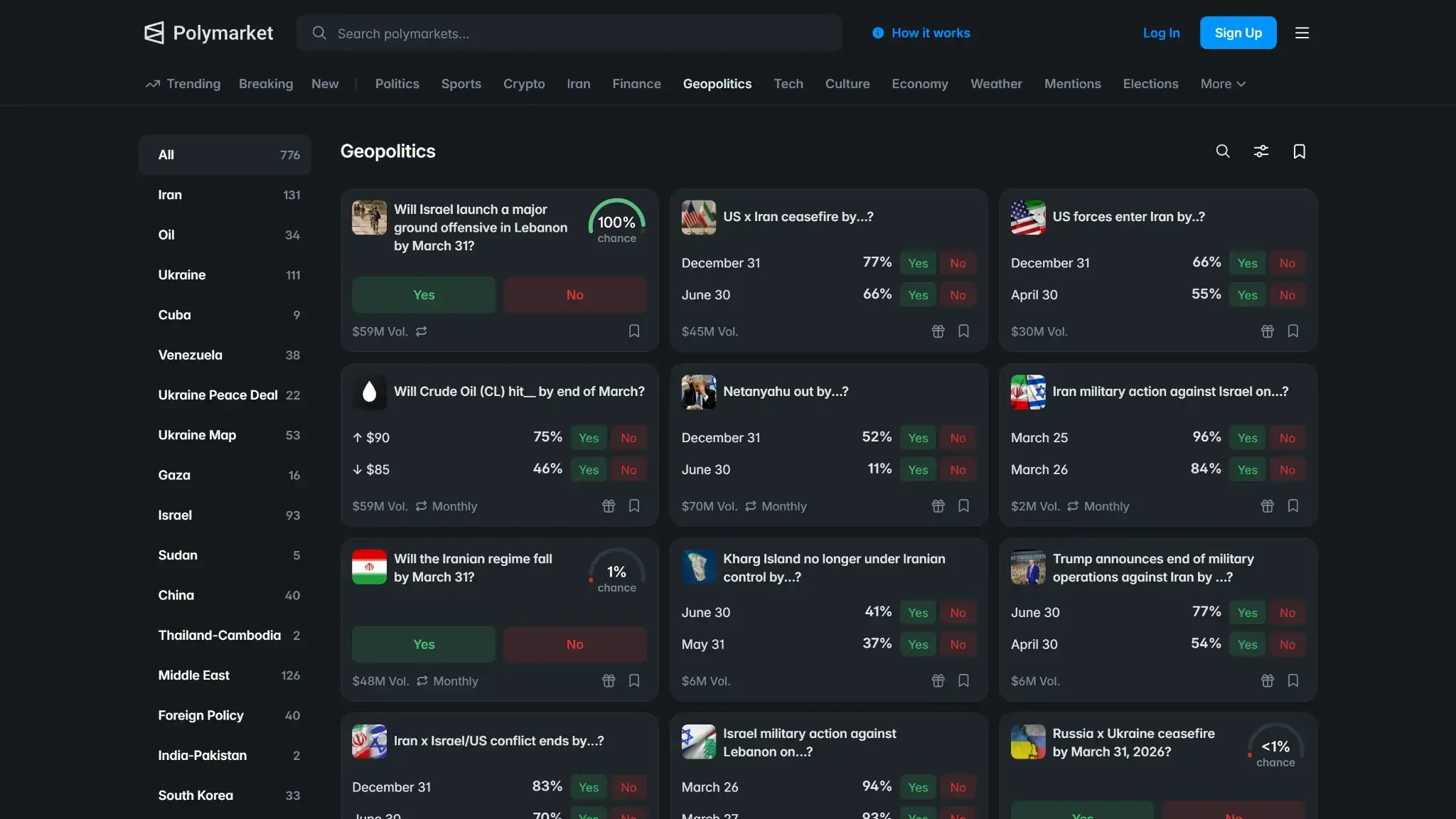
| Geopolitics | Wars, ceasefires, diplomacy | 451 events | Wording-sensitive rules |
| Finance, economy | Earnings, rates, stocks | 587 events | Economy is 172 of 587 |
| Culture, weather, tech | Awards, temperatures, AI | 1,095 events | No combos |
Election traders can follow live election markets from the U.S. midterms to Brazil's presidential race, and sports markets run from moneylines to spreads, totals and player props.
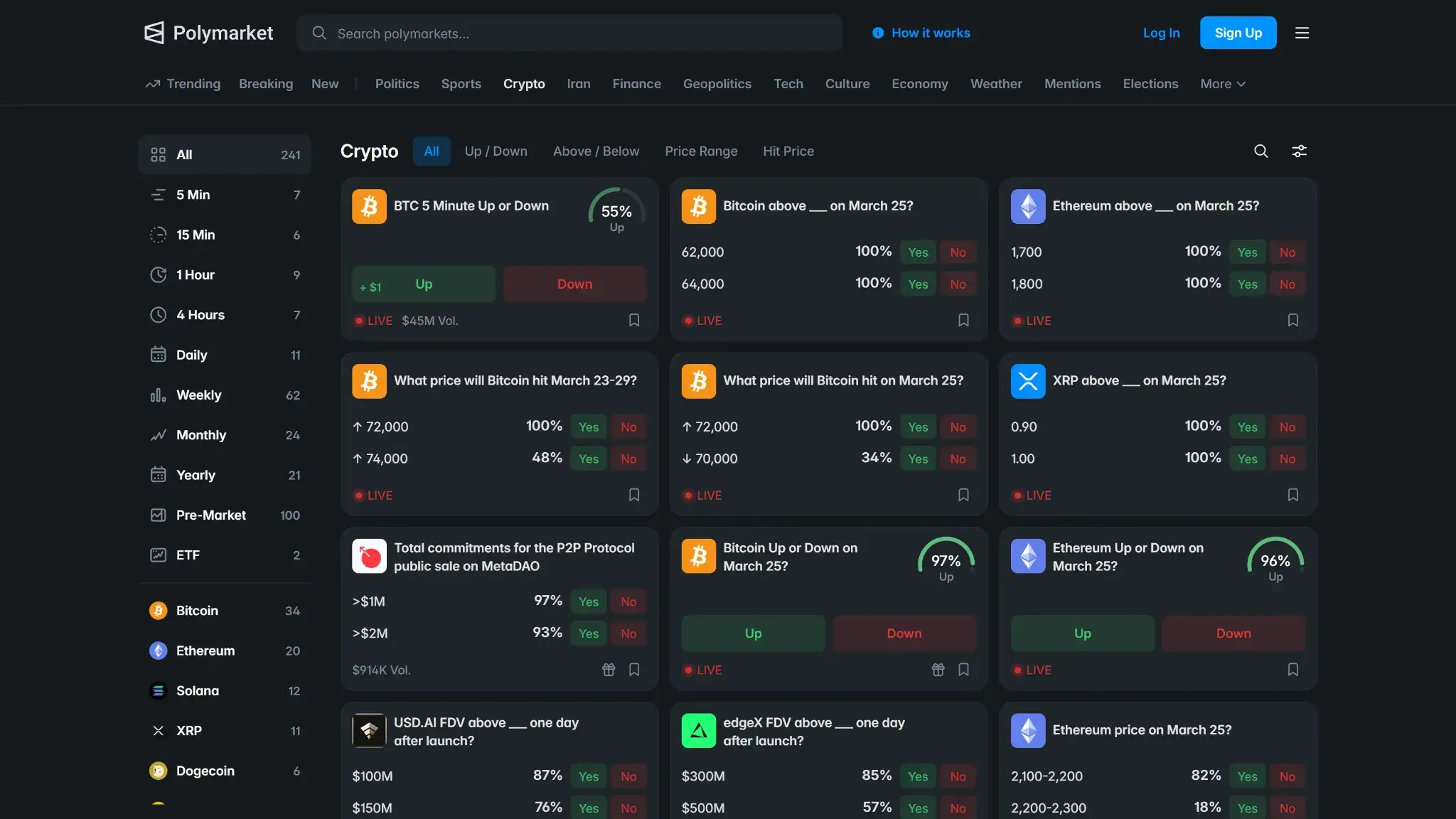
Crypto traders get crypto price predictions that settle every 5 minutes, 15 minutes or hour, plus longer ladders on where bitcoin or ether will trade by a date.
Traders who only want U.S. politics can compare PredictIt, a dollar-based political market that runs on CFTC staff no-action relief.
Contract Design Notes
- Binary markets: Yes or No on a single outcome, the default.
- Multi-outcome events: linked markets where only one outcome can win, such as an election with several candidates. Holding No on every other candidate is treated as the same position as Yes on one.
- Range and threshold markets: ladders on a price or a count, such as how high bitcoin goes this year.
- Combos: multi-leg positions on sports markets only, priced by market makers on request. Every leg has to win, and a combo can be sold before it settles.
- Listings: Polymarket lists every market itself. Traders can suggest markets but can't create them.
Liquidity, Order Book and Execution Quality
Across 12 of the most-traded politics and sports markets, the median top-of-book spread was 1¢ and the median depth within 2¢ of the mid price was $63,871. Kalshi's comparable sample had a median of $72,580 within 2¢ and the same 1¢ median spread. Ten markets traded at a 1¢ spread, one at under a tenth of a cent, and one at 2¢. Sports order books were the deepest, at $48,772 to $779,126 within 2¢. Politics was uneven. Four markets carried $10,000 or more, while a Trump–Putin meeting market held $585 and a Maduro sentencing market held $229.
| Market | Spread | Depth ±2¢ |
|---|---|---|
| Nationals vs. Tigers | 1¢ | $779,126 |
| Falcons vs. Packers | 1¢ | $624,803 |
| Rays vs. Yankees | 1¢ | $294,560 |
| Flávio Bolsonaro wins Brazil | Under 0.1¢ | $100,960 |
| Blue Jays vs. Orioles O/U | 1¢ | $78,122 |
| Ole Miss vs. Florida | 1¢ | $69,854 |
| Lula wins Brazil | 1¢ | $57,888 |
| Norway wins vs. Denmark | 1¢ | $48,772 |
| Hormuz traffic normal by Dec 31 | 1¢ | $28,411 |
| Bab el-Mandeb closed by Dec 31 | 1¢ | $10,621 |
| Trump and Putin don't meet | 1¢ | $585 |
| Maduro gets 60+ years | 2¢ | $229 |
Limit orders rest on the book and fill in pieces as other traders take them. Market orders fill right away against the best prices, and in thin markets a larger order walks through several price levels. The displayed price is the midpoint of the best bid and ask, unless the spread is wider than 10¢, in which case it's the last traded price. That's worth checking before trusting the odds on a quiet market.
In sports markets, orders that would match immediately wait 3 seconds before they reach the book, and every resting order is canceled when the game starts. When Polymarket adds a clarification to a market's rules, it clears that market's order book and cancels all resting orders. Selling before resolution works whenever a buyer is on the other side. In the sample, 10 of the 12 markets held more than $10,000 within 2¢ of the price, and the two smallest were the politics markets named above.
Fees and Total Cost to Trade
Polymarket charges takers, the traders whose orders match immediately, using fee = shares × rate × price × (1 − price). The fee is highest at a 50¢ price and shrinks toward 1¢ and 99¢, so a trade at 30¢ costs the same as one at 70¢. Traders who post resting limit orders pay nothing and share in daily rebates funded by taker fees. The rate depends on the category:
| Category | Rate | Fee at 50¢ |
|---|---|---|
| Crypto | 0.07 | 1.75¢ |
| Sports, economy, culture, weather | 0.05 | 1.25¢ |
| Politics, finance, tech, mentions | 0.04 | 1¢ |
| Geopolitics | 0 | Free |
Fees apply only to markets listed after each category's fee start date, and 99.3% of open markets now have them. Fees are worked out when an order matches, charged in USDC and rounded to five decimal places. Frequent takers earn back 3% to 50% of their fees through a volume tier program that started on May 28, 2026.
Buying 100 shares of a sports market at 50¢ with a market order costs $50 plus a $1.25 fee. Selling them at 60¢ with another market order returns $60 minus a $1.20 fee. The round trip costs $2.45 in fees and leaves $7.55 of the $10 gain. Posting the buy as a resting limit order that waits on the book cuts the fees to $1.20.
Deposits and withdrawals are free on Polymarket's side, while blockchain networks and outside exchanges charge their own fees. Withdrawals to USDC pass through a swap that the website caps at under 0.1% of the amount.
Funding, Settlement and Cash-Out Flow
Every deposit converts to pUSD, the token Polymarket uses for all trading. pUSD is backed 1:1 by bridged USDC (USDC.e) held in a Polygon contract, and it replaced USDC.e as the trading balance on April 28, 2026.
Deposits
| Method | Minimum | Arrives | Fee |
|---|---|---|---|
| Crypto on Polygon, Solana, Base | $2 | Minutes | Network only |
| Crypto on Ethereum | $3 | Minutes | Network only |
| Bitcoin | $3.60 | Minutes | Network only |
Deposits work from 15 networks and more than 200 tokens, including stablecoins, ETH, SOL and BTC, and they convert to pUSD automatically. Each account gets its own deposit address. Deposits below a network's minimum wait until the total clears it. There's no card or bank deposit on Polymarket.com, so fiat has to go through an exchange first. Crypto sent on the wrong network can sometimes be recovered with Polymarket's recovery tool, but tokens sent straight to the exchange contract are lost for good.
Withdrawals
| Method | Arrives | Fee |
|---|---|---|
| Crypto, any supported network | Processed instantly | Network only |
| pUSD on Polygon | Processed instantly | Network only |
| Bank account | Through an exchange | Exchange's fees |
Withdrawals have no holds. The swap from pUSD to USDC can run short of funds at times. Splitting a large withdrawal gets around it, and so does withdrawing pUSD directly, though some exchanges no longer accept pUSD deposits.
Once someone proposes an outcome, an undisputed market finalizes about 2 hours later and winning shares redeem for $1 each in pUSD through a claim in your portfolio. A disputed market takes 4 to 6 days. From there, money reaches your wallet as fast as the network confirms it.
Resolution Rules, Market Integrity and Disputes
Every market lists its rules under the order book, including the resolution source, the end date and how edge cases settle. The UMA Optimistic Oracle, a separate crypto protocol, decides outcomes. An approved proposer posts a bond, usually $750, and anyone can challenge it within 2 hours. A second challenge sends the question to a vote of UMA token holders, after 24 to 48 hours of debate and about 48 hours of voting. A vote can also settle a market 50/50 when no outcome fits, paying 50¢ a share. Polymarket's terms say it isn't involved in resolving markets, and it says it can't reverse a finalized result. It does write each market's rules, though.
Polymarket can add clarifications to a market's rules, which UMA voters are expected to consider and which it says can't change the question's intent. Two 2026 markets turned on how Polymarket read the rules:
- Strategy bitcoin sale (May 2026): Strategy's filing reported a 32-bitcoin sale between May 26 and May 31. Polymarket's added wording made the outcome turn on the sale being publicly confirmed inside that window, and UMA voters settled the market No. On July 3, 2026, traders filed suit against Polymarket in New York state court, seeking to bar rule changes once an outcome is known.
- Venezuela invasion (January 2026): after the U.S. operation that captured Nicolás Maduro, Polymarket said the operation didn't meet the market's definition of an invasion, and Yes holders weren't paid.
In March 2025, the Ukraine minerals market resolved Yes although no deal had been signed. One large UMA holder cast about a quarter of the votes, and Polymarket said it couldn't issue refunds. In July 2025, the market on whether Volodymyr Zelensky would wear a suit resolved No after two challenges. Since August 2025, only approved addresses can propose outcomes, though anyone can still dispute. Voting power stays concentrated, and traders report resolutions they believe contradict the facts, most often blaming large UMA holders.
Polymarket's terms ban insider trading on confidential information, on tips from someone who owes a duty to keep it, and by anyone who can influence an outcome. They also ban spoofing, wash trading and manipulation. Polymarket monitors trading with outside surveillance firms and can ban wallets or refer cases to law enforcement.
Security, Custody, Privacy and Trust
Your money is held in a smart wallet you control. As the entity table above shows, no licensed custodian or clearing house stands behind that wallet. The trading contracts and pUSD were audited by Quantstamp and Cantina in March 2026, and a public bug bounty runs through Cantina. pUSD's contract can be upgraded, and its administrators can pause conversion back to USDC.
In December 2025, Polymarket blamed a flaw at a third-party login provider for accounts drained by attackers. In June 2026, a compromised third-party script on the website drained about $3.1 million from user wallets, and Polymarket said it would refund affected users in full. Traders report scam accounts posing as support. Polymarket staff never ask for a login code.
Every trade and position is public on the blockchain and stays there after an account is deleted. Deleting an account removes the profile and personal data, but only after every position is closed and every dollar withdrawn.
UX, Apps, Automation and Data Access
Polymarket.com trades on the web only, in any modern browser on desktop, tablet or phone. The Polymarket apps in the App Store and Google Play belong to Polymarket US and don't reach Polymarket.com accounts. Phone traders use the mobile browser.
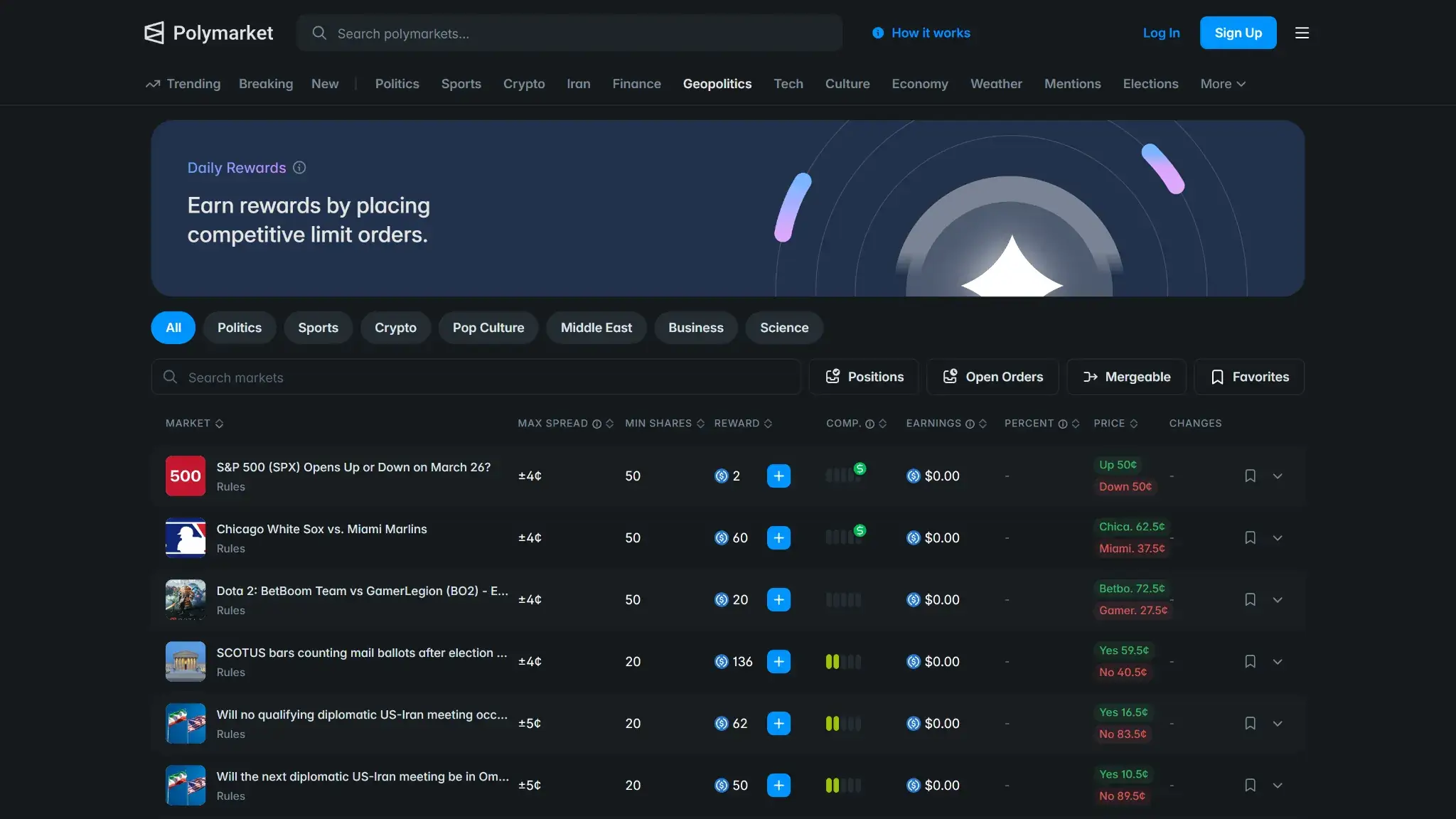
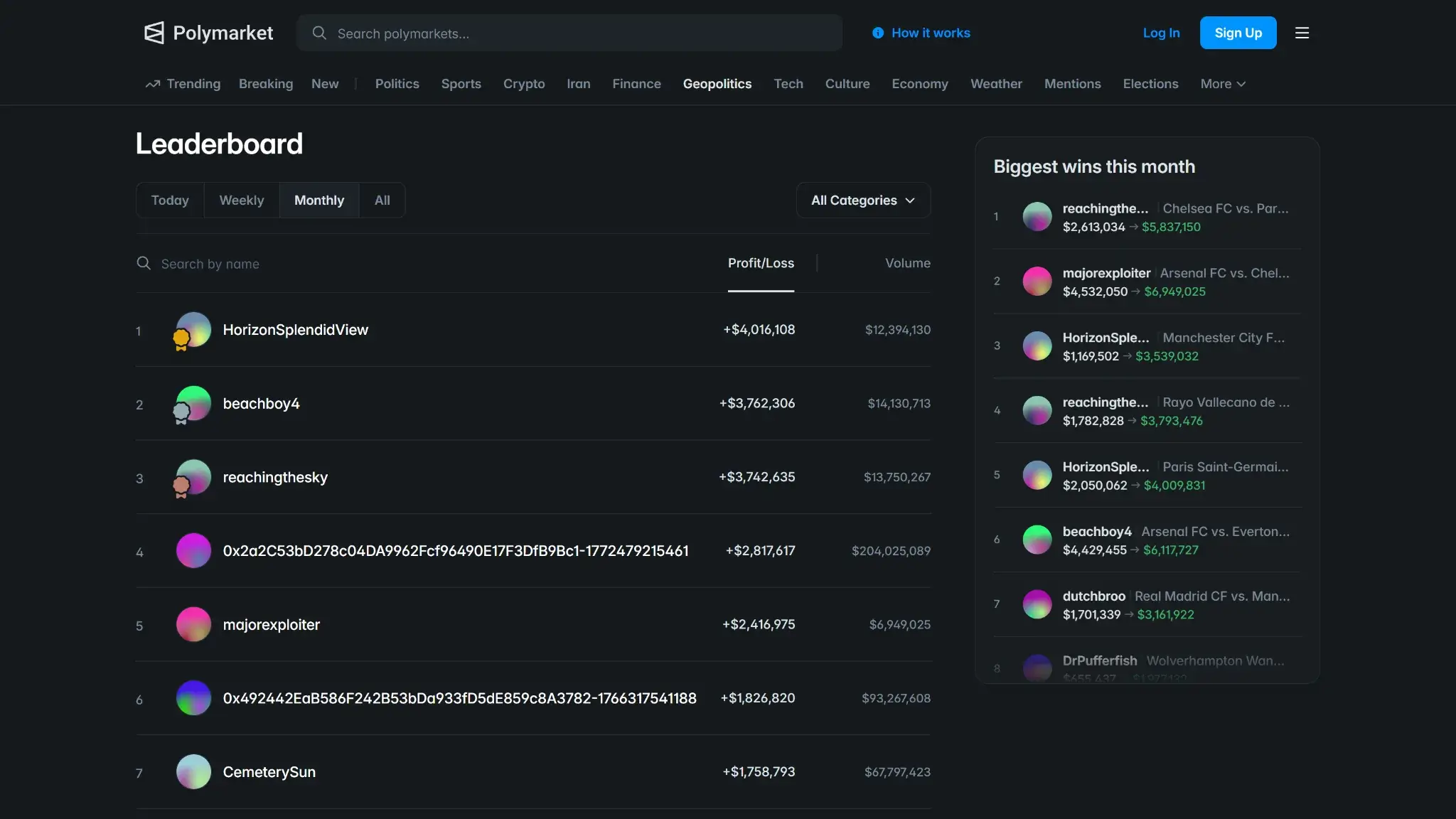
Polymarket's public prediction-market API has three read-only parts that need no key: Gamma for markets and events, the CLOB (central limit order book) for order books and prices, and the Data API for trades, positions and leaderboards. WebSocket feeds stream order-book changes, price history covers past markets, and TypeScript and Python code libraries handle trading. Market makers and own-account traders can apply to host servers next to Polymarket's in London. The tooling suits bot builders and market makers, and casual traders can ignore it.
Taxes, Statements and Record-Keeping
Polymarket.com issues no tax forms and no account statements, and its terms leave working out any tax to the trader. Your records are an accounting export (a ZIP of CSV files covering your activity) and the full onchain history of your wallet, the Polymarket side of what you need to work out tax on prediction-market gains. Records from the exchanges and wallets you deposit from cover the rest. Crypto tax software can read all of them, which helps, because deposits, conversions and withdrawals can be taxable events too. Treatment varies by country.
Customer Support, Limits and Incident Handling
Support works through a chat window on the website and by email at support@polymarket.com, with no phone line and no stated response time. Market questions and clarification requests go through Polymarket's Discord. Traders report messages to support going unanswered and deposits that didn't show up in their balance. Formal complaints go to hello@polymarket.com, and the terms require 60 business days of negotiation before a trader can take a claim to private arbitration under Panama law.
Polymarket sets no fixed position or trade-size limit, and the terms let it set limits case by case. A status page reports outages. Polymarket announces planned trading-engine restarts on Discord about 2 days ahead, and after each restart the book accepts only resting orders for 2 minutes. The April 28, 2026 upgrade paused trading for about an hour and canceled every open order.
Prediction Markets Pillar Scores
- Funding and withdrawals 20% weight Deposit routes, minimums and holds, settlement to balance, withdrawal timing, limits, and bank or wallet access.7.0 / 10
- Fees and total cost 15% weight Trading commissions, broker charges, profit fees, funding and withdrawal costs, gas, and currency conversion.8.0 / 10
- Liquidity and execution 15% weight Executable spreads, order-book depth, slippage, order handling, and the ability to exit before resolution.10.0 / 10
- Market rules and resolution 15% weight Resolution sources, outcome definitions, edge cases, payout rules, challenge windows, and disputed outcomes.4.0 / 10
- Safety, custody and eligibility 15% weight Serving entities and permissions, custody or contract safeguards, collateral, account controls, eligibility, and setup.5.5 / 10
- Market coverage and contracts 10% weight Relevant live events, category coverage, contract types, expiries, listing timeliness, and useful alternatives.10.0 / 10
- Usability, support and reporting 10% weight Trading usability, order and portfolio views, relevant data tools, human support, dated terms, statements, and exports.4.0 / 10
Final Verdict
Polymarket.com earns a 6.9 under our prediction market scoring. Its order books are the reason to use it, with a 1¢ median spread and $63,871 of median depth within 2¢ on its most-traded markets. Taker fees are below Kalshi's 1.75¢ at 50¢ in every category but crypto, and withdrawals are processed instantly with no Polymarket fee. The score reflects everything around the book. No regulator licenses it, disputed markets can end in a token-holder vote with no refunds on record, funding is crypto only, trading is web only, and there's no tax paperwork. Pick it if you hold crypto and trade liquid politics and sports markets from a country outside its restricted list. Traders who like the crypto model but can't trade here can compare other crypto prediction markets. For bank deposits or a regulator behind the account, a regulated exchange from our prediction market rankings fits better.

CryptoSlate may earn a commission when you use partner links, at no extra cost to you. Our reviews, ratings, and editorial decisions remain independent of advertisers. Read How CryptoSlate Makes Money for funding details.