Federal Reserve accelerates balance sheet reduction with $46 billion cut in a week
Intensifying quantitative tightening signifies continued shift away from expansionary monetary policy



Quick Take
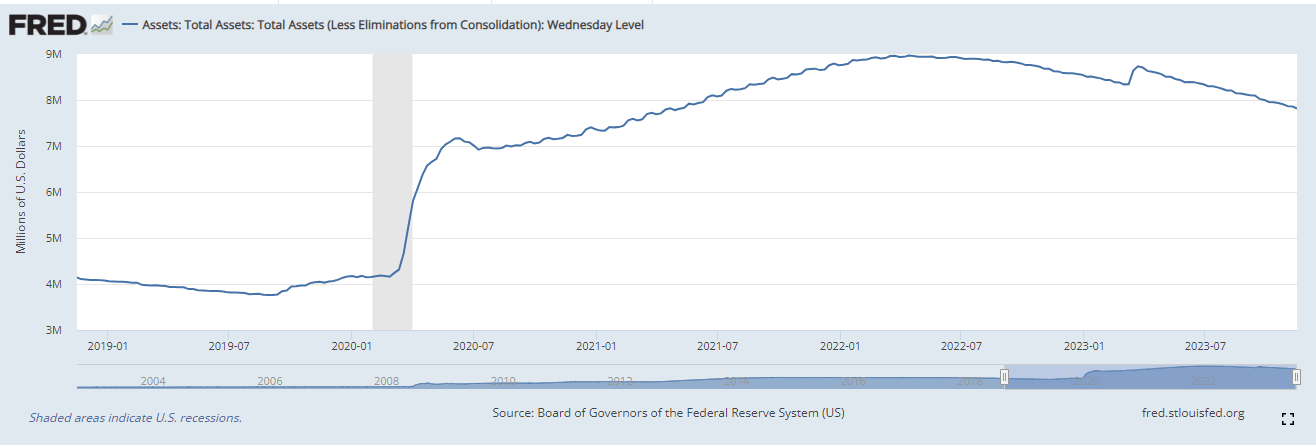
The Federal Reserve's balance sheet contraction continues at a heightened pace, according to recent data. In the last week, the Fed drew down its balance sheet by $46 billion, a substantial increase from the $6 billion reduction the previous week. As a result of this quantitative tightening, the balance sheet now stands at $7.8 trillion. This contraction signifies a continued shift away from the expansionary monetary policy implemented during the height of economic instability.
However, this balance sheet reduction is still dwarfed by the Fed's response to the financial turbulence in 2020. In the span of a few weeks, the Fed had expanded its balance sheet from $4.1 trillion to $7.1 trillion through an aggressive quantitative easing program. Despite the ongoing reductions, the Fed's balance sheet remains nearly $1 trillion higher than it was in July 2020, highlighting the magnitude of the intervention required to stabilize financial markets.