
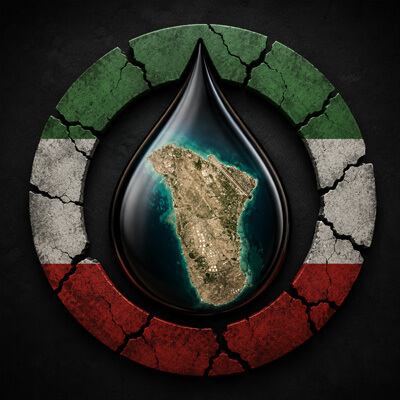
Kharg Island no longer under Iranian control by…?
Current Odds
Odds Summary
December 31 leads at 8.5% reported probability on Polymarket.
Polymarket · Last synced
Market Analysis
Kharg Island odds price escalation against a hard control threshold

The curve rises across later deadlines, yet the implied story still treats loss of Iranian control as an extreme endpoint. That gap points to a market separating disruption risk from the much harder test embedded in the resolution language.

The market’s shape suggests a narrow thesis: escalation risk is worth pricing, while an actual loss of Iranian control over Kharg Island requires a much heavier evidentiary and operational threshold. That distinction matters because the contract resolves on control, so severe headlines can still fall short of the rule.
The curve says time helps, while the endpoint stays remote
The listed Yes prices rise from 2.5% on the earliest supplied timeframe to 12.5% by August 31. Inference from that curve: the market assigns some cumulative value to a longer window for a crisis to develop, yet keeps the outcome in a tail-risk zone. The slope matters because it points to path dependence. A quick change in control would require a compressed chain of events, while later deadlines allow more room for military, political, or administrative developments to compound.
| Listed timeframe | Yes price |
|---|---|
| June 24 | 2.5% |
| June 30 | 3.7% |
| July 31 | 6.5% |
| August 31 | 12.5% |
The jump across deadlines also implies that the market treats duration as meaningful evidence. If control of the island were expected to change mainly through a single sudden event, the curve would likely be flatter across nearby dates. The steeper later pricing suggests an inferred sequence: pressure first, breakdown second, a recognizable change in control only after that.
The rule makes dramatic disruption weaker than clear control loss
The resolution criterion is specific: the market resolves yes if Kharg Island is no longer under Iranian control by March 31, 2026 at 11:59PM ET. That wording matters because it creates a line between disruption and governance. A strike, blockade, evacuation, or contested report could move attention toward the contract while leaving the decisive question unresolved if Iran still exercises control under the rule.
This helps explain why the market can support heavy activity while the Yes prices remain relatively low. The event is framed around a binary status change, and adjudication would likely require credible evidence of who controls the island. The supplied context gives no separate resolution language for temporary disruption, partial denial of access, or economic impairment, so the market has reason to demand evidence that maps directly onto control.
Large volume signals salience, not confidence in the endpoint
With $53.58 million in volume, $623,480 in liquidity, and $2.81 million in open interest, this is no obscure political contract. The activity matters because it indicates that Kharg Island has become a focal point for pricing geopolitical tail risk within the Polymarket event structure. Yet the low-to-mid single digit pricing on earlier dates shows that attention and probability can diverge when the outcome requires a rare territorial-control shift.
Liquidity also changes how the market may react to new information. A contract with this depth can absorb disagreement, but it can also reprice quickly if evidence crosses the resolution threshold. The market-implied story is therefore conditional: routine escalation headlines may create volatility, while a verified change in authority would matter far more than rhetoric or speculation.
Repricing would need evidence tied to authority on the island
The most important catalysts are evidentiary because the contract turns on a status claim. Since the supplied source context does not establish any factual development beyond the market terms and prices, the following should be read as hypothetical scenarios that could matter if credibly reported:
- Verified reports that non-Iranian forces occupy or administer Kharg Island.
- An official Iranian acknowledgment that it no longer controls the island.
- Credible third-party confirmation of a transfer, surrender, occupation, or loss of governing authority.
- A Polymarket rule clarification addressing temporary control, contested control, or partial control.
- Evidence that an apparent disruption leaves Iranian authority intact, which would weaken the link between headlines and resolution.
Each catalyst matters because it would reduce the gap between market narrative and resolvable fact. The market is likely to be most sensitive to developments that answer who controls the island, since developments that only imply risk can still leave the final settlement question open.
The main counter-signal is continuity through alarming headlines
The strongest counterargument to a rising curve is that geopolitical headlines can sound decisive while producing no qualifying change under the market rule. If Iranian administration, military presence, or recognized authority continues despite attacks or threats, the Yes case loses force because the contract is anchored to control rather than severity. That is the failure mode for the market’s escalation premium: the story can become dramatic without becoming resolvable.
Ambiguity is another pressure point. A temporary seizure, competing claims, or limited denial of access could create a pricing shock, yet final resolution would depend on how control is interpreted. For that reason, the market’s current structure appears to reward time while still discounting outcomes that depend on contested facts. The central tension is clear: the longer the window, the more room for escalation; the stricter the rule, the harder it is for escalation alone to settle the question.
Sources
What Could Move the Odds?
Market-Implied Thesis
The 8.5% December 31 Yes quote implies a low—but nonzero—chance that Iranian control of Kharg ends by year-end.
Because Kharg handles most Iranian crude exports, this reflects a tail-risk transfer of control rather than routine disruption.
What Could Reprice It
A Polymarket clarification or resolution of the March 31, 2026 cutoff could reset pricing because displayed later timeframes conflict with that deadline.
The principal repricing mechanism is a rules decision, not an oil-loading update, since the written resolution date is already past.
Where the Market May Be Weak
October and December labels conflict with rules setting resolution at March 31, 2026, weakening the connection between quoted prices and the stated event.
The January 1, 2027 close date adds ambiguity: participation may reflect a different timeframe interpretation than the written criterion.
Counter-Signal
Kharg’s continued operation after strikes and its role as Iran’s main export hub argue against a near-term durable loss of Iranian control.
Bloomberg reported continued loading on March 4, 2026, while EIA identifies Kharg as Iran’s largest export terminal, raising the threshold for control to change.
Market Details
- Resolution criteria
- This market will resolve to "Yes" if Kharg Island is no longer under Iranian control by March 31, 2026 11:59PM ET. Otherwise, this market will resolve to "No".
- Platform
-


- Category
- Politics › Iran
- Scheduled deadline
- January 1, 2027, 4:59 AM UTC
- Market rules summary
- Multi-timeframe Polymarket event. Each listed timeframe is represented by its Yes price on the underlying binary market. View full rules
Frequently Asked Questions
What are the current Kharg Island no longer under Iranian control by… odds?
Polymarket reports Kharg Island no longer under Iranian control by… odds with December 31 at 8.5% and October 31 at 0.7%. These probabilities are market-implied and can change as liquidity and trading activity update. The latest market snapshot includes $76.45M volume, $237.88K liquidity, and $1.02M open interest. CryptoSlate last synced this market data at Oct 21, 2026, 19:42 UTC.
What could move the Kharg Island no longer under Iranian control by… prediction market odds?
The 8.5% December 31 Yes quote implies a low—but nonzero—chance that Iranian control of Kharg ends by year-end. Because Kharg handles most Iranian crude exports, this reflects a tail-risk transfer of control rather than routine disruption. Catalysts to watch include Polymarket clarification of the applicable settlement cutoff, Polymarket settlement clarification or resolution, and A provider ruling on timeframe and settlement.
How does the Kharg Island no longer under Iranian control by… prediction market resolve?
This market will resolve to "Yes" if Kharg Island is no longer under Iranian control by March 31, 2026 11:59PM ET. Otherwise, this market will resolve to "No". Multi-timeframe Polymarket event. Each listed timeframe is represented by its Yes price on the underlying binary market.
Related Iran Markets
 US announces halt in Iran offensive operations date
 US x Iran Effective Ceasefire date
  Will the U.S. invade Iran before 2027?