
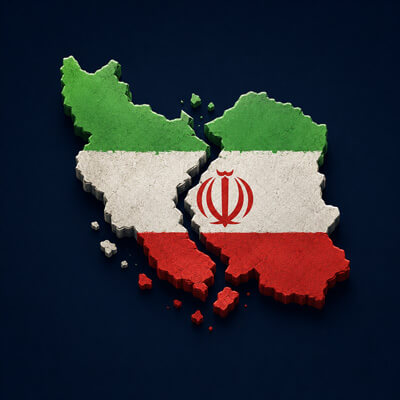
Will the Iranian regime fall by June 30?
Final Results
Market Resolution
Polymarket reports No as the winning outcome for the Will the Iranian regime fall by June 30 prediction market with a final probability of 100%. Scheduled deadline: Jun 30, 2026, 00:00 UTC. Final reported trading volume was $65.93M.
Polymarket · Final sync
 Kharg Island no longer under Iranian control by…?
  Will the U.S. invade Iran before 2027?
  Iran agrees to surrender enriched uranium stockpile by…?
 Market Analysis
Iran regime-fall odds pit tail risk against hard resolution rules

The market’s severe skepticism can be read as a judgment about timing, proof, and control of state institutions. With a binary deadline approaching, even dramatic instability would need to cross a sharper line than pressure on Tehran’s leadership.

Polymarket is pricing an Iranian regime collapse by June 30 as a remote tail event because the contract demands a completed loss of governing authority inside a fixed window. The 1.5-cent "Yes" price and 98.6-cent "No" price point to a market-implied story in which political pressure can be intense while still failing to satisfy the resolution test.
The price is treating regime fall as a deadline problem
The resolution criteria matter as much as the country question: "Yes" requires the Islamic Republic of Iran’s current ruling regime to be overthrown, collapsed, or otherwise cease to govern by June 30, 2026, 11:59 PM ET. That wording makes finality central. A destabilizing sequence that begins before the cutoff and ends after it carries limited value for "Yes." The low price therefore implies that the market assigns little probability to the full chain of events reaching a verifiable endpoint before the deadline.
The rules reward institutional continuity over visible stress
The hidden assumption behind the price is that governing institutions can absorb severe strain without triggering a qualifying regime fall. Under the rules, unrest, elite tension, policy reversal, external pressure, or a contested leadership moment would matter only if they culminated in the current regime no longer governing. This matters because headline severity and resolution relevance can diverge. A crisis that weakens authority politically may still leave enough command structure intact for the contract to resolve "No."
Large volume has tested the view, while trader concentration matters
The market has drawn $53.13 million in volume, $11.57 million in open interest, and $810,650 in liquidity, so the low-probability view is supported by more than an idle quote. That level of activity suggests the deadline-and-proof thesis has been repeatedly contested. The 102-trader count also matters: a relatively concentrated participant base can make the displayed price sensitive to how a small group interprets ambiguous news. Liquidity can dampen routine moves, while a shared reassessment among larger accounts could shift the contract quickly.
Only evidence of authority changing hands would force reassessment
Because the contract turns on whether the regime ceases to govern, catalysts with the strongest pricing impact would need to speak directly to control. Hypothetical examples include:
- A verifiable announcement that a new governing authority has replaced the current regime.
- Evidence that core enforcement or administrative bodies no longer take orders from existing leadership.
- Control of government institutions shifting to an alternative authority before the deadline.
- Official or widely verifiable documentation that the current regime has collapsed or been overthrown.
These scenarios matter because they compress the gap between political stress and resolution proof. By contrast, isolated reports of disorder, diplomatic pressure, or rhetorical escalation would have weaker pricing force unless they establish that the current regime has stopped governing.
A sudden insider break is the strongest challenge to the price
The main counterargument is the possibility of nonlinear collapse. A regime can appear administratively intact until a decisive factional break, command failure, or replacement authority emerges. In that scenario, the calendar risk changes quickly because the market would move from assessing broad instability to assessing whether the resolution language has been met. The lead indicator would be public evidence that insiders with coercive or administrative power had shifted allegiance or stopped recognizing existing leadership.
Ambiguity can keep the dominant outcome anchored during turmoil
The chief failure mode for a "Yes" repricing is ambiguity. If competing claims of authority emerge while current institutions continue operating, the contract may still lack a clean resolution path. The market’s heavy tilt toward "No" can be read as confidence that any potential crisis would either fall short of a governing collapse or remain too legally and factually unresolved by the cutoff.
For that reason, the current pricing is best interpreted as a rule-specific judgment about institutional continuity through a near-term deadline. The market is requiring proof that authority has changed, collapsed, or ceased in a way that can be resolved cleanly. Until that proof appears, political volatility has less direct impact than the contract’s demanding definition of regime fall.
Sources
Market Details
- Resolution criteria
- This market will resolve to "Yes" if the Islamic Republic of Iran’s current ruling regime is overthrown, collapsed, or otherwise ceases to govern by June 30, 2026, 11:59 PM ET. Otherwise, this market will resolve to “No”.
- Platform
-


- Category
- Politics › Iran
- Scheduled deadline
- June 30, 2026, 12:00 AM UTC
- Market rules summary
- Binary market. Payout is 1 USDC for a winning outcome, 0 USDC for a losing outcome. View full rules
Frequently Asked Questions
What was the final result of the Will the Iranian regime fall by June 30 prediction market?
Polymarket reports No as the winning outcome for the Will the Iranian regime fall by June 30 prediction market with a final probability of 100%. The final market snapshot includes $65.93M volume and $1.5M open interest. CryptoSlate last synced the final market data at Jul 1, 2026, 06:17 UTC.
How does the Will the Iranian regime fall by June 30 prediction market resolve?
This market will resolve to "Yes" if the Islamic Republic of Iran’s current ruling regime is overthrown, collapsed, or otherwise ceases to govern by June 30, 2026, 11:59 PM ET. Otherwise, this market will resolve to “No”. Binary market. Payout is 1 USDC for a winning outcome, 0 USDC for a losing outcome.
Related Iran Markets
 US announces halt in Iran offensive operations date
 US x Iran Effective Ceasefire date Will the U.S. invade Iran before 2027?