
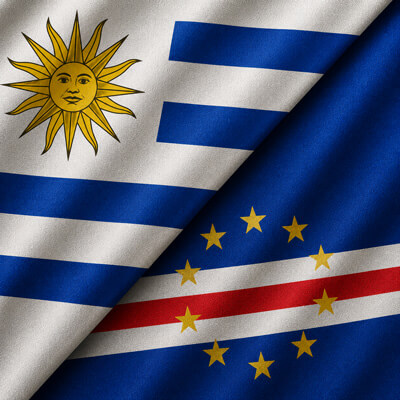
Uruguay vs. Cabo Verde
Ended Jun 21, 2026, 22:00 UTC
Market resolution
Polymarket reports Draw as the winning outcome for the Uruguay vs. Cabo Verde prediction market with a final probability of 100%. The market closed on Jun 21, 2026, 22:00 UTC. Final reported trading volume was $23.42M.
Final probabilities, volume, and open interest are sourced from Polymarket and were last synced at Jun 22, 2026 1:42 am.
Uruguay’s favorite status collides with Cabo Verde’s draw-friendly path
The market leans toward a familiar hierarchy, yet the draw line carries much of the real story. For a three-way World Cup result, the pricing depends on whether Uruguay’s perceived advantage survives lineup, incentive, and match-state uncertainty.


Uruguay’s 67.5% share, against 11.5% for Cabo Verde and 22.5% for the draw, tells a clear market-implied story: the favorite is expected to have the better path to a decisive result, while the three-way format still forces a meaningful allowance for stalemate. That matters because the pricing is doing two jobs at once: ranking the teams and estimating how often Uruguay’s advantage turns into a win instead of a draw.
The favorite share implies a team-strength gap with a draw tax attached
As an inference from the listed odds, the market is assigning Uruguay a materially larger chance of winning than either alternative, which points to an assumed gap in quality, depth, or match control. The important qualifier is the 22.5% draw outcome. In a two-sided framing, every non-Cabo Verde result would live together; here, the draw removes a large portion of the favorite’s natural cushion. That separation matters because any evidence that lowers scoring expectations can move probability toward the draw while leaving Cabo Verde’s win chance mostly unchanged.
This structure explains why Uruguay can be treated as the clear favorite while still leaving room for a cautious or low-event match. A single-goal favorite in soccer often carries a path where territorial control produces pressure with limited separation. The market’s current shape seems to price that tension: Uruguay’s implied advantage is strong enough to dominate the board, yet the draw is large enough to act as the main limiter on the favorite outcome.
Cabo Verde’s win line is small because resilience is priced elsewhere
Cabo Verde’s 11.5% share signals a narrower path to an outright win while leaving room for competitive passages. In this format, a disciplined defensive performance, slow tempo, or Uruguay failing to convert chances would more naturally feed the draw bucket. That matters because positive information for Cabo Verde can split in two directions: evidence of containment may lift the draw, while evidence of genuine chance creation would matter more for the Cabo Verde outcome.
The distinction is important ahead of a World Cup match because tournament games can reward restraint depending on the wider context. If pre-match information suggested Cabo Verde’s approach is built around denying space and accepting long stretches without the ball, the market could read that as draw-relevant. If information pointed to an aggressive setup, Uruguay defensive absences, or a matchup that creates transition chances, the same broad underdog narrative could become win-relevant.
Liquidity makes the current hierarchy harder to shift casually
The market shows $132.14K in volume, $69.54K in open interest, and $1.36M in liquidity. As an inference from those figures, there is enough displayed liquidity for the quoted hierarchy to resist small bursts of opinion. This matters because a price move would likely need either materially new information or sustained activity large enough to work through the available liquidity, especially with the close set for June 21 at 10:00 PM UTC.
That structure can also create a blind spot. Thick available liquidity can make a market look settled before late team news has been absorbed. Because the listed resolution source is FIFA’s official World Cup result, the market’s fundamental question is narrow: who wins the match, or whether it ends level. News that changes likely starters, tactical incentives, or match conditions matters only to the extent it changes that official result distribution.
Tournament incentives can redirect probability between draw and win paths
The largest repricing catalyst may be the incentive picture around the match, especially if new information before kickoff clarifies whether caution or urgency is more valuable. A hypothetical scenario in which a point is strategically useful would make the draw outcome more central to the market’s story. A hypothetical scenario in which one side needs a win would change the expected tempo, increasing the importance of early-game risk and late-game chasing.
- Confirmed lineups showing rotation or unexpected absences would test the assumed Uruguay control premise.
- Fresh context about tournament incentives could shift probability between the draw and outright-win outcomes.
- A move in volume and open interest through existing liquidity would show that new information is reaching executed trades.
- Any FIFA-linked clarification affecting match status or official result treatment would matter because settlement depends on the FIFA source.
The failure mode is a low-event match that validates the draw
The main counter-signal to the favorite-heavy story is a match profile where Uruguay’s advantage fails to generate separation. That could come from conservative selection, a compact Cabo Verde setup, poor chance conversion, or game-state incentives that make risk unattractive. The market consequence would be concentrated in the draw because the current pricing already leaves that outcome as the largest alternative to Uruguay.
For Cabo Verde, the market-changing evidence has to go further than competitiveness. A credible path to an outright win would require signals that Cabo Verde can turn resistance into scoring chances, or that Uruguay’s expected control is weaker than the odds imply. Until such evidence appears, the current configuration makes sense as a hierarchy with one major caveat: in a three-way soccer market, the favorite must defeat the opponent and the draw at the same time.
Sources
Market details
- Resolution criteria
- This event is for the upcoming FIFA World Cup game, scheduled for Sunday, June 21, 2026 between Uruguay and Cabo Verde.
- Platform
-


- Category
- Sports › World Cup
- Close date
- June 21, 2026, 10:00 PM UTC
- Settlement source
- fifa.com
- Market rules summary
- Multi-outcome Polymarket event. Each listed option is represented by its Yes price on the underlying market. View full rules
Frequently asked questions
What was the final result of the Uruguay vs. Cabo Verde prediction market?
Polymarket reports Draw as the winning outcome for the Uruguay vs. Cabo Verde prediction market with a final probability of 100%. The final market snapshot includes $23.42M volume and $5.09M open interest. CryptoSlate last synced the final market data at Jun 22, 2026, 00:42 UTC.
How does the Uruguay vs. Cabo Verde prediction market resolve?
This event is for the upcoming FIFA World Cup game, scheduled for Sunday, June 21, 2026 between Uruguay and Cabo Verde. Multi-outcome Polymarket event. Each listed option is represented by its Yes price on the underlying market. The settlement source listed for this market is fifa.com.
Related World Cup markets
 Spain vs. Argentina
 France vs. England
 England vs. Argentina