
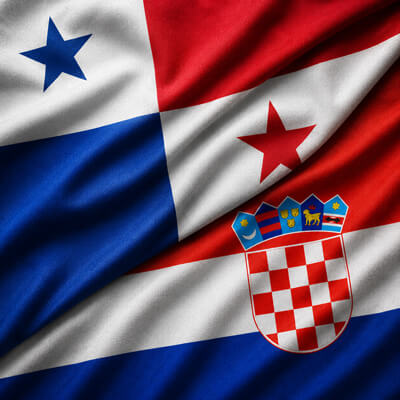
Panama vs. Croatia
Ended Jun 23, 2026, 23:00 UTC
Market resolution
Polymarket reports Croatia as the winning outcome for the Panama vs. Croatia prediction market with a final probability of 100%. The market closed on Jun 23, 2026, 23:00 UTC. Final reported trading volume was $17.68M.
Final probabilities, volume, and open interest are sourced from Polymarket and were last synced at Jun 24, 2026 2:12 am.
Croatia’s Heavy Favorite Status Meets Soccer’s Draw Gravity Against Panama
The market is leaning on Croatia’s baseline strength while assigning real weight to a stalemate. That split matters because this contract settles on a single World Cup result, where team hierarchy, tournament incentives, and match-state volatility can collide.


The current split is easiest to read as a market giving Croatia first claim on the match while keeping a meaningful draw lane open. Croatia at 63.5%, Panama at 13.5%, and the draw at 23.5% imply a hierarchy, yet the hierarchy is being filtered through a sport where one goal can dominate the entire settlement.
Croatia’s share says baseline strength is carrying the early price
Because resolution is tied to FIFA's official result for the June 23, 2026 World Cup game, the market has a clean endpoint and very few current match-day facts. That pushes the price toward broad priors: which side is treated as more likely to control territory, create chances, and avoid needing an unusual game state. Croatia’s 63.5% share is an inference from price that those priors dominate before final lineups and tournament context have hardened.
Panama’s price carries a different burden than Croatia’s. At 13.5%, Panama is assigned a much narrower route: enough defensive stability to keep the score low, plus a conversion event that changes the match. The market-implied story gives Croatia several ways to win; Panama’s route depends more heavily on a specific disruption.
The draw carries its own logic in this matchup
At 23.5%, the draw sits well above Panama’s win price. That relationship matters because a stalemate can be produced by Panama defending successfully, Croatia failing to convert dominance, or both teams settling into a low-event rhythm. The draw captures multiple paths where Panama can earn settlement parity without controlling the match for 90 minutes.
| Outcome | Yes price | Market-implied burden |
|---|---|---|
| Croatia | $0.635 | Baseline quality translates into a win |
| Draw | $0.235 | Low-event match or missed conversion chances |
| Panama | $0.135 | Defensive hold plus a decisive attacking moment |
That is why the draw share matters to the market’s structure. It absorbs much of the skepticism that Panama can win outright while still acknowledging that Croatia’s presumed advantage can fail to settle as a win. In a three-way soccer market, the middle outcome can become the main expression of caution around the favorite.
Displayed liquidity can mask how much the story still depends on new inputs
The market lists $1.02M in liquidity against $60.64K of volume and $35.4K of open interest. The displayed depth can make the top-level percentages look settled, yet the amount actually put to work is still modest relative to the time left before the close. That matters because new information can have a large narrative effect even if the screen appears deep.
Long-dated sports contracts often hold a broad prior until concrete match inputs arrive. In this case, the close date at 11:00 PM UTC on June 23, 2026 leaves a wide window for changes in squad availability, tactical setup, or tournament stakes. Each item would matter because it speaks directly to which of the three settlement routes becomes easier to imagine.
Advancement incentives could move the draw more than team headlines
The largest repricing catalyst may come from the context surrounding the match, as a hypothetical scenario. If a point helps both teams reach a desired tournament outcome, the draw probability would have a stronger causal story. If one side needs a win, the market would have to account for more aggressive late-game choices, which can redistribute probability away from a quiet stalemate and toward decisive outcomes.
- Confirmed absences or returns would affect whether Croatia's baseline advantage is durable.
- A conservative Panama setup, if credibly signaled, would support the draw pathway as much as the Panama win pathway.
- A Croatia lineup designed for control over risk could reinforce the favorite share while keeping the draw alive.
- Any official FIFA schedule or match-status change would matter because the contract relies on that settlement source.
The main counter-signal is a game that compresses chance creation
The strongest challenge to the market-implied Croatia story is a match profile with limited shots, few transition chances, and long stretches where the favorite’s control produces possession without separation. That kind of setup would make the 63.5% Croatia share depend heavily on conversion efficiency, which is exactly the condition that can pull probability toward the draw.
For Panama, the market’s low win price implies that a simple competitiveness argument is insufficient; the result would likely need a specific break, such as an early goal, set-piece success, penalty, red-card swing, or Croatia chasing the game into exposure. Those are hypothetical match events, but they explain why Panama’s outright price remains much lower than the draw despite both benefiting from a low-scoring game.
The market is therefore telling a disciplined story: Croatia owns the broadest route, the draw owns the most plausible resistance to that route, and Panama needs the cleanest disruption. The price can change quickly once the abstract hierarchy gives way to lineups, incentives, and tactical clues that make one settlement path feel less theoretical.
Sources
Market details
- Resolution criteria
- This event is for the upcoming FIFA World Cup game, scheduled for Tuesday, June 23, 2026 between Panama and Croatia.
- Platform
-


- Category
- Sports › World Cup
- Close date
- June 23, 2026, 11:00 PM UTC
- Settlement source
- fifa.com
- Market rules summary
- Multi-outcome Polymarket event. Each listed option is represented by its Yes price on the underlying market. View full rules
Frequently asked questions
What was the final result of the Panama vs. Croatia prediction market?
Polymarket reports Croatia as the winning outcome for the Panama vs. Croatia prediction market with a final probability of 100%. The final market snapshot includes $17.68M volume and $8.85M open interest. CryptoSlate last synced the final market data at Jun 24, 2026, 01:12 UTC.
How does the Panama vs. Croatia prediction market resolve?
This event is for the upcoming FIFA World Cup game, scheduled for Tuesday, June 23, 2026 between Panama and Croatia. Multi-outcome Polymarket event. Each listed option is represented by its Yes price on the underlying market. The settlement source listed for this market is fifa.com.
Related World Cup markets
 Spain vs. Argentina
 France vs. England
 England vs. Argentina