
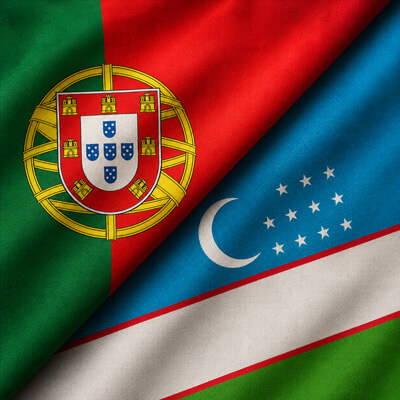
Portugal vs. Uzbekistan
Ended Jun 23, 2026, 17:00 UTC
Market resolution
Polymarket reports Portugal as the winning outcome for the Portugal vs. Uzbekistan prediction market with a final probability of 100%. The market closed on Jun 23, 2026, 17:00 UTC. Final reported trading volume was $17.78M.
Final probabilities, volume, and open interest are sourced from Polymarket and were last synced at Jun 23, 2026 8:22 pm.
Portugal’s Heavy Price Meets Soccer’s Draw Gravity Against Uzbekistan
The market’s Portugal lean is easy to explain, yet the draw sits at the center of the real debate. The most important inputs are team-quality assumptions, match-state incentives, and late tournament information that could alter a seemingly straightforward favorite story.


This market is pricing Portugal as the side whose baseline quality can carry the match, while assigning the draw a meaningful role as the main path that interrupts that assumption. That structure matters because the contract closes on June 23, 2026, so the current price is anchored in pre-match priors ahead of final tactical information.
The price is built on a large Portugal quality prior
At 81.5% for Portugal, 13.5% for the draw, and 5.5% for Uzbekistan, the market-implied story is clear: Portugal is expected to control enough of the match to turn superiority into a win most of the time. Because the supplied context includes odds, rules, liquidity, volume, and settlement information, any claim about team strength is an inference from price, rather than an independently sourced roster or ranking claim. That matters because the market is leaning on broad priors that can hold for long periods, then become sensitive to concrete team news near kickoff.
The draw is the market’s main resistance to a simple favorite story
The draw price is the most important qualifier in the market. Its 13.5% share implies that the market sees a tied result as more plausible than an Uzbekistan win, which fits the logic of a match where the weaker side may benefit from keeping the score level as long as possible. The multi-outcome rules make this especially relevant: a tied final score has its own bucket, so Portugal support must overcome both Uzbekistan’s win path and the draw path. That separate draw outcome prevents the favorite’s implied dominance from translating into a near-total win probability.
| Market input | Why it matters to pricing |
|---|---|
| Portugal at 81.5% | Implies a large quality and reputation prior is doing most of the work before team news. |
| Draw at 13.5% | Signals that match tempo, caution, and a low-margin game script remain meaningful blockers. |
| Uzbekistan at 5.5% | Suggests the market grants a direct upset path, while treating it as narrower than a stalemate. |
Deep liquidity can harden early assumptions before team news arrives
The market lists $1.13 million in liquidity, $111,690 in volume, and $70,740 in open interest. That combination matters because visible liquidity can make the current distribution feel stable, while the relatively early stage of the event leaves room for fresh information to do most of the repricing work later. A World Cup match scheduled more than a year out is especially exposed to changes in squad availability, tactical hierarchy, and tournament incentives. The current market has enough depth to express conviction, yet the decisive information set has yet to arrive.
Late tournament incentives could change the meaning of superiority
The close time of June 23, 2026 at 5:00 PM UTC matters because the final market price will likely absorb information unavailable today. Since FIFA is the settlement source, the official match result is the endpoint, but the path into that result can shift if the broader tournament context creates different incentives. As a hypothetical example, a scenario where one side benefits from caution could raise the relevance of the draw outcome. A scenario where either side needs a win could push the market to focus more on attacking lineups, substitutions, and late-game risk taking.
- Confirmed lineups would matter because they convert broad team priors into a specific match setup.
- Hypothetical injuries or suspensions would matter because the current price is built before final squad information.
- Any tournament-table scenario that changes incentive to attack would matter because the draw has a separate settlement path.
- Official FIFA match details and result reporting matter because they anchor resolution for all three outcomes.
The main failure mode is a match script that keeps Uzbekistan alive
The strongest counterargument to the current distribution is a game state where Portugal’s superiority fails to produce separation. That does not require Uzbekistan to dominate; it only requires the match to stay close enough for the draw bucket to gain importance and the Uzbekistan win bucket to retain a late path. This matters because the favorite price depends on converting control into a final-score result. If the pre-match setup points toward caution, rotation, or limited attacking ambition, the market’s focus could shift from who is stronger to how quickly Portugal can create separation.
For editorial review, the central tension is therefore the gap between a broad Portugal prior and the soccer-specific value of a draw. The market is giving Portugal a commanding position, but its structure also shows respect for a match where one goal, one lineup surprise, or one incentive change can alter the pricing logic before settlement.
Sources
Market details
- Resolution criteria
- This event is for the upcoming FIFA World Cup game, scheduled for Tuesday, June 23, 2026 between Portugal and Uzbekistan.
- Platform
-


- Category
- Sports › World Cup
- Close date
- June 23, 2026, 5:00 PM UTC
- Settlement source
- fifa.com
- Market rules summary
- Multi-outcome Polymarket event. Each listed option is represented by its Yes price on the underlying market. View full rules
Frequently asked questions
What was the final result of the Portugal vs. Uzbekistan prediction market?
Polymarket reports Portugal as the winning outcome for the Portugal vs. Uzbekistan prediction market with a final probability of 100%. The final market snapshot includes $17.78M volume and $9.53M open interest. CryptoSlate last synced the final market data at Jun 23, 2026, 19:22 UTC.
How does the Portugal vs. Uzbekistan prediction market resolve?
This event is for the upcoming FIFA World Cup game, scheduled for Tuesday, June 23, 2026 between Portugal and Uzbekistan. Multi-outcome Polymarket event. Each listed option is represented by its Yes price on the underlying market. The settlement source listed for this market is fifa.com.
Related World Cup markets
 Spain vs. Argentina
 France vs. England
 England vs. Argentina