

Quick Take
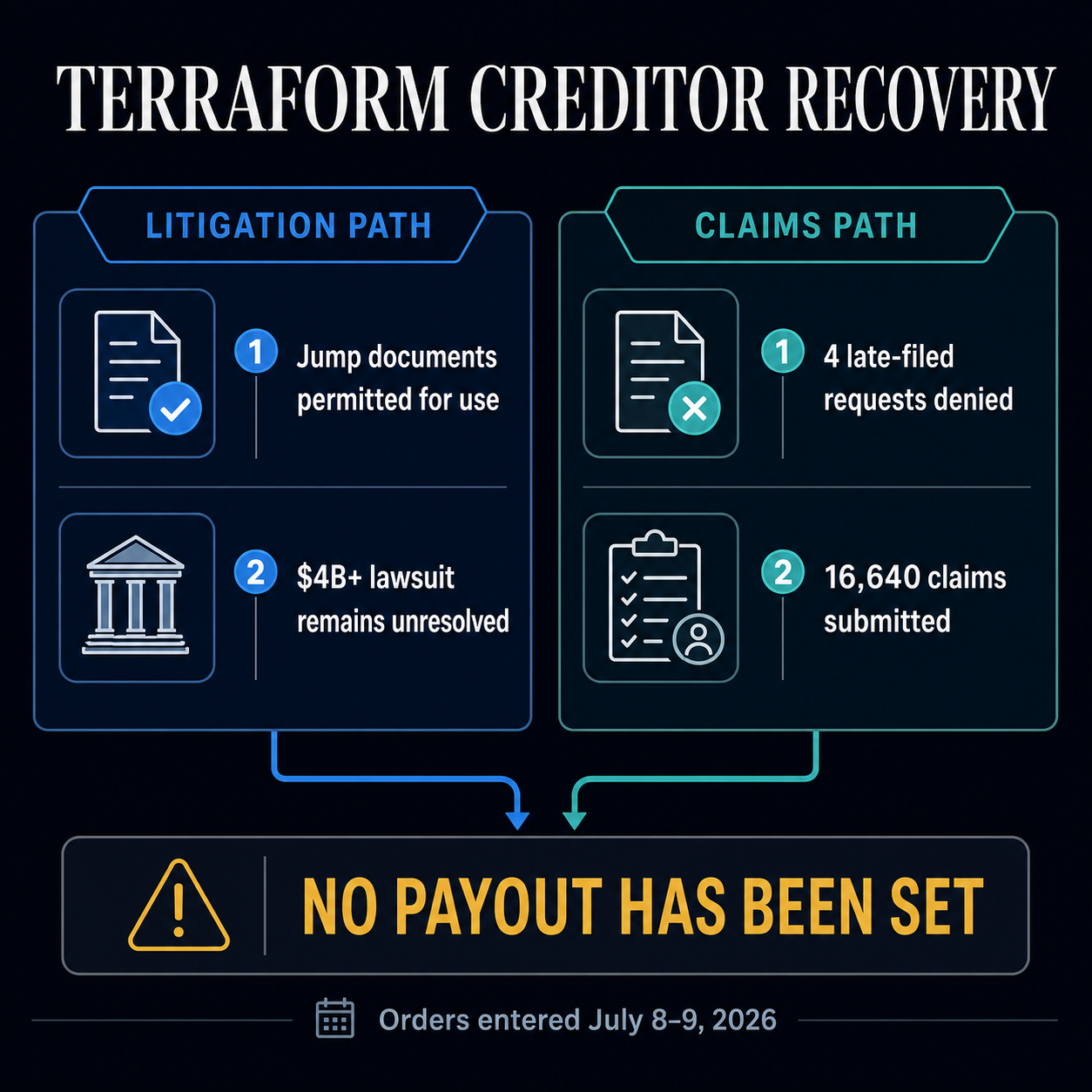
- A bankruptcy judge let Terraform's plan administrator use Jump Trading documents in the $4 billion-plus lawsuit and rejected four late claims.
- The evidence ruling removes a barrier to pursuing Jump, while the late-claim denials keep those requests out of any recovery pool.
- Jump's liability and any creditor payout remain unresolved as the Illinois case and claims review continue.


Terraform Labs’ bankruptcy court cleared the Plan Administrator to use Jump Trading documents in a lawsuit seeking at least $4 billion while rejecting four late crypto-loss claims.
One order lets the administrator use Jump Trading documents in the $4 billion lawsuit. The other rejects four late claims, narrowing who may share in any recovery. Neither decides whether Jump owes money or how much creditors could receive.
Court permits evidence after finding a violation
In a July 8 order, Bankruptcy Judge Brendan L. Shannon found that the Plan Administrator violated the protective order as written by using “Jump Reproduced Documents” in the Illinois lawsuit.
Shannon then modified the order to permit those documents to be used in the Jump action, including in an amended complaint. The change took effect immediately, but the judge left decisions on removing confidentiality designations to the court handling the Illinois case.
The Delaware ruling lets the administrator use the documents in the lawsuit without making them public or deciding whether they support the claims or any creditor recovery.
The Plan Administrator says the case seeks at least $4 billion and alleges that Jump entered a secret arrangement to support TerraUSD and received $1.5 billion in Bitcoin reserves without written agreements or oversight. Those allegations have not been adjudicated.
Jump opposed the change, arguing that it consented to reproduce the materials only under restrictions limiting their use to the bankruptcy. It also said that modification would allow the administrator to bypass a discovery stay in securities cases and expose competitively sensitive information.
CryptoSlate covered the original lawsuit in December.
The claims ruling has a more limited scope than social media posts suggested. Docket 1276 was a certification filed July 8; the signed order was entered July 9 as Docket 1281.
That order denied motions from four named people seeking permission to file crypto-loss claims after the deadline. It also directed Kroll, the claims agent, to update the register. It did not state that every late claimant is barred.
The administrator reports approximately 16,640 submitted crypto-loss claims and says determinations are continuing on a rolling basis. Submitted claims are not the same as allowed claims, which will determine who can share in distributions.
What changes for creditor recoveries
Existing claimants now face a simpler reality: any added recovery depends on Jump’s lawsuit surviving early challenges and ending in a judgment or settlement.
If it does, net proceeds could increase the assets available for allowed claims. If it fails, permission to use the documents doesn't generate any revenue on its own.
Four late claims are now out, but any recovery from Jump still depends on a lawsuit with no settled value or outcome.
Mentioned in this article




Editorial credits