
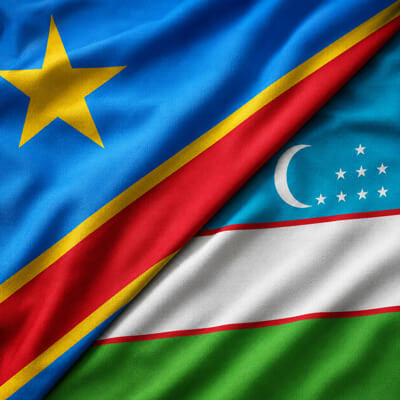
DR Congo vs. Uzbekistan
Ended Jun 27, 2026, 23:30 UTC
Market resolution
Polymarket reports DR Congo as the winning outcome for the DR Congo vs. Uzbekistan prediction market with a final probability of 100%. The market closed on Jun 27, 2026, 23:30 UTC. Final reported trading volume was $14.53M.
Final probabilities, volume, and open interest are sourced from Polymarket and were last synced at Jun 28, 2026 3:12 am.
DR Congo Leads as Draw Risk Compresses Uzbekistan Gap
The three-way board gives DR Congo the lead, but it leaves enough probability in both Uzbekistan and the draw to make late team news unusually powerful. The central question is whether the favorite’s edge survives a World Cup match environment still lacking final roster and context details.


DR Congo’s 46.5% win price builds a clear hierarchy into the June 27, 2026 World Cup match, yet the board stops short of treating the fixture as one-sided. Uzbekistan at 28.5% and the draw at 25.5% create a pricing structure where DR Congo leads, but its path depends heavily on assumptions that can be challenged by squad news, match context, and official FIFA updates closer to kickoff.
DR Congo owns the top slot while the margin stays narrow
The market-implied story is that DR Congo has the strongest single path to three points, with a price that sits well above Uzbekistan and the draw. In a three-outcome soccer market, that lead matters because the draw absorbs roughly a quarter of the distribution before either team can win. Among decisive results, DR Congo accounts for about three-fifths of the combined team-win probability, an inference from the listed Yes prices.
That structure suggests a baseline advantage without a runaway profile. The market is allowing for DR Congo superiority in enough scenarios to lead the board, while also assigning Uzbekistan a credible win path and treating a level result as a live outcome. The significance is that evidence improving Uzbekistan’s competitiveness does not need to flip the hierarchy immediately; it can first drain probability into the draw, then into Uzbekistan’s win price if the case strengthens.
The draw price is carrying much of the caution
The 25.5% draw price is close enough to Uzbekistan’s 28.5% to shape the entire market. Because Polymarket lists each option as a Yes price in a multi-outcome event, probability allocated to the draw directly limits how high either team’s win price can move. A reasonable inference is that the market sees match states where neither side separates early, which keeps both outright outcomes constrained.
This matters because soccer-specific news can reallocate probability in several directions at once. A hypothetical conservative lineup, cautious tactical setup, or tournament situation where a level result helps one side could strengthen the draw and compress both team-win outcomes. A hypothetical setup favoring open play, aggressive selection, or higher late-game urgency could move probability away from the draw and magnify whichever team is viewed as better equipped to benefit.
| Implied assumption | Market consequence |
|---|---|
| DR Congo has the stronger baseline | Supports its lead over both alternatives |
| Uzbekistan remains a credible winner | Prevents the favorite from separating further |
| The draw is materially live | Caps both win prices and raises lineup sensitivity |
| Key information will arrive late | Makes official updates and squad news more influential |
The long runway turns today’s price into an information placeholder
The market closes on June 27, 2026, leaving a long period before FIFA’s official match result resolves the event. That timeline matters because the current board is pricing a future fixture before final match-day variables are known. The listed odds therefore lean on broad priors and early expectations, while many of the inputs that determine a World Cup match result remain outside the supplied context.
Potential catalysts are easy to identify, though most are hypothetical until sourced by official or team channels. Final squad announcements could confirm the current DR Congo-leading story if they show availability of expected starters and continuity in preparation. They could weaken it if Uzbekistan’s squad picture looks stronger than assumed or if DR Congo faces absences. Injuries, suspensions, late fitness decisions, venue-related conditions, travel timing, and any preceding tournament results that alter incentives can all shift whether the market prices this as a game for control, containment, or late volatility.
Liquidity steadies the board, while volume leaves room for sharper moves
The market shows $1.03 million in liquidity against $48.38K in volume and $31.86K in open interest. The inference is that displayed liquidity can make the three-way board look orderly early, while realized participation is still modest relative to the amount available. That matters because early prices may be anchored by model-driven liquidity and broad assumptions until more match-specific information attracts heavier engagement.
A sudden cluster of official news could therefore matter more than routine early activity. If several pieces of information point in the same direction, such as confirmed absences on one side combined with a tactical or incentive backdrop that favors the other, the market would have to reassign probability across all three outcomes. The three-way structure amplifies that process because a change in the draw view can move both team prices even without a direct reassessment of team quality.
The main counter-signal is an Uzbekistan case that protects the draw
The strongest challenge to the current market-implied story is evidence that Uzbekistan can keep the match in a narrow band while preserving enough attacking threat to win. That scenario would matter because it attacks DR Congo’s price through two channels: a higher chance of a level result and a stronger Uzbekistan win path. Since Uzbekistan already sits closer to the draw than to DR Congo, the market leaves space for a counter-case built around match control and game state discipline.
The confirmation path for DR Congo is more direct: official information that supports its squad strength, preparation, and ability to turn superiority into a decisive result would reinforce the existing hierarchy. The failure mode is subtler. If new evidence points toward a lower-event match where the draw remains powerful and Uzbekistan’s win route becomes more credible, the current lead can narrow without a single dramatic headline. That is why the draw price is the market’s central hinge, even though DR Congo holds the leading outcome today.
Sources
Market details
- Resolution criteria
- This event is for the upcoming FIFA World Cup game, scheduled for Saturday, June 27, 2026 between DR Congo and Uzbekistan.
- Platform
-


- Category
- Sports › World Cup
- Close date
- June 27, 2026, 11:30 PM UTC
- Settlement source
- fifa.com
- Market rules summary
- Multi-outcome Polymarket event. Each listed option is represented by its Yes price on the underlying market. View full rules
Frequently asked questions
What was the final result of the DR Congo vs. Uzbekistan prediction market?
Polymarket reports DR Congo as the winning outcome for the DR Congo vs. Uzbekistan prediction market with a final probability of 100%. The final market snapshot includes $14.53M volume and $6.24M open interest. CryptoSlate last synced the final market data at Jun 28, 2026, 02:12 UTC.
How does the DR Congo vs. Uzbekistan prediction market resolve?
This event is for the upcoming FIFA World Cup game, scheduled for Saturday, June 27, 2026 between DR Congo and Uzbekistan. Multi-outcome Polymarket event. Each listed option is represented by its Yes price on the underlying market. The settlement source listed for this market is fifa.com.
Related World Cup markets
 Spain vs. Argentina
 France vs. England
 England vs. Argentina