
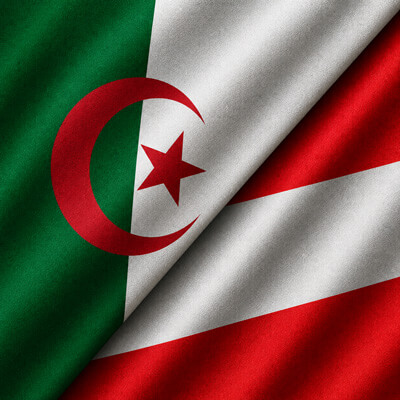
Algeria vs. Austria
Final Results
Scheduled deadline: Jun 28, 2026, 02:00 UTC
Market Resolution
Polymarket reports Draw as the winning outcome for the Algeria vs. Austria prediction market with a final probability of 100%. Scheduled deadline: Jun 28, 2026, 02:00 UTC. Final reported trading volume was $21.97M.
Polymarket · Final sync
Market Analysis
Austria Leads, Yet Draw Pricing Keeps Algeria Close

The pricing gives Austria the clearest win path, yet the draw sitting between both teams signals a match where small pre-kickoff updates could carry unusual weight. The analytical question is whether caution comes from matchup balance, unresolved team news, or the settlement format itself.

Austria’s 38.5% share gives it the clearest market-implied path in this June 27 World Cup matchup, although the spread across all three outcomes points to a game where separation remains limited. Algeria at 30.5% and the draw at 31.5% matter because the market is assigning almost as much weight to stalemate dynamics as to either team’s outright win case. That structure suggests a contest priced around controlled margins, pre-kickoff information gaps, and a settlement setup where the draw is an independent outcome.
Austria leads because the market grants it the cleanest win path
The direct read from the listed Yes prices is straightforward: Austria has the strongest single result case, Algeria sits close enough to prevent a one-sided interpretation, and the draw has enough weight to keep Austria’s lead modest. That matters editorially because the market is separating Austria’s perceived team-strength advantage from the probability of a match state that blocks a decisive result. A favorite priced below 40% in a three-way football market implies respect for the opponent and for the structural frequency of close games.
| Outcome | Yes price | Market-implied message |
|---|---|---|
| Algeria | 30.5% | Competitive enough to keep the favorite contained |
| Draw | 31.5% | Stalemate scenario carries central weight |
| Austria | 38.5% | Clearest win path, without a dominant spread |
The draw price carries the market’s caution about match script
The rules list the draw as its own outcome, which gives defensive or low-scoring match scripts a direct settlement path. That matters because Algeria does not need to be priced as clearly superior for its presence to pressure Austria’s probability; Algeria only needs enough perceived resistance to keep a stalemate live. The draw sitting one point above Algeria also signals that the market may be giving more weight to game control, scoring scarcity, and late-match risk management than to a clean upset narrative.
This is an inference from the odds structure, not a claim about either team’s current form. With only the market prices and FIFA settlement source supplied, the clearest evidence is the clustering itself. A wider Austria lead would imply that pre-match priors are overpowering draw risk. Here, the clustering says the match is being treated as sensitive to first goal, tempo, and team selection rather than a simple hierarchy test.
Unresolved availability keeps broad team priors from dominating
The close date of June 28, 2026, places settlement immediately after the scheduled match window, which means the next major information arrives close to kickoff. Starting lineups, late injuries, suspensions, tactical choices, and official match logistics are all hypothetical catalysts until confirmed through reliable match channels. That matters because a national-team market can move sharply when expected selections become actual selections, especially if one side’s attacking or defensive setup changes the probability of a decisive result.
The current structure implies that broad pre-match priors have been weighed, while lineup-specific certainty has not taken full control of the pricing. If Austria fields a stronger-than-expected attacking setup against an Algeria side missing key defensive pieces, Austria’s win share could absorb some of the probability now sitting in draw and Algeria. If Algeria’s lineup looks more stable or if Austria’s selection reduces finishing threat, the draw and Algeria outcomes could gain relative attention.
Liquidity can make the price look steadier than conviction
The market lists $83.4K in volume, $48.25K in open interest, and $919.52K in liquidity. That combination matters because the displayed market can absorb routine activity while still being vulnerable to information that changes the shared match script. Liquidity can support tighter pricing, yet the gap between liquidity and realized volume suggests the current balance may owe as much to order-book depth as to a wide base of settled views.
For an editorial read, that means a stable headline price should be interpreted with care. The market has enough liquidity to make the three-way split visible, although the open interest indicates a smaller pool of committed exposure than the headline liquidity figure. A material team-news update, official FIFA match-status clarification, or sudden shift in pre-match expectations could therefore matter more than small incremental flows.
Lineups and incentives can force the next repricing
The clearest catalysts are the ones that convert a balanced match thesis into a more specific game script. Each would matter because it affects where probability migrates among Austria, Algeria, and draw, instead of merely changing sentiment around one side.
- Official FIFA match information: confirmation of match status, kickoff details, and final reporting source can tighten settlement confidence.
- Starting XIs: a stronger attacking setup for either team would pressure the draw case, while conservative selections could reinforce it.
- Late availability news: hypothetical injuries, suspensions, or unexpected exclusions could shift the balance quickly because the current spread is narrow.
- Tournament context: if the match situation creates incentives to protect a result or chase a win, the draw probability could move in either direction.
The main counter-signal is a match context that punishes caution
The strongest challenge to the current compressed structure would be evidence that the game is likely to open up. A tactical or incentive setup that rewards early risk-taking would weaken the draw-centered interpretation and make the market more sensitive to which side owns the better finishing path. In that scenario, Austria’s modest lead could either expand if the information favors its attack or narrow if Algeria’s matchup case becomes more concrete.
The current price therefore tells a restrained story: Austria is preferred, Algeria is close enough to matter, and the draw is central because the settlement format rewards stalemate scenarios directly. The next repricing is likely to come from information that changes the expected match script, not from the raw existence of a favorite.
Sources
Market Details
- Resolution criteria
- This event is for the upcoming FIFA World Cup game, scheduled for Saturday, June 27, 2026 between Algeria and Austria.
- Platform
-


- Category
- Sports
- Scheduled deadline
- June 28, 2026, 2:00 AM UTC
- Settlement source
- fifa.com
- Market rules summary
- Multi-outcome Polymarket event. Each listed option is represented by its Yes price on the underlying market. View full rules
Frequently Asked Questions
What was the final result of the Algeria vs. Austria prediction market?
Polymarket reports Draw as the winning outcome for the Algeria vs. Austria prediction market with a final probability of 100%. The final market snapshot includes $21.97M volume and $13.13M open interest. CryptoSlate last synced the final market data at Jun 28, 2026, 04:27 UTC.
How does the Algeria vs. Austria prediction market resolve?
This event is for the upcoming FIFA World Cup game, scheduled for Saturday, June 27, 2026 between Algeria and Austria. Multi-outcome Polymarket event. Each listed option is represented by its Yes price on the underlying market. The settlement source listed for this market is fifa.com.
Related Markets
 Spain vs. Argentina
 France vs. England
 England vs. Argentina