
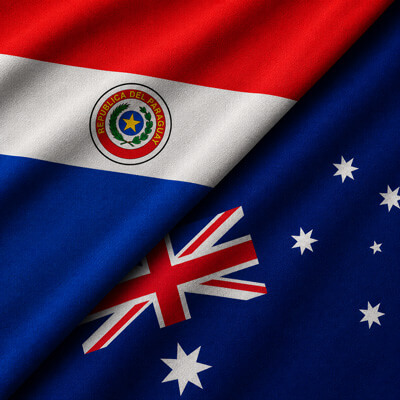
Paraguay vs. Australia
Ended Jun 26, 2026, 02:00 UTC
Market resolution
Polymarket reports Draw as the winning outcome for the Paraguay vs. Australia prediction market with a final probability of 100%. The market closed on Jun 26, 2026, 02:00 UTC. Final reported trading volume was $12.44M.
Final probabilities, volume, and open interest are sourced from Polymarket and were last synced at Jun 26, 2026 5:22 am.
Draw Leads as Paraguay Holds Thin Edge Over Australia
The market is leaning into a stalemate while still granting Paraguay the stronger win path. That mix points to a cautious pre-match consensus shaped by settlement mechanics, long-dated liquidity, and the risk that tournament incentives reshape the game before kickoff.


The current pricing carries a clear thesis: Paraguay has the stronger route to a win, yet the match result the market treats as most likely is neither side separating. That matters because the largest price is attached to game state and incentives, while the team prices depend on information that may arrive much closer to the June 25, 2026 kickoff.
The modal outcome is a stalemate, which changes the win-path math
Draw leads at $0.415, ahead of Paraguay at $0.345 and Australia at $0.245. The inference is that the market sees limited separation between the sides, enough to make a shared result more plausible than either standalone win. In a three-outcome football market, that shape matters because a favorite can exist without becoming the modal outcome. Paraguay’s edge over Australia is meaningful only after accepting the market’s larger claim: the match is expected to stay close enough for a draw to carry the most weight.
| Price signal | Market-implied story | What could pressure it |
|---|---|---|
| Draw at $0.415 | Low separation and a result that can survive cautious incentives | Evidence that both teams need to chase a win |
| Paraguay at $0.345 | Preferred winner if the match produces separation | Team news that narrows the perceived quality gap |
| Australia at $0.245 | A live win path, though behind Paraguay’s | Signals of a more open, transition-heavy match |
Paraguay’s edge depends on assumptions the market has yet to test
Paraguay’s price sits ten cents above Australia’s, which implies a pre-match lean toward Paraguay when the draw is set aside. The supplied context does not include rankings, squad lists, venue details, injuries, or tactical sources, so that lean should be read as an inference from market pricing instead of a sourced football claim. This matters because long-dated sports markets often lean on broad priors before official team information can do the work. If later evidence points to a stronger Paraguay lineup, cleaner rest situation, or more favorable match context, the current hierarchy has a factual pathway to persist. If Australia receives confirming news on availability, form, or tactical fit, the gap between the win outcomes becomes easier to challenge.
Deep posted liquidity can keep an early consensus in place
The market shows $250.64K in volume, $1.35M in liquidity, and $123.12K in open interest. That mix suggests there is meaningful capacity to trade the event, while the actual amount already matched remains modest relative to the posted liquidity. The market implication is important: prices may be anchored by a long-dated consensus with limited need to update until sharper football information arrives. Deep liquidity can absorb small opinion shifts, yet discrete news can still matter if it changes the basic assumptions behind the draw-leading structure.
The close date of June 26, 2026 at 2:00 AM UTC also gives the market a long runway. That makes the current distribution less about final team conditions and more about a placeholder view of relative strength, scoring expectations, and settlement design. Because the FIFA source is the settlement anchor, official match information and the eventual recorded result carry direct importance for how this market resolves.
Tournament incentives could hit the draw price before the team prices
The biggest catalyst for repricing may be the incentive picture around the match. Since Draw is a separate listed outcome, any scenario that makes a point acceptable for one or both sides would support the current shape. A scenario that makes three points materially more important would pressure the draw-led thesis because teams would have less reason to protect a balanced game state. That incentive channel matters because it can alter expected behavior without requiring a change in underlying team quality.
- Hypothetical lineup or injury news could shift the market if it changes expected attacking output or defensive stability.
- Official match details from FIFA could matter if they affect rest, travel, kickoff conditions, or preparation windows.
- Tournament-table context before kickoff could change whether a draw is strategically useful or costly.
- A sharp increase in volume or open interest would signal that the long-dated consensus is being tested by stronger conviction.
The main counter-signal is evidence of an open game
The strongest challenge to a draw-leading market is any credible indication that the match will be played with more space, more transition, or more aggressive selection than the current distribution implies. A draw can survive many match scripts, yet it becomes harder to sustain as the expected scoring environment rises. This is why Australia’s $0.245 price still matters: if the underdog win path becomes more credible, the match also becomes harder to frame as controlled and low-separation.
The market is therefore making two connected claims: Paraguay is the preferred winner, and the game may still be closer to a stalemate than to either team taking full control. The first claim will be tested by team-specific information; the second will be tested by incentives, tactical posture, and any signs that the match could open up before settlement on the FIFA result.
Sources
Market details
- Resolution criteria
- This event is for the upcoming FIFA World Cup game, scheduled for Thursday, June 25, 2026 between Paraguay and Australia.
- Platform
-


- Category
- Sports › World Cup
- Close date
- June 26, 2026, 2:00 AM UTC
- Settlement source
- fifa.com
- Market rules summary
- Multi-outcome Polymarket event. Each listed option is represented by its Yes price on the underlying market. View full rules
Frequently asked questions
What was the final result of the Paraguay vs. Australia prediction market?
Polymarket reports Draw as the winning outcome for the Paraguay vs. Australia prediction market with a final probability of 100%. The final market snapshot includes $12.44M volume and $8.14M open interest. CryptoSlate last synced the final market data at Jun 26, 2026, 04:22 UTC.
How does the Paraguay vs. Australia prediction market resolve?
This event is for the upcoming FIFA World Cup game, scheduled for Thursday, June 25, 2026 between Paraguay and Australia. Multi-outcome Polymarket event. Each listed option is represented by its Yes price on the underlying market. The settlement source listed for this market is fifa.com.
Related World Cup markets
 Spain vs. Argentina
 France vs. England
 England vs. Argentina