
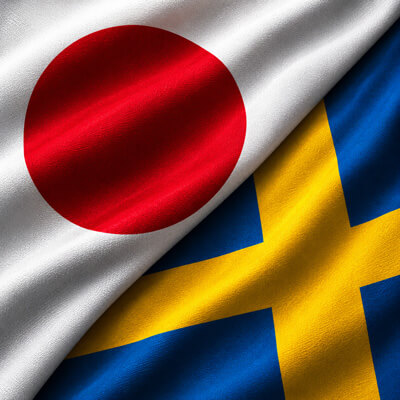
Japan vs. Sweden
Ended Jun 25, 2026, 23:00 UTC
Market resolution
Polymarket reports Draw as the winning outcome for the Japan vs. Sweden prediction market with a final probability of 100%. The market closed on Jun 25, 2026, 23:00 UTC. Final reported trading volume was $39.73M.
Final probabilities, volume, and open interest are sourced from Polymarket and were last synced at Jun 26, 2026 2:22 am.
Can Japan’s lead survive draw-heavy World Cup incentives?
The screen gives Japan the clearest path, yet the draw sits close enough to Sweden to make game-state incentives central. The path to repricing likely runs through qualification math, lineup information, and clarity on how conservative each side can afford to be.


Japan’s lead is best read as a conditional story: the market is rewarding Japan with the largest single outcome price, while keeping enough probability in both Sweden and the draw to signal that match control and settlement context matter as much as a simple team-strength view. That matters because this is a three-result World Cup market; confidence in one side has to compete with the structural pull of a draw and with incentives that may only become visible once tournament context is known.
Japan’s price implies a lead without a dominant-match assumption
At 43.5% for Japan, 29.5% for Sweden, and 27.5% for the draw, the market-implied story favors Japan while keeping nearly three-fifths of probability outside a Japan win. The causal read is that Japan gets credit for the most likely win path, while the market has resisted converting that into a near-binary call. For editorial purposes, the important signal is the gap between Japan and Sweden, coupled with the draw sitting almost level with Sweden. The price is saying Japan can be the preferred side in pre-match terms while a stalemate remains a credible competitor to either team winning.
That shape matters because any new information that increases expected separation between the teams would likely affect the opponent and draw buckets at the same time. Information that points to a tighter game can pressure both win outcomes at once and make the draw the main beneficiary. In a three-way market, Japan’s lead carries two separate assumptions: a greater chance of outscoring Sweden and a match profile that avoids drifting into a low-event stalemate.
The draw is the price anchor because it competes with both teams
The 27.5% draw price is the most important constraint on the two win prices. Because the rules list a draw as its own outcome, the market is allocating meaningful weight to a result that can be produced by balanced strength, conservative late-game incentives, or poor finishing. This matters for repricing because a draw can remain stable even if sentiment shifts between Japan and Sweden; that would keep the total space available to either win outcome capped.
| Market clue | Pricing inference |
|---|---|
| Japan is the highest-priced outcome | The market gives Japan the clearest single win path. |
| Draw sits close to Sweden | A low-separation match script is central to the current structure. |
| $979.93K liquidity versus $51.82K volume | Displayed depth exceeds realized turnover, so catalysts can still matter. |
| June 25, 2026 close | Future tournament context has ample time to enter the price. |
Displayed liquidity can make the price look steadier than conviction
The quoted liquidity of $979.93K against $51.82K in volume and $25.57K open interest creates a different editorial signal from the win probabilities themselves. Liquidity can make the market look deep at the top of the page, while realized volume and open interest show how much positioning has actually accumulated. The distinction matters because a price supported by available liquidity can still move quickly if a catalyst causes order books to be refreshed, pulled, or repriced.
That structure also helps explain why Japan can hold a clear lead without the market settling around a single narrative. The fixture closes on June 25, 2026, leaving a long runway for information to enter: squad selections, injuries, suspensions, starting lineups, venue-specific conditions, and tournament-table incentives are all hypothetical catalysts until documented by official or reliable sources. A long pre-match window raises the value of optionality, which tends to keep secondary outcomes alive.
Tournament incentives can matter as much as team strength
The biggest hidden assumption is that both teams will pursue a win with similar urgency. That may hold in a vacuum, yet World Cup matches are rarely priced only on pre-tournament team preference once earlier results start shaping qualification math. If this game arrives with one side needing a win and the other able to advance with a draw, the draw price could become more sensitive than either team’s baseline probability. If both sides need three points, the same fixture could tilt toward a higher-variance profile that redistributes probability from the draw to the win outcomes.
This is why the close date matters. A late-June 2026 settlement means official tournament context will eventually enter the price alongside pre-event assumptions. Before that context is known, the current structure can be read as a compromise: Japan is granted the strongest win path, Sweden is close enough to demand respect in the pricing, and the draw preserves space for incentive-driven caution.
Repricing would likely start with information that changes the game script
The most direct catalysts are those that alter the probability of one team controlling territory, tempo, or late-game incentives. Because the supplied market context does not include team news, any discussion of injuries, tactical changes, or squad decisions must be treated as hypothetical. The same applies to venue effects or weather: these would matter only once sourced, because they change scoring conditions and the plausibility of a draw.
- Official squad or lineup news that changes expected chance creation could move Japan and Sweden while simultaneously shifting the draw.
- Earlier World Cup results, if applicable to qualification math, could change whether a draw is useful to either side.
- Clarification of settlement wording or match timing, if any ambiguity emerges, would matter because the draw is a listed outcome.
- A sharp increase in volume or open interest would show that the price is being tested by more committed positioning alongside displayed liquidity.
Sweden gaining while the draw holds would challenge the current story
The main failure mode for the current market-implied story is a Sweden-led repricing that leaves the draw stable. If Sweden gains mainly at Japan’s expense, the market would be shifting its team-strength assumption. If Sweden gains alongside the draw, the story would be about Japan’s path narrowing through a tighter match profile. Those are different signals, and separating them matters because the draw can disguise whether the market is reacting to Sweden specifically or to a lower-separation game.
The pricing tells a restrained story: Japan is the leading single outcome, Sweden remains close enough to prevent a two-horse simplification, and the draw is large enough to discipline both win prices. The next meaningful moves are most plausibly tied to evidence that changes the expected game script, the qualification incentives, or the credibility of a stalemate under the event’s listed rules.
Sources
Market details
- Resolution criteria
- This event is for the upcoming FIFA World Cup game, scheduled for Thursday, June 25, 2026 between Japan and Sweden.
- Platform
-


- Category
- Sports › World Cup
- Close date
- June 25, 2026, 11:00 PM UTC
- Settlement source
- fifa.com
- Market rules summary
- Multi-outcome Polymarket event. Each listed option is represented by its Yes price on the underlying market. View full rules
Frequently asked questions
What was the final result of the Japan vs. Sweden prediction market?
Polymarket reports Draw as the winning outcome for the Japan vs. Sweden prediction market with a final probability of 100%. The final market snapshot includes $39.73M volume and $26.07M open interest. CryptoSlate last synced the final market data at Jun 26, 2026, 01:22 UTC.
How does the Japan vs. Sweden prediction market resolve?
This event is for the upcoming FIFA World Cup game, scheduled for Thursday, June 25, 2026 between Japan and Sweden. Multi-outcome Polymarket event. Each listed option is represented by its Yes price on the underlying market. The settlement source listed for this market is fifa.com.
Related World Cup markets
 Spain vs. Argentina
 France vs. England
 England vs. Argentina