
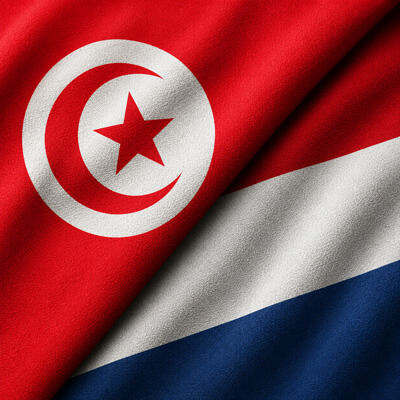
Tunisia vs. Netherlands
Ended Jun 25, 2026, 23:00 UTC
Market resolution
Polymarket reports Netherlands as the winning outcome for the Tunisia vs. Netherlands prediction market with a final probability of 100%. The market closed on Jun 25, 2026, 23:00 UTC. Final reported trading volume was $10.16M.
Final probabilities, volume, and open interest are sourced from Polymarket and were last synced at Jun 26, 2026 2:12 am.
Netherlands Win Price Faces Its Real Test in Draw Risk
The market leans heavily toward Dutch control, yet the listed draw outcome reveals a different pressure point: whether superiority converts before tournament incentives slow the game. Squad news, group-table context, and official match updates could carry growing weight beside broad team reputation as kickoff nears.


The market is pricing Tunisia-Netherlands as a favorite-versus-friction match: Netherlands carries the dominant win share, while the draw sits high enough to show that the main challenge is converting superiority into a result inside a World Cup setting. That structure matters because a single match can reprice quickly when team news, group incentives, or match tempo changes the path from control to scoreboard.
The favorite price depends on superiority translating into goals
At 74.5% for Netherlands, 16.5% for the draw, and 9.5% for Tunisia, the market-implied story gives the Dutch side a clear first claim on the result. That is an inference from the listed prices, since the supplied context provides market terms and settlement sources, without team rankings, squad lists, or recent form. The significance is that the price is doing two things at once: assigning a large probability to Netherlands winning and treating a Tunisia win as a narrower route than a stalemate.
That split matters in soccer because a favorite can control territory and still fail to turn control into the official result. The combined non-Netherlands outcomes sit above one quarter of the market, with the draw taking the larger share of that resistance. The market is therefore pricing Tunisia’s most plausible path through containment before it prices a direct upset path through outscoring Netherlands.
The draw share shows how tournament incentives can interfere with dominance
The draw option is the pressure point in this market because it can be strengthened by incentives that are external to raw team quality. The match is scheduled for June 25, 2026, and the World Cup context means the group-table situation before kickoff could affect both teams’ tolerance for risk. If a point would meaningfully improve one side’s qualification position, a slower match script could become more plausible; if both teams need a win, the draw channel could lose some support.
This is a hypothetical catalyst because the supplied context does not include the group standings or prior match results. Still, it matters because the market must price the June fixture before knowing what the June 25 incentive map will look like. The closer the match gets, the more the draw price may function as a measure of group-stage pressure, not only team-strength comparison.
The calendar makes early assumptions vulnerable to squad information
The close date, June 25, 2026 at 11:00 PM UTC, leaves a long runway for information that can reshape the market’s baseline. National-team squads, injury availability, suspensions from earlier tournament matches, and starting lineups can all alter how much weight the market gives to the favorite’s conversion path. Because the current context does not provide roster specifics, the price is leaning on broad pre-match priors until official team information arrives.
That timing matters because the favorite’s large share may be sensitive to any news that affects finishing, chance creation, or defensive stability. A confirmed full-strength Netherlands lineup would support the existing story of control converting into victory. A hypothetical rotation signal, an injury to a central attacker or defender, or a suspension from a prior match could push attention toward the draw and Tunisia channels because the market would have to reassess how resilient the favorite’s win route is.
Liquidity supports the quoted shape, volume limits the consensus signal
The market shows $72.36K in volume, $997.21K in liquidity, and $44.87K in open interest. That matters because the quoted probabilities sit inside a relatively liquid market structure, yet the traded volume and open interest remain modest compared with the displayed liquidity. The result is a price that can look stable while still leaving room for sharper movement when match-specific information replaces broad assumptions.
| Market signal | Hidden assumption | Why it matters |
|---|---|---|
| Netherlands at 74.5% | Control turns into goals | The favorite path depends on execution, not only superiority |
| Draw at 16.5% | Containment is more plausible than a Tunisia win | Group incentives and tempo can lift the stalemate route |
| Tunisia at 9.5% | Upset requires a narrower match script | Early goals, set pieces, or lineup surprises would matter quickly |
The table captures why liquidity matters for interpretation. A well-quoted market can anchor a broad thesis, but the strongest repricing events are likely to come from information that changes the assumptions in the middle column. That makes official FIFA match details, team announcements, and the group-state context more important than the headline favorite share alone.
The main counter-signal is a match script that slows the favorite
The strongest challenge to the market-implied story is a low-event match in which Netherlands has possession without separation. Since the event includes a draw outcome and settles against the official FIFA result source, game state carries direct pricing force. A scoreless first half, a conservative tactical setup, or a hypothetical Tunisia goal against the run of play would increase the relevance of the draw and Tunisia outcomes because the favorite would need to solve both the clock and the opponent.
That counter-signal matters before kickoff as well. Any evidence pointing to defensive caution, reduced attacking personnel, or group-table incentives favoring restraint would weaken the clean favorite narrative and shift the market’s focus toward how Netherlands wins, not only whether it is the stronger side on paper. Conversely, official information showing a first-choice Dutch setup and a game context that rewards aggression would help confirm why the market assigns the Netherlands win path such a large share.
Sources
Market details
- Resolution criteria
- This event is for the upcoming FIFA World Cup game, scheduled for Thursday, June 25, 2026 between Tunisia and Netherlands.
- Platform
-


- Category
- Sports › World Cup
- Close date
- June 25, 2026, 11:00 PM UTC
- Settlement source
- fifa.com
- Market rules summary
- Multi-outcome Polymarket event. Each listed option is represented by its Yes price on the underlying market. View full rules
Frequently asked questions
What was the final result of the Tunisia vs. Netherlands prediction market?
Polymarket reports Netherlands as the winning outcome for the Tunisia vs. Netherlands prediction market with a final probability of 100%. The final market snapshot includes $10.16M volume and $5.45M open interest. CryptoSlate last synced the final market data at Jun 26, 2026, 01:12 UTC.
How does the Tunisia vs. Netherlands prediction market resolve?
This event is for the upcoming FIFA World Cup game, scheduled for Thursday, June 25, 2026 between Tunisia and Netherlands. Multi-outcome Polymarket event. Each listed option is represented by its Yes price on the underlying market. The settlement source listed for this market is fifa.com.
Related World Cup markets
 Spain vs. Argentina
 France vs. England
 England vs. Argentina