
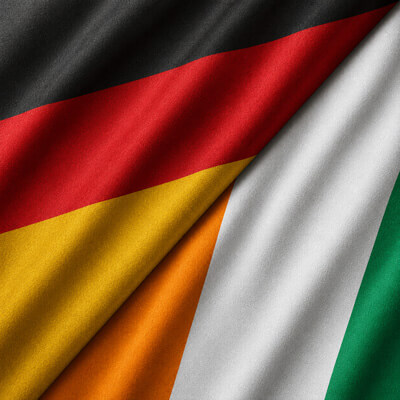
Germany vs. Côte d’Ivoire
Ended Jun 20, 2026, 20:00 UTC
Market resolution
Polymarket reports Germany as the winning outcome for the Germany vs. Côte d’Ivoire prediction market with a final probability of 100%. The market closed on Jun 20, 2026, 20:00 UTC. Final reported trading volume was $42.52M.
Final probabilities, volume, and open interest are sourced from Polymarket and were last synced at Jun 20, 2026 11:42 pm.
Germany’s strong price faces World Cup draw and rotation traps
The market is telling a story of German control, yet the draw line and deep liquidity leave room for match-state, lineup, and group-table surprises to matter. The question is how much of the favorite’s price rests on assumptions that may only become visible near kickoff.


Germany is priced as the clear winner because the market-implied story treats this as a matchup where favorite quality should produce territorial control and enough scoring chances to beat both Côte d’Ivoire and the draw. The size of the draw quote, however, shows that the market is also paying for the familiar World Cup constraint: one game, limited scoring events, and tournament incentives can compress a gap that looks wider before kickoff.
Germany’s price leans on control, conversion, and game-state stability
As a Polymarket multi-outcome event, the listed Yes prices put Germany at $0.635, Côte d’Ivoire at $0.165, and the draw at $0.205. That distribution matters because it does more than rank the teams. It implies Germany is expected to set the terms of the match often enough that a neutral result still sits behind the win outcome. The causal assumption is tempo: if Germany can keep possession in safer areas, limit transition exposure, and avoid chasing the game, the favorite’s path becomes cleaner.
The market may also be placing weight on assumed squad depth, but the supplied market data leaves rosters, injuries, venue, and group standings unresolved. That absence matters because this price has to absorb assumptions that will eventually become concrete. A strong German lineup would confirm the control narrative; evidence of rotation, fitness management, or awkward rest dynamics would make the top outcome more dependent on finishing variance.
The draw price says containment has its own path
The draw at $0.205 is meaningful because it sits above Côte d’Ivoire’s win price. In market terms, a low-scoring match state appears more plausible than a full underdog win. That aligns with a World Cup incentive logic in which the underdog’s most attainable path may be slowing rhythm, protecting central spaces, and turning the game into fewer decisive moments. If that game script gains support through lineup or tactical news, the draw share could become the main pressure point on Germany’s price.
For Côte d’Ivoire, the price allows an upset pathway while treating it as requiring more conditions: early scoring leverage, set-piece value, transition chances, or a German error that changes risk appetite. The so-what for pricing is asymmetry of paths. A draw can emerge from containment; a Côte d’Ivoire win likely needs containment plus a decisive event.
Late information can matter because the market is already deep
With $571.78K in volume, $1.9M in liquidity, and $336.99K in open interest, this market has enough participation for late information to show up visibly. The significance is editorial: deeper liquidity can reveal which assumptions participants are willing to defend as kickoff approaches. Here, team-news shocks, official lineup releases, or credible injury reporting could be incorporated quickly because the market already has a sizable base of open exposure.
The close date, June 20, 2026 at 8:00 PM UTC, creates a long runway for repricing because the market is open well before final tournament context is known. That matters because World Cup matches are context-sensitive. If this game arrives after either side has already banked points or faces qualification pressure, incentives around risk, rotation, and substitution timing can change the practical meaning of pre-match strength.
Group incentives could challenge a simple favorite-underdog read
The cleanest hidden assumption is that both teams need the same result and will optimize for a win from the opening whistle. A different table setup could alter that premise. A team satisfied with a draw may tolerate sterile possession or slower restarts; a team needing three points may open space earlier. Because the market includes a draw as a distinct outcome, those incentive shifts matter directly to all three prices.
| Possible evidence | Why it matters to pricing |
|---|---|
| Germany names an aggressive, first-choice attack | Supports the control-and-conversion story behind the favorite price |
| Côte d’Ivoire signals a compact, transition-focused setup | Adds weight to the draw-led containment path |
| Table math rewards caution for either side | Raises the relevance of slower tempo and risk management |
| Fitness or suspension news affects finishers or central defenders | Changes the balance between draw pressure and upset pathways |
Resolution is tied to the upcoming FIFA World Cup game listed for June 20, so official FIFA match status and result are the core reference points. This makes postponement, venue, and official match designation more than logistics; they determine whether the same event assumptions being priced today still match the contest that ultimately settles.
German frustration is the failure mode the draw is pricing
The strongest counterargument to the current hierarchy is that single-match football outcomes often hinge on moments that a favorite’s pre-match price cannot fully specify. The market already gives the draw a significant role, which means the central threat to Germany’s price may come from evidence that the match can stay level deep into the second half. That could be a conservative German lineup, a Côte d’Ivoire setup built for transition restraint, adverse fitness news, or incentives that reward caution.
Evidence that would confirm the current hierarchy would be more direct: Germany naming a strong attacking XI, pre-match reporting that points to high urgency, or early World Cup results that force a win-oriented approach. Evidence that weakens it would cluster around friction: absences, rotation, or a table scenario where a draw carries enough value to reduce risk-taking. The market’s current shape is therefore a claim about match control staying stronger than tournament friction, with the draw price marking the place where that claim is most vulnerable.
Sources
Market details
- Resolution criteria
- This event is for the upcoming FIFA World Cup game, scheduled for Saturday, June 20, 2026 between Germany and Côte d'Ivoire.
- Platform
-


- Category
- Sports › World Cup
- Close date
- June 20, 2026, 8:00 PM UTC
- Settlement source
- fifa.com
- Market rules summary
- Multi-outcome Polymarket event. Each listed option is represented by its Yes price on the underlying market. View full rules
Frequently asked questions
What was the final result of the Germany vs. Côte d’Ivoire prediction market?
Polymarket reports Germany as the winning outcome for the Germany vs. Côte d’Ivoire prediction market with a final probability of 100%. The final market snapshot includes $42.52M volume and $16.84M open interest. CryptoSlate last synced the final market data at Jun 20, 2026, 22:42 UTC.
How does the Germany vs. Côte d’Ivoire prediction market resolve?
This event is for the upcoming FIFA World Cup game, scheduled for Saturday, June 20, 2026 between Germany and Côte d'Ivoire. Multi-outcome Polymarket event. Each listed option is represented by its Yes price on the underlying market. The settlement source listed for this market is fifa.com.
Related World Cup markets
 Spain vs. Argentina
 France vs. England
 England vs. Argentina