
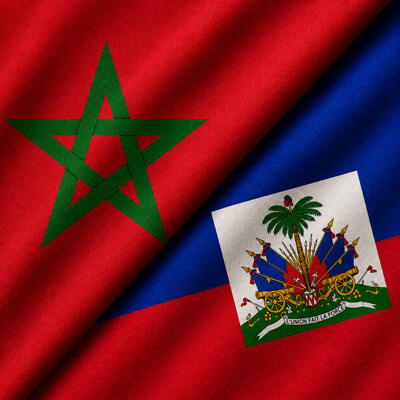
Morocco vs. Haiti
Final Results
Scheduled deadline: Jun 24, 2026, 22:00 UTC
Market Resolution
Polymarket reports Morocco as the winning outcome for the Morocco vs. Haiti prediction market with a final probability of 100%. Scheduled deadline: Jun 24, 2026, 22:00 UTC. Final reported trading volume was $27.42M.
Polymarket · Final sync
Market Analysis
Morocco’s favorite status hinges on Haiti avoiding a low-event game

The split points to a market comfortable with Morocco’s control, while the draw still has a real path through tempo and tournament incentives. The useful question is which missing pre-match facts can turn a heavy favorite into a tighter one-game outcome.

Morocco’s price is built on the idea that the market-implied stronger side can turn control into a result, while Haiti’s best route is concentrated in delay, compression, and one-game variance. That matters because this market is resolving a single FIFA World Cup match on June 24, 2026, where the same market-implied gap can produce a win, a draw, or a late swing depending on game state.
Morocco’s price is a claim about sustained control
At $0.755 for Morocco, $0.165 for the draw, and $0.085 for Haiti, the market-implied story is clear: Morocco is expected to spend more of the match in positions where its win condition is live. That inference comes from the odds; no ranking table is supplied in the market context. The price has to assume more than a pre-match talent gap; it also assumes Morocco can convert that gap into shots, territory, and protection against the equalizer.
This matters because the favorite price is sensitive to sequencing. An early Morocco goal would validate the control assumption by forcing Haiti to open space. A long scoreless first half would place more weight on the draw branch, since every minute without separation makes the favorite’s remaining path narrower. The current distribution therefore treats Morocco’s advantage as durable across both the opening phase and the late-game phase.
The draw price exposes Haiti’s most credible route
The draw Yes price is almost double Haiti’s outright Yes price, a meaningful clue about how the market ranks underdog paths. Haiti’s market-implied route is more likely to involve preventing a decisive Morocco result than taking full control of the match. That matters because positive Haiti signals may first affect the draw share: defensive structure, goalkeeper availability, or a tournament situation where a point has value would all support the stalemate path if those conditions emerge.
The reverse also applies. Evidence that Morocco needs margin, selects an attacking lineup, or faces a Haiti team forced to chase the game would weaken the draw’s role. Those are hypothetical pre-match scenarios at this stage; the supplied context establishes the fixture, odds, settlement source, and timing, while team sheets and group-table incentives will arrive much closer to kickoff.
Deep listed liquidity can make an early number look settled
The market shows $78.86K in volume, $46.72K in open interest, and nearly $996.87K in liquidity. That mix matters because the visible price can appear firm while the amount of resolved disagreement is still modest for a World Cup fixture with a long runway. The close date leaves months for new information to shift the assumptions behind the current split.
Large liquidity also changes the editorial read of the price. It suggests there is capacity for meaningful price changes when information arrives, yet the existing volume indicates limited stress-testing against confirmed match context. In practical analytical terms, the price is an early consensus around relative team strength, with future catalysts likely to determine how much of that consensus survives into kickoff week.
Repricing pressure should come from match context
Because settlement follows the FIFA result and Polymarket lists three outcomes, the eventual official scoreline is the only resolution fact that matters. Before then, the largest odds moves would likely come from information that changes the expected match script. The strongest catalysts are concrete, dated, and verifiable close to the event.
| Possible new information | Why it would matter |
|---|---|
| Confirmed Morocco absences or rotation | Reduces confidence in sustained pressure and late-game control. |
| Confirmed Haiti absences | Makes the draw-prevention route harder to sustain. |
| Group-table incentives after earlier matches | Can change whether either side benefits from a conservative posture. |
| Weather, venue, or referee context if officially available | Could affect tempo, stoppages, and set-piece importance. |
| Opening lineups and tactical shape | Forces the market to replace national-team priors with personnel-specific assumptions. |
The main failure mode is a narrow match that lasts too long
The clearest counter-signal to Morocco’s pricing is a match script where Haiti keeps the game narrow past the point at which pre-match quality dominates the conversation. A 0-0 score deep into the first half, limited Morocco chance quality, or early signs that Haiti can exit pressure would push the market toward the draw branch because the outcome tree compresses quickly in football.
That failure mode matters even without a Haiti goal. Since the Haiti win price is far below the draw price, the market is already saying the underdog’s strongest disruption is stalemate pressure. The relevant counter-signal is evidence that Morocco’s expected control fails to produce separation soon enough, with Haiti’s outright takeover remaining a smaller branch according to the listed prices.
For now, the market-implied thesis gives Morocco command of the result and assigns Haiti a narrower but coherent route through delay. The close date and liquidity profile make the setup highly sensitive to late-arriving facts: lineups, incentives, and match conditions can move the balance between a controlled favorite win and a draw-shaped upset path long before FIFA publishes the final result.
Sources
Market Details
- Resolution criteria
- This event is for the upcoming FIFA World Cup game, scheduled for Wednesday, June 24, 2026 between Morocco and Haiti.
- Platform
-


- Category
- Sports
- Scheduled deadline
- June 24, 2026, 10:00 PM UTC
- Settlement source
- fifa.com
- Market rules summary
- Multi-outcome Polymarket event. Each listed option is represented by its Yes price on the underlying market. View full rules
Frequently Asked Questions
What was the final result of the Morocco vs. Haiti prediction market?
Polymarket reports Morocco as the winning outcome for the Morocco vs. Haiti prediction market with a final probability of 100%. The final market snapshot includes $27.42M volume and $12.82M open interest. CryptoSlate last synced the final market data at Jun 25, 2026, 00:32 UTC.
How does the Morocco vs. Haiti prediction market resolve?
This event is for the upcoming FIFA World Cup game, scheduled for Wednesday, June 24, 2026 between Morocco and Haiti. Multi-outcome Polymarket event. Each listed option is represented by its Yes price on the underlying market. The settlement source listed for this market is fifa.com.
Related Markets
 Spain vs. Argentina
 France vs. England
 England vs. Argentina