
Switzerland vs. Algeria
Final Results
Scheduled deadline: Jul 3, 2026, 03:00 UTC

Market Resolution
Polymarket reports Switzerland as the winning outcome for the Switzerland vs. Algeria prediction market with a final probability of 100%. Scheduled deadline: Jul 3, 2026, 03:00 UTC. Final reported trading volume was $16.1M.
Polymarket · Final sync
Market Analysis
Switzerland’s edge faces a draw-heavy World Cup pricing test
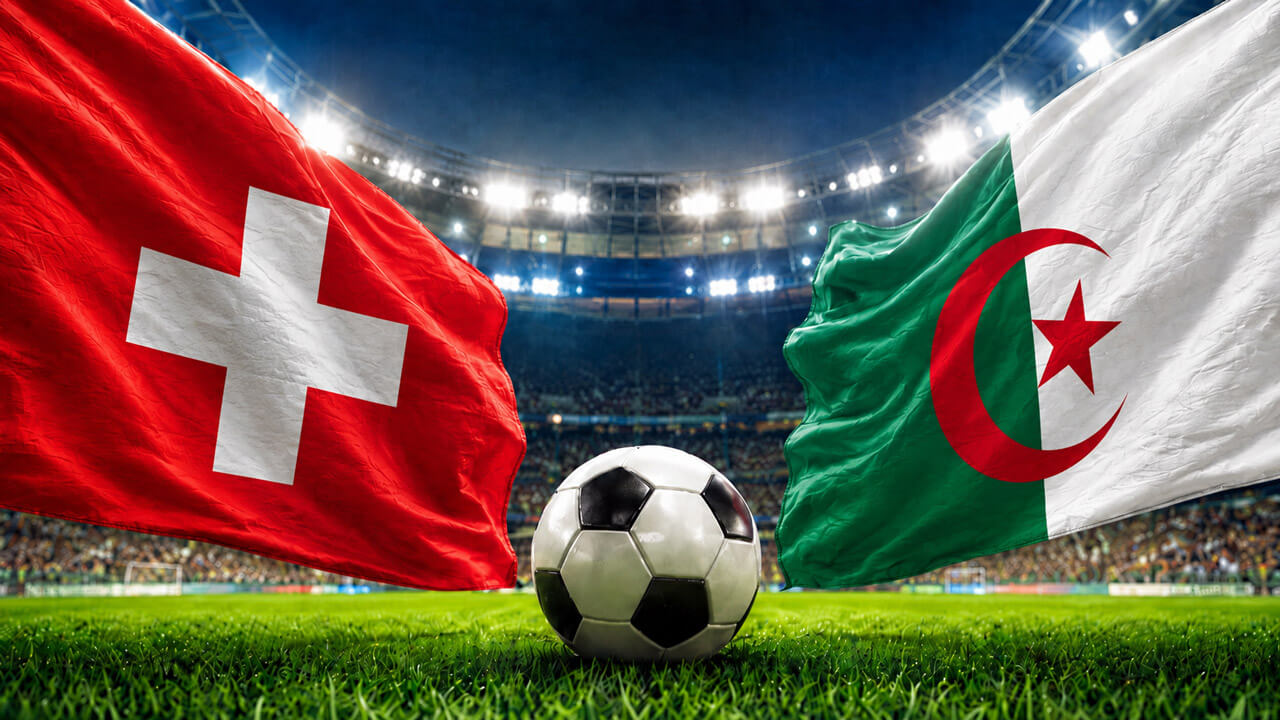
The market’s lean toward Switzerland rests on assumptions about matchup quality, single-match fragility, and the way a three-way World Cup price absorbs caution. The draw sits close enough to matter, turning team news and tournament incentives into potential catalysts for a reshaped distribution.

This market is pricing Switzerland as the clear preferred side while stopping short of a majority-style win case. That split is the useful signal: the odds imply a team-strength lean toward Switzerland, yet the separate draw outcome is large enough to restrain the favorite and make match context the main source of future movement.
Switzerland leads because the market starts from a quality gap
An inference from the listed odds is straightforward: Switzerland at 47.5% versus Algeria at 23.5% gives Switzerland roughly twice Algeria’s win probability. That matters because the debate starts with a Switzerland preference and then asks how much of that preference survives the draw bucket in a single World Cup match.
The 28.5% draw price keeps Switzerland’s case below a clean majority. For the market, a Switzerland-positive update has to do more than improve perceptions of the team; it has to pull probability away from either Algeria or the draw. That distinction makes lineup intent, match tempo, and tournament incentives especially important once concrete information arrives.
The draw is the swing outcome in this pricing structure
Because the rules list Draw (Switzerland vs. Algeria) as a separate option, every update has to be sorted into three places. A cautious setup, a low-event match script, or a scenario where both teams tolerate a point would naturally feed the draw outcome first. These scenarios are hypotheticals drawn from the market structure, since the supplied context gives no tactical, roster, or group-table evidence.
- Switzerland’s price implies a perceived advantage that still needs conversion into a win.
- Algeria’s price implies a credible upset path, though smaller than the stalemate path.
- The draw’s size means defensive or incentive-based news can matter as much as team-strength news.
Displayed depth can keep early priors in place
The market shows $575.18K in liquidity, $118.75K in volume, and $103.19K in open interest. Inferred from market data, that mix suggests a market with meaningful displayed capacity and existing exposure, while the traded volume leaves plenty of scope for later information to reshape the distribution as the match approaches.
| Market evidence | Why it matters for pricing |
|---|---|
| $575.18K liquidity | Displayed depth can absorb minor flow, keeping the broad shape stable until stronger information arrives. |
| $118.75K volume | The market has enough activity to form a view, with room for fresh information to carry weight. |
| $103.19K open interest | Existing exposure creates a reason for rapid adjustment around official updates. |
The long runway to the July 3, 2026 close also matters. Early prices can encode broad assumptions about relative strength, while late prices can become more sensitive to final squads, injuries, suspensions, and starting lineups if those public details emerge before settlement.
Algeria’s path has to separate from the draw
Algeria’s 23.5% price keeps the underdog outcome live in the market’s story. The important distinction is that Algeria strength has to be expressed as a win, since the draw already has its own lane. Evidence that merely supports resistance or containment could feed the draw more directly than the Algeria win outcome.
The main failure mode for Switzerland’s lead is a match environment where superiority turns into control without separation. A hypothetical lineup pattern built for caution, fatigue management, or tournament positioning could move attention away from Switzerland’s win and toward draw. A genuine Algeria-positive catalyst would need to show a path from survival into scoring and match control.
Rules clarity and team sheets are the cleanest repricing triggers
The settlement source is FIFA’s World Cup page, while Polymarket rules define this as a multi-outcome event with each option represented by its Yes price. That matters because a listed draw outcome makes any settlement clarification around result treatment highly relevant if ambiguity appears before the game.
- Provider or FIFA clarification on the relevant result convention if questions arise.
- Official fixture updates that affect timing, venue assumptions, or match status.
- Final squad news, injuries, suspensions, or tactical signals from public pre-match information.
- Starting lineups that indicate whether either side is prioritizing aggression, control, or caution.
- Hypothetical tournament-table incentives from earlier results that change each team’s need to win.
The current pricing holds together if later information reinforces Switzerland as the stronger win candidate and gives little support to a draw-heavy script. It becomes more fragile if public evidence clusters around stalemate mechanisms or Algeria-specific attacking credibility. The distribution is split across three credible buckets, so the catalyst that matters most is the one that changes which bucket explains the match best.
Sources
Market Details
- Resolution criteria
- This event is for the upcoming FIFA World Cup game, scheduled for Thursday, July 2, 2026 between Switzerland and Algeria.
- Platform
-


- Category
- Sports
- Scheduled deadline
- July 3, 2026, 3:00 AM UTC
- Settlement source
- fifa.com
- Market rules summary
- Multi-outcome Polymarket event. Each listed option is represented by its Yes price on the underlying market. View full rules
Frequently Asked Questions
What was the final result of the Switzerland vs. Algeria prediction market?
Polymarket reports Switzerland as the winning outcome for the Switzerland vs. Algeria prediction market with a final probability of 100%. The final market snapshot includes $16.1M volume and $7.36M open interest. CryptoSlate last synced the final market data at Jul 3, 2026, 05:37 UTC.
How does the Switzerland vs. Algeria prediction market resolve?
This event is for the upcoming FIFA World Cup game, scheduled for Thursday, July 2, 2026 between Switzerland and Algeria. Multi-outcome Polymarket event. Each listed option is represented by its Yes price on the underlying market. The settlement source listed for this market is fifa.com.
Related Markets
 Spain vs. Argentina
 France vs. England
 England vs. Argentina