
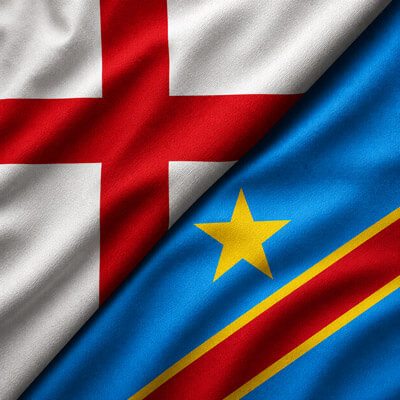
England vs. DR Congo
Final Results
Scheduled deadline: Jul 1, 2026, 16:00 UTC

Market Resolution
Polymarket reports England as the winning outcome for the England vs. DR Congo prediction market with a final probability of 100%. Scheduled deadline: Jul 1, 2026, 16:00 UTC. Final reported trading volume was $25.4M.
Polymarket · Final sync
Market Analysis
England’s Heavy Favorite Status Leaves Room for World Cup Friction
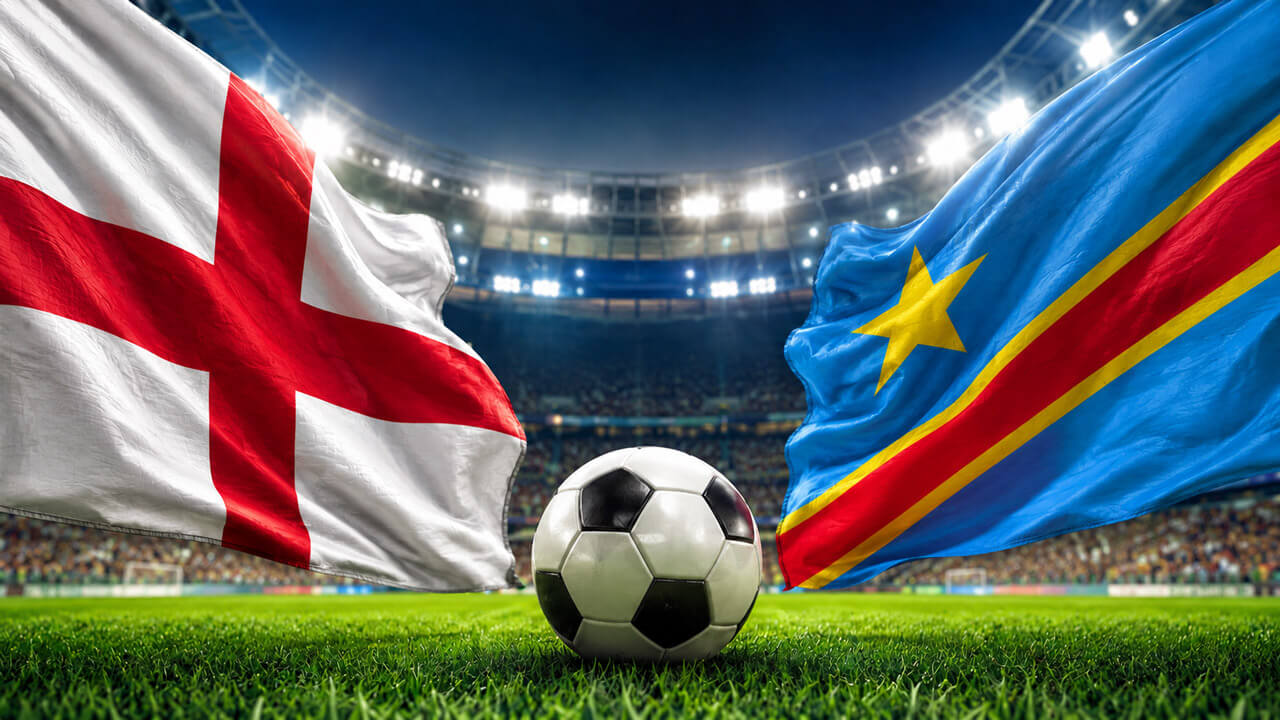
The price leans on a simple hierarchy: England’s reputation carries more weight than the match-specific risks that can surface near kickoff. The analytical tension sits in how much of that confidence comes from team-strength priors versus assumptions still waiting for lineups, incentives, and official match detail.

This market treats an England win as the central case, with the price at 77.5% against 16.5% for a draw and 6.5% for DR Congo. The inference is that pre-match team-strength priors dominate the single-game risks attached to a World Cup fixture. That matters because fresh evidence that reinforces or damages that hierarchy should carry more price relevance than the mere passage of time.
The price starts with a hierarchy that favors England’s baseline
The strongest explanation for the England-heavy line is the market-implied hierarchy between the teams. The supplied context omits rankings, rosters, venue, recent form, and tournament-stage incentives, so the price itself is carrying much of that hierarchy. In that setting, England’s quote functions as a reputation and depth proxy: the market implies expectation of greater chance creation, control, and resilience across normal match states.
That matters because reputation-led prices can stay stable until concrete information arrives, then react to details that were absent from the original premise. An official squad, a key absence, a tactical change, or a match context that reduces attacking incentive would matter more here than generic World Cup attention. The current split leaves DR Congo with a narrow outright-win path, while the draw carries a larger share of the resistance to England’s baseline.
The draw price is the market’s restraint on the favorite story
The 16.5% draw price is the market’s check on a clean England narrative. Its position above DR Congo’s 6.5% price implies the most credible alternative to an England win is a match state where perceived superiority fails to convert into a decisive result. Because the market lists a draw as a separate settlement path, the non-England side can carry weight without an equal-strength assumption.
This matters for catalysts because draw-sensitive information can pull from both sides. A hypothetical weather forecast or tactical setup that points to lower scoring would strengthen the logic behind a level result, while a confirmed aggressive England lineup could pressure the draw before saying much about DR Congo’s own upset route. The draw is the clearest signal of how much single-match friction the market is willing to price alongside England’s structural advantage.
High liquidity can make a thinly tested view look settled
Liquidity of $460.4K sits far above the $19.69K in volume and $18.25K in open interest. That ratio matters because the visible price can look well anchored while completed disagreement remains modest. Inference from these fields: passive liquidity may be giving the market a firm surface, even though the final information set for the match is still forming.
The practical effect is a line that may absorb casual activity without proving that a broad, information-rich consensus has formed. In a pre-match sports market, liquidity can stabilize quotes before the inputs that matter most—lineups, injuries, role assignments, and tournament incentives—become available. That makes the England price a cleaner read on prior belief than on match-specific evidence.
Final pre-match information has a direct path into the odds
The market closes on July 1, 2026, the same date listed for the fixture, with FIFA identified as the settlement source. That timing matters because late, source-verifiable updates can still challenge the assumptions behind the current structure. Since the listed materials omit squad status and venue conditions, official information in those areas would have a direct path into the probabilities.
| Potential input | Why it would matter to this price |
|---|---|
| Official squad or injury news | Tests whether England’s favorite status rests on available first-choice players or broader national-team depth. |
| Confirmed starting lineups | Transforms reputation into match-specific evidence, especially if either side rotates or changes shape. |
| FIFA fixture or match-record update | Matters because resolution depends on the official source and the draw is a listed outcome. |
| Tournament incentive context | A hypothetical need for goal difference, rotation, or risk control could shift the balance between England and draw paths. |
The main failure mode is a match that compresses quality gaps
The strongest counterargument is that a one-off football match can compress differences between teams. DR Congo’s 6.5% outcome can become more salient through a red card, early goal, penalty, set-piece sequence, or goalkeeper error. These are hypothetical match events, yet they matter because the favorite price is built around the assumption that England’s superiority has enough time and possession to assert itself.
Before kickoff, the sharper counter-signal would be source-verifiable evidence that unavailable-player or incentive risk belongs inside the England premise. An England lineup missing assumed starters, a DR Congo setup that credibly limits chances, or a tournament scenario where a draw has strategic value would all work through the same channel: they would make the 16.5% draw outcome a stronger competitor to England’s 77.5% baseline.
Sources
Market Details
- Resolution criteria
- This event is for the upcoming FIFA World Cup game, scheduled for Wednesday, July 1, 2026 between England and DR Congo.
- Platform
-


- Category
- Sports
- Scheduled deadline
- July 1, 2026, 4:00 PM UTC
- Settlement source
- fifa.com
- Market rules summary
- Multi-outcome Polymarket event. Each listed option is represented by its Yes price on the underlying market. View full rules
Frequently Asked Questions
What was the final result of the England vs. DR Congo prediction market?
Polymarket reports England as the winning outcome for the England vs. DR Congo prediction market with a final probability of 100%. The final market snapshot includes $25.4M volume and $10.94M open interest. CryptoSlate last synced the final market data at Jul 1, 2026, 18:32 UTC.
How does the England vs. DR Congo prediction market resolve?
This event is for the upcoming FIFA World Cup game, scheduled for Wednesday, July 1, 2026 between England and DR Congo. Multi-outcome Polymarket event. Each listed option is represented by its Yes price on the underlying market. The settlement source listed for this market is fifa.com.
Related Markets
 Spain vs. Argentina
 France vs. England
 England vs. Argentina