
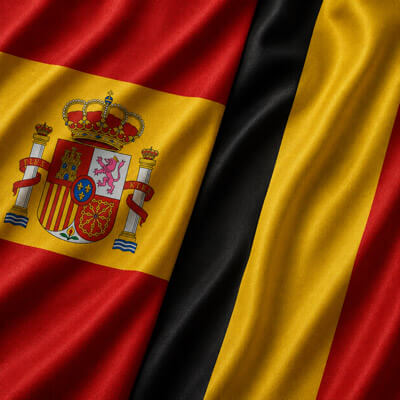
Spain vs. Belgium
Final Results
Scheduled deadline: Jul 10, 2026, 19:00 UTC

Market Resolution
Polymarket reports Spain as the winning outcome for the Spain vs. Belgium prediction market with a final probability of 100%. Scheduled deadline: Jul 10, 2026, 19:00 UTC. Final reported trading volume was $38.94M.
Polymarket · Final sync
Market Analysis
Spain’s Control Meets Belgium’s Veteran Punch in Quarter-Final Pricing
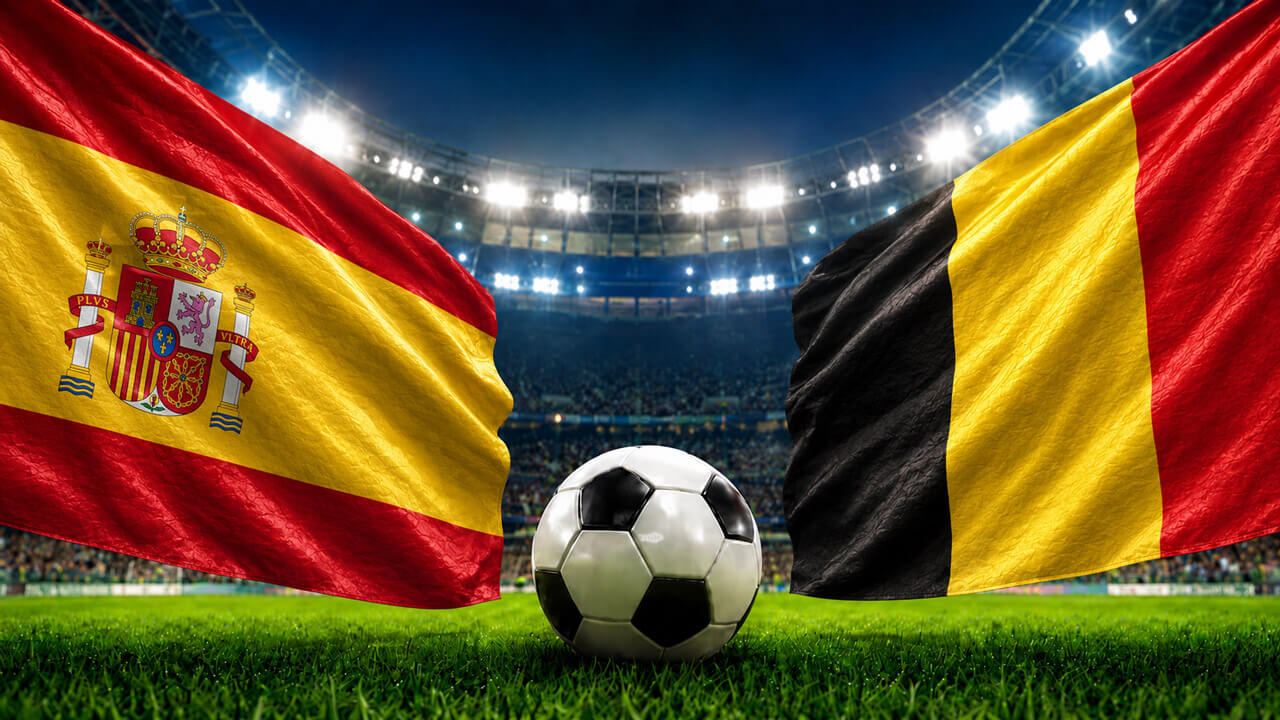
Spain’s price leans on recent tournament authority, a fit elite spine, and a narrow win over Portugal. Belgium’s 4-1 knockout surge keeps the underdog case alive because one De Bruyne-Lukaku performance can change the shape of this quarter-final quickly.

Spain’s 60.5% share of the market points to a clear favorite, yet the combined 41% assigned to a draw or Belgium win shows this quarter-final is being priced as a contest with meaningful upset and stalemate paths. The tension is simple: Spain bring the deeper recent resume and the cleaner squad story, while Belgium bring enough veteran match-winners to make one tactical or fitness development matter.
Spain’s favorite status rests on control, availability, and recent proof
The market-implied story starts with Spain’s tournament profile. FIFA lists Luis de la Fuente’s team as the reigning European champions, with Rodri, Pedri, Lamine Yamal, Nico Williams, and Unai Simón among the named 26-man World Cup squad. That matters because Spain’s price is supported by specific availability rather than reputation alone: their ball-winning, midfield control, wide threat, and goalkeeping spine are all represented in the confirmed squad context.
Spain’s 1-0 Round of 16 win over Portugal on July 6 adds a recent knockout data point that helps explain why the favorite side is carrying a premium. A narrow win over a major opponent signals defensive competence and game-state discipline, both valuable in a quarter-final where a single goal can dominate pricing. For this market, Spain’s appeal is tied to the idea that de la Fuente’s side can reduce variance by controlling territory and limiting Belgium’s transition volume.
Belgium’s 4-1 win keeps the underdog path visible
Belgium’s 16.5% price does not require the market to view them as equal to Spain across a full tournament sample. It only requires a credible route through one match. FIFA’s schedule context says Belgium reached this quarter-final by beating the United States 4-1 in the Round of 16, a result that gives the underdog case fresh evidence rather than a purely historical foundation.
The reason that matters is personnel concentration. Belgium’s named squad includes Kevin De Bruyne, Thibaut Courtois, Thomas Meunier, Axel Witsel, and Romelu Lukaku. FIFA also notes Lukaku is Belgium’s all-time leading scorer with 89 goals in 124 caps, while his season was hampered by injuries. That combination explains both sides of the market’s restraint: Belgium have enough high-impact players to punish Spain, yet their route is sensitive to fitness, minutes management, and whether Lukaku can sustain physical output against a possession-heavy opponent.
The draw price signals respect for a low-margin match script
The 24.5% draw price is the most important clue that the market is not treating Spain’s edge as a blowout assumption. In a quarter-final between two squads with elite experience, the draw outcome captures a script in which Spain have more of the ball while Belgium defend deeper, compress central areas, and wait for isolated attacks through De Bruyne’s passing or Lukaku’s hold-up play.
This matters because Spain’s 1-0 win over Portugal supports a controlled, low-scoring interpretation, while Belgium’s 4-1 win over the United States supports a more explosive counterargument. The market has to balance those signals. A Spain lead would validate the control thesis and could push attention toward Belgium’s need to chase. A scoreless first half, or early evidence that Belgium can slow Spain’s wingers, would make the draw outcome more central to the pricing conversation.
Late team news can outweigh broad tournament narratives
Because the match is FIFA World Cup 2026 Match 98, scheduled for July 10 at Los Angeles Stadium, the repricing window is concentrated around confirmed lineups, warm-up reports, and tactical selections. The market has $369.66K in volume, $4.44M in liquidity, and $253.66K in open interest, so new information can be expressed quickly if it changes assumptions about player availability or role.
The highest-impact triggers are straightforward:
- Spain midfield availability: any issue involving Rodri or Pedri would weaken the control-based case that supports Spain’s favorite status.
- Belgium attacking fitness: any positive or negative signal on Lukaku’s readiness would matter because Belgium’s chance creation can hinge on his finishing, hold-up play, and penalty-box presence.
- Courtois selection and condition: Belgium’s upset path improves if their goalkeeper is positioned to absorb Spain pressure over long stretches.
- Wing matchups: Spain’s use of Lamine Yamal and Nico Williams can force Belgium’s veteran defenders into repeated one-on-one decisions, changing the balance between control and transition risk.
The main failure mode is Belgium making Spain’s control feel sterile
The clearest counter-signal to Spain’s pricing would be Belgium turning Spain’s possession into low-quality territory. If De Bruyne finds early passing lanes behind Spain’s midfield, or if Lukaku pins centre-backs long enough to bring runners into play, the match can shift toward a pattern where Spain still control the ball while Belgium create the more dangerous moments. That scenario matters because it attacks the hidden assumption behind Spain’s price: that possession will translate into defensive security and repeatable chances.
Spain’s side of the market would be reinforced by early signs that Rodri and Pedri are dictating tempo, Yamal and Williams are forcing Belgium backward, and Unai Simón has little direct work. Belgium’s side would gain a stronger narrative if Courtois is tested but comfortable, De Bruyne receives the ball facing forward, and Lukaku looks physically capable of repeated duels. The current pricing is best read as a premium for Spain’s structure and recent tournament authority, with a meaningful allowance for Belgium’s veteran ceiling and the draw-heavy nature of elite knockout football.
Sources
Market Details
- Resolution criteria
- This event is for the upcoming FIFA World Cup game, scheduled for Friday, July 10, 2026 between Spain and Belgium.
- Platform
-


- Category
- Sports
- Scheduled deadline
- July 10, 2026, 7:00 PM UTC
- Settlement source
- fifa.com
- Market rules summary
- Multi-outcome Polymarket event. Each listed option is represented by its Yes price on the underlying market. View full rules
Frequently Asked Questions
What was the final result of the Spain vs. Belgium prediction market?
Polymarket reports Spain as the winning outcome for the Spain vs. Belgium prediction market with a final probability of 100%. The final market snapshot includes $38.94M volume and $20.09M open interest. CryptoSlate last synced the final market data at Jul 10, 2026, 21:42 UTC.
How does the Spain vs. Belgium prediction market resolve?
This event is for the upcoming FIFA World Cup game, scheduled for Friday, July 10, 2026 between Spain and Belgium. Multi-outcome Polymarket event. Each listed option is represented by its Yes price on the underlying market. The settlement source listed for this market is fifa.com.
Related Markets
 Spain vs. Argentina
 France vs. England

 England vs. Argentina