

GPT-5.6 release date
Final Results
Scheduled deadline: Jul 31, 2026, 23:59 UTC
34 more outcomes Other final results
- June 28No
- June 29No
- June 30No
- July 1No
- July 2No
- July 3No
- July 4No
- July 5No
- July 6No
- July 7No
- July 8No
- July 10No
- July 11No
- July 12No
- July 13No
- July 14No
- July 15No
- July 16No
- July 17No
- July 18No
- July 19No
- July 20No
- July 21No
- July 22No
- July 23No
- July 24No
- July 25No
- July 26No
- July 27No
- July 28No
- July 29No
- July 30No
- July 31No
- Not released before AugustNo
Market Resolution
Polymarket reports July 9 as the winning outcome for the GPT-5.6 release date prediction market with a final probability of 100%. Scheduled deadline: Jul 31, 2026, 23:59 UTC. Final reported trading volume was $1.01M.
Polymarket · Final sync
 Anthropic IPO date
  AI bubble burst in 2026?
  What will Anthropic’s valuation hit by December 31?
 Market Analysis
July 9 Dominance Tests OpenAI’s Preview Versus Release Gap
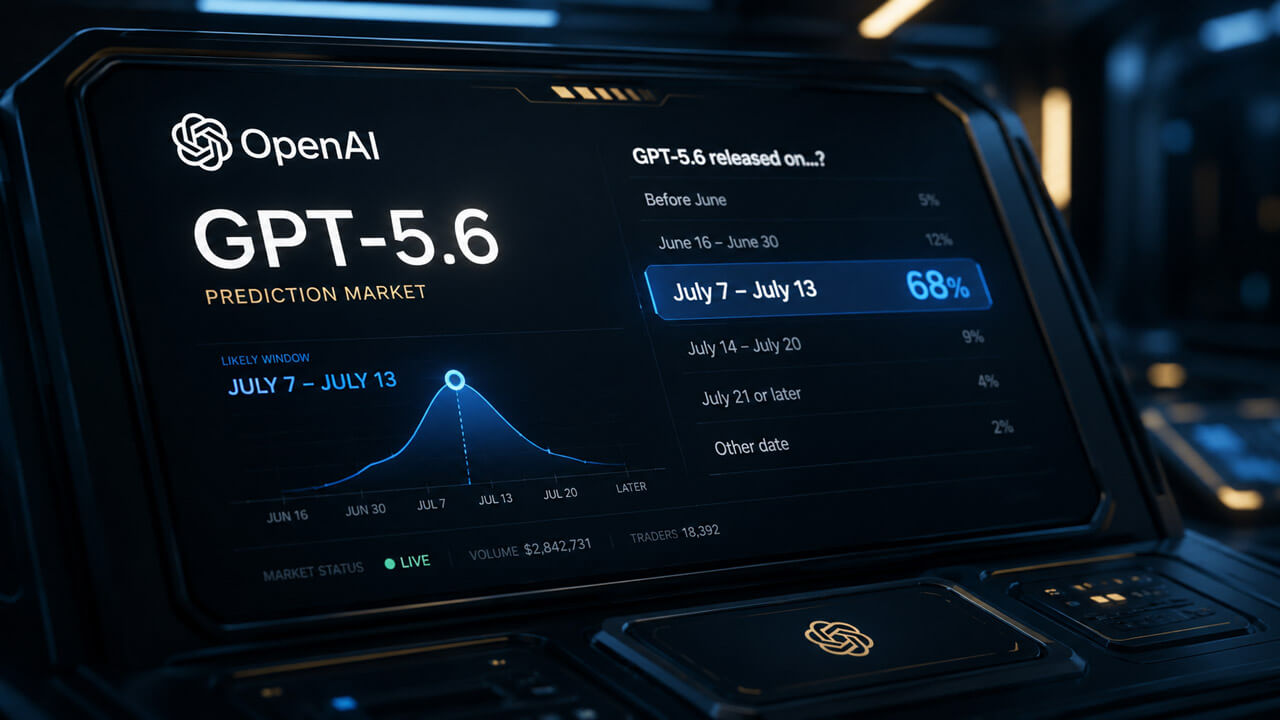
OpenAI has shown GPT-5.6, but only inside a restricted preview. The market’s concentration around one early-July date depends on whether infrastructure rollout language becomes public access under the event’s rules.

The market’s heavy lean toward July 9 is best read as a judgment about rollout mechanics: OpenAI has already announced GPT-5.6, so the live question is when a limited preview becomes general public availability under the resolution criteria. That distinction matters because the official record currently supports existence, capability, and planned expansion, while stopping short of a public ChatGPT or broad API release.
The July 9 cluster points to a calendar thesis
July 9 sits at 81.3%, up 18.3 percentage points over 24 hours, while July 10 is far behind at 4.3% and “Not released before August” is 3.4%. With $666,590 in volume, $166,560 in liquidity, and $91,550 in open interest, this is no longer a thin curiosity around an AI rumor; the market has converged on a specific near-term event window.
The causal story behind that concentration appears to be that OpenAI’s June 26 GPT-5.6 preview created a short runway to broader access. A release roughly two weeks after announcement would fit a phased rollout narrative if OpenAI has already completed enough safety, capacity, and partner testing to open the model to the general public. The July 9 price therefore embeds an inference from timing and rollout language, rather than a confirmed date from OpenAI.
Preview status is the hinge in the resolution rules
The event resolves on the date, in Eastern Time, when OpenAI’s GPT-5.6 model is made available to the general public. That makes the difference between a preview and a release decisive. OpenAI’s help-center language says GPT-5.6 Sol, Terra, and Luna are currently available only through the API and Codex to a limited set of approved partners and trusted organizations, with no ChatGPT availability during the preview.
That restriction is the main reason the market cannot simply resolve from the June 26 announcement. OpenAI has already established that GPT-5.6 exists and is being used, yet the public-access threshold remains unmet based on the supplied sources. For July 9 to become the resolving date, the relevant evidence would need to show general availability, such as a public ChatGPT model picker rollout, open API access beyond approved partners, or official OpenAI language saying GPT-5.6 is available to all eligible users.
Cerebras creates a real July catalyst, with ambiguity attached
OpenAI’s own GPT-5.6 Sol announcement gives the July thesis a concrete anchor: the company said GPT-5.6 Sol will launch on Cerebras at up to 750 tokens per second in July, with access initially limited to select customers as capacity expands. That statement supplies a plausible reason for early-July pricing because it connects GPT-5.6 to a named infrastructure partner and a dated deployment window.
The ambiguity is that a Cerebras launch for select customers may fall short of “available to the general public.” If OpenAI or Cerebras announces a July 9 availability milestone, the exact wording would matter to resolution. A launch page aimed at enterprise customers, a waitlist, or a select-customer performance demo could validate the market’s timeline intuition while failing to satisfy the event’s public-release threshold. That is why the same catalyst can support July concentration and create resolution risk around what counts as public access.
| Evidence type | Why it matters to the market |
|---|---|
| Official OpenAI general availability statement | Would directly address the event’s release condition. |
| ChatGPT model picker access | Would provide visible public evidence if GPT-5.6 appears for broad users. |
| API access beyond approved partners | Could support resolution if access is no longer restricted. |
| Cerebras select-customer launch | May move expectations while leaving public-access criteria contested. |
OpenAI’s safety language argues for caution on exact dates
OpenAI describes GPT-5.6 Sol as its strongest model yet and says the phased release is tied to increased capabilities and stronger safeguards. That framing matters because high-capability model launches often depend on safety evaluations, capacity management, monitoring, and policy controls. The market’s July 9 concentration assumes those constraints resolve quickly enough to allow a broad release within days.
The help center also says OpenAI has not announced a general availability date and plans to expand access “as soon as possible.” That phrase supports eventual expansion, yet it offers no commitment to July 9 or any listed date. The market’s current shape therefore relies on an inference that “as soon as possible” maps onto a near-immediate public rollout, likely influenced by the separate July Cerebras reference.
The strongest counter-signal is continued restricted access
The cleanest way for the July 9 thesis to weaken would be official confirmation that GPT-5.6 remains limited to approved partners, trusted organizations, Codex, API preview users, or select Cerebras customers after that date. Because the market is so concentrated, even a small clarification from OpenAI distinguishing preview access from general release could shift attention toward later July dates or the “Not released before August” outcome.
Other hypothetical catalysts could also force a reassessment: a delayed Cerebras rollout, new safety-review language, a capacity-related pause, or a public launch of only one GPT-5.6 variant with restricted eligibility. The event’s wording covers “OpenAI’s GPT-5.6 model,” so resolution may hinge on whether any GPT-5.6 variant becomes generally available, while the sources distinguish Sol, Terra, and Luna and describe Sol’s Cerebras path separately.
The market’s central tension is therefore procedural. The official materials make an early July release plausible enough for a concentrated date thesis, yet the same materials preserve a preview/public-access gap that can only be closed by a clear OpenAI availability change. Until that gap closes, July 9 is a bet on the interpretation of rollout signals and the speed of OpenAI’s conversion from controlled preview to public release.
Sources
Market Details
- Resolution criteria
- This market will resolve according to the date (ET) on which OpenAI's GPT-5.6 model is made available to the general public.
- Platform
-


- Category
- Tech › AI
- Scheduled deadline
- July 31, 2026, 11:59 PM UTC
- Market rules summary
- Multi-outcome Polymarket event. Each listed option is represented by its Yes price on the underlying market. View full rules
Frequently Asked Questions
What was the final result of the GPT-5.6 release date prediction market?
Polymarket reports July 9 as the winning outcome for the GPT-5.6 release date prediction market with a final probability of 100%. The final market snapshot includes $1.01M volume and $118.12K open interest. CryptoSlate last synced the final market data at Jul 9, 2026, 20:17 UTC.
How does the GPT-5.6 release date prediction market resolve?
This market will resolve according to the date (ET) on which OpenAI's GPT-5.6 model is made available to the general public. Multi-outcome Polymarket event. Each listed option is represented by its Yes price on the underlying market.
Related AI Markets
 Which AI model will lead Arena on October 19, 2026?
  Which company will lead Agent Arena in October 2026?


 When will OpenAI announce its paused training has resumed?