

World Cup: Nation To Reach Semifinals
Ended Jul 13, 2026, 00:00 UTC
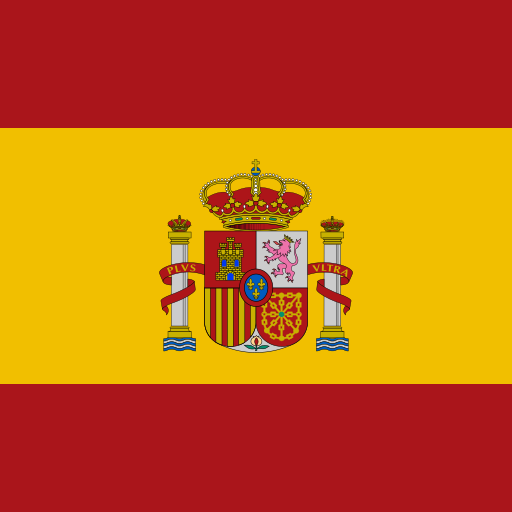
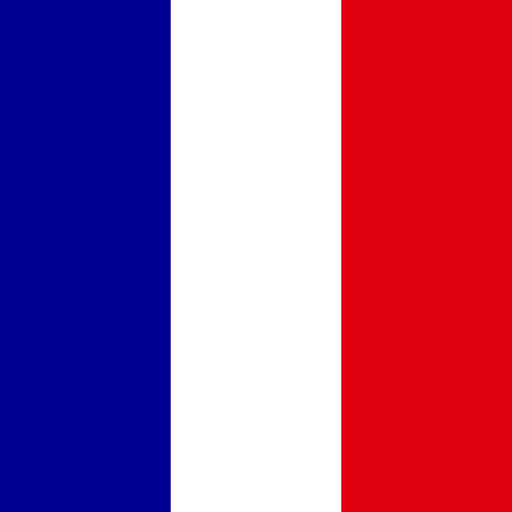

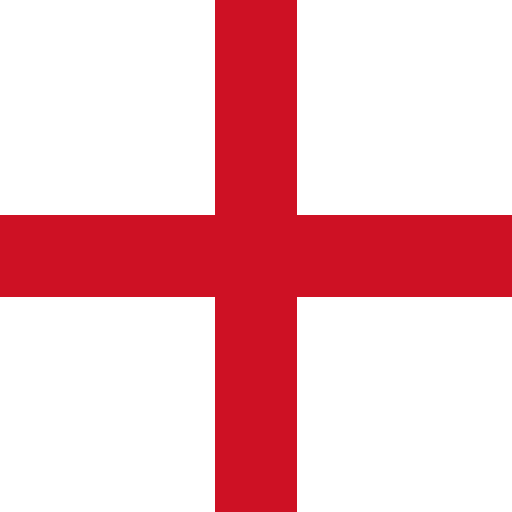
43 more outcomes Other final results
- South KoreaNo
- South AfricaNo
- CzechiaNo
- CanadaNo
- SwitzerlandNo
- QatarNo
- Bosnia and HerzegovinaNo
- BrazilNo
- MoroccoNo
- ScotlandNo
- HaitiNo
- USANo
- AustraliaNo
- ParaguayNo
- TurkiyeNo
- GermanyNo
- EcuadorNo
- Ivory CoastNo
- CuracaoNo
- NetherlandsNo
- JapanNo
- TunisiaNo
- SwedenNo
- BelgiumNo
- IranNo
- EgyptNo
- New ZealandNo
- UruguayNo
- Saudi ArabiaNo
- Cape VerdeNo
- SenegalNo
- NorwayNo
- IraqNo
- AustriaNo
- AlgeriaNo
- JordanNo
- PortugalNo
- ColombiaNo
- UzbekistanNo
- DR CongoNo
- CroatiaNo
- PanamaNo
- GhanaNo













Market resolution
This World Cup: Nation To Reach Semifinals prediction market is settled. The percentages above are the final outcome probabilities reported by Polymarket.
Final probabilities, volume, and open interest are sourced from Polymarket and were last synced at Jul 12, 2026 7:03 am.
Four Semifinal Places Create Pressure Below World Cup’s Elite Cluster
The market’s top tier is crowded enough that path dependence may matter as much as team hierarchy. Current pricing suggests a world where pedigree buys resilience, while the next tier needs a draw, roster, or form catalyst to force a broader reshuffle.


The semifinal market is organized around a hard scarcity problem: four available places and a small group priced as if they can survive several different tournament paths. That inference matters because the question resolves on a single threshold, so the market is rewarding teams perceived to have more than one route through the bracket while making everyone else more dependent on future path information.
The front four are priced as path-resistant contenders
Argentina at 48%, France at 47%, Spain at 44.5%, and England at 36.5% form a clear upper tier. The market-implied story is that these teams carry enough depth or perceived consistency to keep semifinal access alive across a range of draws. This matters because their prices rely on resilience assumptions: a damaging roster development, tactical disruption, or route packed with other high-priced teams would attack the reason they sit above the field.
The gap from England to Portugal at 29% gives the top tier its editorial meaning. It says the market is drawing a line between teams granted broad-path credibility and teams needing more help from the bracket. That line can move quickly once abstract tournament strength is replaced by a known sequence of opponents.
The chasing group is where bracket news should carry more weight
Portugal at 29%, Brazil at 26.5%, the Netherlands at 23.5%, Germany at 22.5%, Norway at 19.5%, and the USA at 18.5% sit in a second cluster with meaningful semifinal pricing, yet each stands well below the leading four. The inference from those prices is conditional confidence: enough respect to clear easier sequences, paired with greater sensitivity to an early meeting with an elite-priced side.
| Tier inferred from Yes prices | Teams | Market-implied dependency |
|---|---|---|
| Upper tier | Argentina, France, Spain, England | Multiple plausible routes to the semifinals. |
| Chasing tier | Portugal, Brazil, Netherlands, Germany, Norway, USA | Route quality can change pricing more visibly. |
| Middle tier | Mexico, Morocco, Colombia, Belgium, Switzerland, Japan | Needs confirmation from draw, roster, or pre-tournament form. |
Norway’s 19.5% placement is especially informative because it sits closer to Germany than to many mid-priced names such as Japan at 7% or Switzerland at 8.7%. That matters because the tiering is forward-looking: a single team-specific catalyst can shift how much path help the market thinks Norway needs.
The middle band depends on a narrow route opening
Mexico at 13%, Morocco and Colombia at 11.5%, Belgium at 9.5%, Switzerland at 8.7%, Japan at 7%, Croatia at 5.8%, Ecuador at 5%, and Canada at 4.8% carry a different message. The market is allowing for a semifinal run, while attaching it to a narrower set of routes. This matters because these prices can react sharply to bracket clearance: one avoided powerhouse in the round before the semifinals can change the story more than a marginal change in squad perception.
The lower listed teams make the same point from the opposite direction. Prices near 3% and below, including Egypt at 3.3%, Ghana at 3.5%, Iran at 1.5%, South Korea at 1.6%, and New Zealand at 0.3%, imply that the market needs several favorable events in sequence before treating a semifinal path as credible. The implication is editorial rather than mechanical: these teams are priced around compounded path dependency.
The long calendar makes future information part of today’s price
The market remains open until July 13, 2026, with $982.34K in volume, $1.93M in liquidity, and $481.91K in open interest. That combination suggests the tiers have enough participation to be meaningful, while the event still carries a long runway for new information. The price structure is therefore exposed to catalysts that convert broad team labels into specific tournament conditions.
- A future draw could cluster high-priced teams into the same route or separate them.
- Final squad news could challenge assumptions about depth and continuity.
- A hypothetical injury to a central player could matter more for teams priced on a narrow path.
- Pre-tournament results could change perceptions of whether a middle-tier team deserves a wider route set.
The main counter-signal is collision among the favorites
The strongest challenge to the current ordering comes from knockout compression. The listed Yes prices sum to roughly 431.7%, above the 400% implied by four semifinal berths before market frictions and any omitted teams are considered. That matters because the aggregate leaves little room for all favored narratives to survive once paths become mutually exclusive.
If the draw places several top-priced teams on a path where only one can reach the semifinals, the market-implied hierarchy would face a direct conflict. France, Argentina, Spain, and England can all carry high individual prices while their routes are abstract; a fixed bracket turns that abstraction into elimination math. That is the failure mode for a market currently leaning on broad strength ahead of known path geometry.
For that reason, the next major repricing phase would likely be driven by specificity. Broad team labels can sustain the present tiers during the information-light period, while concrete bracket routes, confirmed squads, and adverse team news would test whether the leaders keep path-resistant treatment and whether the chasing tier can claim a cleaner road to the final four.
Sources
Market details
- Resolution criteria
- This market will resolve “Yes” if the listed team reaches the 2026 FIFA World Cup Semifinals.
- Platform
-


- Category
- Sports › World Cup
- Close date
- July 13, 2026, 12:00 AM UTC
- Market rules summary
- Multi-timeframe Polymarket event. Each listed timeframe is represented by its Yes price on the underlying binary market. View full rules
Frequently asked questions
What was the final result of the World Cup: Nation To Reach Semifinals prediction market?
Polymarket reports the World Cup: Nation To Reach Semifinals prediction market as closed. The final snapshot shows Spain at 100%, France at 100%, Argentina at 100%, and England at 100%. The final market snapshot includes $5.02M volume and $416.64K open interest. CryptoSlate last synced the final market data at Jul 12, 2026, 06:03 UTC.
How does the World Cup: Nation To Reach Semifinals prediction market resolve?
This market will resolve “Yes” if the listed team reaches the 2026 FIFA World Cup Semifinals. Multi-timeframe Polymarket event. Each listed timeframe is represented by its Yes price on the underlying binary market.
Related World Cup markets
 Spain vs. Argentina
  France vs. England
  England vs. Argentina