

World Cup: Nation To Reach Round of 16
Ended Jul 4, 2026, 00:00 UTC
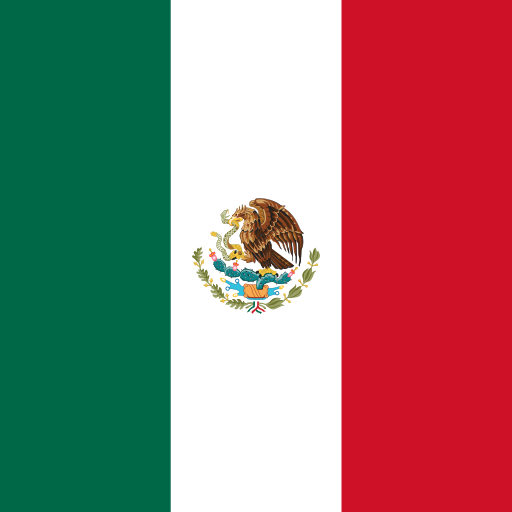
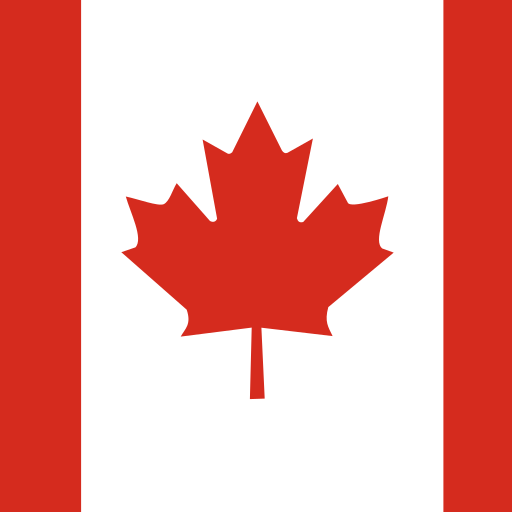

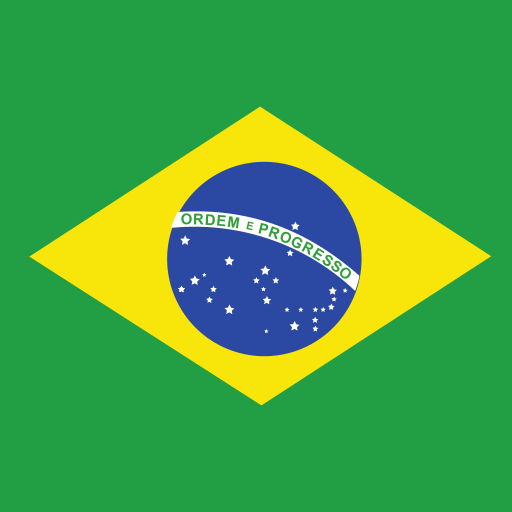
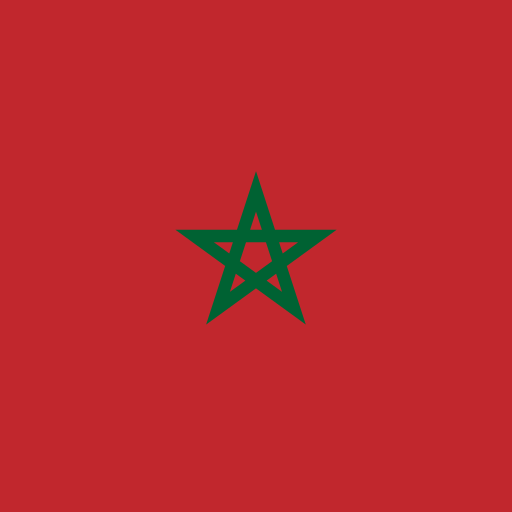
32 more outcomes Other final results
- South KoreaNo
- South AfricaNo
- CzechiaNo
- QatarNo
- Bosnia and HerzegovinaNo
- ScotlandNo
- HaitiNo
- AustraliaNo
- TurkiyeNo
- GermanyNo
- EcuadorNo
- Ivory CoastNo
- CuracaoNo
- NetherlandsNo
- JapanNo
- TunisiaNo
- SwedenNo
- IranNo
- New ZealandNo
- UruguayNo
- Saudi ArabiaNo
- Cape VerdeNo
- SenegalNo
- IraqNo
- AustriaNo
- AlgeriaNo
- JordanNo
- UzbekistanNo
- DR CongoNo
- CroatiaNo
- PanamaNo
- GhanaNo






Market resolution
This World Cup: Nation To Reach Round of 16 prediction market is settled. The percentages above are the final outcome probabilities reported by Polymarket.
Final probabilities, volume, and open interest are sourced from Polymarket and were last synced at Jul 4, 2026 6:47 am.
Round of 16 Prices Turn Reputation Into a Path-Dependency Test
The market is separating teams through squad reputation, group-path assumptions, early liquidity, and knockout-access math. The tension is whether familiar national brands deserve durable confidence before the draw, squad cycle, and injury picture harden.


The market is pricing Round of 16 access as a test of floor, path, and survivability. France at 88.5%, Argentina at 84.5%, Spain and England at 83.5%, Germany at 80.5%, Portugal at 77.5% and the USA at 78.5% form a confidence cluster, while nations such as Morocco, Australia, Egypt, Japan, Croatia and Ecuador sit in a middle band where path dependence carries more weight. Since the rule resolves only on reaching the 2026 FIFA World Cup Round of 16, the prices reward teams expected to avoid early elimination, with title-level ceiling playing a secondary role.
The top tier is priced as a floor on competence
The strongest inference from the odds is that national reputation is being converted into a probability of avoiding a bad tournament start. The elite European and South American names occupy the top end because the market can price continuity, depth and public familiarity into a simple binary endpoint. That matters because a Round of 16 condition can forgive imperfect performances if a team’s baseline talent and tactical identity keep it inside the advancement zone.
Liquidity of $665.58K against $2.09M in volume and $1.16M in open interest adds a second layer: enough capital has gathered to make the ranking informative, while the market remains open to major news. The implication is that top-tier prices may be anchored by broad consensus until a catalyst challenges one of the shared assumptions behind the cluster.
| Pricing band | Examples | Market-implied story |
|---|---|---|
| High confidence | France 88.5%, Argentina 84.5%, Spain 83.5%, England 83.5%, Germany 80.5% | Depth and continuity are being treated as protection against early volatility. |
| Strong but path-exposed | Canada 72.5%, Brazil 71%, Norway 66.5%, Mexico 64.5%, Switzerland 64.5%, Netherlands 64.5% | The odds assign meaningful advancement strength while leaving room for draw, selection and form risk. |
| Path-sensitive middle | Egypt 40.5%, Australia 38%, Morocco 37.5%, Ecuador 36.5%, Croatia 31.5%, Japan 30.5% | A favorable or hostile pairing could carry outsized influence. |
The middle band carries the draw assumption most visibly
Prices around 30% to 40% reveal where the market is compressing several unresolved variables into one number. Morocco at 37.5%, Australia at 38%, Egypt at 40.5%, Ecuador at 36.5%, Croatia at 31.5% and Japan at 30.5% suggest the path matters as much as reputation in this tier. A friendlier group scenario would validate the idea that these teams need a clean route; a difficult route would shift focus toward depth, goal creation and game-state resilience.
This is also where the absence of supplied ranking or squad data matters. The listed context gives prices and resolution rules, so any read on team strength comes from market ordering itself. That creates a blind spot: hypothetical qualifying results, manager changes or squad availability news could revise the market’s mental model quickly.
Low single digits bundle qualification doubts with advancement doubts
Iraq at 1%, New Zealand at 1.4%, Scotland at 1.6%, Uzbekistan at 1.8% and Saudi Arabia at 2.4% sit near the floor because the condition is sequential: a team must be in position to reach the Round of 16 and then clear the early-tournament hurdle. The rules do not isolate those steps, so the price can combine non-appearance risk, draw risk and perceived quality into a single outcome.
That bundling matters because news can move the lower end in larger visible chunks. A hypothetical qualification breakthrough, a draw that places a low-priced team into a more navigable route, or a major squad development would speak directly to the first link in the chain. Once a team’s path narrows, the remaining Yes price has less room to carry hope around later improvement.
The July 2026 close date makes information timing part of the price
The market remains open until July 4, 2026, which turns the board into an early aggregate of priors instead of a near-resolution verdict. That matters because the market can absorb multiple categories of information before settlement: qualifying status, tournament draw, injury windows, hypothetical friendly results, squad announcements and competition evidence before resolution. Each category tests a different assumption behind the same Round of 16 endpoint.
- A future draw that concentrates strong teams in a listed nation’s path would shift attention from brand strength to route difficulty.
- Confirmed squad absences would test whether high-priced teams are assumed to have depth or star dependence.
- Clear improvement in a lower-priced team’s competitive results would challenge the combined qualification-and-advancement burden embedded in the odds.
- Liquidity expansion near major football news would reveal whether the ordering has broad agreement or early-market inertia.
Separate country prices can hide correlated shocks
The main failure mode is treating each country’s price as independent football knowledge. The rules present separate Yes prices for each underlying binary market, but future tournament structure and group paths can create correlations that the board only partly reveals. One unfavorable draw for a cluster of favorites could reshuffle several prices at once, while a path opening for a mid-tier team could make today’s middle band less rigid.
This is the strongest counter-signal to the confidence cluster: the market may be leaning on broad historical trust before the path is known. The cluster can remain coherent while still carrying exposure to the same upstream variables. The next information shocks should matter most when they change the path, the squad floor, or the probability that a listed nation reaches the tournament in shape to compete for early advancement.
Sources
Market details
- Resolution criteria
- This market will resolve “Yes” if the listed team reaches the 2026 FIFA World Cup Round of 16.
- Platform
-


- Category
- Sports › World Cup
- Close date
- July 4, 2026, 12:00 AM UTC
- Market rules summary
- Multi-timeframe Polymarket event. Each listed timeframe is represented by its Yes price on the underlying binary market. View full rules
Frequently asked questions
What was the final result of the World Cup: Nation To Reach Round of 16 prediction market?
Polymarket reports the World Cup: Nation To Reach Round of 16 prediction market as closed. The final snapshot shows Mexico at 100%, Canada at 100%, Switzerland at 100%, and Brazil at 100%. The final market snapshot includes $5.88M volume and $126.64K open interest. CryptoSlate last synced the final market data at Jul 4, 2026, 05:47 UTC.
How does the World Cup: Nation To Reach Round of 16 prediction market resolve?
This market will resolve “Yes” if the listed team reaches the 2026 FIFA World Cup Round of 16. Multi-timeframe Polymarket event. Each listed timeframe is represented by its Yes price on the underlying binary market.
Related World Cup markets
 Spain vs. Argentina
  France vs. England
  England vs. Argentina