
Why RFK’s idea of a Bitcoin-backed dollar is a monetary mirage
CryptoSlate dives deep into RFK Jr.'s proposal to partially back the U.S. dollar with Bitcoin to explore its (un)feasibility.

Introduction
The crypto industry was recently stirred by an audacious proposal from Robert F. Kennedy Jr., who proposed a plan to partially back the U.S. dollar with Bitcoin. Kennedy has become an increasingly popular figure in the American political landscape and has long advocated for financial innovation and the integration of digital assets into the mainstream economy.
Kennedy announced this plan during his presidential campaign and has sparked a flurry of discussion and debate within the crypto industry and beyond.
The media’s interpretation of Kennedy’s words has often been exaggerated, leading to misconceptions about his intentions. Some reports have incorrectly suggested that Kennedy plans to replace the current monetary system with a Bitcoin-backed one fully. This has led to a wave of hype and speculation that may be founded on a superficial understanding of presidential powers and the complexities of implementing such a drastic change to the U.S. monetary system.
In this report, CryptoSlate dives deep into the matter, examining the feasibility of Kennedy’s proposed shift to a partial reserve system for the dollar. The report will explore the current state of the U.S. dollar, the concept of a partially-backed dollar, the potential legal and constitutional challenges, and the market consequences of introducing a Bitcoin-backed dollar.
RFK Jr.’s bold plan
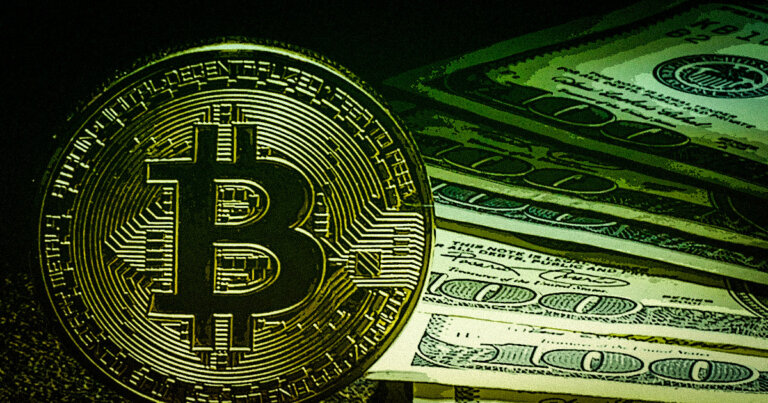
In a video that has since become viral, Robert F. Kennedy Jr. outlined his proposal to partially back the U.S. dollar with Bitcoin. As he explained, his plan is not to completely replace the current monetary system but rather to introduce Bitcoin as a partial reserve. This means that a portion of the U.S. dollar’s value would be backed by Bitcoin, similar to how the gold standard operated in the past.
However, the media’s interpretation of Kennedy’s words has often been exaggerated, leading to misconceptions about his intentions. Many media outlets have taken his words out of context, suggesting that Kennedy plans to replace the current monetary system with a Bitcoin-backed one fully. This is not what Kennedy proposed.
He proposes a cautious approach, suggesting that only a small fraction, starting at 1%, of issued Treasury bills should be backed by hard assets like gold, silver, platinum, or Bitcoin. According to Kennedy, this strategy would strengthen the U.S. Dollar’s position as the world’s reserve currency.
Kennedy believes backing dollars and U.S. debt obligations with hard assets could help restore the dollar’s strength, rein in inflation, and usher in a new era of American financial stability, peace, and prosperity.
Another significant part of Kennedy’s plan involves tax policy. He proposes exempting Bitcoin from capital gains tax, which he believes would greatly benefit innovations, spur investments, and ensure citizens’ privacy. According to Kennedy, this policy would incentivize ventures to grow their businesses in the U.S. instead of moving offshore to places like Singapore, Switzerland, Germany, and Portugal. He further explained that non-taxable events are unreportable, making it more difficult for governments to weaponize currency against free speech.
The U.S. dollar now
Like almost all modern currencies, the U.S. dollar is a fiat currency. This means it’s not backed by a physical commodity like gold or silver. Instead, its value is derived from the trust and confidence people have in the stability of the U.S. government.
Fiat currencies are maintained and regulated by central banks, in this case, the Federal Reserve. The money supply is controlled through monetary policy tools such as open market operations, reserve requirements, and setting interest rates. When the economy needs a boost, the Federal Reserve can increase the money supply, often referred to as “printing money.” In reality, it’s more a matter of adding digital credits to banks’ reserves.
Historically, the U.S. Dollar was backed by gold, a system known as the gold standard. Under this system, the dollar’s value was directly linked to a specific amount of gold. This provided stability, as the government could only print as much money as it had gold to back it up.
However, the U.S. abandoned the gold standard in 1971 under President Richard Nixon, a move known as the Nixon Shock. This was done in response to economic pressures of the time, including inflation and international speculation on the U.S.’s ability to maintain the gold standard. The move allowed for more flexibility in monetary policy but also led to concerns about potential inflation and the devaluation of the dollar.
The shift away from the gold standard had significant consequences. It allowed for more flexibility in monetary policy, enabling the government to respond more effectively to economic crises. However, it also led to concerns about inflation and the dollar’s value, as there was no longer a physical limit to the amount of money that could be created. This has been a ongoing debate among economists and policymakers, with some advocating for a return to a commodity-backed currency and others arguing for the benefits of a fiat system.
In the context of these complexities, RFK Jr.’s proposal to back the U.S. Dollar with Bitcoin represents a significant departure from traditional monetary policy.
A partially-backed U.S. dollar
As the term implies, a partially-backed dollar is a currency system where only a fraction of the total money supply is underpinned by a tangible asset or commodity such as gold.
While the idea of a partially-backed currency isn’t new, it represents a substantial shift from traditional monetary systems where currencies were either entirely backed by a commodity (like the gold standard) or not backed at all (like the current fiat system).
The principle of a partially-backed dollar aims to find a middle ground between commodity-backed currencies’ stability and fiat currencies’ adaptability. By backing a portion of the dollar with gold, the currency could gain some stability and trust associated with commodity-backed currencies. This is because the value of the backed portion of the currency would be tied to the value of gold, which has historically been a stable asset.
Simultaneously, by not backing the entire currency, the government can adjust the money supply to respond to economic conditions. This crucial feature of fiat currencies enables central banks to implement effective monetary policies.
Backing the Dollar with Bitcoin
This concept, while novel, is not entirely without precedent, as it draws parallels to the gold standard system.
The first step in backing the dollar with Bitcoin would be for the U.S. government to acquire a significant amount of BTC. This could be achieved through direct purchases on the open market, much like central banks have done with gold in the past, or through OTC transactions with large exchanges such as Coinbase. The government would then need to establish a secure storage system for its BTC holdings, likely involving cold storage and hot wallets for more immediate transactions.
Once the government has acquired a sufficient amount of Bitcoin, it must declare which fraction of the U.S. dollar is backed by Bitcoin.
The government must also establish a system for converting dollars into Bitcoin. This could be done through a central bank or a network of banks equipped to handle cryptocurrency transactions. These institutions would need the infrastructure to securely handle, store, and transact in Bitcoin.
Furthermore, the government must develop a robust regulatory framework to oversee this new system. This would include regulations to prevent money laundering and other illicit activities and measures to protect consumers and investors — all required by market watchdogs such as the CFTC and SEC.
Finally, it would need to work closely with the broader financial system – including banks, payment processors, and fintech companies – to ensure they are equipped to handle a currency that is partially backed by Bitcoin. This would likely involve significant investment in new technologies and systems and extensive training and education of government employees.
The legal and constitutional challenges of a Bitcoin-backed dollar
Article I, Section 8 of the U.S. Constitution grants Congress the power “To coin Money, regulate the Value thereof, and of foreign Coin, and fix the Standard of Weights and Measures.”
Historically, this has been interpreted to mean that Congress can establish a monetary system and determine what constitutes legal tender. Naturally, the Constitution doesn’t explicitly mention digital assets or cryptocurrencies, so it remains unclear how this provision would apply to a scenario where the government seeks to back the dollar with Bitcoin.
One interpretation could be that since Bitcoin isn’t a physical coin or a form of traditional money, it falls outside the scope of Congress’s constitutional power to “coin money.” This could potentially pose a constitutional challenge to the proposal.
However, this interpretation isn’t universally accepted, and some legal scholars argue that the Constitution’s language is broad enough to encompass digital assets.
In addition to the constitutional issues, there are also numerous legal and regulatory challenges. For instance, Bitcoin and other cryptocurrencies are currently classified as property by the Internal Revenue Service (IRS), not as currency. This classification has significant tax implications and would need to be addressed.
Furthermore, using Bitcoin as a backing for the dollar could run afoul of existing financial regulations. The Bank Secrecy Act and other anti-money laundering laws require financial institutions to perform specific due diligence and transaction reporting requirements. These laws were not designed with cryptocurrencies in mind, and how they would apply to a Bitcoin-backed dollar is unclear.
Market Consequences
In traditional financial markets, such a move could have profound implications. The dollar is the world’s primary reserve currency, and its value influences global trade, commodity prices, and interest rates.
If the dollar were to be backed by Bitcoin, it could introduce a new level of volatility into these systems. Bitcoin’s price fluctuates significantly, and this volatility could potentially be transferred to the dollar. This could lead to increased uncertainty and risk in global financial markets, which are accustomed to the relative stability of the U.S. dollar.
In the cryptocurrency market, the impact could be even more significant. If the U.S. government were to start acquiring Bitcoin to back the dollar, it could increase the price of Bitcoin due to increased demand. This could lead to a speculative bubble and potentially even a market crash if the bubble were to burst.
Moreover, the government’s increased involvement in the Bitcoin market could lead to more regulation of cryptocurrencies. This could impact the decentralized nature of cryptocurrencies, which is one of their main attractions for many users.
Using Bitcoin to back a small percentage of Treasury bills would similarly affect the market. Treasury bills are the most popular and stable investment product in the U.S. and worldwide. Sovereign countries such as Japan and China are one of the largest holders of T-bills, which are used to create stability in their respective monetary systems.
Backing T-bills with assets investors perceive as volatile could result in reduced demand for T-bills, driving the yield higher and increasing the cost of borrowing for the U.S. government.
Conclusion
The proposition of backing the U.S. dollar with Bitcoin, as put forward by RFK Jr., is a concept that, while intriguing, is largely unfeasible. It has ignited considerable debate but also underscores a concerning trend: a superficial understanding of the complexities of the U.S. monetary system, particularly within the crypto industry.
The notion of integrating a digital asset into the backbone of the traditional financial world is a radical departure from established monetary policies. It challenges the long-standing practices of central banks and monetary authorities, suggesting a future where digital assets like Bitcoin could play a central role in global finance.
While this vision appeals to a large part of the crypto industry, it overlooks the intricate and delicate nature of monetary systems.
From a legal and constitutional standpoint, the hurdles are substantial. The U.S. Constitution and existing financial regulations present formidable obstacles to such a policy.
Furthermore, the technical execution of such a system is far from straightforward and would necessitate meticulous planning and implementation.
Given the sheer size of the U.S. government and its track record of implementing complex regulatory frameworks for emerging technologies, assuming such an undertaking would be highly unlikely is safe.
The potential market implications are also significant and could introduce unprecedented volatility and risk. The excitement generated by this idea within the crypto industry could be potentially dangerous, as it may lead to unrealistic expectations and misguided investments.
In conclusion, while backing the U.S. dollar with Bitcoin is certainly thought-provoking, it is also a stark reminder of the need for a deeper understanding of our complex monetary system before entertaining such radical changes.
More Market Reports