







Governance
Cardano’s 2027 budget proposal would let funding stewards seek grants too
Proposed stewards could influence assessments while DReps retain spending votes and a direct funding route awaits its allocation.

$173.34M traded Price signal supported
Trading Activity price-reliability indicator with 100 percent data coverage. Low activity replaces price-derived sentiment because the displayed market price may not be supported by meaningful trading.Target
Peg Health price-stability indicator with 0 percent data coverage. It measures observed market pricing, not reserve quality or redemption safety.30D -21.8% 93.8% below ATH
Price-based current market conditions indicator with 100 percent data coverage. This is not a price forecast.$173,343,959.21 traded over the last 24 hours. The available activity evidence is sufficient to retain the asset’s price-derived signal.
Low activity can make the displayed price sensitive to a handful of trades. Trading Activity assesses price reliability—not project development, legal status, reserves, or solvency.
Price movement Not interpreted while trading support is below the reliability threshold.
What it measures
The model combines reported 24-hour volume, market-cap turnover, valid-pair liquidity, active exchange breadth, and quote freshness. Missing optional evidence lowers coverage; missing volume or a known-stale quote suppresses price-derived interpretation.
Configured model weights
When inputs are missing, these configured weights are renormalized across the available evidence; data coverage records what is missing.
How to read it
Scores of 0–19 are dormant, 20–39 are thin, 40–69 are supported, and 70–100 are active. Scores below 40 withhold price-derived interpretation.
Price momentum across the scored timeframes weighs on the reading. The available evidence produces a bearish reading rather than a price forecast.
A complete ATL and ATH range is not available for this asset.
What it measures
The model converts price momentum, logarithmic historical position, milestone recency, and short-term volume confirmation into one 0–100 score. Missing evidence lowers data coverage instead of counting as neutral.
Configured model weights
When inputs are missing, these configured weights are renormalized across the available evidence; data coverage records what is missing.
How to read it
50 is the neutral midpoint. Scores of 60 or higher are bullish, 40 or lower are bearish, and 41–59 are neutral.
Showing 10 spot markets. Markets excluded from CMC price or volume calculations are hidden.
| Pair | Market details | |||||
|---|---|---|---|---|---|---|
| 1 | ADA/USDT | $0.19141 | Vol (24h) $9.05M | 643 |
| |
| 2 | ADA/USDC | $0.19117 | Vol (24h) $668.65K | 580 |
| |
| 3 | ADA/USD | $0.19108 | Vol (24h) $4.93M | 652 |
| |
| 4 | ADA/KRW | $0.19227 | Vol (24h) $3.05M | 487 |
Use the market pair link to visit this exchange. | |
| 5 | ADA/USDT | $0.19107 Best price | Vol (24h) $2.86M | 567 |
| |
| 6 | ADA/EUR | $0.19165 | Vol (24h) $555.72K | 426 |
| |
| 7 | ADA/USDT | $0.1916 | Vol (24h) $1.9M | 451 |
| |
| 8 | ADA/USDT | $0.19169 | Vol (24h) $1.32M | 524 |
Use the market pair link to visit this exchange. | |
| 9 | ADA/USDT | $0.1912 | Vol (24h) $3.79M | 660 |
Use the market pair link to visit this exchange. | |
| 10 | ADA/USDT | $0.19107 Best price | Vol (24h) $1.57M | 529 |
|
Affiliate Disclaimer: CryptoSlate may receive a commission when you click trading links on this page and complete an action with a third party. This does not influence our editorial independence or coverage.
Proposed stewards could influence assessments while DReps retain spending votes and a direct funding route awaits its allocation.

Developers have integrated major components of Cardano's scaling upgrade, but unlocking its full capacity will require multiple governance votes and stake-pool participation.

Cardano's founder is developing a new programming language as weak DeFi activity raises questions about whether technical progress can translate into adoption.
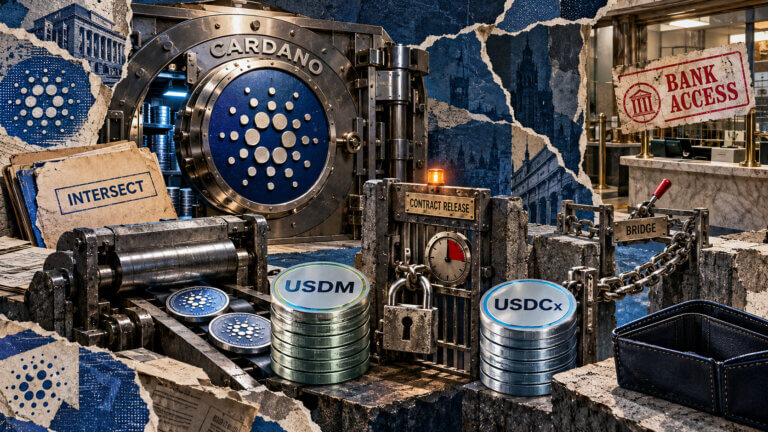
Cardano’s $4.8 million in stablecoin development budgets shifts focus to payment schedules, contract controls, and dollar access through 2027.
See ADA across major fiat currencies and swap the active converter instantly.
Quick SelectUsing the live USD market price. Additional fiat rates will appear after the daily sync.
Cardano is a public, proof of stake layer 1 blockchain whose native asset, ADA, is used for payments, staking, governance, and fees. Designed as a research driven network with formal methods and peer reviewed engineering, Cardano aims to provide a scalable, energy efficient base layer for smart contracts, decentralized applications, and institutional grade financial infrastructure.
Cardano is positioned as a so called third generation blockchain that seeks to address the limitations of earlier networks by separating concerns between settlement, computation, and networking. It uses the Ouroboros proof of stake protocol to secure the chain, with ADA holders delegating stake to validators to help produce blocks and earn rewards. The project is fully open source and supported by a triad of entities, including the Cardano Foundation, development company Input Output, and commercial arm EMURGO.
Cardano maintains a significant share of the smart contract platform market by market capitalization, and ADA is tracked as a top ten asset on CryptoSlate’s Cardano (ADA) page. The network continues to evolve through a long term roadmap that prioritizes formal verification, governance, and incremental performance upgrades.
Cardano was initiated in 2015 and launched on mainnet in 2017 under the leadership of founder Charles Hoskinson. The early Byron and Shelley eras focused on establishing the base ledger and gradually decentralizing block production through community stake pools. Subsequent roadmap phases, notably Goguen and Basho, introduced smart contract capabilities and performance improvements, including the Alonzo upgrade that enabled Plutus based smart contracts and DeFi applications.
In 2024 and 2025, the project entered the Voltaire era, which centers on on chain governance and treasury management. The community ratified a written Cardano Constitution and began formalizing a governance framework in which ADA holders vote on protocol changes and funding proposals. This shift is intended to move stewardship away from founding entities and toward a self sustaining governance system anchored in the chain’s native mechanisms.
Cardano’s design combines a proof of stake consensus protocol with an extended UTXO (eUTxO) ledger model. The eUTxO approach preserves Bitcoin style transaction semantics while allowing more expressive smart contracts. Much of the core code is written in Haskell, and on chain logic is primarily authored in Plutus and Marlowe, languages that emphasize strong typing and formal verification.
Cardano hosts a growing DeFi and application ecosystem, including decentralized exchanges, lending markets, NFT platforms, and identity solutions. The chain’s DeFi total value locked has at times approached all time highs, reflecting interest in yield products, stablecoins, and liquidity protocols built on its smart contract stack. Native tokens and low energy requirements appeal to projects seeking predictable fees and a more conservative security posture.
Recent ecosystem initiatives have focused on strengthening liquidity and infrastructure. The Cardano Foundation and ecosystem contributors have outlined programs to attract fiat backed stablecoins, custodians, bridges, and oracle providers, alongside efforts to turn passive ADA holders into active DeFi participants. Parallel work on Bitcoin interoperability and real world asset rails is intended to connect Cardano based protocols with broader crypto capital flows.
Beyond DeFi, Cardano has been used in pilots for identity and supply chain tracking, especially in markets where verifiable credentials and transparent registries are seen as important public infrastructure. These initiatives align with the project’s stated goal of supporting both open finance and public sector use cases.
Cardano’s initial development was funded through token sales and early backers, with ADA distribution supporting the work of Input Output, EMURGO, and the Cardano Foundation. Over time, the network has shifted toward community directed funding via an on chain treasury that receives a portion of block rewards and fees. This treasury is disbursed based on community votes for ecosystem proposals.
Input Output remains responsible for much of the core protocol engineering, including scalability upgrades such as Hydra and Ouroboros Leios, while EMURGO operates venture and incubation initiatives to back Cardano aligned startups. The Cardano Foundation acts as an independent steward focused on standards, ecosystem growth, and regulatory engagement, and is the subject of ongoing governance debates as the network moves deeper into the Voltaire era.
Despite its focus on rigor and governance, Cardano faces several risks. Competition from other smart contract platforms remains intense, and Cardano’s application ecosystem and liquidity have historically lagged larger DeFi networks. Governance also introduces new attack surfaces, including the possibility of voter apathy, concentration of influence among large stakeholders, and contentious protocol changes.
Regulatory uncertainty is an additional concern, as ADA has been scrutinized in enforcement actions and court filings, alongside other large cap assets. Like other public chains, Cardano is also exposed to smart contract bugs, bridge risks, and broader crypto market volatility. Prospective users and institutions typically monitor ongoing technical upgrades, governance outcomes, and regulatory signals, which are regularly covered in dedicated Cardano news and analysis on CryptoSlate.


The Cardano Foundation is an independent, Swiss-based, not-for-profit organization dedicated to advancing Cardano as a public digital infrastructure.
As of Nov 2, 2026, Cardano trades at $0.19.
Cardano has a market capitalization of $7,052,992,367.76.
Cardano has a 24-hour trading volume of $173,343,959.21.
Cardano reached an all-time high of $3.10, recorded on Sep 2, 2021. It is currently 93.82% below its all-time high.
Cardano recorded an all-time low of $0.017, recorded on Oct 1, 2017. It is currently 1 thousand percent above its all-time low.


