
Overview
Introduction
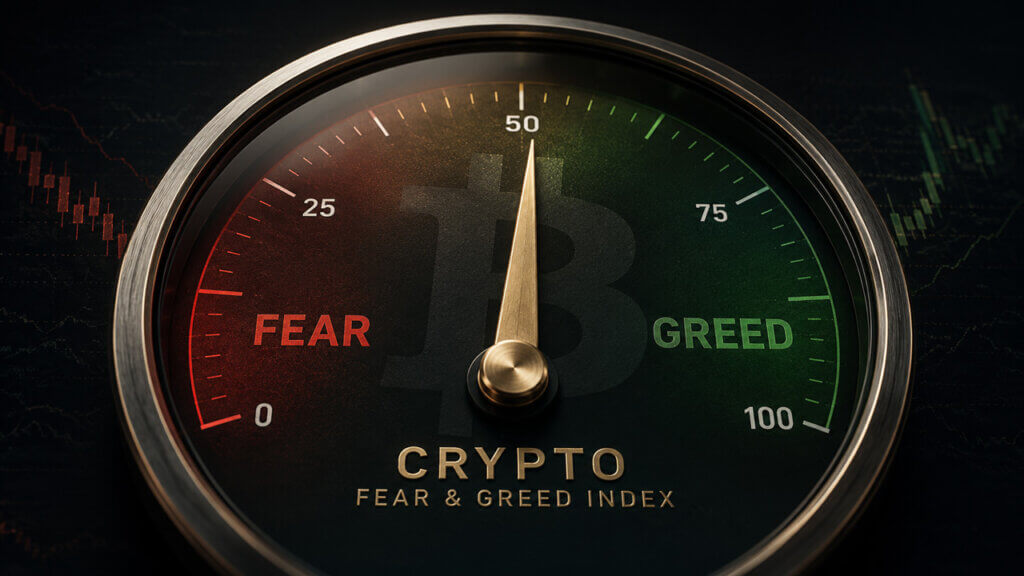
The Crypto Fear and Greed Index is a daily score between 0 and 100 that measures how emotional the crypto market is right now. A low score means participants are fearful, selling cautiously or sitting in cash. A high score means they're greedy, buying aggressively and often chasing momentum.
It was built to make market sentiment readable at a glance. Instead of scanning price charts, social media, and derivatives data yourself, the index compresses all of that into one number. That compression is both its strength and its main weakness.
Key Takeaways
- The Crypto Fear and Greed Index runs from 0 (extreme fear) to 100 (extreme greed) and updates daily.
- A low score does not mean the price will recover. A high score does not mean a crash is coming.
- The index is most useful when read beside price trend, volume, and derivatives data.
- Beginners often treat the index as a signal to act. It works better as a prompt to slow down and look harder.
What the Crypto Fear and Greed Index Measures
The index measures market emotion, not fair value or price direction. It tracks whether crypto participants are behaving fearfully, neutrally, or greedily, based on a set of market behavior and attention signals combined into one score.
A low reading usually reflects stress, caution, or risk-off behavior. Participants are pulling back, selling altcoins, or moving into stablecoins. A high reading usually reflects optimism, FOMO, or crowded bullishness. Participants are buying, borrowing to buy more, and expecting prices to keep rising. Neither reading proves a reversal is coming, because sentiment can stay fearful or greedy while a trend keeps running in either direction.
In practice, the index helps answer three questions before you form a market view:
- Is market mood cautious, balanced, or euphoric right now?
- Does today's score match what price, volume, and derivatives are showing?
- Has sentiment been in this zone for days or only since the last update?
A fear reading that has persisted for three weeks carries different weight than a fear reading that appeared overnight after a single liquidation event. Context is what makes the score useful.
Read the index alongside surrounding evidence: price trend, trading volume, Bitcoin dominance, derivatives positioning, exchange flows, and the tone of market coverage.
Where to Check Today's Crypto Fear and Greed Index
The score changes with each provider's update schedule, so checking a screenshot or cached article value tells you nothing about where sentiment stands right now.
Two main sources publish live readings:
- Alternative.me publishes a live score, historical values, an embeddable image widget, and a free API.
- CoinMarketCap publishes a separate reading at its own Fear and Greed Index dashboard, built on a different methodology with a broader data set.
Before acting on any number you find, run through these five checks:
- Confirm the provider name, since Alternative.me and CMC do not share a model.
- Note the update timestamp, not just the number.
- Read the label (Extreme Fear, Fear, Neutral, Greed, Extreme Greed), not only the digit.
- Compare the current value with the last week and last month to understand whether the mood is shifting or static.
- Look at price trend and volume alongside the sentiment score before drawing any conclusion.
A reading that just flipped from fear to neutral means something different from a neutral score that has held for two weeks. The index answers “what is the mood now,” not “what should I buy now.”
How the 0 to 100 Scale Works
The scale divides sentiment into five zones, each with a label that describes the emotional state of the market at that reading.
| Score Range | What It Usually Means |
|---|---|
| 0-20 | Extreme fear, often linked with panic, forced selling, or capitulation talk. |
| 20-40 | Fear, usually a cautious market with weak risk appetite. |
| 40-60 | Neutral, where sentiment is mixed and context carries more weight. |
| 60-80 | Greed, usually stronger risk appetite and more bullish positioning. |
| 80-100 | Extreme greed, often linked with crowded optimism and FOMO. |
Alternative.me describes 0 as Extreme Fear and 100 as Extreme Greed, while CMC displays a five-zone dial across the same broad range. Exact cutoffs can vary by provider, so the label shown with the score should be read alongside the number.
A few zones are more commonly misread than others:
Neutral (40-60) does not mean the market is safe or stable. It can appear during choppy sideways price action, during pauses inside a downtrend, or when inputs from different parts of the model are pulling in opposite directions. Neutral still needs confirmation from price, volume, and market context before it tells you anything useful.
Extreme greed (80-100) is regularly misread as a sell signal. In previous crypto bull runs, readings above 80 persisted for weeks or months at a time. A high score means the market is crowded and emotional, not that a top is near.
Extreme fear (0-20) is regularly misread as a buy signal for the same reason. Fear can persist through long downtrends. Capitulation, when it happens, often looks extreme for longer than expected. Buying into a low reading without confirming that sell pressure is actually declining has produced losses many times over.
Think of the scale like a thermometer: it tells you whether market mood is hot, cold, or somewhere between, but it does not tell you what happens next.
How the Crypto F&G Index Is Calculated
The calculation differs by provider. Alternative.me publishes its methodology openly. CMC uses a proprietary model it describes in general terms but does not share exact weights for.
Alternative.me builds its index around Bitcoin-specific market and attention signals. That makes Bitcoin market behavior the dominant input. A Bitcoin-led drawdown can move the score sharply even when some altcoins are holding up.
| Input | What It Captures |
|---|---|
| Volatility | Current Bitcoin volatility and drawdowns versus recent averages. |
| Market Momentum and Volume | Buying pressure or weakness compared with recent activity. |
| Social Media | Post activity and engagement around coin-specific hashtags. |
| Surveys | A historical polling input that is currently paused. |
| Dominance | Bitcoin's share of crypto market value as a risk-appetite signal. |
| Trends | Google Trends changes around Bitcoin-related searches. |
None of these inputs works cleanly in isolation. Volatility rises during a bullish breakout as well as during a crash. Social engagement can reflect genuine excitement, panic selling, coordinated bot activity, or a news cycle with no lasting price impact. Bitcoin dominance can rise because participants are fleeing riskier assets, but it can also rise when BTC is simply outperforming altcoins during a normal rotation.
What this means in practice: the score reflects a combination of signals, not a single fact about the market. When the index looks confusing, such as a fear reading while Bitcoin's nominal price is still high, it is usually because one or two inputs (a volatility spike or a dominance shift) are pulling the composite score lower while other signals have not caught up yet.
CoinMarketCap uses a broader model that includes top-cryptocurrency price momentum, implied volatility for BTC and ETH via Volmex indices, options put/call ratios for both assets, the Stablecoin Supply Ratio, and proprietary social and engagement data. This is why CMC's reading can diverge from Alternative.me's. The data universe is wider and the weighting structure is different.
How Traders Use It Without Relying on It Alone
The index is most useful as a filter, not a decision. It can prompt you to slow down, check your assumptions, or look for confirmation before changing your exposure, but it does not replace the analysis that should follow.
The most reliable approach is to read the score alongside other signals. A fear reading combined with weak volume, a broken price trend, and rising exchange inflows suggests real stress. The same fear reading alongside improving momentum, declining sell pressure, and stable on-chain flows suggests something different. The score is the same but the market situation is not.
Useful checks to run alongside the index include the following:
- Trend direction across daily and weekly time frames.
- Trading volume near support or resistance levels.
- RSI or other momentum indicators.
- Funding rates and open interest in perpetual markets.
- Exchange inflows and outflows as a proxy for sell pressure.
- Liquidation clusters around nearby price levels.
- News catalysts and macro events that may be driving the mood.
Some use the index to improve decision-making process rather than to call tops or bottoms. Reviewing DCA sizing after extreme readings, rebalancing a watchlist during periods of extended greed, or waiting one more daily update before making a reactive trade during fear are all low-cost uses of the index that do not require treating it as a forecast.
Common Mistakes When Reading the Fear and Greed Index
The most common mistake is using the index as a forecast. It is a snapshot of current market emotion built from provider-specific inputs. A snapshot can lag price moves, exaggerate a short-lived event, or miss what a specific portfolio is actually exposed to.
The second most common mistake is treating a score as universal when it reflects primarily Bitcoin sentiment. Alternative.me's model is BTC-focused. If your portfolio is mostly altcoins, DeFi tokens, or assets outside the top tier, the reading may not describe your situation at all.
Additional mistakes that regularly appear:
- Buying only because the score is low, without confirming sell pressure has declined.
- Selling only because the score is high, without confirming that trend or momentum has weakened.
- Ignoring the update cadence and acting on a reading that is already 24 hours old.
- Comparing Alternative.me and CMC numbers as if they share a methodology.
- Treating a one-day extreme reading as more significant than a week-long trend in the same direction.
- Letting a single daily reading override a long-term plan.
Some dashboards label the index as the “crypto greed and fear index” with the words reversed. The order does not change the meaning. What matters is the provider, the timestamp, the methodology, and whether you are reading the score alongside confirmation data or on its own.
FAQs
What is the crypto fear and greed index?
The Crypto Fear and Greed Index is a daily sentiment score from 0 to 100 that shows whether crypto market participants are behaving fearfully, neutrally, or greedily. It does not measure intrinsic value or predict price direction.
How is the crypto fear and greed index calculated?
The calculation depends on the provider. Alternative.me combines Bitcoin-focused inputs, including volatility, momentum and volume, social media, dominance, Google Trends, and a paused survey component, into a single weighted score. CMC uses a broader proprietary model that also includes top-cryptocurrency price momentum, BTC and ETH implied volatility via Volmex, options put/call ratios, the Stablecoin Supply Ratio, and engagement signals.
Where can I find the crypto fear and greed index today?
Live readings are available on Alternative.me and CoinMarketCap. Before using the current value, confirm the provider name, check the update timestamp, read the zone label alongside the number, and compare the reading with the past week.
Why do Alternative.me and CMC show different crypto fear and greed index values?
Their data universes and methodologies differ. Alternative.me is built around Bitcoin-specific signals. CMC includes broader crypto momentum, ETH-related inputs, derivatives data, stablecoin supply, and proprietary engagement signals. A gap between the two numbers on the same day is expected, not a sign that one source is incorrect.
Is the crypto fear and greed index a buy signal?
No. Extreme fear may reflect stress, panic, or possible capitulation, but it does not confirm that price will recover. Users still need to check price trend, volume, liquidity, derivatives positioning, and their own risk tolerance before acting.
Does the crypto fear and greed index apply to altcoins or only Bitcoin?
It depends on the provider. Alternative.me’s current methodology is Bitcoin-focused, which means its reading may not reflect altcoin market conditions accurately. CMC’s model covers a broader set of assets, including ETH-linked inputs, but it is still a market-wide composite rather than an altcoin-specific tool.
What does a neutral score mean in crypto fear and greed index?
A neutral score (roughly 40-60) means the index’s inputs are not strongly weighted toward fear or greed. It does not mean the market is stable or safe. Neutral readings can appear during choppy sideways price action, during pauses inside a trend, or when different inputs are pulling in opposite directions. Treat it as a prompt to look harder at price and volume context, not as a green light.
