

Fed Decision in June?
Final Results
Scheduled deadline: Jun 17, 2026, 00:00 UTC
Market Resolution
Polymarket reports No change as the winning outcome for the Fed Decision in June prediction market with a final probability of 100%. Scheduled deadline: Jun 17, 2026, 00:00 UTC. Final reported trading volume was $164.64M.
Polymarket · Final sync
 ECB Interest Rate Decision: October 2026
  How many Fed rate cuts in 2026?
  Fed Decision in October?
 Market Analysis
Fed June Pricing Shows How Inertia Can Overpower Tail Risk
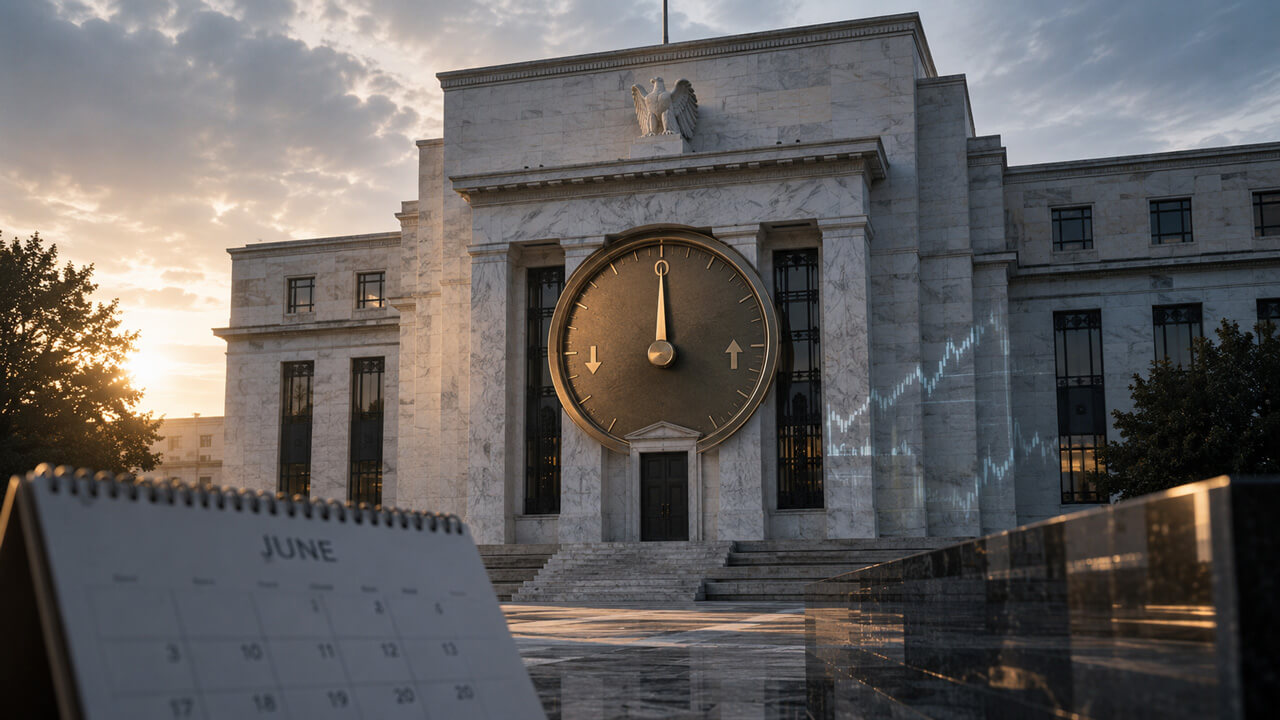
The near-complete lean toward a hold says the market is treating the June meeting as a procedural checkpoint, anchored by the FOMC calendar and narrow settlement rules. The sharper question is what kind of shock would be large enough to break that equilibrium before resolution.

The June Fed decision market is pricing a hold as the dominant outcome because the contract sits close to the meeting itself and resolves on a narrow, official variable: the upper bound of the target federal funds range. At 99.4% for “No change,” against fractions of a cent across cut and hike outcomes, the market-implied story is that policy inertia has become the base case and that only an unusually forceful catalyst can disrupt it.
The price is telling a story of institutional inertia
A hold near $0.994 implies that the market sees the committee preference as largely formed for this meeting. The causal read from the odds is that the debate has collapsed around whether anything at all changes, with directional alternatives priced as remote tails. A 25 bps decrease at 0.3%, a 25 bps increase at 0.4%, and larger moves even lower leave little room for a conventional directional split.
That matters because rate meetings close to decision can become path-dependent. Once the range of plausible official action narrows, fresh information must overcome the institution’s incentive to avoid surprising markets without a clear reason. The prices imply that the burden of proof has shifted from ordinary macro interpretation to evidence of a committee-level decision to move the upper bound.
The rules make a clean hold easier to price
The contract resolves on the upper bound of the target federal funds range, with the Federal Reserve as settlement source. This matters because it strips out adjacent policy details that could otherwise create noise: statement language, dissents, balance-sheet comments, or projection signaling would matter only if they come with an actual change in the target range. The event is therefore sensitive to the mechanical decision; tone around it affects settlement only through an accompanying target-range change.
That design supports the concentration in “No change.” A market tied to a press conference or projections could keep more interpretive uncertainty alive. Here, a single observable official entry controls settlement. Inference from the rules: unless the FOMC changes the upper bound by 25 basis points or more, most macro nuance fails to reach the payout layer.
Large open interest turns consensus into a coordination problem
The market has $86.68 million in volume, $5.03 million in liquidity, and $12.39 million in open interest, which gives the current distribution more weight as a collective commitment than a thin quote would. Those figures cannot settle the policy question. Their relevance is microstructural: late repricing would require either a broad change in conviction or a catalyst strong enough to pull liquidity away from the hold outcome.
High participation also creates a feedback loop around public, checkable inputs. Because the settlement source is official and the close date is fixed, rumors with weak attribution have to compete against a large pool anchored to an observable Fed decision. That helps explain why tiny prices remain in the hike and cut buckets even though a central bank can, in principle, surprise.
| Market feature | Why it matters |
|---|---|
| 99.4% hold price | Signals a process-driven view of policy continuity |
| Upper-bound settlement rule | Limits relevance of commentary without a rate change |
| $12.39M open interest | Raises the threshold for a late collective shift |
Repricing requires evidence that the meeting script has changed
The strongest catalysts would be official or close-to-official signals that the FOMC intends to alter the target range, because the contract cares about the actual range; surrounding commentary matters only through that channel. A hypothetical public statement from the Fed that changes expectations for the June decision would matter more than a generic macro argument. A hypothetical financial-stability shock before the decision could also matter if it created a policy need large enough for the committee to act immediately.
Calendar mechanics create another catalyst. The Federal Reserve calendar is linked as the settlement reference for FOMC timing, so any official schedule or decision-date clarification would matter if it affected which action counts for “June.” That scenario is narrow, but rule-adjacent catalysts often matter more near resolution because the economic debate has already been compressed into an operational result.
The tail outcomes need an official rupture to escape ordinary noise
The main failure mode for the hold thesis is a surprise that arrives with official fingerprints: an emergency-style policy need, a communication shift strong enough to prepare markets for a move, or an FOMC decision that changes the upper bound despite the current price distribution. The tiny prices on both cut and hike outcomes show the market has assigned residual probability to directional tails, with the 25 bps outcomes slightly more credible than 50+ bps moves.
The counter-signal matters because the market’s concentration can mask asymmetry in catalysts. A benign continuation favors inaction, while a discrete, official shock could animate the alternatives. That makes the hold price a statement about process: absent a Fed-authenticated reason to move, the market assumes the institution chooses continuity at the June meeting.
Sources
Market Details
- Resolution criteria
- The FED interest rates are defined in this market by the upper bound of the target federal funds range. The decisions on the target federal funds range are made by the Federal Open Market Committee (FOMC) meetings.
- Platform
-


- Category
- Economy › Economic Policy
- Scheduled deadline
- June 17, 2026, 12:00 AM UTC
- Settlement source
- federalreserve.gov
- Market rules summary
- Multi-outcome Polymarket event. Each listed option is represented by its Yes price on the underlying market. View full rules
Frequently Asked Questions
What was the final result of the Fed Decision in June prediction market?
Polymarket reports No change as the winning outcome for the Fed Decision in June prediction market with a final probability of 100%. The final market snapshot includes $164.64M volume and $2.73M open interest. CryptoSlate last synced the final market data at Jun 17, 2026, 21:27 UTC.
How does the Fed Decision in June prediction market resolve?
The FED interest rates are defined in this market by the upper bound of the target federal funds range. The decisions on the target federal funds range are made by the Federal Open Market Committee (FOMC) meetings. Multi-outcome Polymarket event. Each listed option is represented by its Yes price on the underlying market. The settlement source listed for this market is Federalreserve.
Related Economic Policy Markets
 Bank of Japan interest rate decision: October 2026
  Bank of Canada interest rate decision: October 2026 ECB Interest Rate Decision: October 2026