




ETF
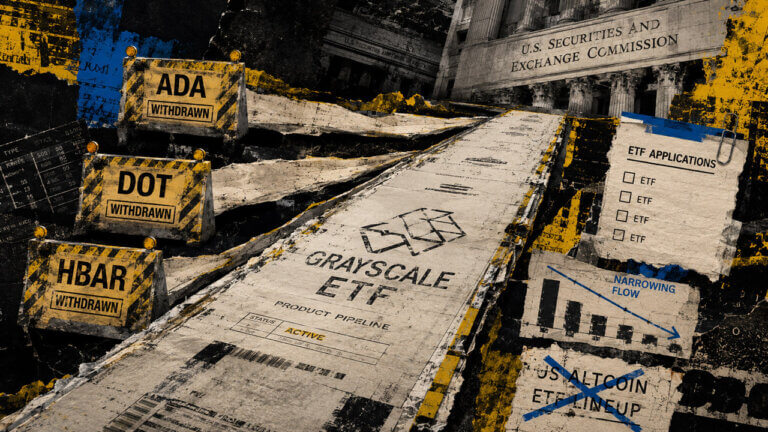
In just 190 seconds, Grayscale quietly pulled the plug on three major altcoin ETFs
Cardano, Hedera and Polkadot registration withdrawals gave no reason for the retreat, while five other Grayscale altcoin filings remained preliminary.

$167.3M traded Price signal supported
Trading Activity price-reliability indicator with 100 percent data coverage. Low activity replaces price-derived sentiment because the displayed market price may not be supported by meaningful trading.Target
Peg Health price-stability indicator with 0 percent data coverage. It measures observed market pricing, not reserve quality or redemption safety.30D +32.3% 97.8% below ATH
Price-based current market conditions indicator with 100 percent data coverage. This is not a price forecast.$167,304,870.27 traded over the last 24 hours. The available activity evidence is sufficient to retain the asset’s price-derived signal.
Low activity can make the displayed price sensitive to a handful of trades. Trading Activity assesses price reliability—not project development, legal status, reserves, or solvency.
Price movement Not interpreted while trading support is below the reliability threshold.
What it measures
The model combines reported 24-hour volume, market-cap turnover, valid-pair liquidity, active exchange breadth, and quote freshness. Missing optional evidence lowers coverage; missing volume or a known-stale quote suppresses price-derived interpretation.
Configured model weights
When inputs are missing, these configured weights are renormalized across the available evidence; data coverage records what is missing.
How to read it
Scores of 0–19 are dormant, 20–39 are thin, 40–69 are supported, and 70–100 are active. Scores below 40 withhold price-derived interpretation.
Logarithmic historical position weighs on it, while Price momentum across the scored timeframes supports the reading. Together these inputs produce a price-neutral reading rather than a price forecast.
A complete ATL and ATH range is not available for this asset.
What it measures
The model converts price momentum, logarithmic historical position, milestone recency, and short-term volume confirmation into one 0–100 score. Missing evidence lowers data coverage instead of counting as neutral.
Configured model weights
When inputs are missing, these configured weights are renormalized across the available evidence; data coverage records what is missing.
How to read it
50 is the neutral midpoint. Scores of 60 or higher are bullish, 40 or lower are bearish, and 41–59 are neutral.
Showing 10 spot markets sorted by CoinMarketCap exchange rank. Markets excluded from CMC price or volume calculations are hidden.
| Pair | |||||
|---|---|---|---|---|---|
| 1 | DOT/USDT | $1.23 | $11.99M | 597 | |
| 2 | DOT/USDC | $1.23 Best price | $2.19M | 551 | |
| 3 | DOT/USD | $1.23 | $4.16M | 607 | |
| 4 | DOT/EUR | $1.23 | $369.26K | 479 | |
| 5 | DOT/KRW | $1.24 | $1.31M | 483 | |
| 6 | DOT/USDT | $1.23 | $5.69M | 543 | |
| 7 | DOT/USDT | $1.23 | $2.17M | 511 | |
| 8 | DOT/USDT | $1.23 | $948.28K | 597 | |
| 9 | DOT/USDT | $1.23 | $2.94M | 610 | |
| 10 | DOT/USDT | $1.23 | $13.26M | 577 |
Affiliate Disclaimer: CryptoSlate may receive a commission when you click trading links on this page and complete an action with a third party. This does not influence our editorial independence or coverage.
Cardano, Hedera and Polkadot registration withdrawals gave no reason for the retreat, while five other Grayscale altcoin filings remained preliminary.

The snapshot tracks direct bridge use, not stranded supply, while self-custodied tokens and protocol positions face separate action paths.

A proof replay bug let the attacker mint over $1 billion DOT tokens on Ethereum, yet shallow DOT pools capped the cashout near $240,000.

Stablecoin sector sees dynamic growth with PayPal, Plasma, and Polkadot each targeting distinct opportunities and challenges.
See DOT across major fiat currencies and swap the active converter instantly.
Quick SelectUsing the live USD market price. Additional fiat rates will appear after the daily sync.
Polkadot is the native crypto asset of the Polkadot network, a multichain protocol designed to connect specialized blockchains under a shared security model. Rather than acting as a single smart contract chain in the style of Ethereum, Polkadot is built as a base layer that coordinates multiple connected chains, historically known as parachains, while enabling interoperability and unified security across the wider network. DOT is central to that system because it is used for staking, governance, and the allocation of network resources.
Polkadot was created to address a long-standing problem in blockchain design, namely that separate networks often operate in isolation, with limited ability to exchange data, assets, or security guarantees. Its architecture centers on a relay chain that provides consensus and coordination, while connected chains handle application-specific execution. This allows projects to build custom environments instead of forcing every application into the same execution model.
DOT is the network’s native token and plays several core roles. It is used in staking to help secure the system, in governance through Polkadot’s onchain voting framework, and in mechanisms related to network resource access. As Polkadot’s design evolved, DOT became tied not only to the original parachain model but also to newer approaches such as coretime markets and OpenGov.
Polkadot emerged from the work of Gavin Wood, one of Ethereum’s co-founders and the former CTO of Ethereum, along with Parity Technologies and the Web3 Foundation. The project was conceived as a way to move beyond single-chain limitations by giving independent blockchains a common security and communication layer. That vision made Polkadot one of the most ambitious infrastructure projects in crypto from the outset.
The network gained early attention for its parachain model, in which individual chains could connect to Polkadot and benefit from shared security. Over time, however, the project’s focus broadened. Governance shifted toward OpenGov, a more flexible and decentralized onchain system, while the network’s resource model moved toward agile coretime, a structure intended to make blockspace more dynamic and easier to access. Polkadot’s roadmap has also increasingly centered on JAM, a redesign of the network’s core computational architecture intended to expand its long-term scalability and flexibility.
Polkadot is best understood as a network for coordinating other blockchains rather than as a single general-purpose application chain. Its architecture is built around interoperability, shared security, and modular execution.
Polkadot’s main use case is as infrastructure for multichain applications, asset transfer, governance systems, and specialized blockchain deployments. It is particularly relevant for projects that want custom execution environments but do not want to manage an entirely separate security layer. This places Polkadot in a different category from monolithic smart contract platforms and also differentiates it from loosely connected blockchain ecosystems without shared security.
DOT’s position in the market reflects that infrastructure role. It is not primarily a payments token or memecoin; it is a network asset tied to staking, governance, treasury management, and the economic coordination of a technically complex blockchain system. That gives it long-term relevance, but it also means its success depends on developer adoption, ecosystem usage, and whether Polkadot’s architecture translates into sustained demand.
Polkadot’s biggest challenge has been complexity. Its architecture, while technically sophisticated, can be harder for developers, users, and investors to understand than simpler networks. The shift from parachain auctions to coretime, along with the broader roadmap toward JAM, has also made the project more dynamic but less straightforward to evaluate from the outside.
There is also competitive pressure. Polkadot operates in a market crowded with alternative approaches to scaling, interoperability, and modular blockchain design. Networks tied to Ethereum rollups, Cosmos-style appchains, and high-throughput monolithic chains all compete for the same developers and liquidity. For DOT holders, that means the asset’s value is closely linked to execution quality, ecosystem traction, and governance effectiveness.
Polkadot remains important because it represents one of crypto’s clearest attempts to build a true multichain base layer with shared security and native interoperability. DOT matters not simply as a tradable token, but as the economic and governance asset behind that vision. Even in a crowded infrastructure market, Polkadot continues to stand out for its technical ambition, its evolving governance model, and its effort to turn blockspace, coordination, and interoperability into a unified network design.


As of Oct 6, 2026, Polkadot trades at $1.23.
Polkadot has a market capitalization of $2,097,443,622.21.
Polkadot has a 24-hour trading volume of $167,304,870.27.
Polkadot reached an all-time high of $55.00, recorded on Nov 4, 2021. It is currently 97.76% below its all-time high.
Polkadot recorded an all-time low of $0.73, recorded on Aug 18, 2026. It is currently 68.92% above its all-time low.
Parity Technologies is a blockchain infrastructure development company best known for building core technologies within the Polkadot ecosystem.