Explore CryptoSlate’s Institutional Playbook, a 3-part guide series on exchange due diligence, crypto-as-a-service, and token listing strategy for institutional teams.
Explore CryptoSlate’s Institutional Playbook, a 3-part guide series on exchange due diligence, crypto-as-a-service, and token listing strategy for institutional teams.
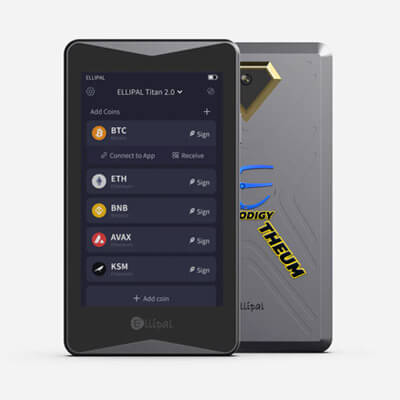
This Ellipal Titan 2.0 review covers a non-custodial cold wallet built for mobile-first holders who want QR-only signing and a larger screen instead of cable or Bluetooth connectivity. Its biggest strength is the larger screen, which makes on-device review clearer during QR-based offline signing. Its main trade-off is that routine use depends heavily on the phone app, and every send takes longer than it does on faster USB or Bluetooth hardware wallets.
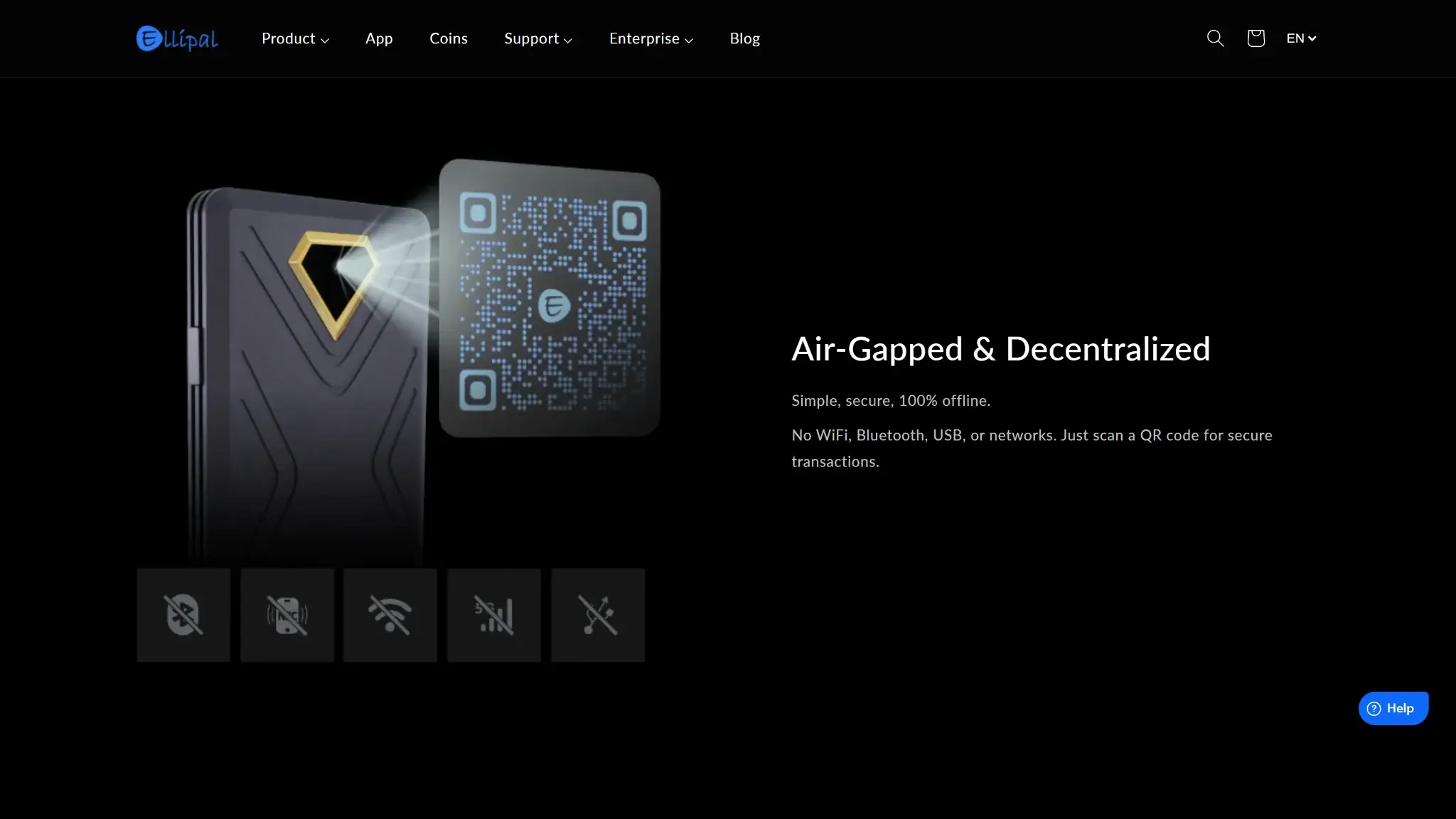
QR-only signing removes USB, Bluetooth, Wi-Fi, and other live transaction links from normal use.
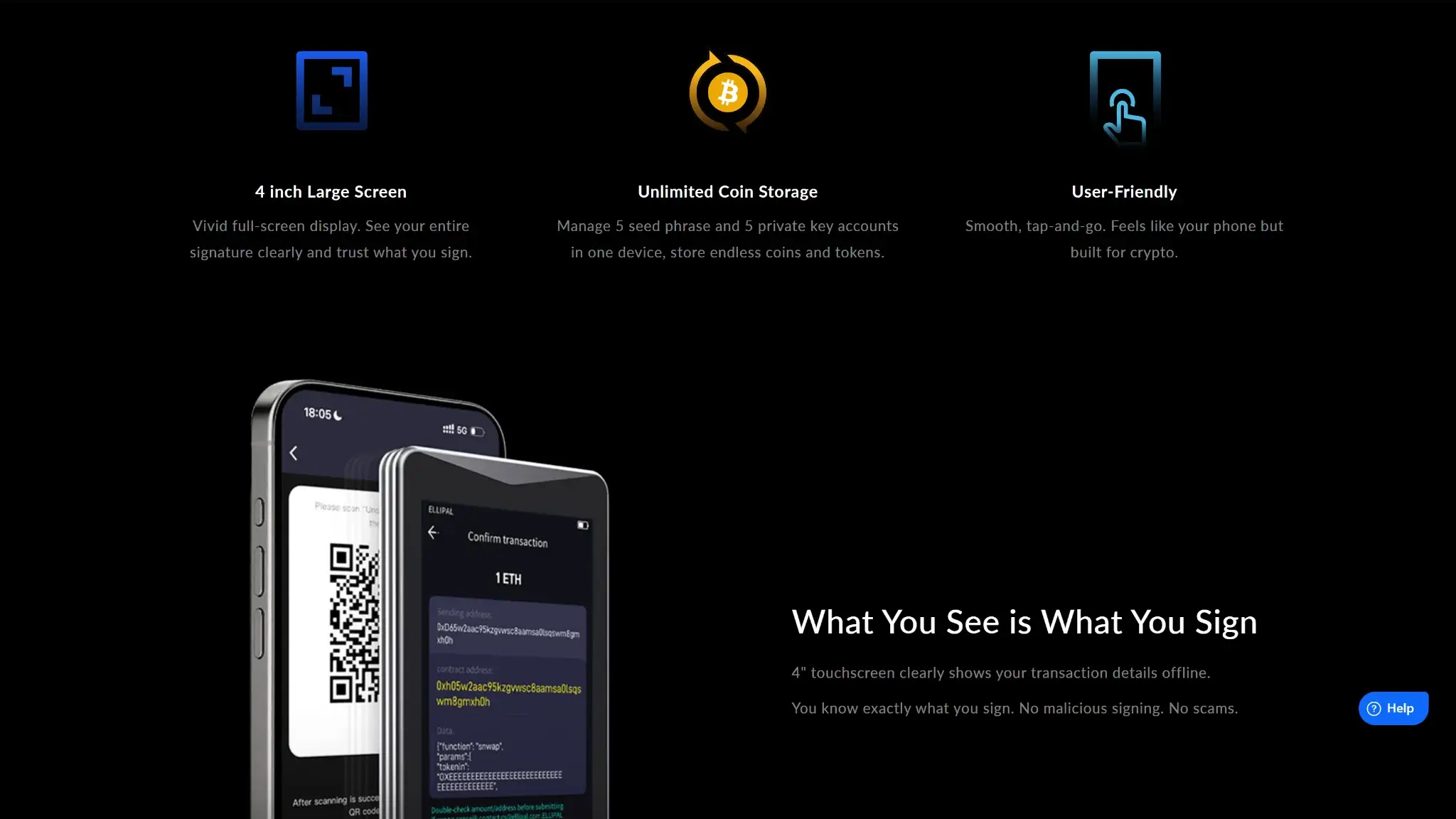
The 4-inch touchscreen gives more room to review addresses, amounts, and fees before approval.
The Ellipal app combines wallet management with swaps, buy and sell, staking, and web3 entry points.
The metal sealed body and tamper-focused design make the device feel more purpose-built than many cheaper air-gapped wallets.
Cons
Routine use depends heavily on the phone app for balances, token management, and transaction creation.
Every send takes longer because the workflow always loops through QR scans in both directions.
Firmware updates are manual and rely on a MicroSD card, adapter, and careful file handling.
Ellipal is only partially open source, which will matter to buyers comparing more transparent rivals.
Who Ellipal Titan 2.0 is Best for — and Who Should Skip It
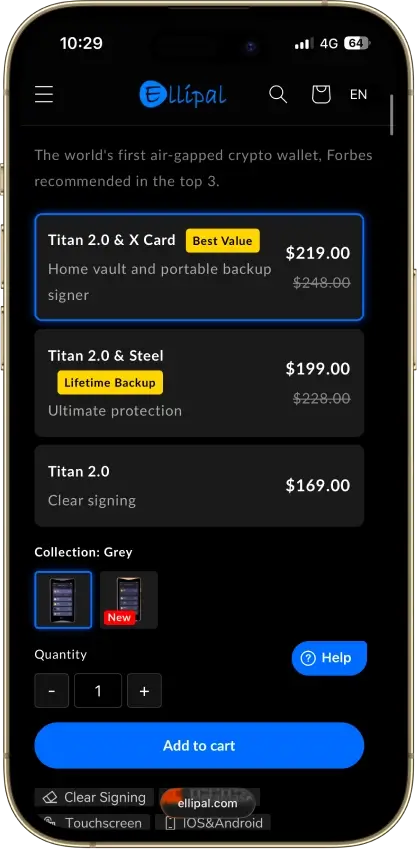
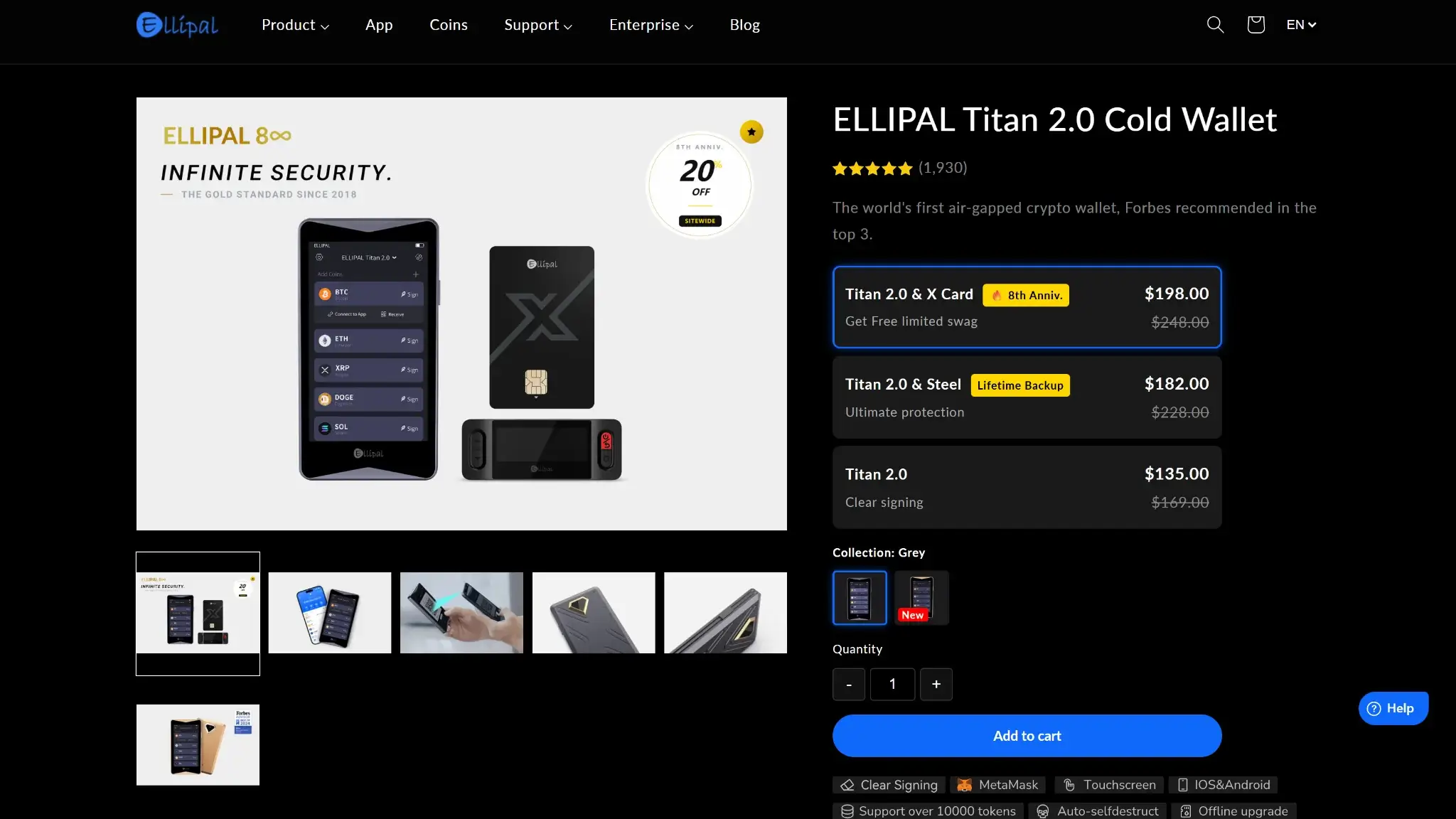
ELLIPAL Titan 2.0 cold wallet product page showing bundle options, pricing, product gallery, and add to cart section.
Ellipal Titan 2.0 is best for buyers who care more about offline signing and clear on-device review than about speed. It works best as a long-term self-custody wallet managed from a phone, not as a tool for frequent transactions or heavy browser-wallet use.
Best Fit
Why It Fits
Who Should Skip It
Why They Should Skip It
Long-term holders
QR-only signing and a larger screen suit slower, more deliberate storage and occasional sends
Frequent senders
Every send requires a two-way QR flow and depends on the app
Mobile-first users
The wallet is designed around the phone app for balances, setup, and transaction creation
Desktop-first users
There is no native desktop management suite, and desktop use mainly routes through MetaMask QR
Buyers who want full key control
It is non-custodial, uses a seed phrase with optional passphrase, and supports BIP39 recovery
Buyers who want simple account recovery
There is no cloud restore, no synced recovery, and no provider reset if recovery data is lost
Buyers who want cold storage without USB or Bluetooth
Normal signing does not rely on a live cable or wireless data connection
Daily DeFi users
WalletConnect and MetaMask QR work, but the web3 flow is slower and less fluid than extension-first wallets
Buyers who care about larger on-device review
The 4-inch touchscreen makes addresses and fees easier to verify before approval
Buyers who want fully open-source firmware
The wallet is only partially open source, which may be a deal-breaker for transparency-focused users
Choose Titan 2.0 if you want a slower, more deliberate signing routine with full self-custody. Look elsewhere if you want the fastest workflow, a smoother desktop experience, or a wallet that works more naturally with browser-based web3 tools.
What is Ellipal Titan 2.0 and How Does it Work?
Ellipal Titan 2.0 is a self-custody hardware wallet that works with the Ellipal app on iOS and Android. The easiest way to understand it is to split the job between the phone and the device.
The app handles: balances, token management, transaction setup, swaps, staking, buy and sell, and web3 access.
The Titan handles: offline key storage and final transaction approval.
How signing works: the app creates an unsigned QR code, the Titan scans it, you review the details on the Titan screen, and the Titan returns a signed QR code for the app to broadcast.
The app is where you manage the wallet, and the Titan is where you approve transactions.
What Changed After the 2025 Hot Wallet Shutdown
Ellipal discontinued its hot wallet service on October 31, 2025. The app now supports Titan Series and X Card cold-wallet users only. A wallet created or recovered directly inside the app is a hot wallet, not Titan cold-wallet use.
Wallet Type, Custody and Recovery Model
ELLIPAL Titan feature page highlighting air-gapped and decentralized security with QR-code signing and no Wi-Fi, Bluetooth, USB, or network connections.
This is a straightforward self-custody hardware wallet. The user controls the keys, the device handles signing, and recovery depends on keeping the seed phrase and any passphrase safe. The model is portable enough for long-term storage because recovery works outside the original device, but it is not forgiving if the recovery data is lost.
Wallet classCold hardware wallet
Who controls the keysUser
Recovery method24-word seed phrase with optional passphrase; BIP39 recovery supported
Can you export keys or seed?Yes, the seed phrase is part of setup and recovery; private-key recovery is also available
Portability to another walletEasy for BIP39-compatible recovery, as long as the correct seed phrase and passphrase are intact
What happens if you lose the deviceYou can recover the wallet on another compatible wallet with the seed phrase and passphrase if one was used
What happens if you lose the recovery methodAccess can become permanently unavailable
Who can help recover accessSupport can guide the process, but nobody can reconstruct a lost seed phrase or forgotten passphrase
Best use caseLong-term storage with full user-controlled custody
Titan 2.0 supports up to 10 accounts in total. Ellipal’s current account-management pages describe that as five seed-phrase accounts and five private-key accounts.
The key distinction is between losing the hardware and losing the recovery data. Losing the Titan is usually recoverable. Losing the seed phrase, or forgetting a passphrase tied to the wallet, is where loss becomes permanent.
Supported Assets, Networks and Compatibility
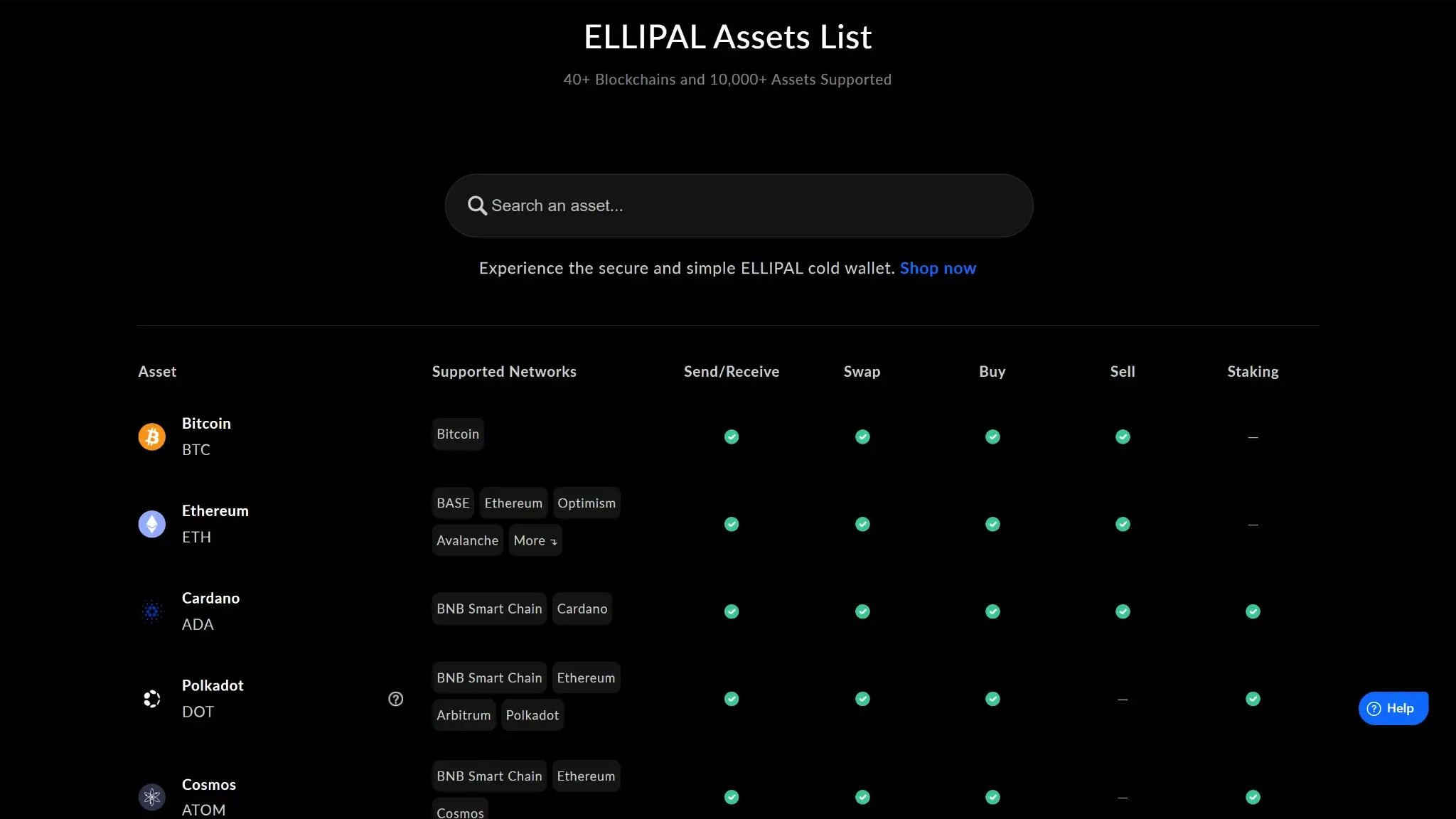
ELLIPAL supported assets list showing cryptocurrencies, supported networks, and features such as send, receive, swap, buy, sell, and staking.
Ellipal covers the major chains most holders care about and supports the common token standards that go with them. What matters more is whether the exact token and action you care about—sending, swapping, staking, or using a dApp—works the way you expect in the app and on the device.
Major chains supportedBroad multi-chain support, including major networks such as Bitcoin, Ethereum, BNB Chain, Solana, XRP Ledger, Cardano, and others
Token standardsBroad multi-chain asset support rather than one ecosystem only; exact token support varies by chain and workflow
PlatformsAndroid, iOS, MetaMask, WalletConnect, and dApps. Desktop use remains secondary and mainly routes through MetaMask QR.
Hardware supportN/A — this is the hardware wallet
Connection methodsQR for pairing, account sync, and signing; MicroSD plus adapter for firmware updates; WalletConnect and MetaMask QR routes for web3 access
Notable gapsNo native desktop management suite, no USB or Bluetooth signing, and exact token support should be checked case by case
NFT support covers Ethereum and Polygon only. Broader NFT language should be avoided unless a specific additional chain is verified.
For most buyers, the wallet is broad enough for a diversified portfolio, but it still makes sense to check exact chain, token, and workflow support before moving meaningful funds.
Core Features and Real-world Use Cases
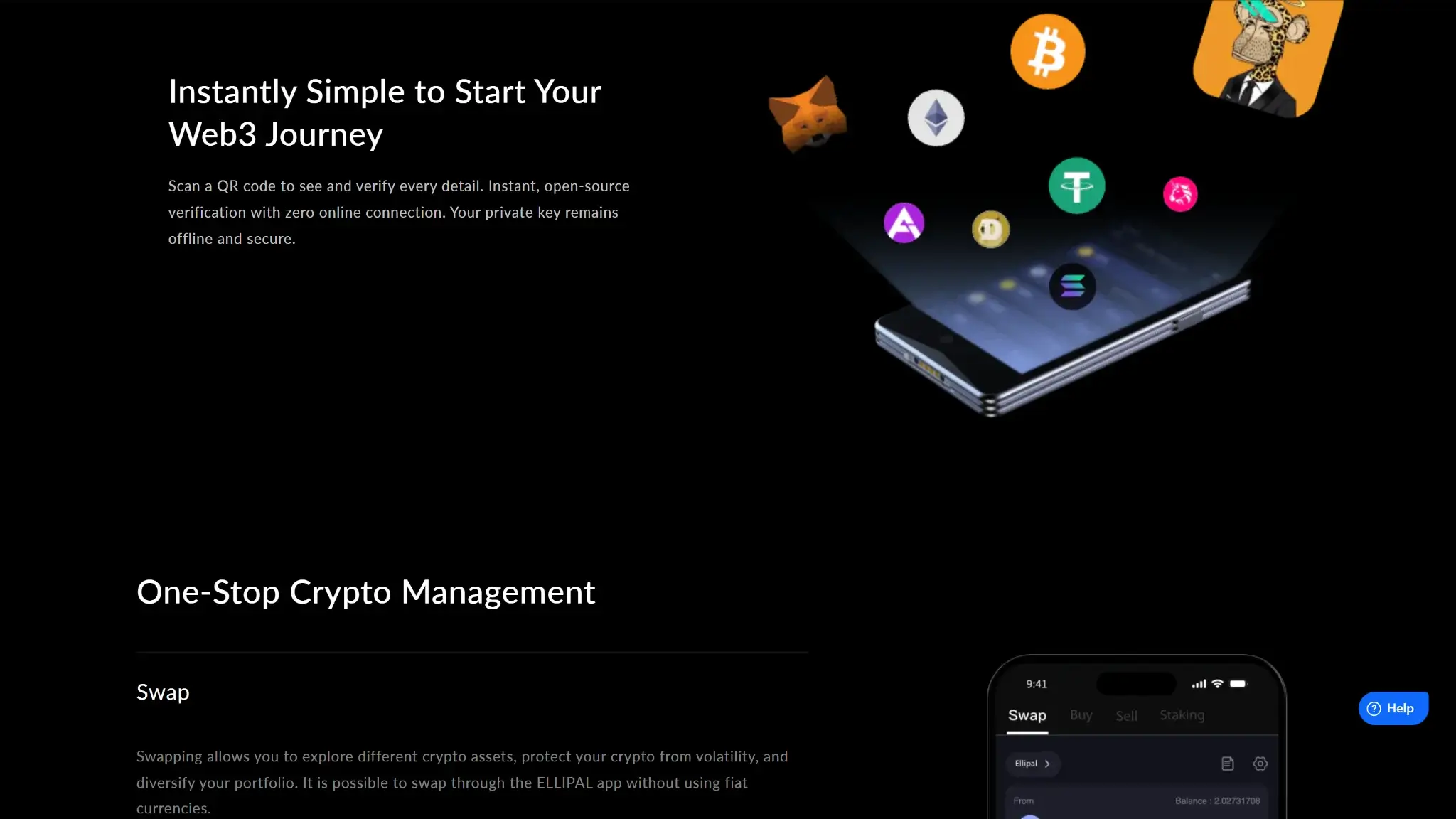
ELLIPAL Titan feature page showing Web3 onboarding, one-stop crypto management, swap support, and mobile app interface.
Against rivals like Ledger Nano X, SafePal S1, Keystone 3 Pro, and Trezor Safe 5, Titan 2.0 offers more than basic cold storage but less day-to-day flexibility than wallets built around extensions or faster desktop flows. Most of those extra features live in the Ellipal app or in partner integrations, while the Titan itself remains an offline signing device.
Feature Area
What Users Can Do
How It Works in Practice
Key Limitations, Costs, or Risks
Swaps and Trading
Swap supported assets and convert between chains where routes exist
Built into the Ellipal app and routed through third-party providers including Changelly and SWIFT
Spreads, network fees, third-party routing, and route visibility are weaker than on dedicated trading tools
Bridging
No dedicated native bridge tool is clearly documented
Users mainly rely on swap routes where available or use external dApps through web3 connections
Smart contract risk, extra fees, chain coverage limits, and more friction than a wallet with a clearer bridge workflow
Staking and Earn
Stake selected assets
One-tap staking through the Ellipal app. Staking support covers ADA, ATOM, XTZ, DOT, and KSM. ETH and SOL staking are still pending.
Partner dependence, asset-by-asset limits, and typical staking risks such as lockups, delays, or validator issues
DApp Access and Connectivity
Connect to dApps, use WalletConnect sessions, and access web3 tools and NFT apps
Ellipal supports Android, iOS, MetaMask, WalletConnect, and dApps. Desktop use remains secondary and mainly routes through MetaMask QR.
Mobile-first flow, slower signing, session friction, and the usual phishing and approval risks around web3 use
NFTs
Store and access supported NFTs
NFT support covers Ethereum and Polygon. Activity is tied more to app and dApp flows than to deep native management tools.
Management depth is lighter than on wallets with stronger gallery and portfolio tooling, and NFT support is narrower than general token support
Buy and Sell With Fiat
Buy and sell crypto with fiat inside the app
Buy and sell services run through third-party providers including MoonPay, Simplex, Bifinity, and Banxa, depending on region and payment method
KYC at provider level, regional limits, provider fees, and no exchange-linked balance system or internal custodial transfer layer
The feature set is broad enough for storage, light swapping, basic staking, and occasional web3 use, but it is not equally polished across every workflow. Titan 2.0 works best when you want one mobile app for common wallet actions while keeping signing on dedicated hardware. The trade-off is that many convenience features come from partner services or WalletConnect-style integrations rather than from the hardware wallet itself, so active on-chain users will run into more friction, more provider dependence, and more extra costs than they would on a wallet built for frequent web3 use.
Fees and Total Cost of Ownership
Ellipal Titan 2.0 is easy to price at the hardware level and harder to price once you start using the app’s services. The wallet itself is a one-time purchase, shipping and import charges can raise the upfront cost, and most ongoing costs come from the blockchain or from outside partners rather than from Ellipal directly. That makes it easier to budget for long-term storage than for active use, where spreads, on-ramp fees, and network costs add up quickly.
Cost Component
What Users Pay
When It Applies
Notes
Device or wallet price
$169
One-time
Base Titan 2.0 hardware price
Shipping and import costs
Varies
Hardware orders
Shipping is calculated at checkout; import duties and taxes may apply by country
Network fees
Variable
Sends, swaps, and any on-chain action
Chain dependent and not controlled by Ellipal
Swap spread or routing fee
Not disclosed
Swaps
Depends on third-party providers such as Changelly and SWIFT, plus gas
On-ramp fee
Variable
Buying crypto
Provider dependent through services that can include MoonPay, Simplex, Bifinity, and Banxa
Withdrawal fee
Not applicable at wallet level
Not applicable
No custodial account withdrawal layer; users still pay network fees when moving assets on-chain
Subscription or premium fee
None disclosed
Not applicable
No wallet-level subscription
The main distinction here is between wallet cost and transaction cost. Ellipal itself is mostly a one-time hardware expense, while recurring costs come from blockchain activity and partner services inside the app. Buyers who mostly store assets and send occasionally will notice the hardware price more than the service layer. Buyers who swap, buy, sell, or move funds often will care more about provider spreads, gas, and regional payment costs than about the wallet price itself.
Security Architecture and Trust
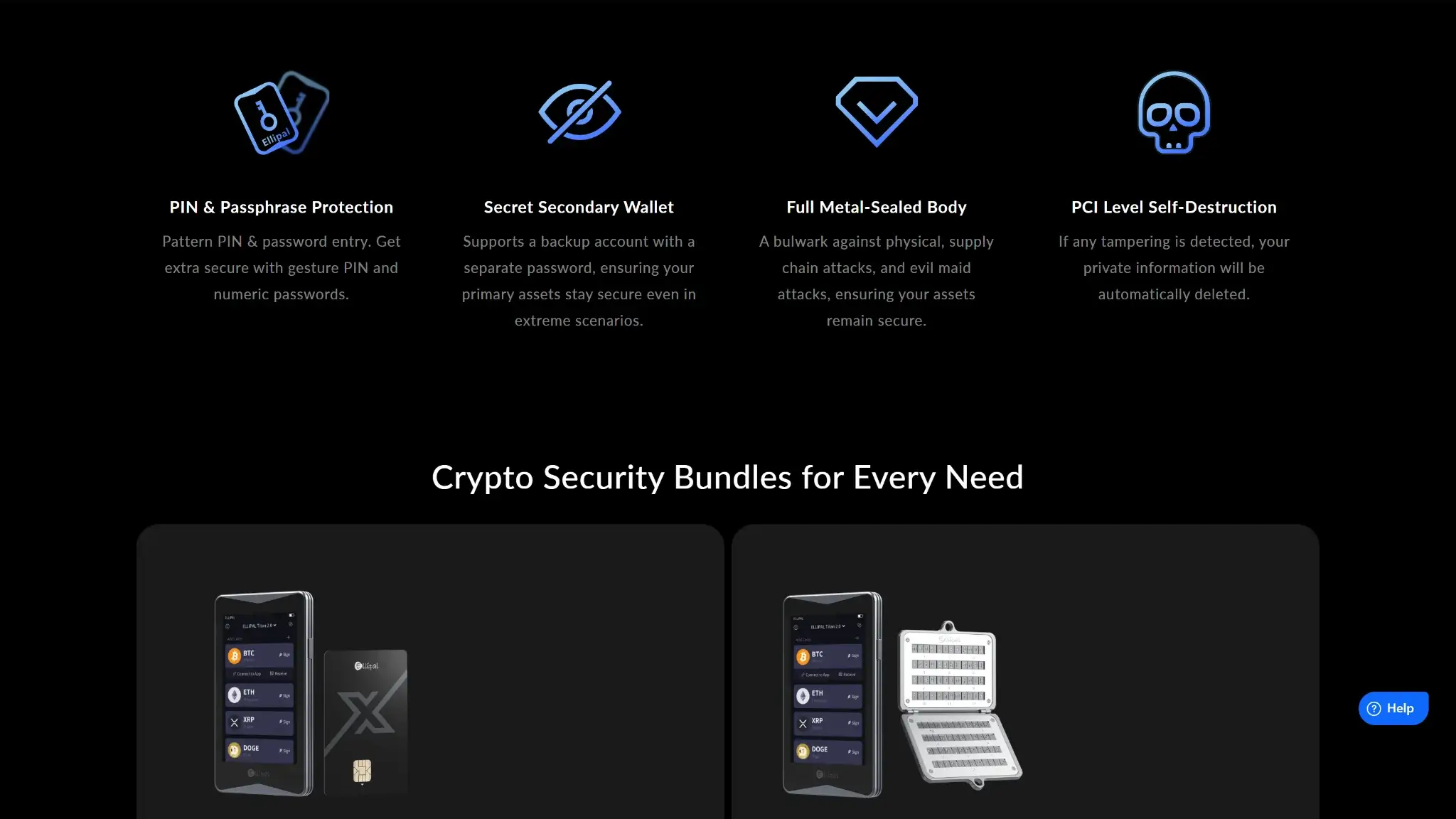
ELLIPAL Titan security features page covering PIN and passphrase protection, secret secondary wallet, full metal-sealed body, self-destruction, and bundle options.
Ellipal Titan 2.0 has a clear security model for buyers who want full key control and offline signing, but it is not the most transparent wallet in its class. Its strongest points for Titan 2.0 users are dedicated offline key storage, QR-based signing instead of live USB or Bluetooth connections, and a device that adds a secure element, tamper-focused design, PIN and passphrase protection, and a visible on-device approval step.
Key control modelUser-controlled keys stored on the Titan device
Recovery model24-word seed phrase with optional passphrase; BIP39 recovery supported
External validationEllipal runs a public vulnerability bounty program and has public disclosure history, including the 2021 Towo Labs writeup covering website and XRP-app issues that were fixed
Open-source statusPartial — QR-code generation code and update-mechanism code are open, while key-generation code remains closed
Anti-scam protectionsOn-device clear signing, phishing warnings, no Telegram support, and support/security contact channels
Incident posturePublic phishing warnings are documented, and public vulnerability-disclosure history exists through the Towo Labs writeup
Titan 2.0’s security model is straightforward: keys stay offline on the device, signing happens only after on-device review, and the wallet uses a CC EAL5+ secure element, a sealed metal body, tamper-triggered data deletion, and a wipe after 10 wrong password or pattern attempts. Ellipal also runs a public vulnerability bounty program and accepts reports at [email protected].
One older Bitcoin issue is still worth noting: some Cake Wallet versions before v4.1.7 created weak 12-word Electrum-format Segwit Bitcoin wallets. Affected funds should be moved to a newly generated wallet from a known-good version or another compatible wallet. Other coin types and mnemonic-format variations were not part of that vulnerable Bitcoin-wallet class in the public write-up.
Backup, Recovery and Loss Scenarios
ELLIPAL Titan feature section showing the 4-inch screen, unlimited coin storage, user-friendly design, and clear-signing transaction display.
Titan 2.0 is resilient if the hardware fails, but it is not forgiving if the recovery data is lost. Support can explain the process, confirm which recovery path applies, and point users to the right setup or restore steps, but support cannot reconstruct a missing seed phrase, recover a forgotten passphrase, or reverse permanent loss caused by missing backup data.
Scenario
What Happens
What Support Can Help With
Permanent Loss Risk
Lost phone
The app can be reinstalled and reconnected to the Titan; the phone does not hold the keys for Titan-based accounts
App setup, pairing steps, and troubleshooting
Low if the Titan and recovery data are intact
Lost hardware wallet
Funds can be restored on another compatible wallet with the seed phrase and passphrase if used
Recovery guidance only
Low if the seed and passphrase are intact
Broken device
Same outcome as a lost device; recovery depends on the backup, not the original hardware
Recovery guidance and firmware/setup help
Low if the seed and passphrase are intact
Forgotten PIN or password
Repeated wrong attempts can wipe the device, after which recovery depends on the backup
Reset and recovery guidance
Moderate if the seed exists; high if it does not
Lost seed phrase
There is no practical fallback recovery path
Support cannot restore it
High
Forgotten passphrase
The related hidden wallet may become inaccessible even if the seed phrase still exists
Support cannot recover the passphrase
High for that wallet
Cloud restore or synced recovery
Not offered for Titan-based self-custody recovery
Not applicable
Not applicable
Readers moving from an old Ellipal hot wallet or any app-based wallet should create a new cold wallet on Titan and transfer assets into it, rather than continue using the old hot-wallet setup.
Losing the hardware is usually survivable, while losing the recovery data is not. That makes Titan 2.0 a solid long-term storage tool for organized users, but a poor fit for anyone who wants account recovery to work like a normal consumer app.
UX, Performance and Platform Support
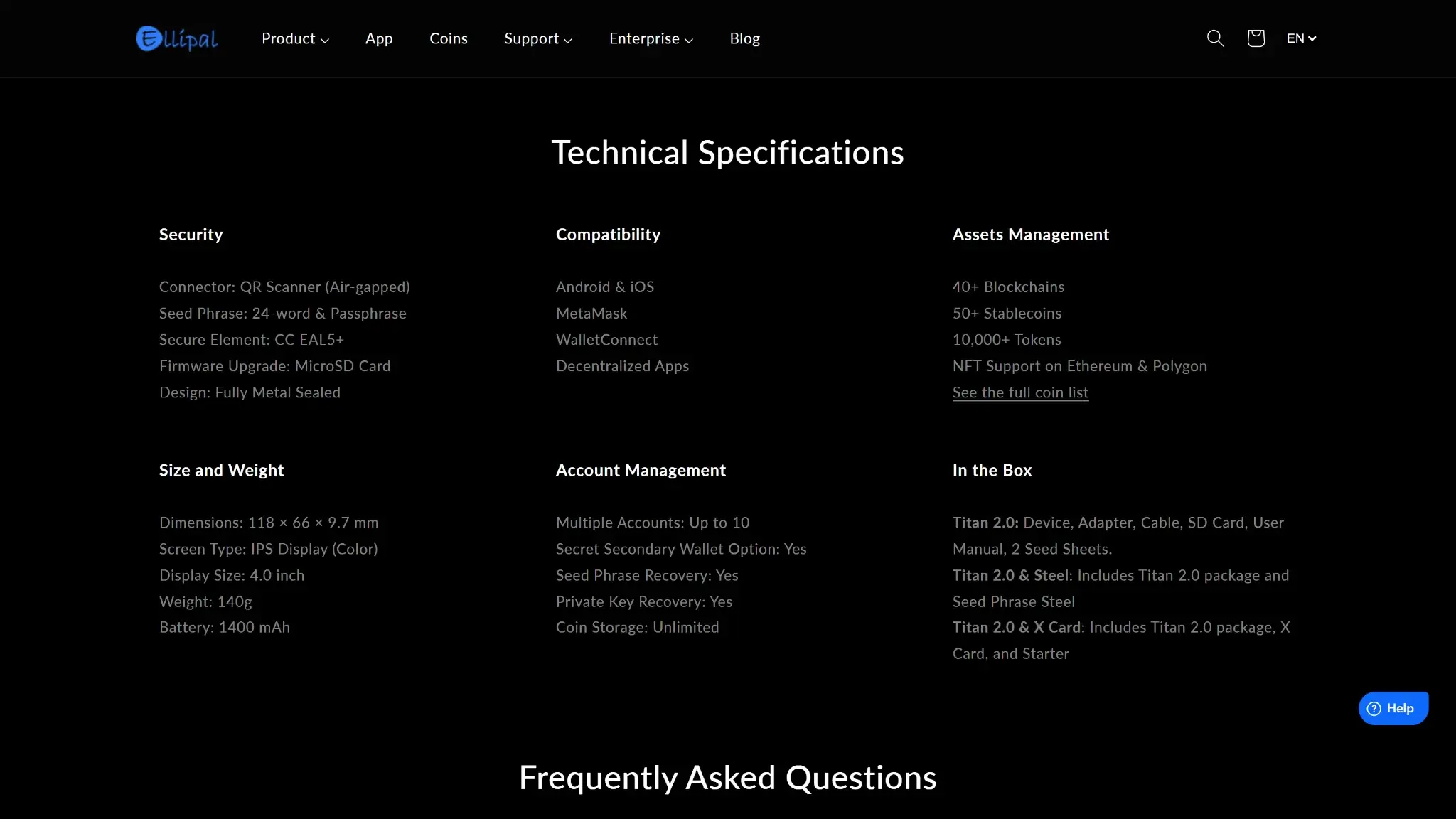
ELLIPAL Titan technical specifications page listing security, compatibility, asset management, size and weight, account management, and in-box contents.
Titan 2.0 is easier to understand than many hardware wallets, but it is not faster to use. The app-device split is clear, the large screen makes transaction review more comfortable, and the QR signing model makes sense after a few sends. The downside is that almost everything runs through the phone app, there is no native desktop management suite, and the manual firmware process creates more friction than the smoother update experience offered by some rivals.
Platform Support Table
Platform
Availability
Notes
iOS
Yes
Full app support for balances, management, and transaction setup
Android
Yes
Full app support for balances, management, and transaction setup
Browser Extension
No
No native Ellipal browser extension
Desktop
Limited
No native desktop management suite; desktop web3 access exists through MetaMask QR linking on a camera-equipped computer
Web App
No
No native Ellipal web app
Desktop use remains secondary and mainly routes through MetaMask QR. MetaMask QR linking needs a camera-equipped computer and firmware 3.11.0 or above. The mobile app also runs on Apple-silicon Macs with macOS 12.5 or later, but that does not turn Titan 2.0 into a full desktop wallet suite.
The 4-inch touchscreen is a genuine usability advantage because it makes addresses and fees easier to review. There are no external buttons to learn, the battery makes mobile use more convenient, and the sealed body feels durable, but the device is still bulkier than smaller stick-style wallets. The QR connection flow is easy to understand, though slower than cable or Bluetooth. Update quality is acceptable once the process is understood, but the MicroSD-plus-adapter setup is one of the weaker parts of the overall experience because it is less forgiving and easier to get wrong than modern plug-and-update systems.
Customer Support, Documentation and Incident Handling
Support for Titan 2.0 is better on documentation than on real-time human help. The official site has a visible help center, setup guides, firmware pages, and recovery articles, which matters because most Titan 2.0 problems are procedural rather than account-based. Human support is more limited, and email is the main official support path.
Support cannot reverse an on-chain transfer, recover a lost seed phrase, or restore a forgotten passphrase.
Channel
Availability
Typical Use
Notes
Help center
Available online
Docs, setup, firmware, and troubleshooting
Broad enough for common device and app issues, but scattered across guides and support posts
Live chat
No
Not available
No official live chat
Email or tickets
Yes
Technical issues, setup, firmware, and app problems
Ellipal support uses [email protected] and targets a reply within 2 business days
Status page
No
Not available
No official status page
Community channels
X and official blog/news; no Telegram support
Announcements and general awareness
Ellipal has no customer service support on Telegram and warns users never to share the 24-word recovery phrase
The documentation is good enough for setup, recovery, and update tasks, but the support model is not built to rescue Titan 2.0 users from self-custody mistakes. That makes the experience workable for careful users who follow instructions, but less reassuring for buyers who expect fast human help when something goes wrong.
Final Verdict
Titan 2.0 is a good option if offline signing matters more to you than speed and you are comfortable managing the wallet from your phone. The QR flow and larger screen make on-device review easier than it is on many wallets at this price, and the metal body feels like a dedicated signer rather than a cheap accessory. The tradeoffs are slower sends, manual firmware updates through a MicroSD card and adapter, and closed key-generation code. At $169, you are paying for isolation and screen comfort, not speed or desktop flexibility.
QR-only signing removes USB, Bluetooth, Wi-Fi, and other live transaction links from normal use.
The 4-inch touchscreen gives more room to review addresses, amounts, and fees before approval.
The Ellipal app combines wallet management with swaps, buy and sell, staking, and web3 entry points.
The metal sealed body and tamper-focused design make the device feel more purpose-built than many cheaper air-gapped wallets.
CONS
Routine use depends heavily on the phone app for balances, token management, and transaction creation.
Every send takes longer because the workflow always loops through QR scans in both directions.
Firmware updates are manual and rely on a MicroSD card, adapter, and careful file handling.
Ellipal is only partially open source, which will matter to buyers comparing more transparent rivals.
Affiliate Disclosure
Disclaimer: CryptoSlate may receive a commission when you click links on our site and make a purchase or complete an action with a third party. This does not influence our editorial independence, reviews, or ratings, and we always aim to provide accurate, transparent information to our readers.
FAQ
Is Ellipal Titan 2.0 custodial or non-custodial?
Ellipal Titan 2.0 is non-custodial, which means the user controls the keys and recovery data rather than a provider.
Is Ellipal Titan 2.0 a hot wallet or a cold wallet?
It is a cold hardware wallet that signs transactions offline while using the Ellipal app as the management interface.
Does Ellipal Titan 2.0 give you a seed phrase?
Yes. The setup process includes a 24-word seed phrase, and users can also enable an optional passphrase.
Is Ellipal Titan 2.0 safe?
It has a strong offline signing model, a secure element, and on-device approval, but safety still depends on protecting the recovery data and avoiding phishing or bad signing decisions.
Which chains does Ellipal Titan 2.0 support?
It supports a broad multi-chain lineup, including major networks such as Bitcoin, Ethereum, BNB Chain, Solana, XRP Ledger, and Cardano, but exact token and workflow support should be checked case by case.
What fees does Ellipal Titan 2.0 charge?
The main direct cost is the hardware price, while ongoing costs come from network fees and third-party partner fees for swaps, buys, or sells inside the app.
Does Ellipal Titan 2.0 require KYC?
Not at the wallet level, but identity checks can apply when users access third-party buy or sell services through the app.
What happens if you lose your device or recovery method?
Losing the device is usually recoverable with the seed phrase and passphrase if used, but losing the recovery data can cause permanent loss of access.