Explore CryptoSlate’s Institutional Playbook, a 3-part guide series on exchange due diligence, crypto-as-a-service, and token listing strategy for institutional teams.
Explore CryptoSlate’s Institutional Playbook, a 3-part guide series on exchange due diligence, crypto-as-a-service, and token listing strategy for institutional teams.
Cake Wallet is a non-custodial hot wallet for people who want Monero, Bitcoin, swaps, and privacy tools in one app. It stands out because it goes beyond basic storage. It gives users privacy-focused tools, built-in swaps, and spending options in the same product. The trade-off is day-to-day friction. Users need to pay attention to sync, nodes, fees, and partner flows.
Broader chain coverage than many users expect from a wallet that started around Monero.
Mobile and desktop support give it more range than mobile-only privacy wallets.
Lightning adds a faster Bitcoin payment layer for users who want more than base-chain payments.
Cons
Sync status and node issues can confuse new users.
Not a browser extension, so it is a weak fit for heavy DeFi and dApp users.
Hardware support is broader than older setup pages suggest, but coverage still varies by device, asset, and platform.
Fees come from several layers, so total cost is harder to judge before checkout.
It is still a hot wallet, so it is not the right tool for large long-term holdings that need hardware-level isolation.
Who Cake Wallet is Best for — and Who Should Skip It
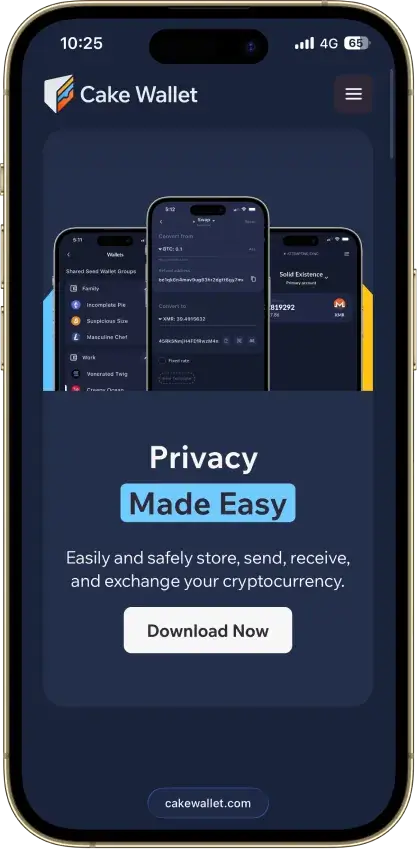
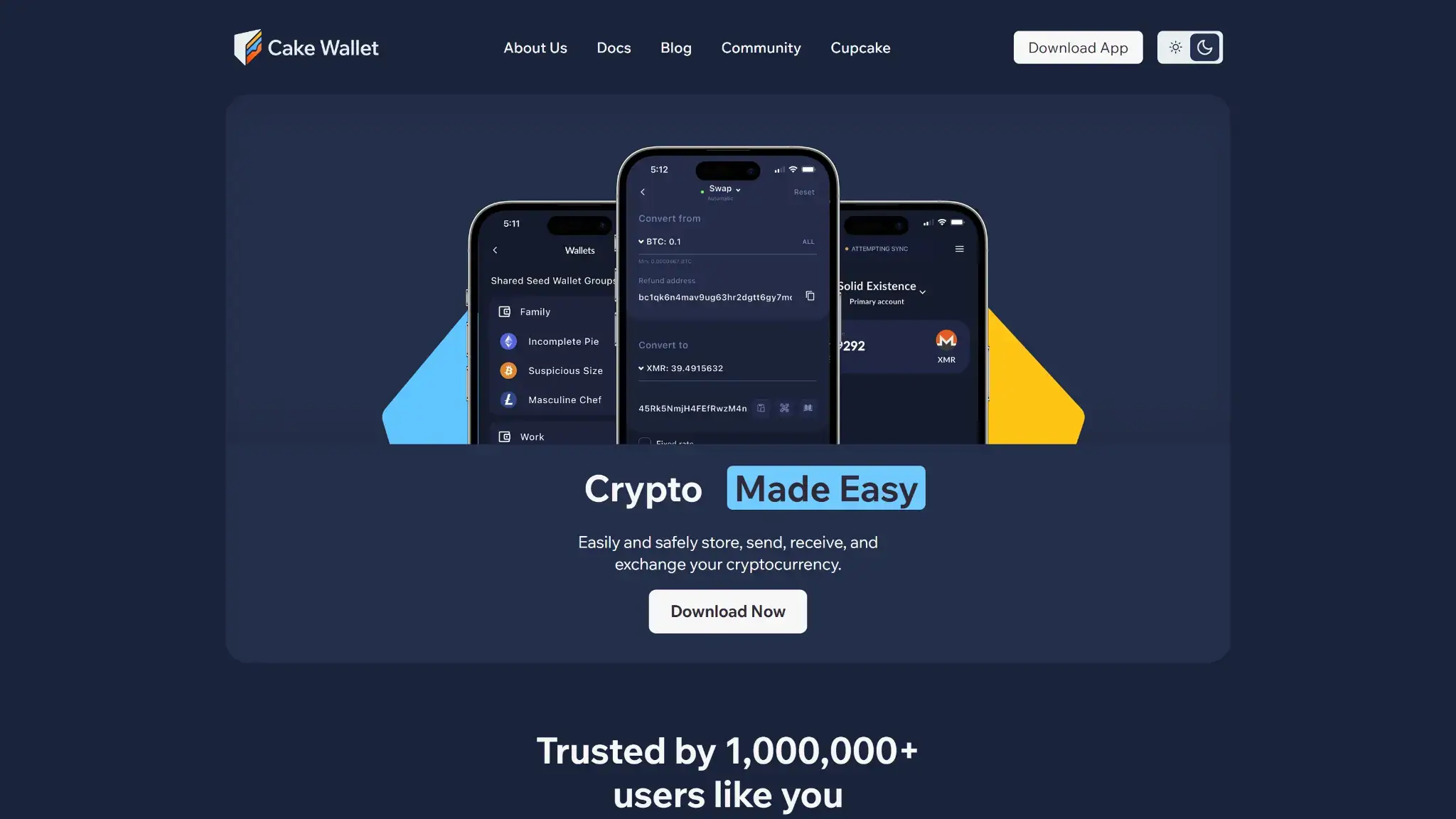
Cake Wallet website hero showing “Crypto Made Easy” with app screenshots and a Download Now button.
Cake Wallet fits users who want everyday self-custody with Monero at the center. It works well for people who want to hold XMR and BTC, swap between assets, use privacy tools, and handle all of that from one app.
It is a weaker fit for users who want the easiest wallet possible or deep browser-based DeFi access. People who want one-click extension use, broad NFT features, or cold-storage-first security should look elsewhere.
User type
Fit
Why
Monero-first self-custody user
Strong fit
Cake gives Monero more attention than most general wallets
Bitcoin user who also wants swaps and privacy tools
Strong fit
Silent Payments, PayJoin, Lightning, and in-app swaps make it more flexible than a basic BTC wallet
Passive holder who wants long-term cold storage
Weaker fit
Cake is still a hot wallet, even with some hardware support
Browser-extension DeFi user
Weak fit
Cake is not built around extension-based dApp sessions
Beginner who wants full key control and can handle some setup friction
Good fit
Recovery is simple, but sync and network details still need attention
User who wants account recovery and platform-managed support
Weak fit
Cake is non-custodial, so recovery stays with the user
What is Cake Wallet and How Does it Work?
Cake Wallet is a self-custody wallet app for Android, iPhone, iPad, macOS, Linux, and Windows. It started as a Monero wallet. It now supports a wider set of chains, token wallets, swaps, buy and sell partners, Cake Pay, and Lightning for Bitcoin.
Users access it on their own device. There is no exchange-style account to open before creating a wallet. Setup starts with a local PIN. Then the user creates a wallet or restores one from a seed phrase, backup file, QR code, or a supported hardware flow.
Keys stay on the user’s device. Cake does not hold them. Most transactions are approved in the app. On supported hardware flows, signing moves to the external device for the assets and platforms it supports.
However, Cake does more than store coins.
Hold and send Monero, Bitcoin, and a wider set of supported chains.
Use token wallets on supported networks such as Ethereum, Tron, Solana, and other EVM chains.
Swap assets inside the app through third-party providers.
Buy and sell selected assets through partner services.
Use Cake Pay for gift cards and payment-style spending.
Use privacy tools such as custom nodes, Tor options, Silent Payments, PayJoin, and Litecoin MWEB.
Wallet Type, Custody and Recovery Model
Cake Wallet is a non-custodial hot wallet. The user controls the keys. Cake does not hold funds or recover access for the user.
Recovery depends on wallet type. Standalone Monero wallets use 16-word Polyseed by default or 25-word legacy seeds. Wallet Groups can use one 12-word BIP39 seed across multiple supported assets. Cake also supports backup-file, QR, and hardware-based restore flows where applicable.
Wallet classHot software wallet
Who controls the keysUser
Recovery methodRecovery depends on wallet type. Standalone Monero wallets use 16-word Polyseed by default or 25-word legacy seeds. Wallet Groups can use one 12-word BIP39 seed across multiple supported assets. Cake also supports backup-file, QR, and hardware-based restore flows where applicable
Can you export keys or seed?Yes, but the exact export and restore path varies by wallet type
Portability to another walletPartial
What happens if you lose the deviceYou can restore on a new device if you still have the correct seed, backup file, QR restore path, or supported hardware setup
What happens if you lose the recovery methodAccess to funds can be permanently lost
Who can help recover accessNobody can recover funds without the recovery method; support can help with app issues only
Best use caseDaily self-custody, privacy-focused asset management, and in-app swaps
Cake is not a managed account. There is no provider-side reset if you lose both the device and the recovery method. The user gets full control. The user also carries full recovery responsibility.
Supported Assets, Networks and Compatibility
Cake Wallet supports far more than its Monero-first image suggests. Users searching for Cake Wallet supported coins or Cake Wallet supported cryptocurrencies are usually asking two things: which chains work natively, and which token standards work on top. It covers major privacy, Bitcoin, and selected smart-contract ecosystems. It also supports tokens on several networks. Support is not identical across platforms. Mobile gets newer assets and features first, and Linux desktop 5.9.0 did not include Zcash, Decred, or Zano. It is still more focused than a browser-extension web3 wallet.
Token standardsERC-20 and other EVM tokens, including BEP-20 on BNB Smart Chain, plus SPL tokens on Solana and TRC-20 tokens on Tron
PlatformsiPhone, iPad, Android, macOS, Linux, Windows
Hardware supportDevice-, asset-, and platform-specific support across Ledger, Trezor, BitBox, Trezor Safe 7, and selected Cupcake or Coldcard Q flows
Connection methodsUSB, Bluetooth on supported Ledger flows, QR on supported restore or signing flows, and in-app swap and payment flows
Notable gapsNo browser extension, limited dApp access, no broad NFT-first tooling, and hardware support varies by asset and platform
Cake covers many assets, but it is not a browser-based web3 hub. It is stronger for self-custody, swaps, privacy tools, and mixed mobile or desktop use than for extension-led DeFi workflows.
Core Features and Real-world Use Cases
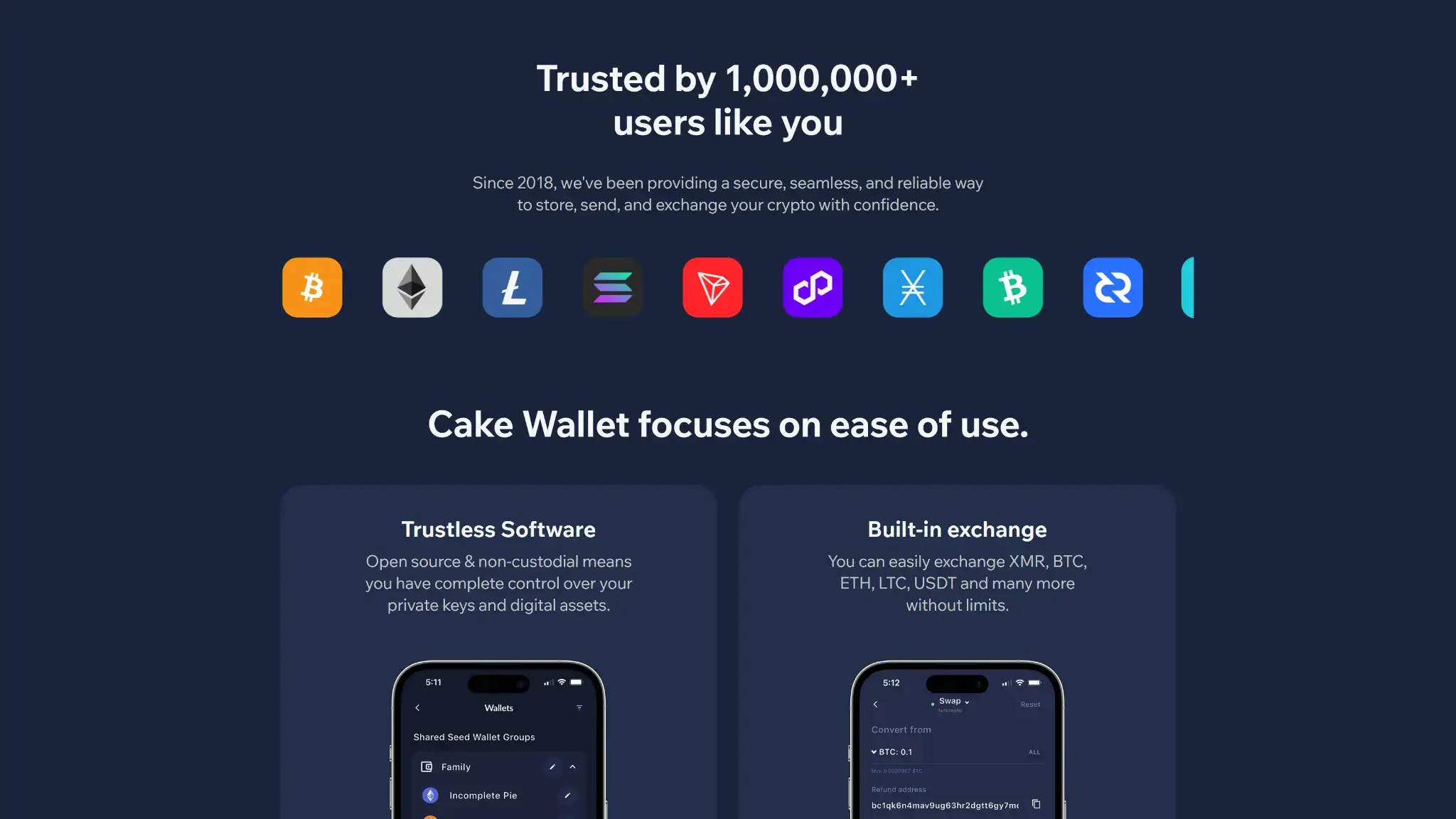
Cake Wallet website section showing “Trusted by 1,000,000+ users” and feature cards for trustless software and built-in exchange.
Cake is broader than a simple Monero wallet, but narrower than a full web3 wallet plus extension stack. It works best for self-custody users who want to hold XMR and BTC, swap between assets, buy or sell through partners, and spend through Cake Pay without leaving the app.
For users wondering how to buy Monero on Cake Wallet, the main routes are partner buys when available or swapping into XMR inside the app.
Feature area
What users can do
How it works in practice
Key limitations, costs, or risks
Swaps and trading
Swap supported assets and convert between coins and tokens
Swaps run through third-party providers inside the app; users compare available quotes and routes at the time of the trade
Quotes vary by provider, pair, and region; spreads and network fees apply; route visibility is limited compared with advanced trading tools
Staking and earn
Use limited earn-style features
Cake does not offer a native staking dashboard. The clearest earn feature is dEURO savings and yield tooling added in the 2025 cycle
Not a general staking wallet; this is an earn feature, not broad staking support
dApp access and connectivity
Use Ethereum WalletConnect flows and selected chain-specific tools without a browser-extension workflow
Cake supports Ethereum WalletConnect flows and chain-specific in-app tooling such as Jupiter swaps on Solana rather than extension-led dApp sessions
Weak fit for heavy browser-based DeFi and NFT use; fewer session and connection options than web3-first wallets
Exchange and account features
Buy and sell with fiat partners and move between wallet activity and partner services
Buys and sells happen through partner-powered flows inside the app; wallet creation itself does not require an exchange account
KYC may apply at the partner layer; pricing varies by provider; service availability depends on country and asset
Card, borrowing, and spending
Spend through Cake Pay gift cards and payment-style products
Cake Pay sits inside the wider Cake setup and lets users turn crypto into spending products without using a full exchange account
Conversion fees apply; product availability varies; this is spending support, not a full debit-card or borrowing stack
The strongest tools sit inside Cake’s core wallet experience. That includes self-custody, privacy controls, Monero and Bitcoin support, and simple in-app asset movement. Buys, sells, swaps, and Cake Pay extend what the wallet can do, but those layers depend on partners, quotes, regional availability, and extra fees. Users who want privacy-focused self-custody with a few convenience tools will find the mix strong. Users who want broad DeFi access, NFT management, staking depth, or a full smart-account experience will not.
Fees and Total Cost of Ownership
Cake Wallet is free to download. There is no account fee. There is no subscription fee. The real costs come later. Users pay network fees, swap spreads, partner fees for buying or selling, and Cake Pay conversion costs when they use those services.
The biggest pricing mistake is to treat all of that as one wallet fee. It is not.
Cake Wallet swap fees and Cake Wallet exchange fees are not fixed wallet charges. They change by provider, route, region, and network. Blockchain gas is separate from swap pricing. Swap pricing is separate from buy and sell partner quotes. Cake Pay has its own cost layer too. Optional hardware costs also sit outside the wallet itself.
Cost component
What users pay
When it applies
Notes
Device or wallet price
Free for the wallet; optional hardware device cost varies by external signer
One-time
Cake itself is free; hardware costs apply only if the user adds a supported device
Shipping and import costs
N/A for the wallet; varies for optional hardware orders
Hardware orders
Not part of Cake Wallet pricing
Network fees
Variable
Sends, swaps, and Lightning or on-chain activity
Chain dependent; paid in the native gas asset where required
Swap spread or routing fee
Quote-based and not fixed
Swaps
Third-party provider pricing; route, pair, and region affect the final quote
On-ramp fee
Variable
Buying crypto
Partner dependent; Onramper is a routing layer, not the direct seller
Withdrawal fee
No separate Cake withdrawal fee
Withdrawals
Users still pay the blockchain network fee
Subscription or premium fee
None
N/A
No monthly or yearly wallet plan
The day-to-day cost profile is reasonable for a self-custody wallet, but it is not always easy to predict before the final transaction screen. Users who mostly hold and send will mainly notice network fees. Users who buy, swap, and cash out inside the app will see more hidden friction. That friction comes from partner quotes, spread differences, and region-based pricing. Cake is cheap as a wallet. It gets more expensive if it becomes your all-in-one service hub.
Security Architecture and Trust
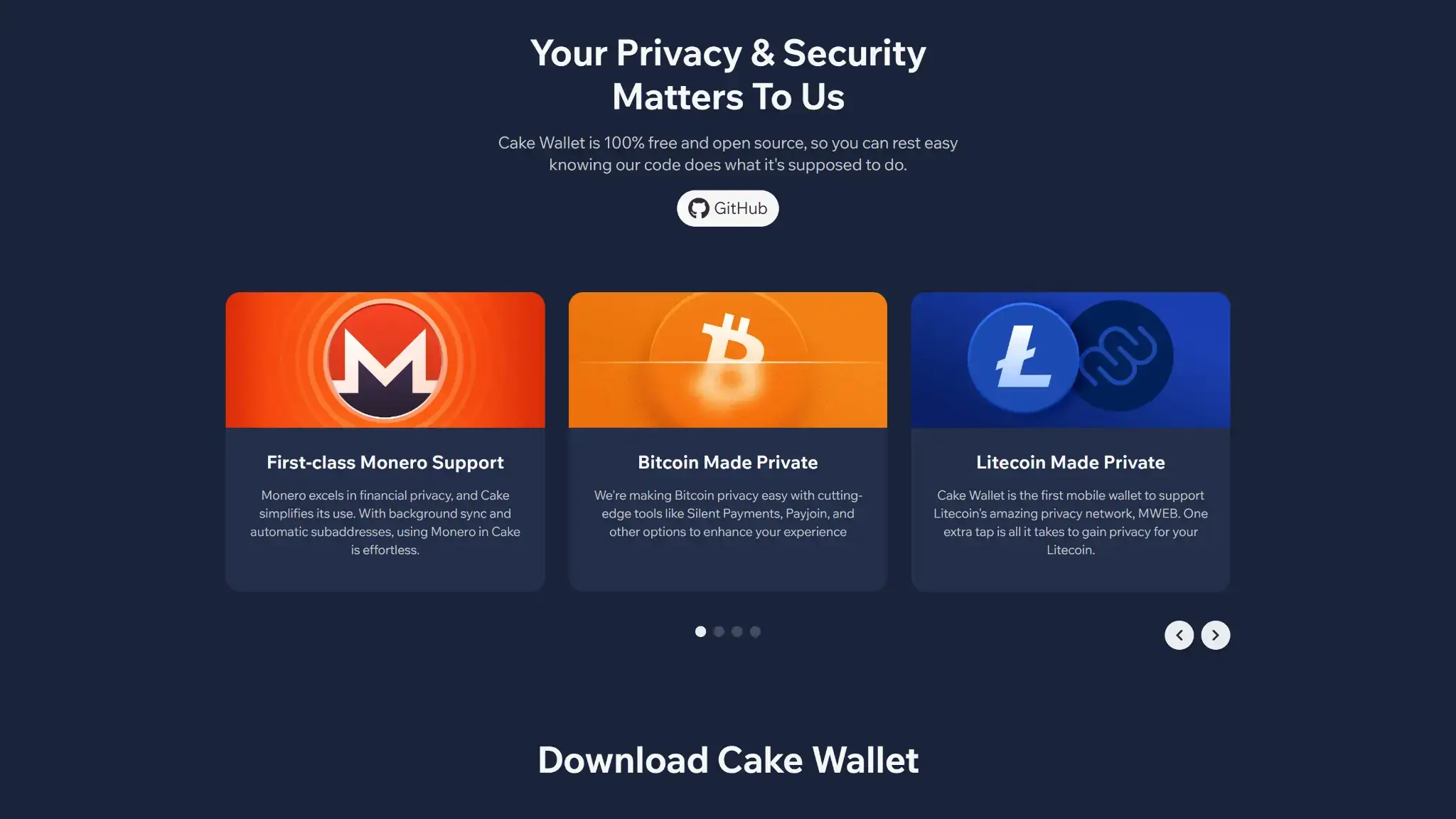
Cake Wallet website privacy and security section highlighting Monero support, Bitcoin privacy tools, and Litecoin privacy features.
Cake’s security model is solid for a hot wallet, but it still carries normal hot-wallet risk. Keys stay on the user’s device, and recovery stays with the user. Signing happens in the app unless a supported hardware flow moves signing to an external device. Protection layers include a local PIN, biometric unlock on supported devices, custom nodes, and Tor options. Cake 2FA is a limited secondary control for casual or local-access threats. It is not a substitute for hardware-wallet security or multisig. Cake also lacks some protections common in web3-first wallets, such as broad transaction simulation, a built-in revoke dashboard, and stronger extension-style approval tooling.
Cake is open source under an MIT license, and the code is public.
The table below gives the trust model in one place.
Key control modelUser-held local keys
Recovery modelRecovery depends on wallet type. Standalone Monero wallets use 16-word Polyseed by default or 25-word legacy seeds. Wallet Groups can use one 12-word BIP39 seed across multiple supported assets. Cake also supports backup-file, QR, and hardware-based restore flows where applicable
External validationOpen-source codebase is public; broad current wallet-wide audit coverage is Not disclosed
Open-source statusYes, MIT license
Anti-scam protectionsLocal PIN, biometrics, custom nodes, and Tor options; Cake 2FA is a limited secondary control for casual or local-access threats; no broad transaction simulation or revoke dashboard
Incident posturePublicly disclosed older weak 12-word Electrum-format Segwit Bitcoin wallet issue with clear migration guidance; no provider-side recovery model
Risk remains where it usually remains in hot wallets. A compromised phone or desktop can still expose funds. Fake apps, fake support, bad backups, and careless signing are still the main failure points. Cake reduces some of that risk through local controls and clearer self-custody boundaries. It does not remove it. Users who want the strongest isolation should still use a hardware wallet for larger balances.
One older Bitcoin issue is still worth noting: some Cake Wallet versions before v4.1.7 created weak 12-word Electrum-format Segwit Bitcoin wallets. Affected funds should be moved to a newly generated wallet from a known-good version or another compatible wallet. Other coin types and mnemonic-format variations were not part of that vulnerable Bitcoin-wallet class in the public write-up.
Backup, Recovery and Loss Scenarios
Recovery is one of the most important parts of this wallet. Cake gives the user control, but that also means the user carries the recovery burden. Support can help with app issues, sync issues, and setup problems. Support cannot restore funds if the user loses the recovery method.
The exact recovery path depends on the wallet type. Standalone Monero wallets use 16-word Polyseed by default or 25-word legacy seeds. Wallet Groups can use one 12-word BIP39 seed across multiple supported assets. Cake also supports backup-file, QR, and hardware-based restore flows where applicable. Recovery is flexible, but not uniform across every asset and setup.
Scenario
What happens
What support can do
When loss is permanent
Lost phone or desktop
Funds can still be restored on a new device if the user still has the correct recovery method
Support can help with restore steps and troubleshooting
Loss is permanent only if the recovery method is also gone
Broken device
Same as a lost device; funds are not tied to the hardware itself if recovery data still exists
Support can help with app setup and restore guidance
Loss is permanent only if the recovery method is missing too
Forgotten PIN
The user may need to reinstall and restore the wallet, depending on the device and setup
Support can explain the restore path
Loss becomes permanent only if the user cannot restore the wallet
Lost seed phrase or main recovery method
The wallet may still be recoverable only if that wallet type also has a valid backup file, QR restore path, or supported hardware path
Support cannot recover the funds without a valid recovery path
Loss is permanent if no working recovery method remains
Lost hardware wallet
Funds may still be recoverable if the user still has the correct seed or backup for that hardware-backed wallet flow
Support can help explain compatible restore options
Loss is permanent if both the device and its recovery path are gone
Sync or app issue that looks like fund loss
Funds may still be there, but the wallet may need to sync fully or connect to a healthy node
Support can help with sync, nodes, and app troubleshooting
Not permanent unless the actual recovery method is gone
The main rule is simple. Lose the device, and recovery is usually still possible. Lose the recovery method, and the loss can become permanent. That is the trade-off of non-custodial control.
UX, Performance and Platform Support
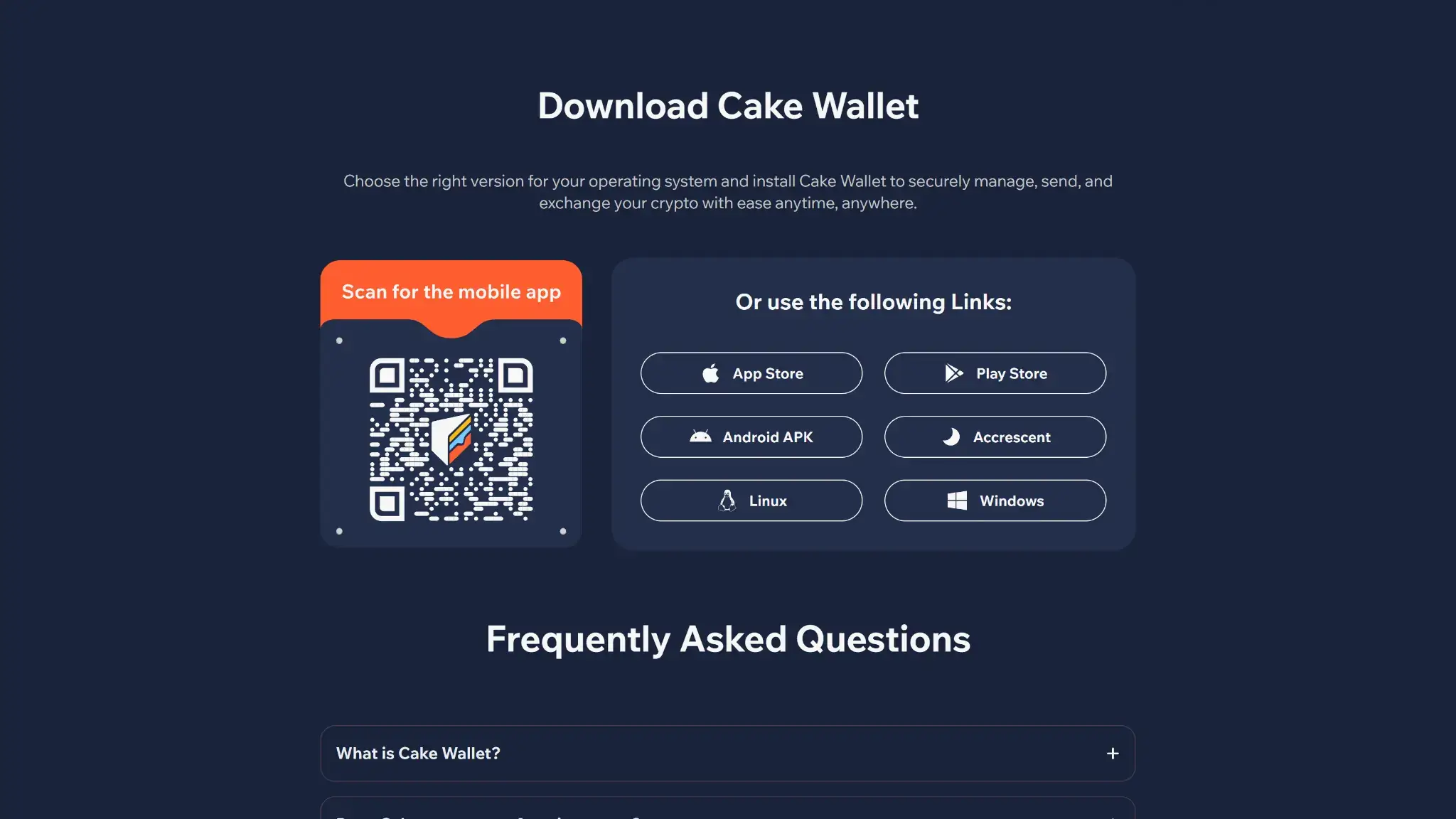
Cake Wallet website download section with QR code and buttons for App Store, Play Store, Android APK, Linux, and Windows, plus FAQ.
Cake is easy enough to use once the basics are clear. Sending and receiving are simple. More advanced actions take more attention because users need to watch sync status, node health, fees, and provider quotes. That makes Cake a better fit for users who want control than for users who want the easiest possible setup.
Platform support is broad, but parity is incomplete. Cake runs on iPhone, iPad, Android, macOS, Linux, and Windows. There is no browser extension and no web app. Mobile gets new assets and features first, and Android gets broader background sync. Cake works best as a privacy-focused self-custody wallet for holding, sending, swapping, and spending. It is a weaker fit for heavy dApp use or simple beginner-first use.
Platform
Availability
Notes
iOS
Yes
Strong mobile support; no browser-extension parity
Android
Yes
Best mobile fit for power users; broader background sync support
Browser extension
No
Major limitation for DeFi and web3-heavy users
Desktop
Yes
Available on macOS, Linux, and Windows
Web app
No
Cake is not a browser-based wallet platform
Cake gets the balance mostly right for its target user. The interface is safe enough to use well, but only if the user pays attention. It favors clear wallet state over maximum simplicity. That suits privacy-focused self-custody users. It does not suit everyone.
Customer Support, Documentation and Incident Handling
Cake has useful documentation. Human support is more limited. The docs help with setup, sync problems, swap basics, and common errors. Human support can help with app issues and partner-routing questions. It cannot reverse an on-chain transfer or restore a lost seed phrase.
Support works best when the problem is technical, not custodial. If the wallet is not syncing, a node is failing, or a trade is stuck in a provider flow, support can point the user in the right direction. If the user sent funds to the wrong address or lost the recovery method, support cannot get the funds back.
Channel
Availability
Typical use
Notes
Help center
Self-serve
Docs, setup, troubleshooting
Stronger than average for a wallet app
Live chat
Limited
Docs-page support bubble, in-app support, and Cake Pay Web live chat
Cake Pay Web uses its own live-chat bubble
Email or tickets
Yes
Technical issues and support questions
Main wallet support runs through [email protected] and in-app support
Telegram, email, docs-page support bubble, and in-app support for wallet issues
Announcements, troubleshooting, and support routing
Cake Pay Web has separate live chat
Cake can help with the app. It cannot act like a bank or exchange. That is normal for a non-custodial wallet.
Final Verdict
Cake Wallet earns its rating for privacy-focused self-custody. The Monero workflow is strong, the chain coverage is wider than the wallet's reputation suggests, and built-in swaps, Cake Pay, and Lightning reduce the need to switch apps for everyday use. The friction is real too. Sync issues, node health, and layered partner fees require more user attention than most mainstream wallets ask for. The missing browser extension rules it out for active DeFi use. Users who want Monero at the center with a practical set of tools around it will find it well suited. Users who want simplicity or extension-led web3 access will not.
Broader chain coverage than many users expect from a wallet that started around Monero.
Mobile and desktop support give it more range than mobile-only privacy wallets.
Lightning adds a faster Bitcoin payment layer for users who want more than base-chain payments.
CONS
Sync status and node issues can confuse new users.
Not a browser extension, so it is a weak fit for heavy DeFi and dApp users.
Hardware support is broader than older setup pages suggest, but coverage still varies by device, asset, and platform.
Fees come from several layers, so total cost is harder to judge before checkout.
It is still a hot wallet, so it is not the right tool for large long-term holdings that need hardware-level isolation.
Affiliate Disclosure
Disclaimer: CryptoSlate may receive a commission when you click links on our site and make a purchase or complete an action with a third party. This does not influence our editorial independence, reviews, or ratings, and we always aim to provide accurate, transparent information to our readers.
FAQ
Is Cake Wallet custodial or non-custodial?
Cake Wallet is non-custodial. The user controls the keys and the recovery method.
Is Cake Wallet a hot wallet or a cold wallet?
Cake Wallet is a hot software wallet. It can work with some hardware flows, but the wallet itself is not a cold wallet.
Does Cake Wallet give you a seed phrase?
Recovery depends on wallet type. Standalone Monero wallets use 16-word Polyseed by default or 25-word legacy seeds. Wallet Groups can use one 12-word BIP39 seed across multiple supported assets. Cake also supports backup-file, QR, and hardware-based restore flows where applicable.
Is Cake Wallet safe and legit?
It is a legitimate non-custodial wallet with public code and a long operating history. For a hot wallet, the security model is solid. Keys stay on the user’s device, and the wallet supports PIN, biometrics, Cake 2FA, custom nodes, and Tor options. It still carries normal hot-wallet risk.
Which chains and supported coins does Cake Wallet cover?
It supports Monero, Bitcoin, Ethereum, Litecoin, Bitcoin Cash, Polygon, Base, Arbitrum, BNB Smart Chain, Solana, Tron, Dogecoin, Nano, Zano, Decred, Wownero, and Zcash. It also supports ERC-20 and other EVM tokens, including BEP-20 on BNB Smart Chain, plus SPL tokens on Solana and TRC-20 tokens on Tron. Support is not identical across platforms. Mobile gets newer assets and features first.
What fees does Cake Wallet charge for swaps and exchange use?
The wallet is free to download. Users mainly pay network fees, swap spreads, partner buy or sell fees, and Cake Pay conversion costs when those services are used. Cake Wallet exchange fees and swap fees are not fixed wallet charges.
Does Cake Wallet require KYC?
Not at wallet level. Partner KYC may apply when buying, selling, or using some payment flows.
What happens if you lose your device or recovery method?
If you lose the device but still have the correct recovery method, you can usually restore the wallet on a new device. If you lose the recovery method too, access to funds can become permanent loss.