






Governance
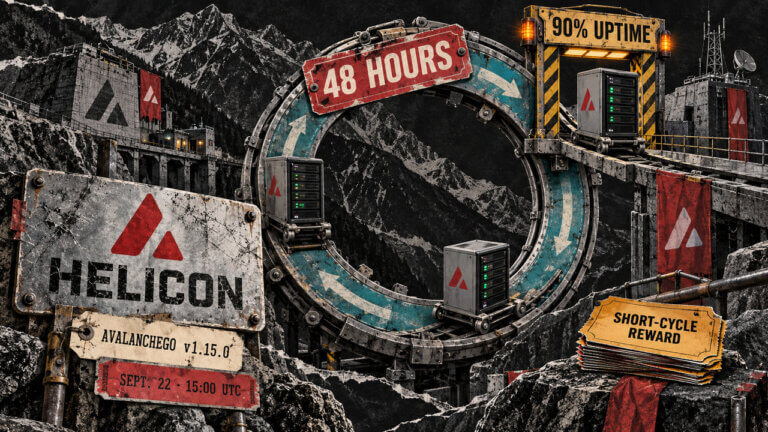
Avalanche just slashed validator lockups to 48 hours, but there’s a catch
Scheduled for Sept. 22, the Avalanche upgrade adds validator auto-renewal while making full cycle rewards harder to secure.

$576.03M traded Price signal supported
Trading Activity price-reliability indicator with 100 percent data coverage. Low activity replaces price-derived sentiment because the displayed market price may not be supported by meaningful trading.Target
Peg Health price-stability indicator with 0 percent data coverage. It measures observed market pricing, not reserve quality or redemption safety.30D +29.8% 92.9% below ATH
Price-based current market conditions indicator with 100 percent data coverage. This is not a price forecast.$576,028,668.24 traded over the last 24 hours. The available activity evidence is sufficient to retain the asset’s price-derived signal.
Low activity can make the displayed price sensitive to a handful of trades. Trading Activity assesses price reliability—not project development, legal status, reserves, or solvency.
Price movement Not interpreted while trading support is below the reliability threshold.
What it measures
The model combines reported 24-hour volume, market-cap turnover, valid-pair liquidity, active exchange breadth, and quote freshness. Missing optional evidence lowers coverage; missing volume or a known-stale quote suppresses price-derived interpretation.
Configured model weights
When inputs are missing, these configured weights are renormalized across the available evidence; data coverage records what is missing.
How to read it
Scores of 0–19 are dormant, 20–39 are thin, 40–69 are supported, and 70–100 are active. Scores below 40 withhold price-derived interpretation.
Logarithmic historical position weighs on it, while Price momentum across the scored timeframes supports the reading. Together these inputs produce a price-neutral reading rather than a price forecast.
A complete ATL and ATH range is not available for this asset.
What it measures
The model converts price momentum, logarithmic historical position, milestone recency, and short-term volume confirmation into one 0–100 score. Missing evidence lowers data coverage instead of counting as neutral.
Configured model weights
When inputs are missing, these configured weights are renormalized across the available evidence; data coverage records what is missing.
How to read it
50 is the neutral midpoint. Scores of 60 or higher are bullish, 40 or lower are bearish, and 41–59 are neutral.
Showing 10 spot markets sorted by CoinMarketCap exchange rank. Markets excluded from CMC price or volume calculations are hidden.
| Pair | |||||
|---|---|---|---|---|---|
| 1 | AVAX/USDT | $10.36 Best price | $53.14M | 720 | |
| 2 | AVAX/USDC | $10.37 | $4.95M | 645 | |
| 3 | AVAX/USD | $10.36 | $12.92M | 658 | |
| 4 | AVAX/KRW | $10.57 | $7.74M | 492 | |
| 5 | AVAX/USDT | $10.36 | $10.49M | 594 | |
| 6 | AVAX/USDT | $10.37 | $10.17M | 551 | |
| 7 | AVAX/USDT | $10.38 | $2.34M | 632 | |
| 8 | AVAX/USDT | $10.36 | $9.97M | 633 | |
| 9 | AVAX/USDT | $10.37 | $15.22M | 593 | |
| 10 | AVAX/USDT | $10.38 | $1.36M | 604 |
Affiliate Disclaimer: CryptoSlate may receive a commission when you click trading links on this page and complete an action with a third party. This does not influence our editorial independence or coverage.
Scheduled for Sept. 22, the Avalanche upgrade adds validator auto-renewal while making full cycle rewards harder to secure.

The Avalanche treasury authorization targets a stated market disconnect while the June 30 token treasury shows why earnings remain exposed.

AVAT’s stock needs to more than triple to clear the $1 bid-price test, while a separate $35 million market-value hurdle remains.

Treasury plans can reshape AVAX’s role in the multi-chain finance, as it did with Ethereum and Solana.
See AVAX across major fiat currencies and swap the active converter instantly.
Quick SelectUsing the live USD market price. Additional fiat rates will appear after the daily sync.
Avalanche is a layer-1 blockchain platform designed for fast finality, customizable blockchain deployments, and smart contract execution at scale. Its native token, AVAX, is used for transaction fees, staking, and securing the network’s validator system. In the broader crypto market, Avalanche has built its identity around performance, modular blockchain design, and an infrastructure model intended to support both consumer-facing applications and more specialized financial or enterprise use cases.
Launched by Ava Labs in 2020, Avalanche entered the market as a smart contract platform competing with Ethereum and other layer-1 networks on speed, cost, and flexibility. Rather than relying on a single execution environment alone, Avalanche was designed with a multi-chain architecture that separates major network functions across different built-in chains. This structure has long been one of the project’s defining technical features and remains central to how the ecosystem is described.
The broader ecosystem is also covered through CryptoSlate’s Avalanche ecosystem page and related news coverage.
Avalanche’s primary network historically centers on three built-in chains. The X-Chain is used for creating and transferring digital assets, the C-Chain is the EVM-compatible smart contract chain where most decentralized applications are deployed, and the P-Chain coordinates validators, staking, and network-level functions. This separation is intended to improve efficiency by assigning different jobs to different chains rather than forcing all activity into one execution layer.
AVAX is used throughout this system. It pays transaction fees, supports staking by validators and delegators, and acts as the core asset linking activity across the platform. For most users and developers, the C-Chain is the most visible part of Avalanche because it supports Ethereum-style applications and tooling, making it easier to port or launch DeFi, NFT, gaming, and tokenization projects.
One of Avalanche’s most important differentiators is its support for custom blockchain environments, historically known as subnets and increasingly framed as application-specific or sovereign layer-1 deployments within the Avalanche ecosystem. These allow projects to launch their own tailored chains with customized validators, economics, and rules while still building within Avalanche’s broader infrastructure stack.
This model has shaped Avalanche’s market position. Instead of competing only as a general-purpose smart contract chain, Avalanche also presents itself as a platform for launching specialized networks aimed at gaming, finance, institutions, and other sector-specific applications. That has made it especially relevant in discussions around tokenized real-world assets, enterprise blockchain infrastructure, and custom execution environments.
Avalanche has maintained a visible role in crypto through a mix of DeFi activity, institutional experimentation, and ecosystem partnerships. The network has attracted protocols focused on trading, lending, stablecoins, and tokenized assets, while also positioning itself as a blockchain environment suitable for organizations that want more control than public shared-state networks typically provide.
That balance between open crypto markets and more structured deployments has given Avalanche a somewhat different profile from chains that are driven mainly by retail speculation or memecoin activity. While it still competes in the same crowded layer-1 sector, its value proposition is more closely tied to flexible infrastructure, performance, and the ability to launch dedicated chains for distinct use cases.
Avalanche’s technical flexibility is also a source of complexity. Its multi-chain structure and custom chain model can be harder for newcomers to understand than simpler single-chain architectures. The ecosystem also faces the usual layer-1 risks, including competition for developers and liquidity, changing market sentiment, and the challenge of sustaining long-term on-chain activity.
There are also execution risks tied to adoption. Avalanche’s long-term relevance depends not just on technical performance, but on whether developers, institutions, and users continue choosing the network over rival ecosystems. For investors and market observers, AVAX represents exposure to a blockchain platform built around speed, modularity, and customizable infrastructure, but one that still operates in one of the most competitive segments of crypto.


As of Oct 9, 2026, Avalanche trades at $10.35.
Avalanche has a market capitalization of $4,589,232,140.16.
Avalanche has a 24-hour trading volume of $576,028,668.24.
Avalanche reached an all-time high of $146.22, recorded on Nov 21, 2021. It is currently 92.92% below its all-time high.
Avalanche recorded an all-time low of $2.79, recorded on Dec 31, 2020. It is currently 271.21% above its all-time low.
Ava Labs is a blockchain technology company and the primary developer of the Avalanche platform, a high-performance, scalable, and secure smart contract platform designed to support decentralized applications (dApps), enterprise blockchain deployments, and interoperable Web3 ecosystems.