






ETF
Bitwise is closing the lowest-fee Dogecoin ETF after rivals captured nearly all the capital
BWOW is being liquidated after nearly 10 months of weak activity and $1.23 million of net outflows.

$1.02B traded Price signal supported
Trading Activity price-reliability indicator with 100 percent data coverage. Low activity replaces price-derived sentiment because the displayed market price may not be supported by meaningful trading.Target
Peg Health price-stability indicator with 0 percent data coverage. It measures observed market pricing, not reserve quality or redemption safety.30D -1.6% 88.0% below ATH
Price-based current market conditions indicator with 100 percent data coverage. This is not a price forecast.$1,023,969,312.59 traded over the last 24 hours. The available activity evidence is sufficient to retain the asset’s price-derived signal.
Low activity can make the displayed price sensitive to a handful of trades. Trading Activity assesses price reliability—not project development, legal status, reserves, or solvency.
Price movement Not interpreted while trading support is below the reliability threshold.
What it measures
The model combines reported 24-hour volume, market-cap turnover, valid-pair liquidity, active exchange breadth, and quote freshness. Missing optional evidence lowers coverage; missing volume or a known-stale quote suppresses price-derived interpretation.
Configured model weights
When inputs are missing, these configured weights are renormalized across the available evidence; data coverage records what is missing.
How to read it
Scores of 0–19 are dormant, 20–39 are thin, 40–69 are supported, and 70–100 are active. Scores below 40 withhold price-derived interpretation.
Price momentum across the scored timeframes weighs on the reading, while logarithmic historical position supports it. Together these inputs produce a price-neutral reading rather than a price forecast.
A complete ATL and ATH range is not available for this asset.
What it measures
The model converts price momentum, logarithmic historical position, milestone recency, and short-term volume confirmation into one 0–100 score. Missing evidence lowers data coverage instead of counting as neutral.
Configured model weights
When inputs are missing, these configured weights are renormalized across the available evidence; data coverage records what is missing.
How to read it
50 is the neutral midpoint. Scores of 60 or higher are bullish, 40 or lower are bearish, and 41–59 are neutral.
Showing 10 spot markets sorted by CoinMarketCap exchange rank. Markets excluded from CMC price or volume calculations are hidden.
| Pair | |||||
|---|---|---|---|---|---|
| 1 | DOGE/USDT | $0.09 | $81.5M | 786 | |
| 2 | DOGE/USDC | $0.09 Best price | $8.28M | 664 | |
| 3 | DOGE/USD | $0.09 | $13.54M | 669 | |
| 4 | DOGE/KRW | $0.09 | $20.27M | 499 | |
| 5 | DOGE/USDT | $0.09 | $35.13M | 651 | |
| 6 | DOGE/USDT | $0.09 | $11.11M | 603 | |
| 7 | DOGE/USDT | $0.09 | $8.58M | 706 | |
| 8 | DOGE/USDT | $0.09 | $28.47M | 709 | |
| 9 | DOGE/USDT | $0.09 | $7.82M | 628 | |
| 10 | DOGE/USDT | $0.09 | $16.57M | 692 |
Affiliate Disclaimer: CryptoSlate may receive a commission when you click trading links on this page and complete an action with a third party. This does not influence our editorial independence or coverage.
BWOW is being liquidated after nearly 10 months of weak activity and $1.23 million of net outflows.

The company had 502.1 million shares outstanding on Aug. 20, while conditional offering warrants cover another 524.2 million.
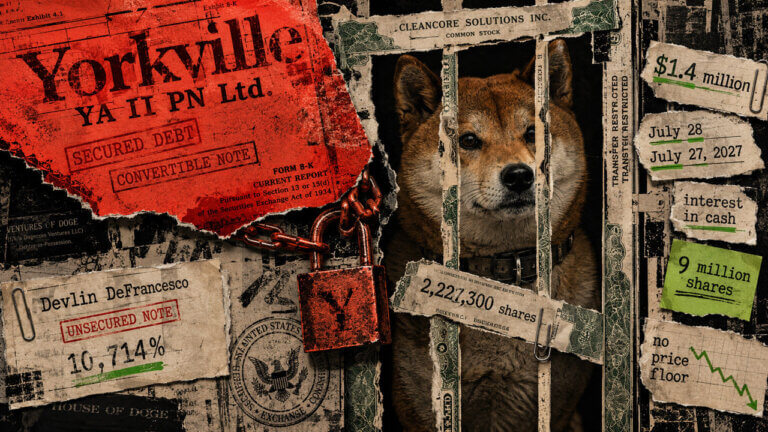
The $1.4 million unsecured note repays principal in 2.2273 million shares, with no disclosed release mechanism or price floor.

From cleaning products and Dogecoin to an $800 million AI contract: Inside CleanCore's high-risk Minnesota ventures.
See DOGE across major fiat currencies and swap the active converter instantly.
Quick SelectUsing the live USD market price. Additional fiat rates will appear after the daily sync.
Dogecoin is the original meme coin and a proof-of-work payment network built around DOGE. It was created as a joke in late 2013 by Billy Markus and Jackson Palmer, then launched on Dec. 6, 2013, using the Doge meme as its cultural identity.
DOGE's staying power comes from community, liquidity, exchange access, and simple payment use rather than smart contracts, staking, governance, or DeFi utility. Dogecoin is described as an open-source, peer-to-peer digital currency framed around an “accidental crypto movement” with a large community.
Dogecoin is best understood as a community-led currency with meme-coin market behavior. Its value and risk profile depend on whether DOGE can maintain deep liquidity, mining security, payment integrations, and social relevance across market cycles.
The main trade-off is supply. Dogecoin has no fixed maximum supply, but issuance is not unlimited at any given point in time. The network has a fixed block reward and predictable annual issuance, which means demand must absorb new DOGE entering circulation over time.
For price-focused users, the most important signals are DOGE trading volume, exchange depth, miner participation, network activity, and meme-coin market sentiment. For longer-term research, the key question is whether Dogecoin can remain useful as a payments-focused meme coin while competing with newer meme tokens, low-fee payment rails, and larger smart-contract ecosystems.
| Field | Detail |
|---|---|
| Asset | Dogecoin |
| Ticker | DOGE |
| Asset Type | Meme coin, payment coin, native proof-of-work asset |
| Launch | Dec. 6, 2013 |
| Founders | Billy Markus and Jackson Palmer |
| Consensus | Proof of Work |
| Mining Algorithm | Scrypt |
| Mineable | Yes |
| Max Supply | No fixed cap |
| Circulating Supply | 156.23B |
| Total Supply | 156.23B |
| Main Use Cases | Payments, tipping, exchange trading, community-led campaigns |
| Website | dogecoin.com |
| Explorer | Dogechain and other Dogecoin explorers |
| Whitepaper | No traditional whitepaper. Dogecoin uses public documentation through Dogepedia and Dogecoin Core resources |
| Main Risk Areas | Meme-coin volatility, open-ended issuance, social momentum, limited native utility beyond payments |
Dogecoin runs on its own blockchain and uses proof-of-work mining. Miners validate transactions, add new blocks, secure the network, and receive DOGE block rewards for the work they provide. Dogecoin uses the Scrypt algorithm rather than Bitcoin's SHA-256 proof-of-work function.
Dogecoin blocks are generated roughly once per minute. Each mined block pays 10,000 newly minted DOGE before transaction fees, which creates ongoing supply growth instead of a fixed-cap scarcity model.
Dogecoin also supports merged mining with Litecoin and other Scrypt-based proof-of-work networks. This means compatible miners can contribute security to Dogecoin while also mining another Scrypt chain with the same work.
DOGE is not a smart-contract platform in the same way as Ethereum or Solana. Users typically interact with Dogecoin through wallets, exchanges, payment processors, tipping tools, merchant integrations, and native Dogecoin transactions.
Dogecoin has open-ended supply with fixed issuance per block. The network currently issues 10,000 DOGE per block, with a new block generated roughly every minute. That equals about 5.26 billion new DOGE per year before minor timing differences.
This makes Dogecoin different from Bitcoin. Bitcoin has scheduled halvings and a fixed maximum supply. Dogecoin has no final cap and no ongoing halving cycle, so supply keeps expanding as miners receive block rewards.
DOGE issuance is limited per block, per day, and per year, and ongoing issuance helps pay miners and support network security.
| Supply Metric | Detail |
|---|---|
| Circulating Supply | 156.23B |
| Total Supply | 156.23B |
| Max Supply | No fixed cap |
| Fully Diluted Valuation | $13.85B |
| Emissions or Issuance | 10,000 DOGE per block, or roughly 5.26 billion DOGE per year |
| Burns | No standard protocol-level burn mechanism |
| Unlocks | Not applicable. DOGE is mined rather than released through token unlock schedules |
| Treasury or Foundation Allocation | No centralized token allocation model like many newer crypto projects |
Dogecoin's supply model matters because DOGE demand has to absorb new issuance. The percentage inflation rate can decline as total supply grows, but the absolute amount of new DOGE added each year remains important for miners, traders, and long-term holders.
Dogecoin trades like a high-liquidity meme coin with its own blockchain. DOGE pricing is calculated from data across 158 exchanges and 329 markets, which reflects unusually broad market access for a meme asset.
That exchange access is one reason DOGE has remained relevant across multiple crypto cycles. Traders can access it on major venues, payment users can move it on the Dogecoin blockchain, and the brand remains one of the most recognizable in crypto.
The same profile creates risk. DOGE can move sharply when social attention rises or fades, and its price can depend more on sentiment, liquidity, and meme-cycle momentum than protocol revenue, staking yield, governance rights, or decentralized application usage.
| Context Item | What to Watch |
|---|---|
| Liquidity | Exchange listings, DOGE trading volume, spreads, and order book depth |
| Network Activity | Transactions, active addresses, fees, and wallet usage |
| Security Model | Scrypt mining, merged mining, hashrate, and mining pool concentration |
| Payment Usage | Merchant support, payment processor integrations, wallet support, and GigaWallet adoption |
| Supply Mechanics | 10,000 DOGE block rewards, no fixed supply cap, and annual issuance |
| Development | Dogecoin Core releases, developer activity, Foundation projects, and ecosystem tooling |
Dogecoin is the benchmark meme coin because it combines meme culture with a live proof-of-work blockchain. Many newer meme coins exist only as tokens on another network. DOGE has its own chain, miners, wallets, and transaction history.
Its verified utility is narrower than its cultural footprint. DOGE is used for payments, tipping, exchange trading, and community activity, but it does not natively provide DeFi lending, staking, smart-contract apps, or governance rights.
The Dogecoin Foundation's manifesto emphasizes usefulness, people, openness, and reliability over technical complexity or profit-driven economics.
| Meme Coin Item | Detail |
|---|---|
| Origin | Created in 2013 around the Doge meme |
| Community | Long-running “Shibe” community with payment, tipping, and meme culture roots |
| Utility | Payments, tipping, merchant integrations, exchange trading, and community campaigns |
| Liquidity | High relative to most meme coins |
| Main Risks | Volatility, open-ended issuance, social momentum, liquidity shifts, and limited native utility beyond payments |
Dogecoin's payment story is real, but it should be framed carefully. DOGE has long been used for tipping and payments, with third-party payment integrations from providers such as BitPay and Coinbase.
The Dogecoin Foundation's GigaWallet project is a more developer-focused part of that payments push. GigaWallet is a backend service that helps online shops, exchanges, and social platforms accept and transact Dogecoin for users.
Payment adoption still depends on merchant demand, wallet support, payment processors, user behavior, and DOGE price volatility. Dogecoin can be used as a payment coin, but its market value is still heavily influenced by trading activity and meme-coin sentiment.
Dogecoin Core is the main software implementation for the Dogecoin network. It allows users to operate a node, uses Scrypt proof of work, and is adapted from Bitcoin Core and other cryptocurrencies.
Dogecoin development is open-source and community-driven. GitHub Projects and Discussions are used for planned and unplanned work around Dogecoin Core, the protocol, and the DOGE asset.
The latest Dogecoin Core release is 1.14.9, published on Dec. 1, 2024 — a minor version release that fixed inherited bugs from upstream Bitcoin and Namecoin code.
For users, the most important development signals are Dogecoin Core maintenance, wallet support, node participation, mining security, and payment infrastructure. Dogecoin does not need to become a DeFi platform to remain relevant, but it does need continued support from developers, miners, exchanges, and users.
Dogecoin price prediction depends on liquidity, supply growth, payment adoption, mining security, and meme-coin market cycles. DOGE can benefit when retail activity and risk appetite rise, but the same sentiment-driven profile can amplify drawdowns.
The main question is whether Dogecoin can maintain its community and exchange liquidity while expanding practical payment usage. DOGE's open-ended issuance means new supply remains part of the pricing equation, even when the percentage inflation rate declines over time.


Dogecoin is a proof-of-work cryptocurrency and the original meme coin. It runs on its own blockchain and is used for payments, tipping, trading, and community-led activity. DOGE matters because it combines a live native network with unusually strong brand recognition and liquidity for a meme asset.
Dogecoin works through a proof-of-work blockchain. Miners use Scrypt-based mining hardware to validate transactions, create new blocks, and secure the network. Dogecoin also supports merged mining with Litecoin and other Scrypt-based networks, which lets compatible miners contribute work to multiple chains.
Dogecoin is commonly used for payments, tipping, exchange trading, and meme-driven community activity. Its usefulness depends on wallet support, merchant integrations, payment processors, exchange liquidity, and whether users treat DOGE as a spendable currency rather than only a speculative asset.
Dogecoin does not have a fixed maximum supply. The network issues 10,000 DOGE per block, with blocks generated about once per minute. This creates open-ended supply growth, although issuance is limited per block, per day, and per year rather than being unlimited at any single moment.
Dogecoin’s ongoing issuance pays miners and supports network security. Removing issuance entirely could weaken miner incentives over time. For users and traders, the important point is that DOGE has fixed annual issuance rather than a fixed final supply.
Yes. Dogecoin is the original meme coin, but it also runs on its own proof-of-work blockchain. That separates it from many newer meme tokens that depend on another network. DOGE’s value still depends heavily on community, liquidity, social momentum, and broader market cycles.
Dogecoin carries crypto asset risk, meme-coin volatility, custody risk, and network-use risk. The blockchain has operated for many years, but DOGE price can move sharply, transactions are generally irreversible, and users must choose wallets, exchanges, and deposit networks carefully.
You can buy Dogecoin through supported exchanges and trading pairs shown in the markets module on this page. For payment methods, fees, wallet setup, and step-by-step instructions, read the full buying guide.
DOGE is the native coin of the Dogecoin blockchain. Wrapped or synthetic DOGE may exist on other networks, but those are separate products with additional issuer, bridge, or smart-contract risk. When depositing or withdrawing DOGE, always match the network supported by the exchange or wallet.
As of Oct 8, 2026, Dogecoin trades at $0.089.
Dogecoin has a market capitalization of $13,848,316,658.95.
Dogecoin has a 24-hour trading volume of $1,023,969,312.59.
Dogecoin reached an all-time high of $0.74, recorded on May 8, 2021. It is currently 87.98% below its all-time high.
Dogecoin recorded an all-time low of $0.00008547, recorded on May 7, 2015. It is currently 103.6 thousand percent above its all-time low.