Explore CryptoSlate’s Institutional Playbook, a 3-part guide series on exchange due diligence, crypto-as-a-service, and token listing strategy for institutional teams.
Explore CryptoSlate’s Institutional Playbook, a 3-part guide series on exchange due diligence, crypto-as-a-service, and token listing strategy for institutional teams.
As we transition into the second half of 2023, inflation concerns have surfaced as a pressing issue in the economic landscape, with implications spanning from the U.S. dollar and the Euro to Bitcoin.
The Consumer Price Index (CPI) in the U.S. reached 4.9% in April 2023, exceeding expectations, while in the E.U., inflation hovers around 7%. Projections for the remainder of 2023 and into 2024 suggest the persistence of these elevated rates, bringing inflation to the forefront of financial discussions.
Understanding the concept of inflation, its history, and potential solutions are paramount for interpreting the current market environment and future trends. This report delves into these elements, examining inflation’s effects on fiat currencies and Bitcoin.
What is inflation?
Inflation is a term that is widely referenced but often misunderstood due to its multifaceted definitions across different contexts.
At its core, inflation is an economic phenomenon defined by a sustained increase in the general level of prices for goods and services within an economy over a specified period.
The academic interpretation of inflation focuses on the concept of purchasing power. Each unit of currency in an economy buys a specific amount of goods or services. As inflation occurs, the amount of goods or services purchasable by the same amount of money reduces, reflecting a decline in the currency’s purchasing power. For example, if the inflation rate is 2%, an item that cost $1 last year will now cost $1.02, signaling that a dollar can purchase less than it previously could.
Economically, inflation is a critical macroeconomic indicator used to measure the health and direction of an economy. Central banks closely monitor inflation rates, targeting a sweet spot typically around 2% annually for developed economies. Moderate inflation is considered a sign of a healthy, growing economy. However, high inflation rates, if sustained, can erode living standards as prices increase faster than wages.
The cultural interpretation of inflation often describes it as a sense of financial instability and decreased economic well-being. Persistent inflation leads to increased living costs, making it more challenging for individuals to meet their daily needs and eroding the value of savings over time.
Exploring the concept of inflation requires diving deep into hyperinflation, as well. And while hyperinflation is much rarer than inflation, the likelihood of it occurring increases the longer inflation persists in an economy.
Hyperinflation represents an extreme form of inflation and is far more devastating economically. It is defined as a rapid, uncontrollable price increase, typically with an inflation rate exceeding 50% per month. It leads to a rapid and dramatic decrease in the purchasing power of a currency and is often associated with severe economic crises.
Unlike regular inflation, which can be a normal part of economic growth, hyperinflation is an economic disaster. It usually results from a collapse in confidence in the currency, often following a period of fiscal crisis, economic mismanagement, or conflict. When hyperinflation occurs, money can become so worthless that people resort to barter trade for goods and services.
History of inflation
History is teeming with notable instances of inflation and hyperinflation, each leaving indelible marks on economies and markets worldwide. These episodes offer crucial insights into these economic phenomena’ mechanisms, repercussions, and resolutions.
Post-World War I, Germany, also known as the Weimar Republic, suffered one of the most infamous instances of hyperinflation. After the expensive reparations imposed by the Treaty of Versailles and the government’s decision to print money to meet its debts, Germany grappled with hyperinflation between 1921 and 1923. At its peak in November 1923, prices doubled approximately every 3.7 days.
Graph showing the CPI in Germany from 1914 to 1924 (Source: Business Insider)
The crisis was eventually mitigated by introducing a new currency, the Rentenmark, backed by real estate and set at a fixed exchange rate with the old currency.
Image showing stacks of Deutschmarks in a Berlin bank, taken in 1923 (Source: Wikimedia Commons)
The Balkan nation of Yugoslavia also suffered hyperinflation between 1992 to 1994. A large budget deficit covered by the excess printing of the dinar caused inflation, which was further exacerbated by a complex mix of political instability and international sanctions. By January 1994, monthly inflation rates peaked at 313 million percent. Daily inflation reached 62%, while the country’s 2.03% hourly inflation rate was higher than developed countries’ average annual inflation rate. After several unsuccessful attempts to curb inflation, the government introduced a new currency, dubbed the “super dinar,” pegged to the Deutsche Mark, along with fiscal and monetary reforms to regain economic stability.
Image showing a 500 billion dinar banknote printed in 1993 (Source: Banknote World)
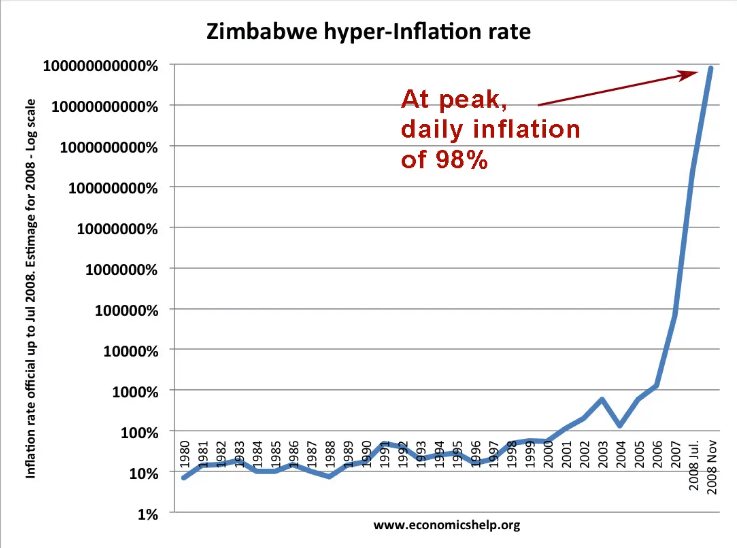
In the early 21st century, Zimbabwe underwent one of the worst cases of hyperinflation. The crisis began in the late 1990s due to fiscal mismanagement and external shocks like severe droughts and peaked between 2007 and 2009. At its zenith in November 2008, Zimbabwe’s hyperinflation rate reached 89.7 sextillion percent per month, almost doubling prices every day. The government eventually adopted the U.S. dollar and the South African rand as legal tender in 2009, a practice known as dollarization, helping to restore economic stability.
Graph showing the inflation rate in Zimbabwe from 1980 to 2008 (Source: Economics Help)
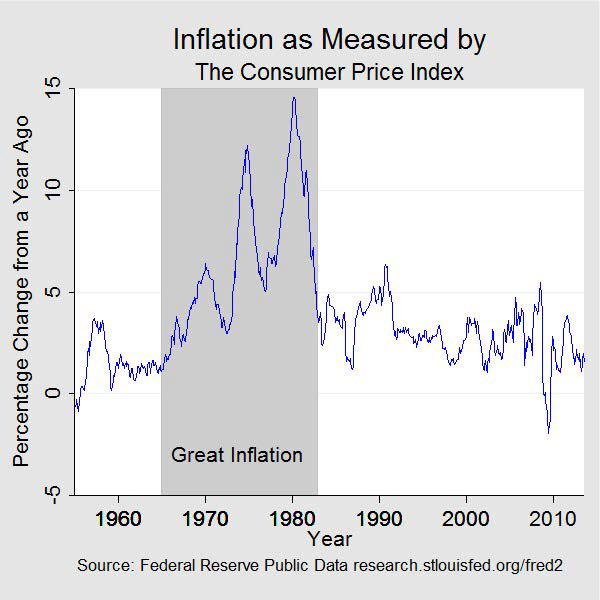
The United States, while never experiencing hyperinflation, grappled with high inflation during the 1970s and early 1980s. This period, known as the ‘Great Inflation,’ saw inflation rates peak at 14.8% in March 1980. The Federal Reserve tamed this inflation with tighter monetary policy, raising interest rates substantially.
High inflation—though not reaching hyperinflation levels—has also been a challenge for various countries in the 21st century. In 2018, Argentina’s inflation rate soared to 47.6% due to mounting national debts and a currency crisis.
Iran experienced a 41% inflation rate in 2019 due to stringent international sanctions, economic mismanagement, and currency devaluation.
Turkey, too, has been wrestling with elevated inflation rates in recent years. Due to geopolitical tensions, an ongoing currency crisis, and the economic impact of the COVID-19 pandemic, the country’s inflation rate soared to around 20% in early 2022.
Effects of inflation in the U.S.
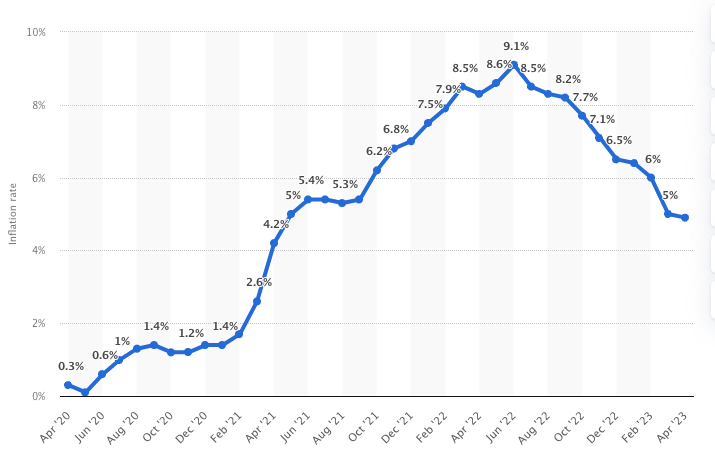
The U.S. has faced an escalating inflationary trend since 2020, triggered by a unique combination of factors. The global pandemic led to supply chain disruptions causing prices to rise. This initiated an aggressive fiscal and monetary response from the government that led to an unprecedented increase in the money supply. These pressures have culminated in an inflation rate of 9.1% in July 2022 — the highest rate over three decades.
Graph showing the monthly 12-month inflation rate in the U.S. from April 2020 to April 2023 (Source: Statista)
This elevated inflation has exerted pressure on the U.S. dollar, leading to its depreciation. While the U.S. dollar traditionally serves as a global reserve currency, sustained inflation has gradually reduced its purchasing power domestically and internationally. If inflation continues unchecked, the dollar’s value could be further eroded, negatively affecting international trade and the U.S.’s economic standing globally.
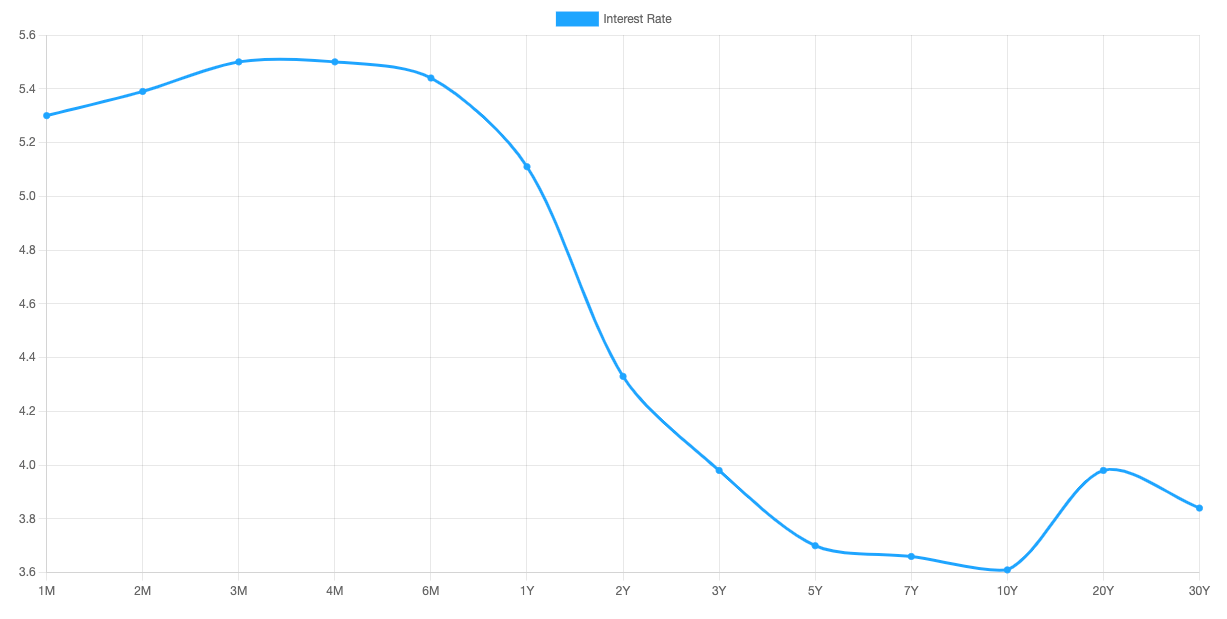
Inflation also invariably influences the investment landscape. Traditionally safe assets like bonds become less attractive in an inflationary environment due to the erosion of real returns over time. The effects inflation had on these assets became evident at the end of May, when U.S. Treasury yields rose to multi-decade highs, signifying a decrease in demand for bills maturing in 1 year or less.
Graph showing the U.S. Treasury yield curve on June 1, 2023. The downward-sloping curve indicates decreased demand for short-duration bills, resulting in higher yields. (Source: U.S. Treasury Yield Curve)
Furthermore, rising inflation has implications for monetary policy. The U.S. Federal Reserve, in response to the inflationary uptick, has signaled a shift towards a more hawkish stance. This shift entails tapering its asset purchase program and advancing interest rate hikes—moves aimed at curbing inflation but also have repercussions for financial markets and economic growth.
If inflation were to rise to hyperinflationary levels—a scenario not seen in the U.S. but experienced in other economies historically—the impacts would be far more severe. Hyperinflation could lead to economic instability, a dramatic loss of confidence in the currency, and, potentially, a significant economic downturn.
Bitcoin and inflation
Bitcoin has emerged as an intriguing player in the inflation discourse. Since its inception, it has been referred to as “digital gold” and an inflation hedge, offering an alternative financial system to one presented by centralized governments.
Bitcoin’s reputation as a hedge against inflation is primarily attributed to its scarcity, as the total supply is capped at 21 million coins. This predetermined supply starkly contrasts the flexible supply of fiat currencies, as it is embedded in the protocol and can’t be altered. Therefore, Bitcoin’s supply can’t be diluted through an increase in supply — a key feature making it resistant to inflation in the long run.
This perception of Bitcoin as an inflation hedge has played a role in shaping its price dynamics. Rising inflation in the U.S. that began in 2020 led to exponential growth in both the adoption and value of Bitcoin. Bitcoin peaked in November 2021, reaching an all-time high of $69,000.
While numerous factors contributed to this rise, inflation concerns likely played a significant part, as investors decided to put excess liquidity in the market into assets that could potentially preserve their value.
The conviction among investors remained high despite the high volatility that saw BTC drop to as low as $15,500. This indicates that most see Bitcoin as a long-term investment.
Developed countries with low inflation tend to see Bitcoin as a speculative long-term investment. However, in regions experiencing high inflation, Bitcoin’s appeal is in its ability to act as a currency substitute.
Countries such as Argentina, Venezuela, Turkey, and Zimbabwe, grappling with inflation and currency instability, have seen a marked increase in Bitcoin adoption. Here, Bitcoin is not seen as an investment or a store of value but as a medium of exchange, providing an alternative to rapidly depreciating local currencies.
In a hypothetical hyperinflation scenario in a major economy like the U.S., Bitcoin could see a surge in demand as investors seek safe havens, potentially driving up its price. However, hyperinflation could also incite severe economic instability, possibly affecting Bitcoin’s price in the short term.
Graph showing Bitcoin’s price and the YoY inflation rate in the U.S. from January 2020 to April 2023 (Source: TradingView)
Conclusion
Inflation is a complex and multi-faceted economic phenomenon that profoundly affects markets, economies, and individuals. History shows how inflation and hyperinflation have significantly shaped economies, from the Weimar Republic and Zimbabwe to Yugoslavia. More recent examples in Argentina and Turkey provide a real-time view of the detrimental effects of inflation.
The inflation surge seen in the U.S. has already affected the economy, impacting the dollar’s value, consumers’ purchasing power, investment landscape, and policy decisions.
In this inflationary narrative, Bitcoin emerges as an intriguing character. Its inherent scarcity, resulting from a cap on its total supply, positions it as potentially resistant to inflation, a feature that has attracted investors and users globally. Notably, in regions grappling with high inflation, Bitcoin has seen an increase in adoption as both an investment and a means of exchange.