Explore CryptoSlate’s Institutional Playbook, a 3-part guide series on exchange due diligence, crypto-as-a-service, and token listing strategy for institutional teams.
Explore CryptoSlate’s Institutional Playbook, a 3-part guide series on exchange due diligence, crypto-as-a-service, and token listing strategy for institutional teams.
Monerujo is a mobile Monero wallet built for Android users who want direct control over how they store, sync, and use XMR on a phone. It is a single-chain wallet built specifically for Monero on Android. Monerujo stays focused on Monero-specific use. Features like custom nodes, Street Mode, local backup handling, and optional Sidekick pairing give privacy-minded Android users more control than a generic wallet usually does. The limits are clear: no iPhone app, no browser extension, no support for other major chains, and limited hardware wallet compatibility.
Built specifically for Monero on Android, so the wallet includes features that matter to XMR users instead of generic multichain extras.
Custom node support gives users more control over how the app connects to the Monero network.
Street Mode can hide balances and past transactions when the wallet is opened in public.
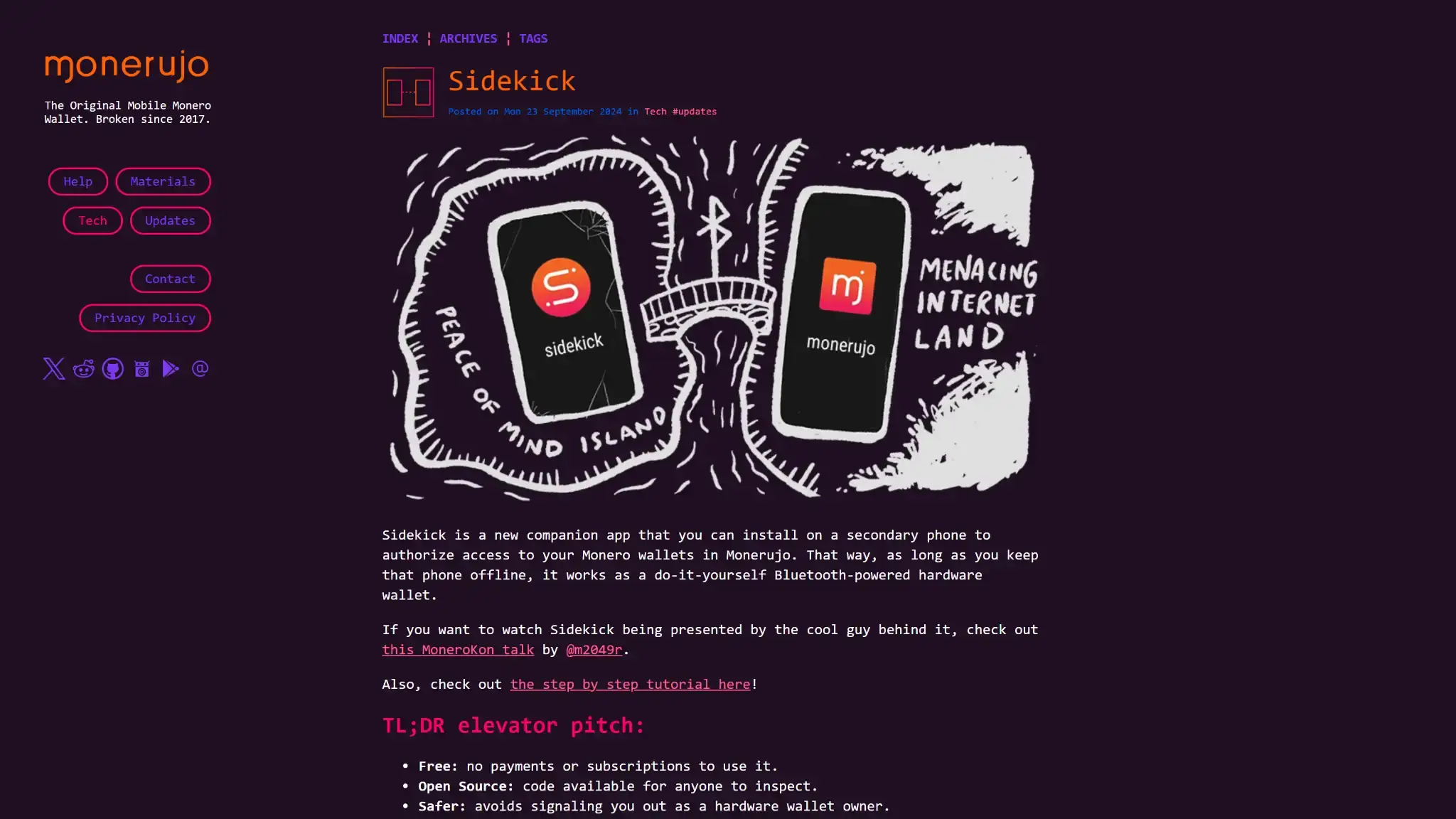
Sidekick adds a separate-phone signing setup for users who want stronger separation between internet access and private keys.
Backup tools are more flexible than many mobile wallets, including wallet export and a separate wallet files restore password.
Cons
Android only, so there is no iPhone, iPad, desktop, or browser-extension version.
Monero-focused design means no support for major non-XMR chains, tokens, NFTs, or DeFi wallet flows.
Hardware wallet support is narrow and depends on Ledger Nano S series with a USB OTG cable.
Built-in swaps rely on a third-party service, so availability, privacy exposure, and execution depend on that provider.
Some advanced functions, such as custom nodes, wallet resets, and file-based restores, can feel technical for casual users.
Who Monerujo Wallet is Best for — and Who Should Skip It
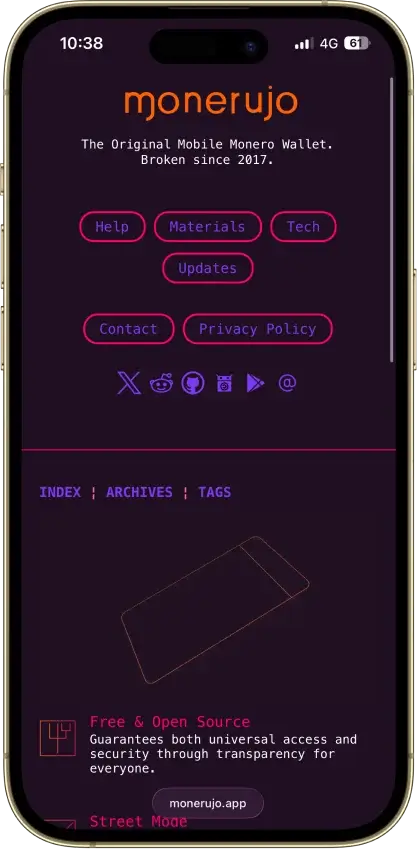
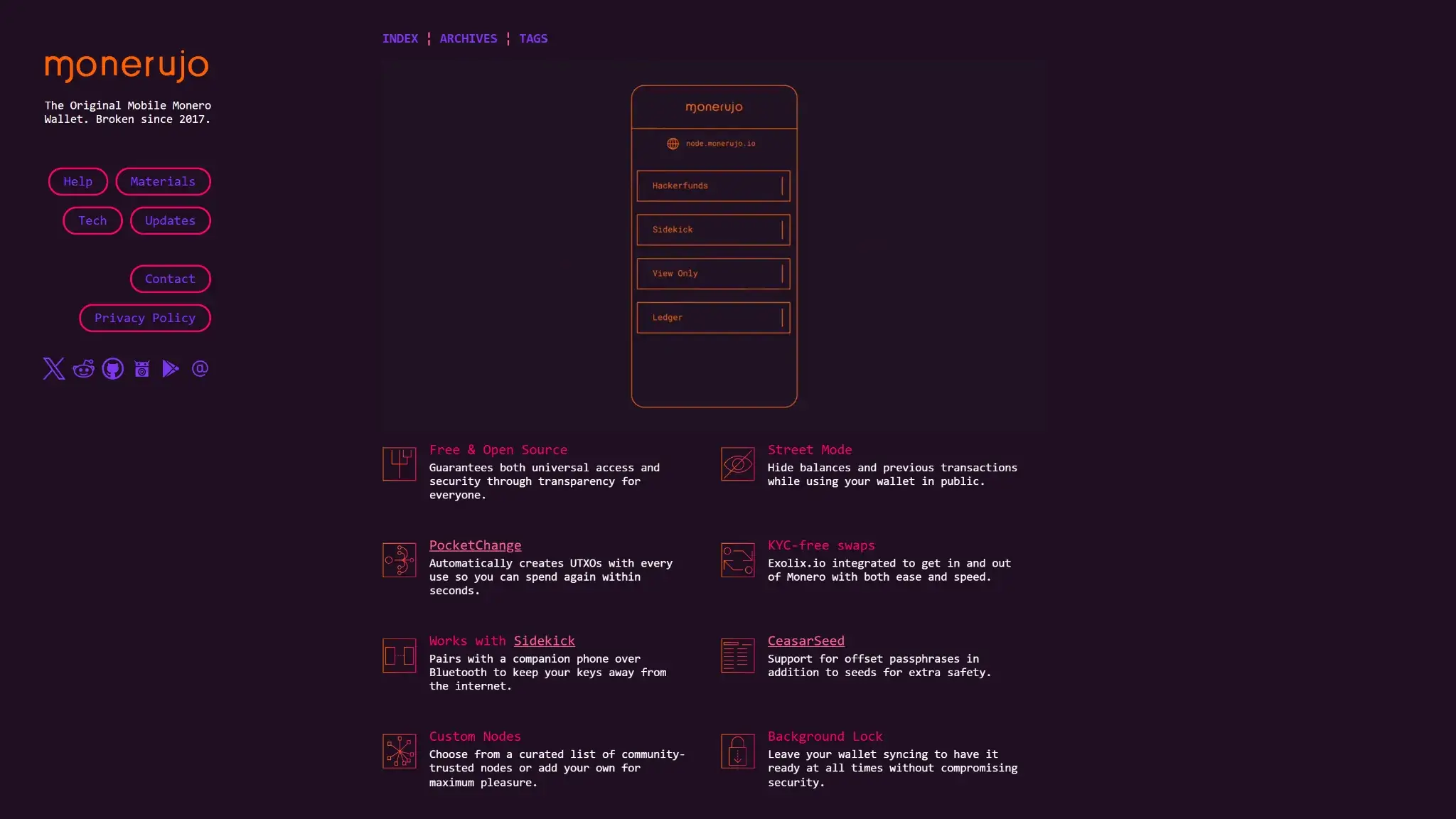
Monerujo homepage showing mobile Monero wallet features like PocketChange and Sidekick
Monerujo is best for Android users who mainly want to hold, send, receive, and manage Monero from a phone without giving up too much control. It suits people who care about node choice, private local backups, and practical Monero-specific tools more than they care about multichain convenience.
People who want one wallet for everything should look elsewhere. It is a poor fit for iPhone users, active DeFi users, people who want built-in account recovery, and anyone who expects broad hardware wallet support or a desktop workflow.
Best Fit
Why It Fits
Who Should Skip It
Why They Should Skip It
Android-first Monero users
The wallet is designed specifically for Monero use on Android phones
iPhone users
There is no iOS app
Users who want more node control
Custom nodes and node discovery give more connection flexibility than many mobile wallets
Multichain users
The wallet is built around Monero rather than broad chain coverage
Privacy-minded users in public settings
Street Mode can hide sensitive balance and transaction details on screen
Users who want account recovery
Recovery depends on wallet backup material rather than provider-managed recovery
Users who want mobile self-custody with a second-device option
Sidekick can separate key storage from the internet-connected phone
People who want a simple mainstream wallet flow
Backup, reset, and restore steps are more technical than in basic retail wallets
Monero users who want occasional swap access
Exolix integration adds a way to move in and out of XMR inside the app
Users who want strong hardware wallet flexibility
Hardware support is limited and not comparable to broader wallet ecosystems
What is Monerujo Wallet and How Does it Work?
Monerujo is a non-custodial Monero wallet for Android. You install it on an Android phone, create or restore a wallet, connect to a Monero node, and use it to send, receive, and monitor XMR.
At a basic level:
Platform: Android only.
Access: Users open the app, unlock the wallet with their chosen password, and connect to a node.
Key Storage: In the standard setup, wallet files stay encrypted on the same phone. In the optional Sidekick setup, keys stay on a second Android phone.
Transaction Approval: Standard wallets sign on the main phone. Sidekick wallets require spending approval on the second phone over Bluetooth.
What You Can Do: Send and receive XMR, scan QR codes, use OpenAlias, connect to custom or discovered nodes, hide balances with Street Mode, create spendable outputs with PocketChange, export backups, and access swaps through Exolix.
What Sidekick Actually Is: Sidekick is not a separate wallet line. It is a companion Android app that works with Monerujo to keep keys off the internet-connected phone.
Monerujo gives users more control than a typical retail wallet, but performance depends heavily on the node you use. When a node is slow, unreliable, or feeding bad data, the app can feel unreliable too.
Backups matter more here than in many mainstream wallets. Monerujo works best for people who record the seed, restore details, and exported wallet material before they build a meaningful balance. Used carelessly, it becomes much harder to recover than a wallet built around account-based recovery.
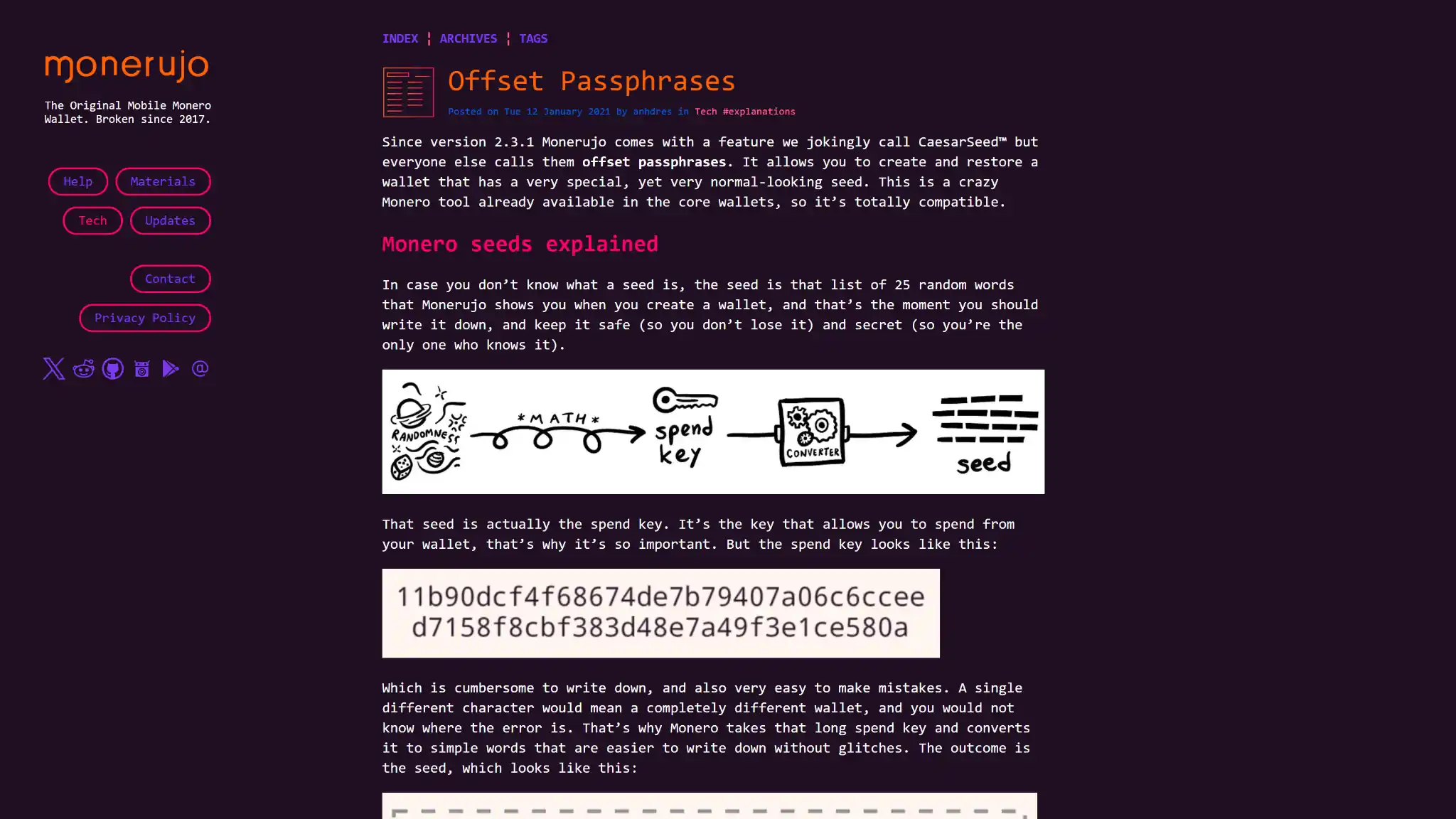
Monerujo offset passphrases guide explaining CaesarSeed and Monero seed backups
Wallet Type, Custody and Recovery Model
This is a non-custodial software wallet. Monerujo does not run as an account with provider-managed access, so the user controls the wallet, the recovery material, and the backup process.
Standard Monero recovery is portable, but the recovery risk sits with the user. If you lose both the device and the recovery material, no support channel can restore access.
Wallet classHot software wallet
Who controls the keysUser
Recovery methodSeed phrase, plus optional wallet backup import
Can you export keys or seed?Yes
Portability to another walletEasy for standard Monero seed recovery, but some local wallet data does not carry over
What happens if you lose the deviceYou can restore on a new device if you still have the correct seed, backup file, QR restore path, or supported hardware setup
What happens if you lose the recovery methodAccess is effectively lost if the phone fails and you no longer have the seed phrase or usable wallet backup material
Who can help recover accessNobody
Best use caseDaily mobile Monero use and self-custody
The key distinction is between on-chain access and local wallet data. Your funds follow the Monero keys, not one phone, but labels, notes, and other local details may not carry cleanly across every recovery path.
Users should also separate seed recovery from file recovery. Monerujo supports both, but file-based recovery depends on exported wallet material and the wallet files restore password, which adds another piece of backup discipline beyond the seed itself.
Monerujo is narrow by design. It supports Monero rather than a broad list of blockchains, so compatibility matters more here than asset breadth.
That focus can be useful for readers who want a dedicated XMR wallet, but it also means clear omissions. There is no multichain token support, no browser wallet flow, and no native path for NFT or DeFi activity.
Major chains supportedMonero
Token standardsN/A
PlatformsAndroid
Hardware supportLimited Ledger Nano S series support
Connection methodsInternet connection to Monero nodes, USB OTG for supported Ledger use, Bluetooth for Sidekick pairing
Notable gapsNo iOS app, no desktop app, no browser extension, no multichain support, no WalletConnect
Monerujo works best for users who want XMR on an Android phone and are comfortable managing node behavior, backups, and occasional troubleshooting inside a Monero-specific setup.
The main limitation is scope. If a user expects one wallet to cover Bitcoin, stablecoins, Ethereum assets, hardware signing across many devices, or extension-based Web3 use, Monerujo will feel restrictive very quickly.
Compared with other Monero wallets, Monerujo offers more than a basic mobile wallet but much less than a full multichain app. It adds custom nodes, node discovery, OpenAlias, PocketChange, built-in swaps, and optional Sidekick support, but it stops well short of dApps, NFTs, and broad chain coverage. It is built for everyday Monero use, not for managing every crypto task from one app.
Feature Area
What Users Can Do
How It Works In Practice
Key Limitations, Costs, Or Risks
Swaps And Trading
Convert in and out of XMR through a built-in swap path
Swaps are handled through the Exolix integration inside the wallet rather than through a native Monerujo liquidity system
Pricing, execution quality, availability, and privacy exposure depend on the third-party provider
Staking And Earn
Not available
Monerujo does not offer native staking, yield products, or delegated earn features
Users looking for passive yield tools need a different wallet or external service, which adds separate platform and counterparty risk
dApp Access And Connectivity
Not supported
There is no WalletConnect flow, browser extension, or in-app Web3 browser for connecting to dApps
DeFi, NFT, and on-chain app use need a different wallet entirely
Exchange And Account Features
Manage Monero directly without opening a custodial exchange account
Users hold their own wallet and can move funds in or out through normal wallet transfers or swap flows
There is no integrated fiat balance, exchange account, or internal transfer system
Smart Account, MPC, Or Passkey Features
Use a second-phone signing model through Sidekick
One Android phone can hold the keys while the main Monerujo phone connects over Bluetooth for transaction approval
This is not MPC, not passkey-based, and not as portable or standardized as mainstream hardware-wallet flows
Most of the feature set is built around one job: using Monero on Android without unnecessary extras. Node control, Street Mode, PocketChange, backup tools, and local wallet handling are core parts of the wallet. Swaps are the main exception, because that flow depends on Exolix rather than Monerujo itself.
For regular XMR storage, transfers, and simple conversion, the wallet covers the basics well. It stops there. Users who need dApp connectivity, staking, NFTs, smart-account tools, or fiat-linked account features will need another wallet. Monerujo works best as a dedicated Monero wallet, not as a general crypto app.
Fees and Total Cost of Ownership
Monerujo itself is free to install and use, so the main costs come from the Monero network and any third-party services a user chooses inside or around the wallet. The cost profile is simpler than with hardware wallets or custodial apps, but users still need to separate Monerujo’s costs from partner and network costs.
The main extra cost path is swaps. Standard wallet use does not require a wallet fee, but swap pricing can include spread, provider margin, and network costs that are not controlled by Monerujo.
Cost Component
What Users Pay
When It Applies
Notes
Device Or Wallet Price
Free
One-time install with no wallet purchase required
The app itself does not have an account cost or subscription
Shipping And Import Costs
N/A
Not applicable
No hardware wallet purchase is required for the standard Monerujo setup
Network Fees
Variable
Sending Monero and swap-related transfers
Fees depend on Monero network conditions and transaction activity
Swap Spread or Routing Fee
Not disclosed
Swaps
Swap pricing depends on Exolix and can include provider spread and network costs
On-Ramp Fee
Not supported
N/A
The wallet does not provide a native fiat on-ramp
Withdrawal Fee
Not applicable
N/A
This is a non-custodial wallet, so there is no custodial withdrawal fee layer
Subscription Or Premium Fee
None
N/A
There is no paid premium tier
The real question is not whether Monerujo is expensive but whether its cost profile stays predictable. For normal XMR storage and transfers, it does. Costs become less transparent when a user leans on swap functionality, because the price paid then depends on a third-party service rather than on the wallet alone.
As a dedicated Monero wallet, Monerujo is cheap to run. As a conversion tool, pricing is less clear. Readers who mainly want mobile Monero storage and transfers should not run into many wallet-level costs. People who expect frequent conversion between XMR and other assets should pay closer attention to provider pricing and execution quality before treating built-in swaps as a default path.
Security Architecture and Trust
Monerujo’s security model is straightforward: you control the keys, but the default setup still depends heavily on the security of one Android device unless you use Sidekick or a supported Ledger. The strongest points are local key control, open-source code, published verification details, and the option to move signing away from the internet-connected phone. The weaker points are the lack of a public third-party audit, limited anti-scam safeguards, and the extra risk that comes with phone-based storage.
In the default setup, Monerujo stores encrypted wallet files on the phone and protects them with its CrAzYpass feature. It derives a long restore password from the user’s normal password and uses Android secure hardware storage plus RSA encryption as part of the process. With Sidekick, private key material can stay on a second Android phone kept offline while the main phone handles network access. Supported Ledger Nano S series devices can also move signing to the hardware wallet over USB OTG.
Key control modelUser-controlled local keys; optional Sidekick can keep keys on a second Android phone; supported Ledger devices can sign from hardware
Recovery modelSeed phrase plus encrypted wallet-file backup and wallet files restore password
External validationOpen-source code, public GitHub releases, SHA256 hashes, APK signature details, and an official F-Droid repo fingerprint; no public third-party audit
Open-source statusYes
Anti-scam protectionsReduced web attack surface because there is no dApp browser or WalletConnect, but no transaction simulation, domain warnings, or approval-revoke tooling
Incident posturePublic recovery guidance exists for corrupted local wallet state, but support cannot recover keys or reverse user mistakes
Signing is straightforward, but it does not add many safety layers. Standard transactions are approved on the same phone after unlock. Sidekick adds a second approval step over Bluetooth, and Ledger support adds hardware confirmation. Monerujo does not provide a Web3-style permission layer, transaction simulation, or an approval dashboard. That matters less here because the wallet has no dApp sessions or token approvals, but it still leaves users with fewer warnings before they send.
The project gives careful users ways to verify what they install. Monerujo is open-source and publishes release hashes, APK signature details, and an F-Droid repo fingerprint. There is no public bug bounty or a recent independent security audit. The main access control is the wallet password, and fingerprint unlock is also available. The biggest remaining risks are fake APKs, weak backups, compromised Android devices, and unreliable nodes.
Backup, Recovery and Loss Scenarios
Monerujo offers more than one recovery path, but every path depends on material the user saved in advance. Without the seed or backup files, there is no provider-side recovery.
Scenario
What You Can Do
What Support Can Help With
When Loss Becomes Permanent
Lost or stolen phone
Restore from the seed phrase on another Android device or compatible Monero wallet, or import an exported wallet backup with the wallet files restore password
Explain restore steps, import flow, and node troubleshooting
Loss becomes permanent if no usable seed and no usable wallet backup remain
Broken phone
Recover from the seed phrase, or recover from exported wallet files if they were backed up before the device failed
Guidance only
Loss becomes permanent once the device fails and no recovery material exists elsewhere
Forgotten normal wallet password
Recover from the seed phrase, or use the wallet files restore password when importing a saved backup
Explain which recovery path still works
Loss becomes permanent if you also lack the seed phrase and all backup material
Lost seed phrase but wallet still opens
Create a fresh backup immediately and record the seed phrase and restore password before changing devices
Support can explain where to find and export the right material
Loss becomes permanent if the working device is later lost, wiped, or locked and no new backup was made
Corrupted local cache or misleading node connection error
Reset the wallet to rebuild local cache data and rescan the chain
Troubleshooting and reset guidance
Funds are not lost from this issue alone, but local notes, labels, and similar wallet-side data may be lost
Lost Sidekick phone
Restore the Sidekick-held wallet from its seed phrase or backup on another device
Setup and pairing guidance only
Loss becomes permanent if the Sidekick-held key material and all recovery material are gone
Lost seed phrase and wallet backup material
None beyond continued use of a still-working, already-accessible device
Support cannot reconstruct keys
Once the last working device is lost, broken, wiped, or locked, access is effectively gone
Support can explain imports, resets, node issues, and common mistakes. It cannot reset a password the way an exchange can, restore a deleted seed from a server, or recover funds from a provider-held backup because Monerujo does not work that way.
There is also no cloud restore or synced account recovery layer to save the user from poor backup habits. That makes Monerujo a better fit for readers who are comfortable treating backup as part of wallet ownership rather than as a feature the app will handle for them later.
UX, Performance and Platform Support
Monerujo is easier to use correctly than many privacy-heavy Monero tools, but it is less polished than mainstream multichain wallets. The single-asset focus keeps the interface lighter, while the harder part is that node choice, backup language, and restore workflows are exposed directly to the user instead of being hidden behind a simplified retail layer.
Platform
Availability
Notes
iOS
No
No iPhone or iPad app
Android
Yes
Main platform; standard wallet use, Sidekick pairing, and limited Ledger support live here
Browser Extension
No
No extension or WalletConnect workflow
Desktop
No
No native desktop app
Web App
No
No browser wallet or hosted web interface
Day-to-day use is fairly clear because Monerujo only handles Monero. The interface avoids the clutter common in multichain wallets, but it still expects users to understand nodes, restore height, wallet files, and cache resets. That makes it usable for beginners, though not in a fully guided way.
Performance depends heavily on node quality. When the node is healthy, balance checks and sends are reasonably quick. When it is slow or out of sync, the wallet can feel inconsistent. Signing is clear enough, with standard sends on the same phone and stronger separation when using Sidekick or Ledger. Recent releases fixed Android 14 and 15 crashes, improved Ledger connectivity, and cleaned up issues such as QR amount handling and node port input. Overall, Monerujo favors control over polish, which suits deliberate Monero users better than people who want the app to hide complexity.
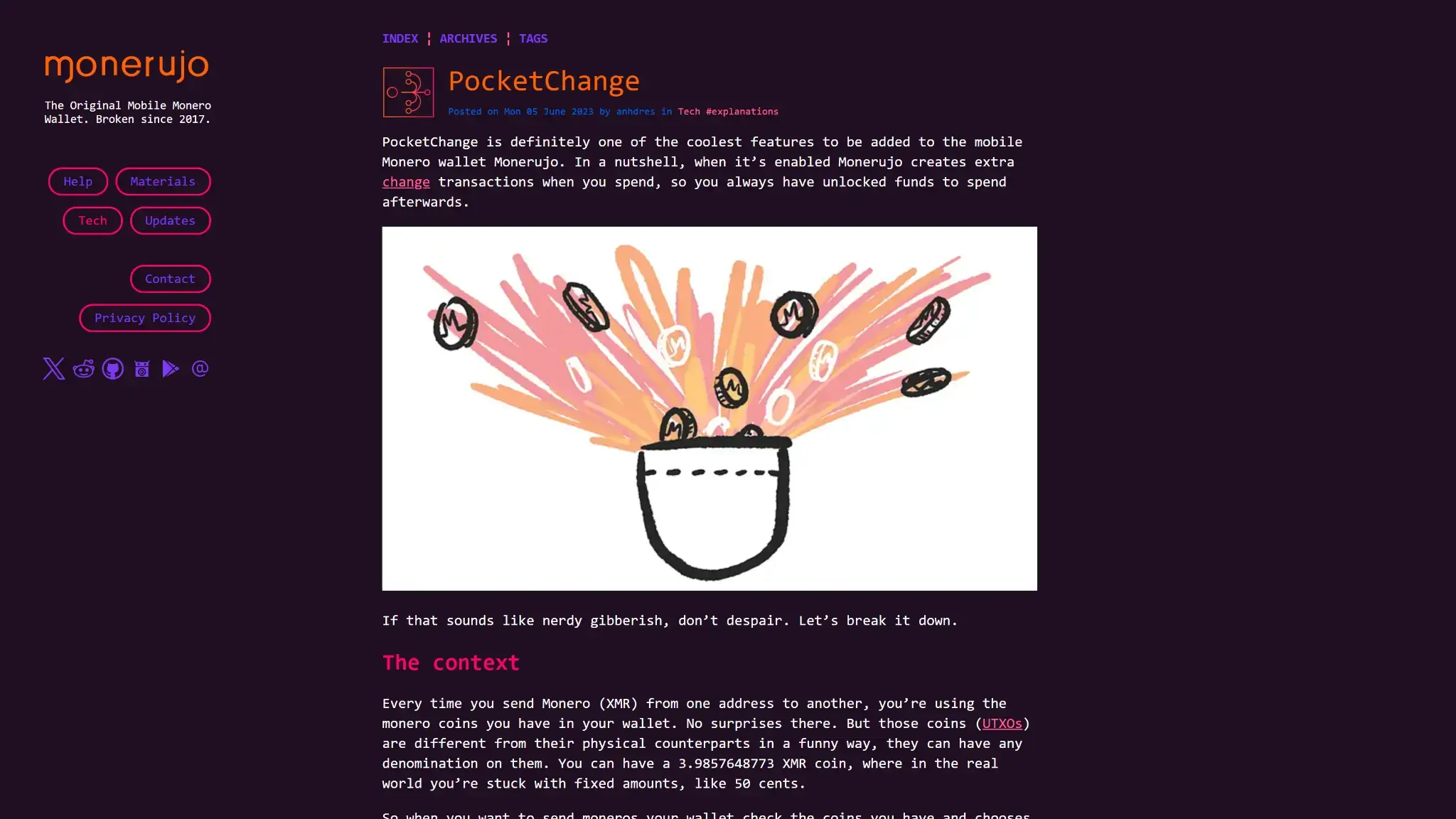
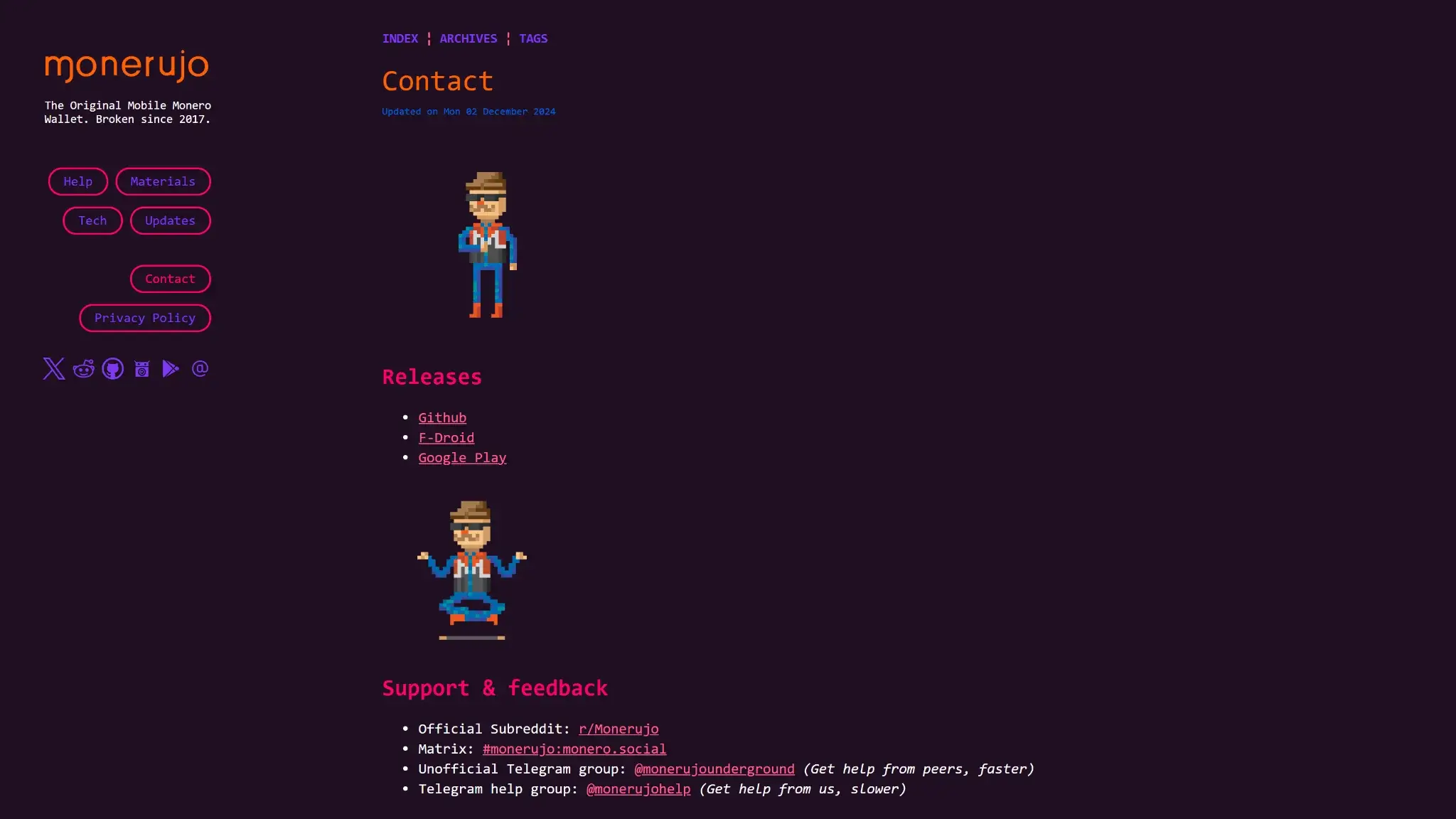
Monerujo contact page with release links, support channels, and community resources
Customer Support, Documentation and Incident Handling
Monerujo’s documentation is more useful than its direct support layer. The project has practical guides available for setup, Sidekick, backups, and corrupt-wallet recovery, but it does not operate like a staffed consumer support desk with fast response guarantees.
Human support is limited. Support can explain restores, node issues, import problems, and recovery steps. It cannot reverse an on-chain transfer, recover a lost seed phrase, reconstruct missing wallet files, or restore access without the user’s backup material.
Channel
Availability
Typical Use
Notes
Help Center
Limited
Docs, setup, troubleshooting
The company has practical tutorials and manuals, but they are closer to help posts than to a structured knowledge base
Official channels include the subreddit, Matrix room, Telegram help group, X, and other social feeds
Incident handling is basic and informal. The project guides users on common problems through help posts, release notes, and community channels rather than through a polished status system. That approach can work for a small open-source wallet, but readers who expect enterprise-style support, guaranteed response times, or incident tracking will find the support model thin.
Final Verdict
Monerujo does one thing: Monero on Android. Custom nodes, Street Mode, and optional Sidekick pairing give serious XMR users more control than most mobile wallets offer. It is best for Android users who want a dedicated XMR wallet with real privacy tools and local key control. It is the wrong choice if you need an iPhone app, desktop access, multichain support, or DeFi. The code is open-source with published verification details, but there is no third-party audit and Exolix swap pricing is opaque.
Built specifically for Monero on Android, so the wallet includes features that matter to XMR users instead of generic multichain extras.
Custom node support gives users more control over how the app connects to the Monero network.
Street Mode can hide balances and past transactions when the wallet is opened in public.
Sidekick adds a separate-phone signing setup for users who want stronger separation between internet access and private keys.
Backup tools are more flexible than many mobile wallets, including wallet export and a separate wallet files restore password.
CONS
Android only, so there is no iPhone, iPad, desktop, or browser-extension version.
Monero-focused design means no support for major non-XMR chains, tokens, NFTs, or DeFi wallet flows.
Hardware wallet support is narrow and depends on Ledger Nano S series with a USB OTG cable.
Built-in swaps rely on a third-party service, so availability, privacy exposure, and execution depend on that provider.
Some advanced functions, such as custom nodes, wallet resets, and file-based restores, can feel technical for casual users.
Affiliate Disclosure
Disclaimer: CryptoSlate may receive a commission when you click links on our site and make a purchase or complete an action with a third party. This does not influence our editorial independence, reviews, or ratings, and we always aim to provide accurate, transparent information to our readers.
FAQ
Is Monerujo custodial or non-custodial?
Monerujo is non-custodial. You control the keys and recovery material.
Is Monerujo a hot wallet or a cold wallet?
In its normal setup, it is a hot software wallet because it runs on an Android phone connected to the internet. Sidekick can add more separation, but it does not turn the main app into a hardware wallet.
Does Monerujo give you a seed phrase?
Yes. Standard wallet recovery is based on the seed phrase, and the app also supports wallet-file backup and restore.
Is Monerujo safe?
It has a solid security model for an Android Monero wallet, especially if you verify the app source and keep strong backups. The main risks are fake APKs, weak backup habits, compromised phones, and bad node choices.
Which chains does Monerujo support?
Monerujo is built for Monero. It does not support broad multichain storage the way many general crypto wallets do.
What fees does Monerujo charge?
The wallet itself is free. Users still pay Monero network fees, and swaps can add third-party pricing costs through Exolix.
Does Monerujo require KYC?
No, not at the wallet level. KYC can still come from external services a user chooses outside the core wallet flow.
Does Monerujo support iOS?
No. Monerujo is an Android wallet and does not offer an iPhone or iPad app.