


ETF
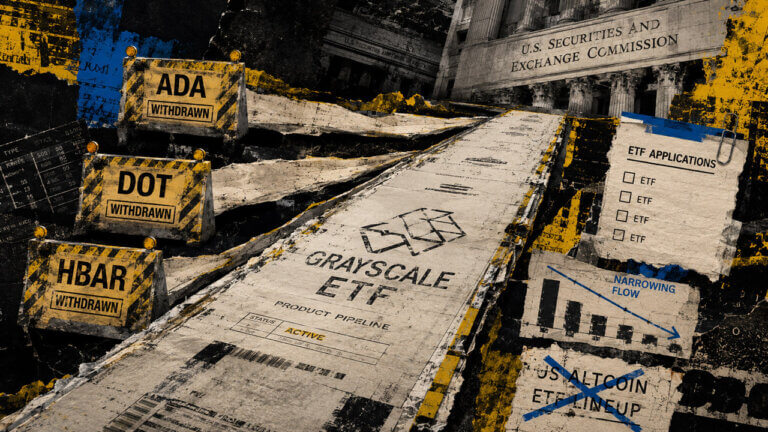
In just 190 seconds, Grayscale quietly pulled the plug on three major altcoin ETFs
Cardano, Hedera and Polkadot registration withdrawals gave no reason for the retreat, while five other Grayscale altcoin filings remained preliminary.

$80.97M traded Price signal supported
Trading Activity price-reliability indicator with 100 percent data coverage. Low activity replaces price-derived sentiment because the displayed market price may not be supported by meaningful trading.Target
Peg Health price-stability indicator with 0 percent data coverage. It measures observed market pricing, not reserve quality or redemption safety.30D -13.9% 86.4% below ATH
Price-based current market conditions indicator with 100 percent data coverage. This is not a price forecast.$80,972,313.13 traded over the last 24 hours. The available activity evidence is sufficient to retain the asset’s price-derived signal.
Low activity can make the displayed price sensitive to a handful of trades. Trading Activity assesses price reliability—not project development, legal status, reserves, or solvency.
Price movement Not interpreted while trading support is below the reliability threshold.
What it measures
The model combines reported 24-hour volume, market-cap turnover, valid-pair liquidity, active exchange breadth, and quote freshness. Missing optional evidence lowers coverage; missing volume or a known-stale quote suppresses price-derived interpretation.
Configured model weights
When inputs are missing, these configured weights are renormalized across the available evidence; data coverage records what is missing.
How to read it
Scores of 0–19 are dormant, 20–39 are thin, 40–69 are supported, and 70–100 are active. Scores below 40 withhold price-derived interpretation.
Price momentum across the scored timeframes weighs on the reading, while short-term volume confirms the stronger move. Together these inputs produce a price-neutral reading rather than a price forecast.
A complete ATL and ATH range is not available for this asset.
What it measures
The model converts price momentum, logarithmic historical position, milestone recency, and short-term volume confirmation into one 0–100 score. Missing evidence lowers data coverage instead of counting as neutral.
Configured model weights
When inputs are missing, these configured weights are renormalized across the available evidence; data coverage records what is missing.
How to read it
50 is the neutral midpoint. Scores of 60 or higher are bullish, 40 or lower are bearish, and 41–59 are neutral.
Showing 10 spot markets sorted by CoinMarketCap exchange rank. Markets excluded from CMC price or volume calculations are hidden.
| Pair | |||||
|---|---|---|---|---|---|
| 1 | HBAR/USDT | $0.08 | $12.1M | 722 | |
| 2 | HBAR/USDC | $0.08 | $1.3M | 638 | |
| 3 | HBAR/USD | $0.08 | $4.88M | 643 | |
| 4 | HBAR/USDT | $0.08 | $30.35K | 424 | |
| 5 | HBAR/USD | $0.08 Best price | $386.53K | 537 | |
| 6 | HBAR/USDT | $0.08 | $273.13K | 527 | |
| 7 | HBAR/KRW | $0.08 | $2.73M | 434 | |
| 8 | HBAR/USDT | $0.08 | $1.96M | 624 | |
| 9 | HBAR/USDC | $0.08 | $435.55K | 612 | |
| 10 | HBAR/USDT | $0.08 | $1.46M | 483 |
Affiliate Disclaimer: CryptoSlate may receive a commission when you click trading links on this page and complete an action with a third party. This does not influence our editorial independence or coverage.
Cardano, Hedera and Polkadot registration withdrawals gave no reason for the retreat, while five other Grayscale altcoin filings remained preliminary.

The verifier accepted identity inputs as proof, letting 250 SAUCE support $9.05 million in principal borrowing.

The new MiCA Alliance was formed to standardize crypto regulatory disclosures and boost sustainability.

Under the partnership, Mondelēz will leverage Hedera's distributed ledger technology (DLT) to enhance digital transformation, supply chain management, and customer engagement.
See HBAR across major fiat currencies and swap the active converter instantly.
Quick SelectUsing the live USD market price. Additional fiat rates will appear after the daily sync.
Hedera, traded under the ticker HBAR, is the native asset of the Hedera network, a public distributed ledger that uses the hashgraph consensus algorithm rather than a conventional blockchain design. The project is positioned around high-throughput payments, tokenization, enterprise-grade applications, and low-cost finality, with HBAR serving as the fuel for network activity and a core component of its proof-of-stake security model.
HBAR is used to pay transaction fees, secure the network through staking, and support a range of applications built on Hedera’s native services. The network is designed to support smart contracts, token issuance, and timestamped messaging through distinct services that developers can access without always relying on complex contract logic. That structure has helped Hedera differentiate itself from many layer-1 networks that center almost entirely on general-purpose smart contracts.
Hedera has long marketed itself as infrastructure for real-world use cases, especially where predictable fees, speed, and operational reliability matter. The network has attracted attention from enterprises, fintech firms, and tokenization projects that want distributed ledger features without the congestion and volatility often associated with more heavily used public chains.
HBAR is more than a transferable asset. It sits at the center of how the network functions economically and operationally.
Hedera’s main technical distinction is hashgraph, a consensus mechanism that uses gossip-based communication and virtual voting to reach agreement on transaction ordering. The network describes this approach as asynchronous Byzantine fault tolerant, with finality typically measured in seconds. Supporters argue that this design offers a combination of speed, fairness, and efficiency that differs from proof-of-work blockchains and even from many proof-of-stake competitors.
Hedera also separates functionality into native services. These include the Hedera Token Service for issuing and managing tokens, the Hedera Consensus Service for recording and ordering event data, and EVM-compatible smart contract support for Solidity-based applications. That mix makes Hedera relevant not only for DeFi-style development, but also for tokenization, compliance-focused applications, data integrity use cases, and enterprise integrations.
HBAR has a maximum supply of 50 billion tokens. That fixed supply has been part of Hedera’s design since the network’s early rollout and plays a central role in how investors evaluate the asset. Circulating supply is lower than the full cap because token distribution has been phased over time through ecosystem allocations, treasury management, grants, and related releases.
For market participants, tokenomics matter because HBAR’s long-term value depends on more than price speculation. Demand is tied to transaction volume, staking participation, application growth, and whether Hedera can continue to convert enterprise interest into durable on-chain activity.
One of Hedera’s most unusual features is its governance structure. The network has historically been overseen by a council model involving major organizations from different industries and geographies. Supporters view this as a practical way to bring institutional credibility and structured governance to public ledger infrastructure. Critics, however, sometimes argue that this model makes Hedera look less grassroots and less decentralized than some rival networks.
In the market, HBAR competes with other large-cap layer-1 assets, payments networks, and tokenization platforms. Its strongest differentiation is not cultural hype or retail speculation, it is the claim that Hedera is built for stable fees, high performance, and enterprise-grade use cases. Whether that translates into long-term token demand depends on sustained adoption rather than branding alone.
HBAR carries familiar risks seen across infrastructure tokens, including competition from other smart contract and tokenization networks, changing developer preferences, and uncertainty around whether enterprise pilots convert into meaningful network usage. There is also ongoing debate in the market about how much value accrues to native tokens when networks emphasize institutional use cases and controlled governance structures.
HBAR matters because it represents a distinct model within crypto, a public network built around hashgraph consensus, fixed supply economics, and a strong push into real-world applications. For investors tracking infrastructure assets beyond the standard blockchain narrative, Hedera remains one of the more differentiated projects in the sector.


Hedera Hashgraph, LLC is the registered organization associated with Hedera.
As of Oct 23, 2026, Hedera trades at $0.078.
Hedera has a market capitalization of $3,441,365,059.78.
Hedera has a 24-hour trading volume of $80,972,313.13.
Hedera reached an all-time high of $0.57, recorded on Sep 16, 2021. It is currently 86.38% below its all-time high.
Hedera recorded an all-time low of $0.01, recorded on Jan 2, 2020. It is currently 675.39% above its all-time low.