



A White House digital assets official has slammed the traditional banking sector's continued opposition to the proposed stablecoin yield compromise in the CLARITY Act.
On April 17, Patrick Witt, the executive director of the White House Presidential Advisory Committee on Digital Assets, accused the financial institutions of “greed or ignorance” due to their intensified lobbying efforts to block yield-bearing stablecoins in the upcoming legislation.
According to him:
“It’s hard to explain any further lobbying by banks on this issue as motivated by anything other than greed or ignorance. Move on.”
US lawmakers make bipartisan sablecoin yield compromise for CLARITY Act
The unusually sharp rhetoric from the administration reflects the widening rift between the White House and Wall Street over the future of the $320 billion stablecoin market.
Over the past year, the White House has made significant efforts to reach a compromise between the banking industry and the crypto sector. However, all has proven abortive so far.
The latest is the Tillis-Alsobrooks proposed bipartisan compromise, which would ban passive yield on stablecoin balances while continuing to permit activity-based rewards.
However, unnamed banking trade associations reportedly argue that even this restricted framework poses a structural threat to the traditional financial system. As a result, they have expanded their lobbying campaign to target multiple senators on the Senate Banking Committee.
Notably, the bankers, through the American Bankers Association, previously claimed that the stablecoin yield loophole in the CLARITY Act could trigger up to $6.6 trillion in deposit outflows.
However, the banking industry's dire projections directly contradict White House data.
A report from the Council of Economic Advisers concluded that a total ban on stablecoin yield would impose a net cost of $800 million on consumers. The report also argued that the “yield prohibition would do very little to protect bank lending, while forgoing the consumer benefits of competitive returns on stablecoin holdings.”
Still, the bankers have rejected these assertions, noting that:
“As yield-paying payment stablecoins expand, households and businesses have stronger incentives to move funds out of bank deposits and into stablecoins, unless Congress prohibits yield.
Even if total deposits in the banking system remain constant, deposits will be reallocated away from smaller banks toward a smaller set of large institutions, and the share of deposits tied up in stablecoin reserves will eat into overall bank lending capacity.”
Demand for yield-bearing stablecoin rises
The legislative gridlock occurs against a backdrop of rapid market evolution, with stablecoin holders increasingly seeking yield-bearing assets.
According to Messari data, the supply of yield-bearing stablecoins has grown 15 times faster than the broader stablecoin market over the past six months.
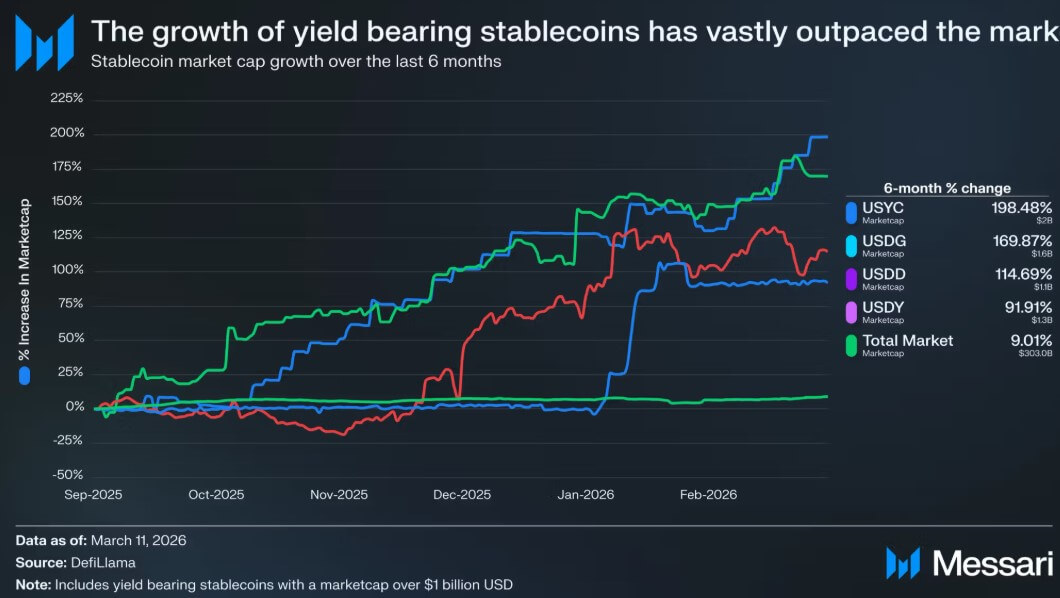
Due to the rapid growth of the sector, time is running out for lawmakers to bridge the gap.
Sen. Thom Tillis told reporters his team is still going back and forth on the compromise text, while Sen. Angela Alsobrooks indicated a release is likely next week.
However, if the Banking Committee fails to advance the bill before the end of April, political realities make passage in 2026 highly unlikely. In fact, Sen. Cynthia Lummis has warned that the bill might not be passed until 2030 if a compromise is not reached quickly.
Meanwhile, the crypto sector maintains that capitulating to bank demands will stifle domestic innovation.
Dan Spuller, executive vice president of industry affairs at the Blockchain Association, said:
“Our industry is in the 11th hour of negotiations and the push to force everything into a bank model is real. Stablecoins are fully reserved payment tools, not deposit-taking institutions. If we get this right, America wins.”
Editorial credits