RedotPay Crypto Card Review

Verified Review
Published Updated

RedotPay is a prepaid, app-linked stablecoin card. You fund the account with supported crypto or fiat, then the app handles spending and conversion across online, in-store, and ATM use. The card is only one part of the product, because the same app also covers transfers, wallet balances, swaps, P2P access and crypto-backed credit.

Yousra Anwar Ahmed
Reviewed by
Fact-checked by
Pending Assignment

RedotPay Overview

Product Name RedotPay
Card Type Prepaid
Network VisaMastercard
Availability 100+ countries, varies by jurisdiction.
Rewards $5 welcome bonus, referral rewards.
Fees Card Issuance fee for virtual is $10; for physical card, it is $100. FX fee is 1.2%; ATM fee is 2%-3%.
Daily Spend / ATM Limit $10,000 monthly withdrawal
Funding Source Bank transfer, on-chain deposit, credit/debit card, Binance Pay, and supported third-party transfers.
Digital Wallets Apple Pay, Google Pay
Virtual Card & Shipping Virtual card can go live soon after KYC, fee payment and successful funding. Physical card production usually takes 10-15 days.

RedotPay Screenshots

RedotPay Pros and Cons

Pros

  • Virtual card can be activated fast for online spend
  • Physical card adds ATM access, not just checkout spend
  • Apple Pay support makes in-store use more practical
  • No annual fee keeps ongoing holding cost lower
  • Card, wallet, swap, transfer, and P2P tools sit in one app

Cons

  • Full KYC is required before core use.
  • Physical card fee is high at $100.
  • FX fee of 1.2% adds drag on cross-currency spend.
  • It is custodial, so spending depends on RedotPay-held balances.
  • Availability and some features vary by jurisdiction.

Who RedotPay Is Best For — And Who Should Skip It

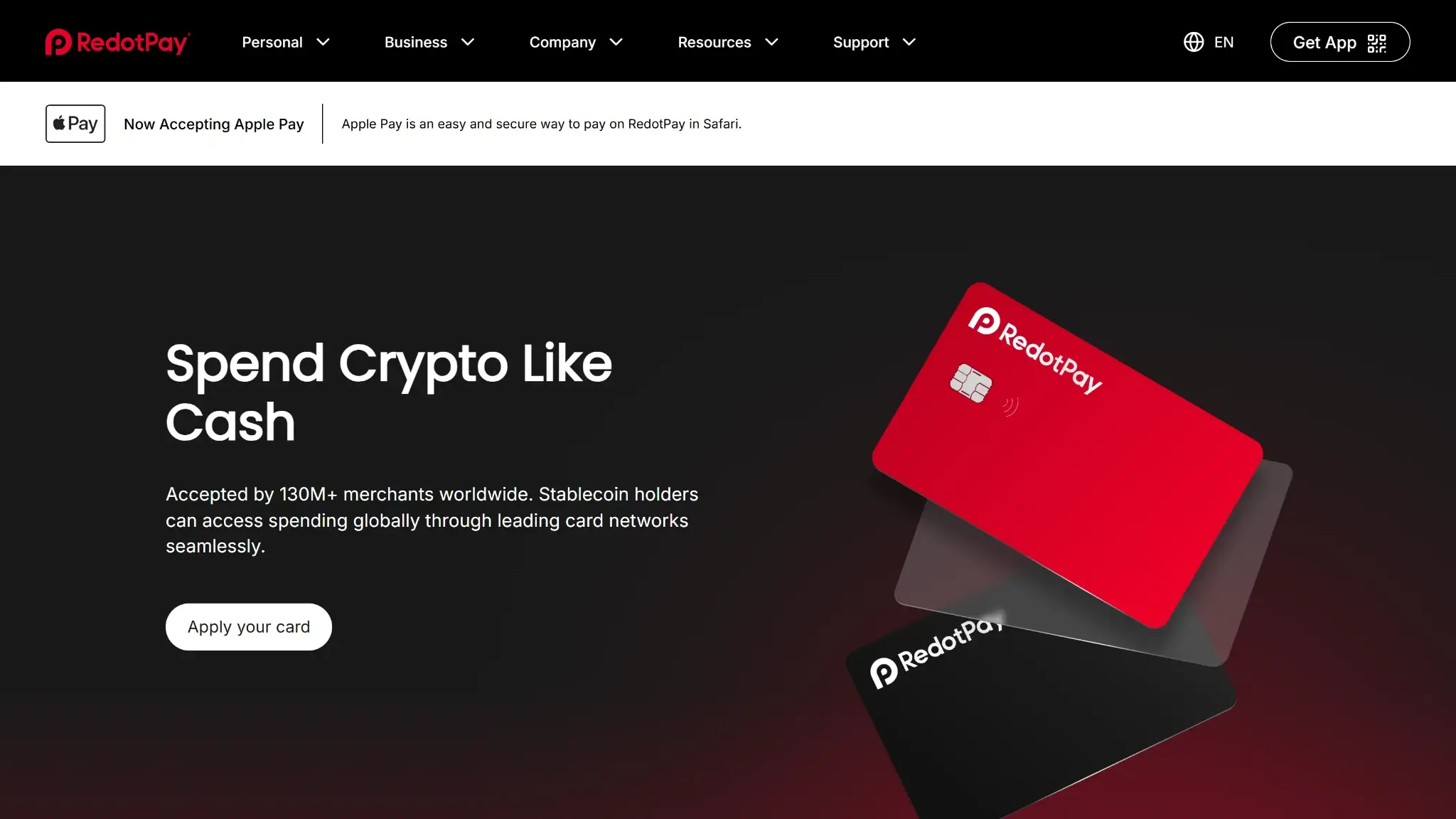
RedotPay hero section promoting crypto spending like cash with a red payment card and global merchant acceptance message.

RedotPay works best as part of a stablecoin spending workflow. Whether it fits depends on how much custody, fees, and verification friction matter to you.

User TypeFitWhy
Everyday SpenderMediumDay-to-day card use is practical, but full verification and upfront card fees add friction.
TravelerMediumPhysical card, Apple Pay, and ATM access help, but the FX fee and jurisdiction limits matter.
Stablecoin UserHighStablecoin funding, spending, and transfers are central to how the product works.
Self-Custody Wallet UserLowThis is an account-based custodial wallet setup, not a direct self-custody spending tool.
Cashback HunterLowThe card is built more around payments access than ongoing card rewards.
Heavy SpenderMediumThe app is broad enough for frequent use, but spending limits are not clearly surfaced here.
Low-KYC UserLowIdentity verification is required before full use.
User Who Wants Simple TaxesLowCard spend can sit alongside swaps, transfers, and crypto balance movement inside one app.

It suits people who already use stablecoins for regular payments and want one app for funding, card spend, and transfers.

It is a weaker fit if you want self-custody, lower upfront costs, or simpler accounting.

What This Card Actually Is and How Spending Works

Spending draws from app-held balances, which can include stablecoins and supported cryptocurrencies. Users preload value before spending, and crypto is converted to fiat at the point of sale. A separate crypto-backed credit feature is also available in the app.

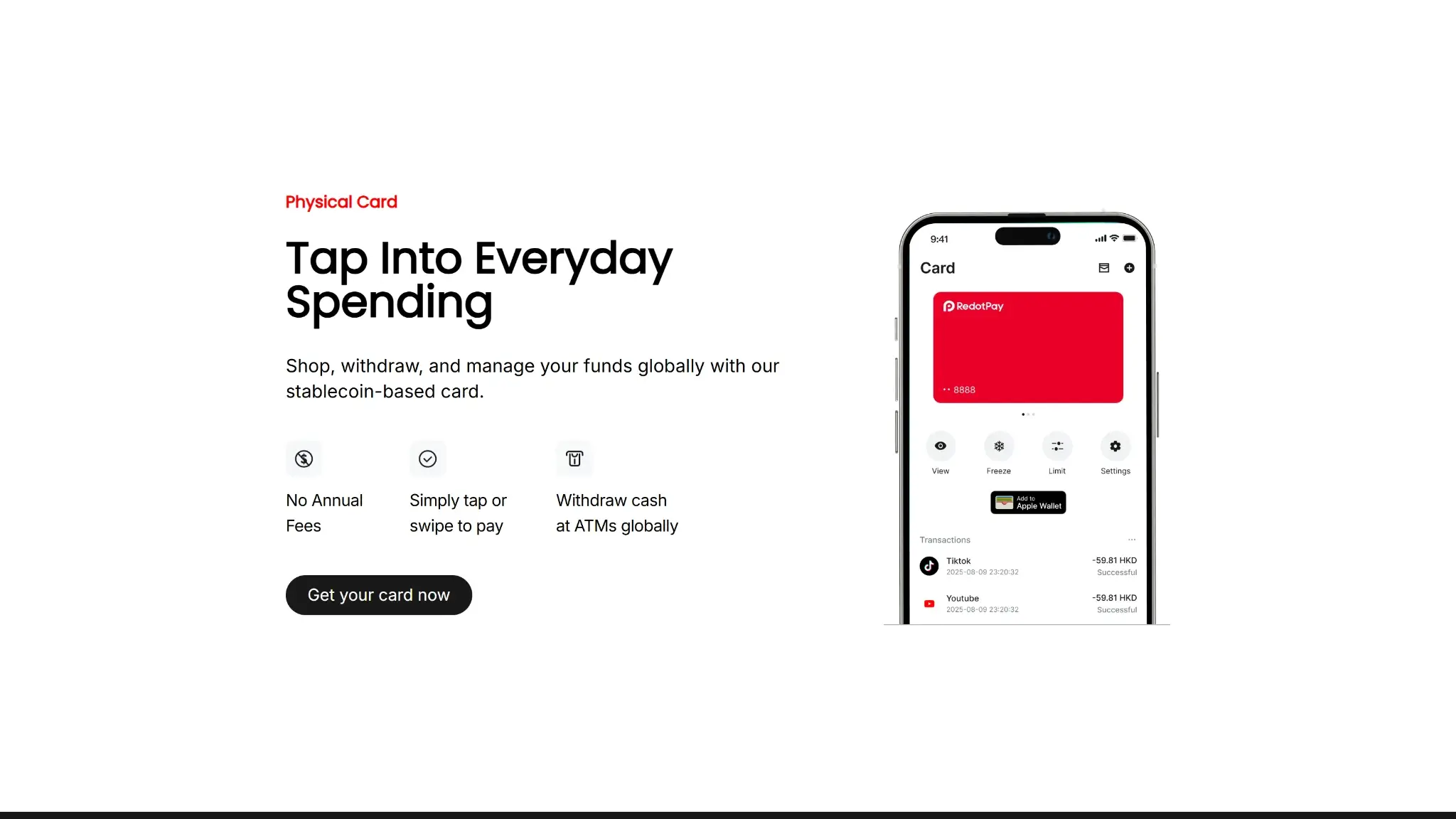
RedotPay physical card section promoting everyday spending, no annual fees, ATM withdrawals, and tap-to-pay support.

The virtual card can be added to Apple Pay and Google Pay for contactless payments, while the physical card enables in-store purchases and ATM withdrawals.

  • Balance sits inside the RedotPay app, not a linked bank account.
  • Users preload funds before spending, or use the separate credit account.
  • Stablecoins and supported crypto can be converted during settlement.
  • Refunds return to the RedotPay balance after processing.
  • Core use cases are online spend, subscriptions, in-store payments, ATM cash access, and travel backup use.

The operating model is simple: load funds into the app, spend from the card, and let RedotPay handle conversion and settlement in the background.

Availability, KYC and Setup Friction

The bigger hurdles are ID checks, country restrictions, and whether your region supports the card format you need.

Region AvailabilityBroad global coverage, but still limited by country, card, and service layer
Unsupported RegionsAfghanistan, Albania, Belarus, Bosnia and Herzegovina, Bouvet Island, Burkina Faso, Burundi, Central African Republic, Mainland China, Congo (Democratic Republic of the), Croatia, Cuba, Eritrea, Ethiopia, Guinea-Bissau, Haiti, Iran, Iraq, Kosovo, Lebanon, Liberia, Libya, Mali, Montenegro, Myanmar, Netherlands Antilles, Nicaragua, North Korea, North Macedonia, Russia, Serbia, Slovenia, Somalia, South Sudan, Sudan, Syria, Ukraine, United States, Venezuela, Yemen, Zimbabwe
Who Can ApplyAdults 18+ in supported regions, with one verified account per person
KYC LevelFull KYC, including ID upload and face scan
Credit CheckNo
Account Or App NeededRedotPay mobile app and a verified account
Card Issuance RestrictionsAfghanistan, Guinea-Bissau, North Macedonia, Albania, Haiti, Russia, Belarus, Iran, Serbia, Bosnia and Herzegovina, Iraq, Singapore, Bouvet Island, Kosovo, Slovenia, Burkina Faso, Lebanon, Somalia, Burundi, Liberia, South Sudan, Central African Republic, Libya, Sudan, Mainland China, Mali, Syria, Congo (Democratic Republic of the), Montenegro, Ukraine, Croatia, Myanmar, United States, Cuba, Netherlands Antilles, Venezuela, Eritrea, Nicaragua, Yemen, Ethiopia, North Korea, Zimbabwe.
Time To First SpendMinutes for virtual after approval and funding, longer for physical because shipping and activation add delay

Setup slows down because full verification, regional restrictions, and card-delivery rules do not follow the same country list.


Funding Rails, Supported Assets and Conversion Path

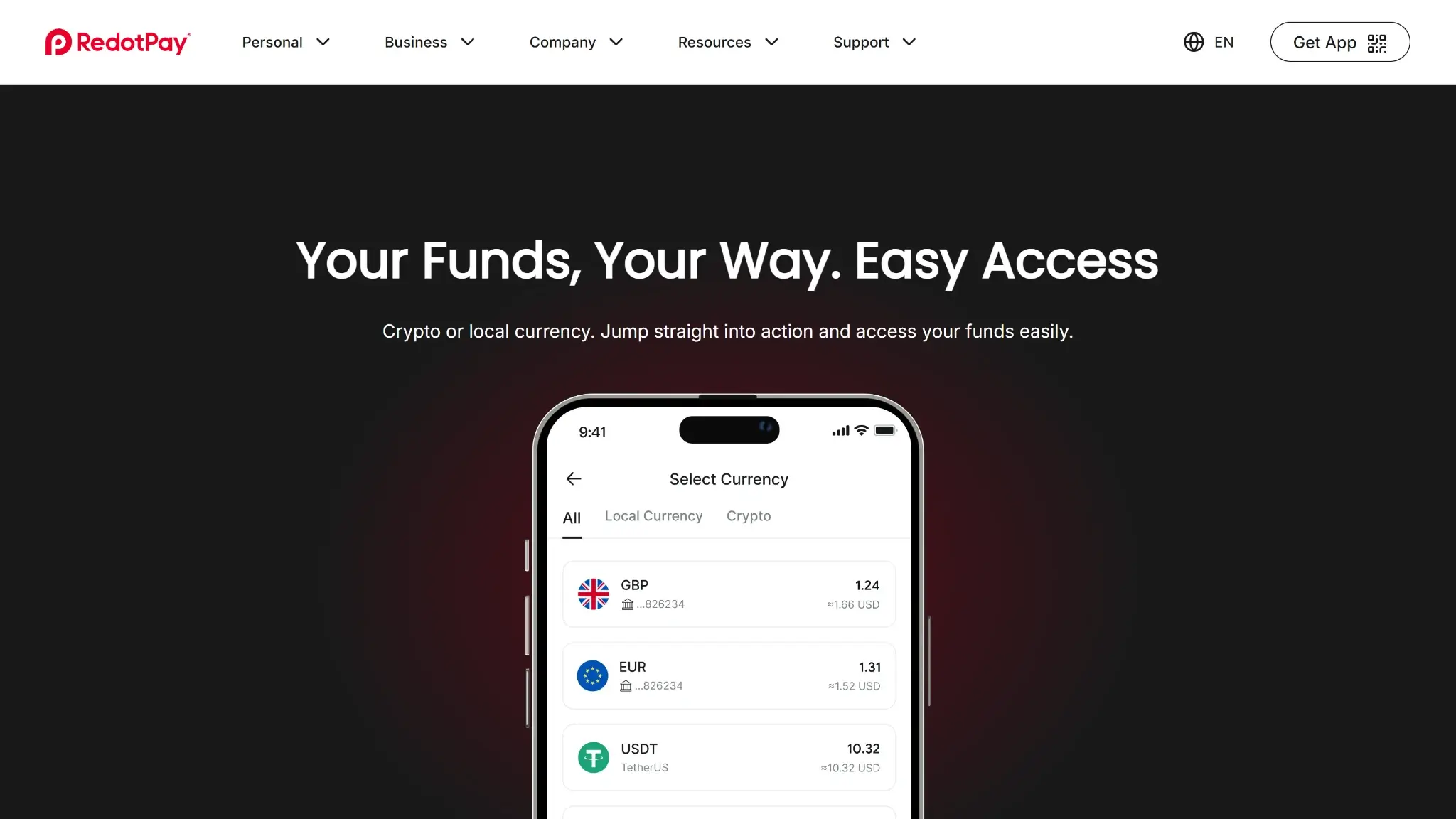
RedotPay multi-currency wallet section showing easy access to crypto and local currency balances on a mobile app screen.

Asset variety matters less than whether the funding route reaches a spendable balance without extra friction.

Funding RailSupported AssetsTypical SpeedMain Friction
Bank TransferEUR, GBP via Currency AccountAround 5 minutes if no review, 1-3 business days if reviewedCurrency Account required first; same-name personal account only; min 10 EUR; direct EUR/GBP withdrawal not available; limits up to 20,000 per transfer, 50,000 daily, 100,000 monthly
Debit Or Credit Top-UpSelected buys such as ETH, USDC, USDTUsually 0.5-2 hours after purchaseBank or card-issuer checks can block payment; some assets vary by region; RedotPay cards cannot be used to buy crypto
Exchange BalanceUSDT, USDC, BTC, ETH via exchange withdrawal or Binance PayBinance Pay after confirmation, or network-dependent if sent on-chainNo native exchange-linked balance; Binance Pay charges 1%; posted limits are USDT/USDC 0.01-50,000, BTC 0.000001-1, ETH 0.000001-20
Onchain StablecoinsUSDT, USDC on network-specific routes shown in-app, with ERC20, BEP20, and TRC20 shown in deposit examplesAfter chain confirmation; USDT-TRC20 example is 5 confirmations, about 1 minute eachNetwork and asset must match exactly; minimum deposit rules apply; wrong-network deposits may not credit
Other Crypto AssetsBTC and ETH direct deposits are clearly surfaced; broader app balances also use BNB, SOL, TON, S, TRX, XRPNetwork-dependentDirect deposit support is narrower than the broader asset menu shown elsewhere in the app
Fiat Wallet Or Cash BalanceApp-held EUR and GBP once topped upImmediate once creditedLocal-currency support is much narrower than the broader crypto side, and the currency-account track adds extra eligibility checks

Stablecoin funding is the most practical route because it matches how RedotPay settles spending. Bank funding is narrower, card-buy flows are more limited, and on-chain deposits need careful network matching.

Rewards, Perks and The Catch

RedotPay has no ongoing rewards program. There is no standard cashback, boosted tier, travel perk, or subscription perk linked to the card.

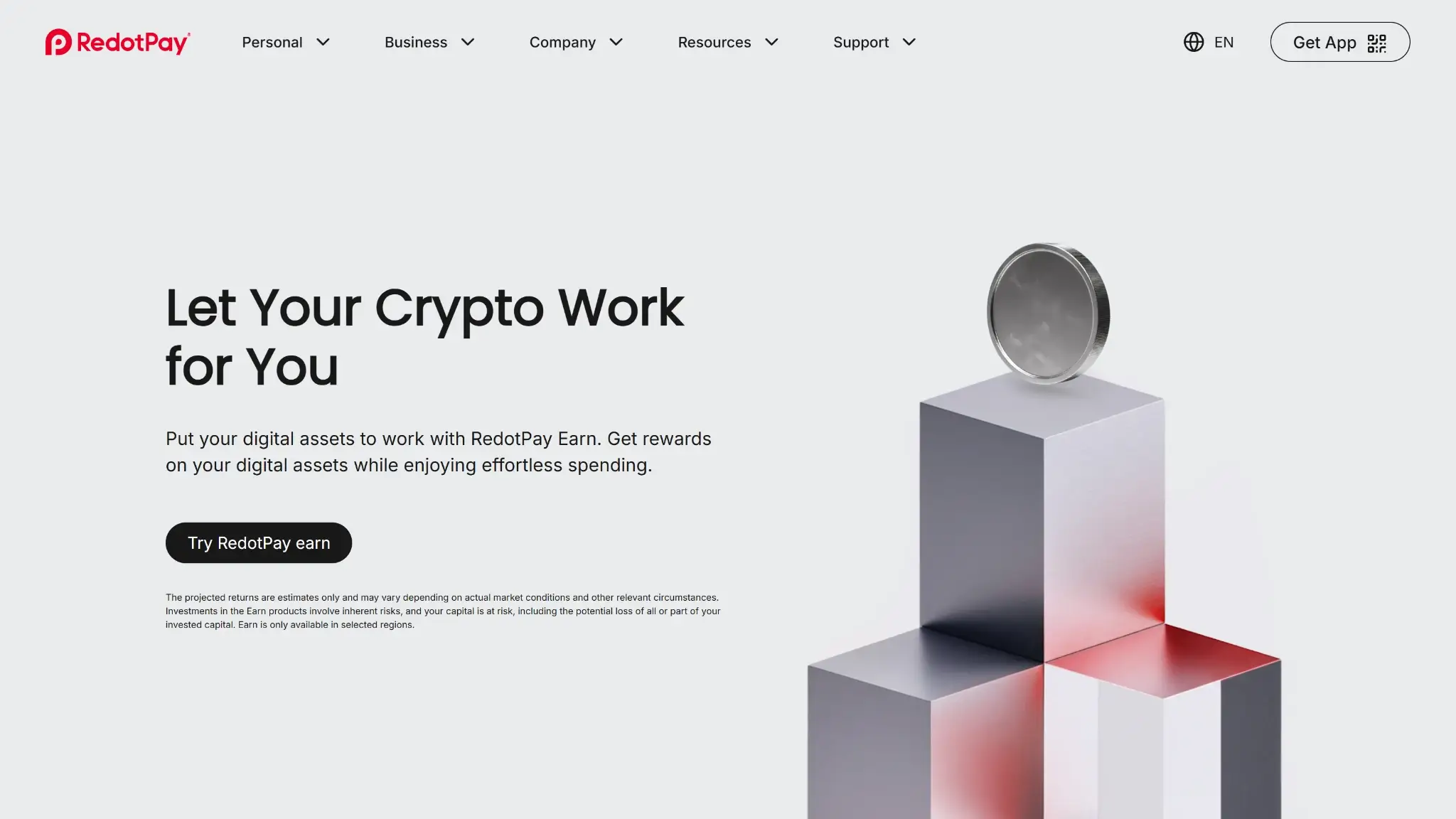
RedotPay earn page promoting crypto rewards and digital asset earning with a coin and geometric platform graphic.

The only visible incentive is the small $5 USDs sign-up bonus and referral commissions paid in USDT. The bonus expires after 30 days and cannot be used toward the card fee. After the welcome bonus, the only remaining incentives are referral commissions and the Earn product in supported regions.

Fees and Total Cost

The absence of a monthly fee is the only obvious cost advantage. Card issuance, FX, ATM, and convenience funding fees all add up.

CostWhat Users PayWhen It HitsNotes
Monthly Or Annual Fee$0OngoingNo monthly, annual, or card management fee
Issuance Or Replacement FeeVirtual card $10, physical card $100, first virtual replacement $5, later virtual replacements $10Card application or reissueCard issuance is non-refundable; replacement needs at least 31 days between requests; card deletion costs $2
Conversion Or Spread Cost1% crypto conversion on ATM cash withdrawals; 1.5% fee on selected merchants, minimum $0.50, after three monthly waiversATM cash-out, selected merchant categories, and final settlementCard settlement uses live exchange pricing, and final charges can differ from the authorization amount
FX Fee1.2%Transactions outside the card currency, including ATM withdrawals in other currenciesThis sits on top of other card costs
ATM FeeHKD card 2%; USD card 2% up to $10,000 monthly ATM use, then 3% above thatPhysical-card ATM withdrawalsATM operator fees can still apply separately
Top-Up FeeUsually $0 for direct deposits; 1% via Binance Pay; 3% via mainstream credit/debit transfer, minimum $1; 3% for supported third-party transfers such as PayPal, minimum $1.When adding fundsConvenience funding is where extra cost starts to pile up
Inactivity Fee$0Not ApplicableThe $5 sign-up bonus expires after 30 days, but that is not an inactivity fee
Network Or Gas FeeVaries by chainOn crypto withdrawalThe app shows the fee before submission; wrong-network recovery can become expensive

The cost problem is the layered structure. Card issuance, FX, ATM, convenience funding, and merchant-specific fees can all hit in the same flow.

Limits, Speed and Cash Access

RedotPay is fast when you stay inside the app and use the virtual card. It gets slower once physical delivery, cash withdrawals, refunds, or extra checks enter the flow.

Virtual Card Setup SpeedVirtual card can go live soon after KYC, fee payment, and successful funding.
Physical Card ProductionPhysical card production usually takes 10-15 days.
Physical Card ShippingShipping usually adds another 5-30 days.
Crypto Deposit TimingCrypto deposits usually credit in 1-15 minutes if the network is moving normally.
USDT-TRC20 Timing ExampleUSDT-TRC20 uses 5 confirmations, about 1 minute each in RedotPay's own example.
EUR And GBP Deposit TimingEUR and GBP deposits can land within 5 minutes if no review starts.
Reviewed Fiat Or Third-Party DepositsReviewed fiat or third-party deposits can take 1-3 business days.
Card Limit ControlsThe app lets users set a per-transaction limit and a daily limit for each card.
Spending CeilingsCertain security-related changes can temporarily reduce card spending to $1,000 per transaction and $1,000 per day for 24 hours.
ATM AccessATM access is physical card only.
ATM Withdrawal Pricing ThresholdUSD-card ATM pricing steps up after $10,000 in monthly withdrawals.
Monthly ATM CeilingATM limits should be checked in-app per card. The current public fee schedule shows USD-card ATM pricing at 2% up to $10,000 of monthly ATM withdrawals and 3% above $10,000.
Refund TimingRefunds usually arrive in 2-15 days after the merchant processes them.
Long-Tail Refund CasesSome e-commerce refunds can take more than a month.
Reversal TimingReversed authorizations usually move from Authorized to Reversal within 1-5 days.
Failed ATM Cash-OutsFailed ATM cash-outs can leave a temporary deduction before the status is corrected.
Common Delay PointsDelays usually show up in KYC reviews, fiat deposit reviews, physical-card shipping, merchant refunds, and withdrawal checks.

Approval, funding, and spending speeds are all different. Virtual-card use can be quick after verification and funding, but cash access, physical delivery, refunds, and reversals move more slowly.

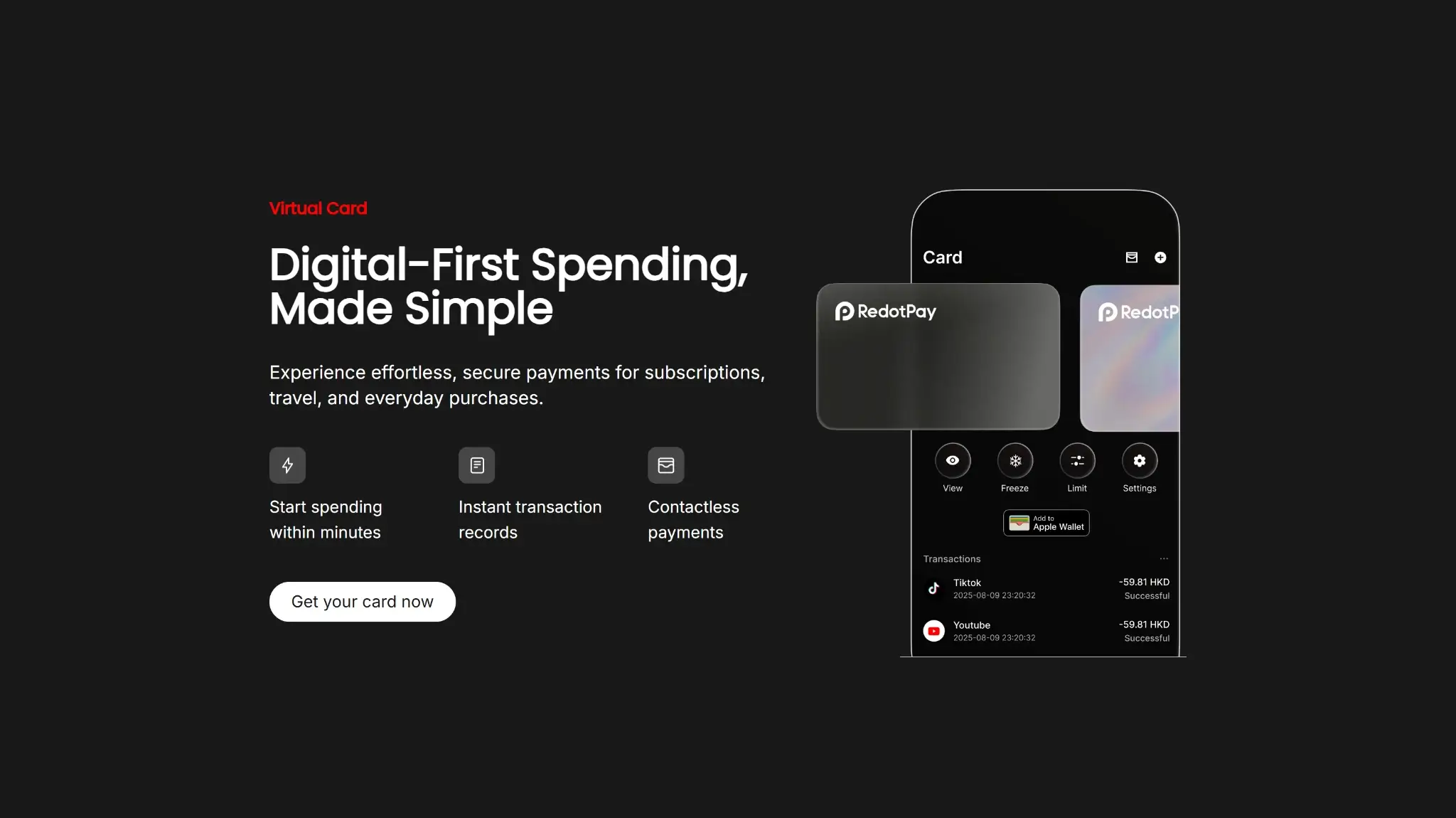
RedotPay virtual card section promoting digital-first spending, instant transaction records, and contactless payments.

Security, Custody and Trust

Trust sits with RedotPay, its card partners, and the custody stack. RedotPay is a fintech, and self-custody does not apply once funds are deposited for normal card use. Funds sit inside the RedotPay account structure, RedotPay and its partners control access, and the account can be restricted or frozen if compliance checks fail. The bigger risk here is custody and issuer dependence, not wallet management.

Card use is barred for illegal or prohibited transactions, and RedotPay adds a 1.5% fee, with a $0.50 minimum, to certain merchants after three monthly waivers. The current public list includes Facebook Ads, Discord, Free Fire, PUBG Mobile, Brawl Stars, eFootball, and Gulf Health Counsel. If KYC, KYT, or AML checks raise concerns, RedotPay and its partners can refuse top-ups, restrict access, freeze balances, and report suspicious activity.

Customer Support, Refunds and Chargebacks

RedotPay app download hero banner showing the headline Where Crypto Meets Real Life with App Store, Google Play, and Android download buttons.

The help center is broad and practical. Case resolution is slower when money is stuck or a dispute needs human handling.

  • The help center is deep, with separate sections for cards, transactions, refunds, fraud, billing statements, and security.
  • In-app live chat is the main real-human support route.
  • Support aims to reply within 1 business day.
  • Refunds still start with the merchant, then flow back through RedotPay.
  • Chargebacks must be filed within 60 days of settlement. Each chargeback request costs $50. They usually take 3-6 months.
  • Support can help with card freezes, fraud reports, billing statements, and dispute intake.
  • Support cannot cancel subscriptions for you.
  • Support cannot reverse completed internal transfers.

Support handles routine card controls and document-heavy disputes. Resolution slows when the merchant, ATM operator, or card network controls the outcome.

Taxes, Statements and Record-Keeping

Record-keeping becomes manual quickly once you use BTC, ETH, or other volatile crypto for funding. Stablecoin spend reduces price-movement complexity but does not remove the reporting requirement. Rewards are barely part of the picture here, but the $5 sign-up bonus and referral payouts can still create extra reporting questions depending on where you file.

The app does give you some basic records, including downloadable card bill statements sent by email and monthly card history in the app. But cost-basis tracking is not surfaced as a dedicated feature, third-party tax software compatibility is Not Disclosed, and CSV-style export support is Not Disclosed. You still need to track source assets, conversion values, spend amounts, refunds, and transfer flows manually.

Final Verdict

RedotPay is built around stablecoin spending, and within that lane it holds up. The virtual card activates quickly after KYC, USDT and USDC are the cleanest funding routes, and one app covers cards, transfers, swaps, P2P, and crypto-backed credit. The fee structure is where it gets harder to ignore: a $100 physical card, a 1.2% FX charge, a 2% ATM fee, and a 3% top-up fee on card or PayPal funding can all land in the same flow, with no rewards to offset any of it. It works for users who already hold stablecoins as spending money and are comfortable with a custodial setup. It is a poor fit if upfront costs, self-custody, or card rewards matter to you.

Overall Score

6.5

PROS

  • Virtual card can be activated fast for online spend
  • Physical card adds ATM access, not just checkout spend
  • Apple Pay support makes in-store use more practical
  • No annual fee keeps ongoing holding cost lower
  • Card, wallet, swap, transfer, and P2P tools sit in one app

CONS

  • Full KYC is required before core use.
  • Physical card fee is high at $100.
  • FX fee of 1.2% adds drag on cross-currency spend.
  • It is custodial, so spending depends on RedotPay-held balances.
  • Availability and some features vary by jurisdiction.
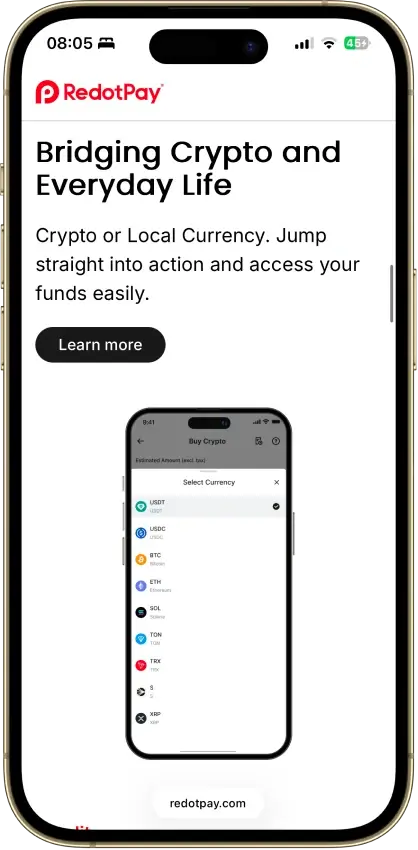
RedotPay mobile screen promoting crypto and local currency access with a buy crypto interface and supported assets list.
Affiliate Disclosure

Disclaimer: CryptoSlate may receive a commission when you click links on our site and make a purchase or complete an action with a third party. This does not influence our editorial independence, reviews, or ratings, and we always aim to provide accurate, transparent information to our readers.

FAQ

Is RedotPay a real credit card, a debit card, or a prepaid card?

RedotPay is a prepaid crypto card. It is not a traditional credit card, and it is not a normal bank debit card linked to a checking account. You preload value into the app, then spend from that balance through the card.

Is RedotPay available in my country?

It depends on your country, your card type, and the service layer you want to use. RedotPay supports users in many regions, but registration, KYC, billing-address approval, and physical-card delivery do not all follow the same country list. The United States and a long list of restricted regions are excluded.

Does RedotPay let me spend USDC or other stablecoins?

Yes. Stablecoins sit at the center of the RedotPay setup, and the card is built around spending app-held balances funded by assets like USDT and USDC. RedotPay also supports broader crypto balances, but stablecoins are the cleaner fit for day-to-day spending.

Does using RedotPay create a taxable event?

It can. In many jurisdictions, spending crypto through a card can count as a taxable disposal because the asset is being converted and used for payment. Stablecoin spending often makes the reporting simpler, but it does not automatically remove the need to track each transaction.

Does RedotPay work with Apple Pay or Google Pay?

Yes, RedotPay supports Apple Pay and Google Pay in supported regions. The virtual card can be linked to digital wallets for online and in-store use, although wallet syncing can sometimes take a couple of days after activation.
Can I use RedotPay for travel, hotels or ATM withdrawals?

Yes, but with some caution. The physical card supports ATM withdrawals, and the card can work for travel spend, but prepaid-card friction still shows up with hotels, gas stations, car rentals, and other merchants that use larger temporary holds or pre-authorizations.

What happens if a merchant refunds me or I need a chargeback?

Merchant refunds go back through the normal card flow and usually take 2 to 15 days after the merchant processes them, though some cases take longer. Chargebacks are available in some situations, but they cost $50, can take 3 to 6 months, and certain transaction types are excluded.

Do I need to stake or hold a token to get the best rewards?

No, because there is no real card rewards stack to unlock here. RedotPay does not run a standard cashback or tiered-rewards structure on the card. The visible incentives are the $5 USDs sign-up bonus and referral commissions.