Governance
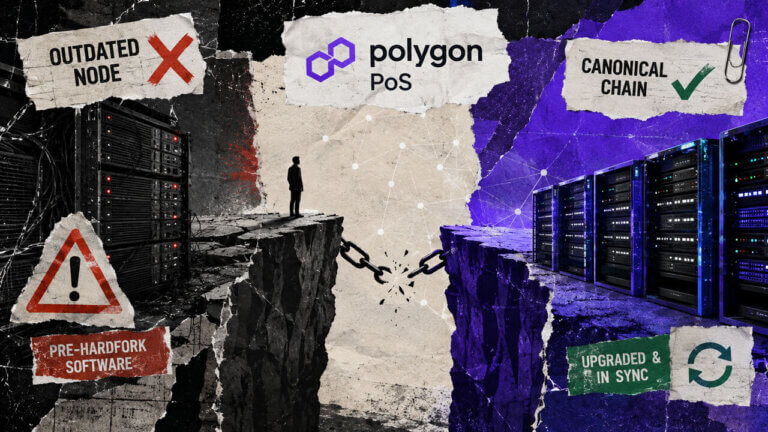
Polygon Labs issues urgent client upgrade notice following Austin and Kyoto hardforks
The Polygon upgrades closed separate block-stall, peer-crash, and validator-work risks, leaving nodes on older binaries outside canonical consensus.

$1.26M traded Price signal supported
Trading Activity price-reliability indicator with 60 percent data coverage. Low activity replaces price-derived sentiment because the displayed market price may not be supported by meaningful trading.Target
Peg Health price-stability indicator with 0 percent data coverage. It measures observed market pricing, not reserve quality or redemption safety.Price-based current market conditions indicator with 17 percent data coverage. This is not a price forecast.
$1,264,461.86 traded over the last 24 hours. The available activity evidence is sufficient to retain the asset’s price-derived signal.
Low activity can make the displayed price sensitive to a handful of trades. Trading Activity assesses price reliability—not project development, legal status, reserves, or solvency.
Price movement Not interpreted while trading support is below the reliability threshold.
What it measures
The model combines reported 24-hour volume, market-cap turnover, valid-pair liquidity, active exchange breadth, and quote freshness. Missing optional evidence lowers coverage; missing volume or a known-stale quote suppresses price-derived interpretation.
Configured model weights
When inputs are missing, these configured weights are renormalized across the available evidence; data coverage records what is missing.
How to read it
Scores of 0–19 are dormant, 20–39 are thin, 40–69 are supported, and 70–100 are active. Scores below 40 withhold price-derived interpretation.
Price momentum across the scored timeframes supports the reading. The available evidence produces a unavailable reading rather than a price forecast.
A complete ATL and ATH range is not available for this asset.
What it measures
The model converts price momentum, logarithmic historical position, milestone recency, and short-term volume confirmation into one 0–100 score. Missing evidence lowers data coverage instead of counting as neutral.
Configured model weights
When inputs are missing, these configured weights are renormalized across the available evidence; data coverage records what is missing.
How to read it
50 is the neutral midpoint. Scores of 60 or higher are bullish, 40 or lower are bearish, and 41–59 are neutral.
Loading market data
Detailed market rows are loading and will appear shortly.
The Polygon upgrades closed separate block-stall, peer-crash, and validator-work risks, leaving nodes on older binaries outside canonical consensus.

Team statements point to a Polymarket private key compromise rather than core contracts or user funds.

Base and Arbitrum earn most profits; where does Polygon fit?

Global Head of Payments at Polygon Labs, Aishwary Gupta, explains what's driving the explosive growth in tokenized RWAs right now.
See MATIC across major fiat currencies and swap the active converter instantly.
Quick SelectUsing the live USD market price. Additional fiat rates will appear after the daily sync.
Polygon, a prominent layer 2 scaling solution on Ethereum, has emerged as a multifaceted and scalable platform, enhancing the Ethereum ecosystem's capabilities. As a layer 2 scaling solution, Polygon effectively addresses major challenges such as high gas fees and slow transaction speeds that have been hurdles for Ethereum users.
Scalability & Efficiency: At its core, Polygon increases transaction throughput by processing transactions off the main Ethereum chain (Layer 1) and then batching them together for finalization on Ethereum. This method significantly reduces congestion and gas fees.
Ethereum Compatibility: Polygon maintains a high degree of compatibility with Ethereum's tools, DApps, and infrastructure, making it a seamless transition for developers and users from Ethereum.
Security: Leveraging Ethereum's robust security model, Polygon adds additional layers of security through its validators and its unique Proof of Stake (PoS) mechanism.
Versatility: It supports multiple scaling approaches, including sidechains, zkRollups, and Optimistic Rollups, offering flexibility for developers in choosing the right scaling solution for their specific needs.
Rapid Adoption: Since its inception, Polygon has seen widespread adoption by numerous DApps, NFT platforms, and decentralized finance (DeFi) projects, attracted by its scalability and low transaction costs.
Major Collaborations: Polygon has partnered with significant industry players like Aave, Curve, and SushiSwap, further integrating into the broader crypto ecosystem.
Token Performance: MATIC, the native token of Polygon, has exhibited strong performance in the crypto market, reflecting the platform's growing popularity and utility.
Polygon was co-founded by a team of experienced blockchain developers and entrepreneurs, including Jaynti Kanani, Sandeep Nailwal, and Anurag Arjun. Their diverse backgrounds and deep understanding of blockchain technology have been instrumental in Polygon's development and success.
Looking ahead, Polygon is well-positioned to play a pivotal role in the evolution of blockchain technology. Its commitment to enhancing scalability and user experience on Ethereum, coupled with a strong team and community support, sets it up for continued growth and innovation in the crypto landscape. As the blockchain sector evolves, Polygon's adaptability and forward-thinking approach will likely keep it at the forefront of technological advancements.


Matic-Network India LLP is the registered organization associated with Polygon.
As of Oct 14, 2026, Polygon trades at $0.22.
Polygon has a market capitalization of $402,374,198.74.
Polygon has a 24-hour trading volume of $1,264,461.86.