






Stablecoins
SAP Pay adds USDC payments, with Circle Mint access required
Tereina’s Circle integration adds a settlement route inside SAP workflows, while institutional checks and regional conditions govern access.

$13.28B traded Price signal supported
Trading Activity price-reliability indicator with 100 percent data coverage. Low activity replaces price-derived sentiment because the displayed market price may not be supported by meaningful trading.Target $1.0000 0.02% below
Peg Health price-stability indicator with 100 percent data coverage. It measures observed market pricing, not reserve quality or redemption safety.Price-based current market conditions indicator with 0 percent data coverage. This is not a price forecast.
$13,277,586,840.00 traded over the last 24 hours. The available activity evidence is sufficient to retain the asset’s price-derived signal.
Low activity can make the displayed price sensitive to a handful of trades. Trading Activity assesses price reliability—not project development, legal status, reserves, or solvency.
Price movement Not interpreted while trading support is below the reliability threshold.
What it measures
The model combines reported 24-hour volume, market-cap turnover, valid-pair liquidity, active exchange breadth, and quote freshness. Missing optional evidence lowers coverage; missing volume or a known-stale quote suppresses price-derived interpretation.
Configured model weights
When inputs are missing, these configured weights are renormalized across the available evidence; data coverage records what is missing.
How to read it
Scores of 0–19 are dormant, 20–39 are thin, 40–69 are supported, and 70–100 are active. Scores below 40 withhold price-derived interpretation.
USDC is trading 0.02% below its $1.00 target. The combined current, reconstructed historical, and volume evidence produces an on-peg reading.
Peg Health measures observed market-price stability only. It does not assess reserves, redemption access, issuer risk, or solvency.
What it measures
The model combines current target deviation, reconstructed price stability, weakest-snapshot resilience, and volume stress. Moving fiat targets use current-price evidence unless matching historical FX targets are available.
Configured model weights
When inputs are missing, these configured weights are renormalized across the available evidence; data coverage records what is missing.
How to read it
Higher scores indicate stronger observed price stability: 90–100 is on peg, 70–89 is watch, 40–69 is stressed, and 0–39 is depegged. A large current deviation can move the result into a more severe band.
Showing 10 spot markets sorted by CoinMarketCap exchange rank. Markets excluded from CMC price or volume calculations are hidden.
| Pair | |||||
|---|---|---|---|---|---|
| 1 | USDC/USDT | $1.00 | $3.31B | 1,045 | |
| 2 | BTC/USDC | $82,443.41 | $323M | 991 | |
| 3 | USDC/EUR | $1.00 | $56.3M | 673 | |
| 4 | USDC/USDT | $1.00 | $259.35M | 871 | |
| 5 | USDC/USDT | $1.00 | $123.76M | 699 | |
| 6 | BTC/USDC | $82,466.31 | $42.95M | 777 | |
| 7 | USDC/USDT | $1.00 Best price | $36.44M | 903 | |
| 8 | HYPE/USDC | $83.50 | $54.94M | 0 | |
| 9 | USDC/USDT | $1.00 | $109.6M | 949 | |
| 10 | Uniswap v4 (Ethereum) | USDC/USDT | $1.00 | $35.39M | 523 |
Affiliate Disclaimer: CryptoSlate may receive a commission when you click trading links on this page and complete an action with a third party. This does not influence our editorial independence or coverage.
Tereina’s Circle integration adds a settlement route inside SAP workflows, while institutional checks and regional conditions govern access.

Aave’s 4.5% GHO borrowing rate closes the yield gap, with the next test whether repayments rebuild USDC and USDT liquidity for savers.

Circle’s current terms allow temporary issuer redemption delays during failed reserve rebalancing as it defends cross-border co-issuance under MiCA.
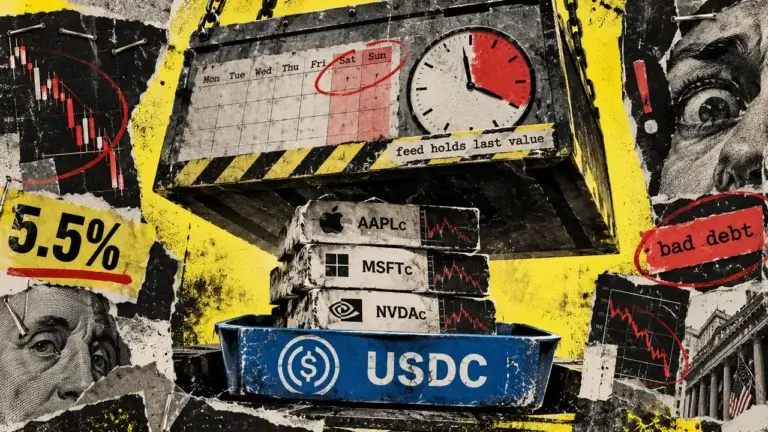
The Base hub permits up to $21 million in USDC borrowing against seven Coinbase stock tokens while their collateral feeds hold Friday's value through the weekend.
See USDC across major fiat currencies and swap the active converter instantly.
Quick SelectUsing the live USD market price. Additional fiat rates will appear after the daily sync.
USDC is a fiat-backed stablecoin issued by Circle and designed to track the U.S. dollar. USDC is a digital dollar backed by highly liquid cash and cash-equivalent assets and redeemable 1:1 for U.S. dollars under applicable terms.
USDC does not run its own blockchain. Circle issues USDC on supported public blockchains, and users transfer it through exchanges, wallets, payment apps, and decentralized finance protocols that support the relevant network. USDC is natively issued on 32 blockchain networks, and unsupported copies, wrappers, or forks should not be treated as Circle-supported USDC.
USDC is best understood as market infrastructure rather than a normal upside-focused crypto asset. It is used for dollar-denominated trading pairs, settlement, DeFi liquidity, payments, remittances, tokenized cash workflows, and cross-border transfers where supported.
For price-focused users, the key question is not whether USDC can rise like a volatile token. The key question is whether it can keep trading close to $1 across exchanges, wallets, and supported networks. USDC's risk profile depends on reserve quality, banking access, redemption rules, issuer controls, regulatory treatment, network support, and market liquidity.
| Field | Detail |
|---|---|
| Asset | USDC |
| Ticker | USDC |
| Asset Type | Fiat-backed stablecoin |
| Launch | September 2018 |
| Issuer | Circle Internet Financial, LLC and Circle Internet Financial Europe SAS |
| Parent Company | Circle Internet Group, Inc. |
| Peg Asset | U.S. dollar |
| Consensus | Not applicable |
| Mineable | No |
| Max Supply | No fixed maximum supply |
| Circulating Supply | 72.91B |
| Total Supply | 72.91B |
| Main Use Cases | Trading pairs, dollar settlement, DeFi liquidity, payments, remittances, and on-chain transfers |
| Direct Redemption | Available under Circle terms to eligible users, with different routes by jurisdiction |
| Website | Circle.com |
| Explorer | Varies by supported network |
| Whitepaper | Not applicable to the current reserve-backed issuer model |
| Main Risk Areas | Peg stability, reserve liquidity, redemption access, bank and custody exposure, issuer controls, regulation, unsupported network risk, and market confidence |
Circle launched USDC on Sep. 26, 2018 as a fiat stablecoin backed by cash reserves and pegged 1:1 with the U.S. dollar. The project originally involved Circle and the Centre open-source consortium, while Circle later brought USDC governance and operations in-house after Centre ceased to operate as a standalone entity in 2023.
USDC works through issuer-controlled minting and redemption. When eligible Circle customers deposit U.S. dollars into a Circle account, Circle can issue the equivalent amount of USDC. When eligible customers redeem USDC, Circle can remove tokens from circulation and return U.S. dollars, subject to terms, verification, fees where applicable, and legal restrictions.
Circle tokenizes USD into USDC at a rate of $1 per 1 USDC and redeems USDC for USD at the same rate, less any applicable fees. Circle does not guarantee that USDC will always trade at exactly $1 on third-party platforms, where exchange prices can move above or below the peg.
Most users do not redeem USDC directly with Circle. Circle Mint is designed for exchanges, institutional traders, banks, and large financial institutions, and individuals and everyday users typically access USDC through exchanges, neobanks, and digital wallets.
Circle publishes reserve information through a transparency process. USDC reserve holdings are disclosed weekly, with mint and burn flows, and a Big Four accounting firm provides monthly third-party assurance that reserve value is greater than the amount of USDC in circulation.
The latest reserve report covers balances as of Feb. 27, 2026. It reported 75,109,039,300 USDC in circulation and $75,176,561,300 in reserve assets at fair value, meaning reported reserve assets exceeded USDC in circulation by about $67.5 million at that reporting date.
| Reserve or Circulation Item | Amount as of Feb. 27, 2026 |
|---|---|
| USDC in circulation | 75,109,039,300 USDC |
| Fair value of reserve assets | $75,176,561,300 |
| Excess reserve assets over USDC in circulation | About $67.5 million |
The reserve report defined USDC in circulation as total USDC supply on approved blockchains minus tokens allowed but not issued, Access Denied Tokens, and Circle Gateway pending burns. That matters because exchange data, blockchain explorers, and issuer reports may treat total supply, circulating supply, and restricted balances differently.
| Reserve Category | Amount as of Feb. 27, 2026 |
|---|---|
| U.S. Treasury securities | $20,435,478,946 |
| U.S. Treasury repurchase agreements | $44,571,000,000 |
| Cash held in Circle Reserve Fund | $1,003,524,160 |
| Timing and settlement difference in Circle Reserve Fund | -$1,242,982,596 |
| Total Circle Reserve Fund assets | $64,767,020,510 |
| Other cash held at regulated financial institutions | $10,382,232,878 |
| Other timing and settlement difference | $27,307,912 |
| Total other USDC reserve assets | $10,409,540,790 |
| Total USDC reserve assets | $75,176,561,300 |
The Circle Reserve Fund is a government money market fund, and other reserve assets are held in segregated accounts at regulated financial institutions. Those segregated accounts are unencumbered and held separately from Circle's general corporate funds.
USDC held in a Circle Mint account is not covered by FDIC, SIPC, FSCS, or similar deposit insurance. That does not mean reserves are absent, but it does mean users should not treat USDC like an insured bank deposit.
Direct redemption with Circle depends on user type, jurisdiction, account access, and compliance checks. Direct Circle redemption is available only to users with a Circle Mint account in good standing, and KYC procedures are required before redeeming USDC.
Circle's EEA redemption framework is different. Circle France is licensed by France's Autorité de contrôle prudentiel et de résolution as an electronic money institution, and its MiCA redemption policy gives Circle Coins holders a right of redemption at par value, subject to the policy's conditions.
For EEA retail holders, Circle France allows users to submit a dedicated redemption request, provide required information, complete identity and transaction-monitoring checks, and provide an EEA bank account IBAN. Once the deposit and checks are complete, the redemption process should not take more than five business days unless discrepancies are identified.
| Redemption Item | Detail |
|---|---|
| Direct redemption outside the EEA | Generally tied to Circle Mint eligibility and account standing |
| Retail EEA redemption | Available through Circle France's MiCA redemption process, subject to checks |
| Circle Mint access | Mint is for institutions and is not available to individuals or small businesses |
| KYC | Required for direct redemption routes |
| Third-party access | Most users buy, sell, or transfer USDC through exchanges, wallets, and apps |
| Important limitation | Secondary-market prices can move above or below $1 |
Most retail users should think of USDC access in two layers. The first layer is exchange or wallet liquidity, where USDC can usually be bought or sold through third-party platforms. The second layer is issuer redemption, which depends on Circle's rules, user eligibility, jurisdiction, and compliance checks.
USDC is natively supported on 32 blockchain networks. The Feb. 27, 2026 reserve report lists the approved blockchains used for USDC accounting and notes that TRON support is redemption-only in that report.
| Network Support Item | Detail |
|---|---|
| Native USDC | Circle-supported USDC issued on approved blockchains |
| Supported network count | 32 native networks per Circle's multichain USDC page |
| Redemption-only note | TRON is listed as redemption-only in the Feb. 27, 2026 reserve report |
| Unsupported copies | Circle is not obligated to support copies, wrappers, or forks |
| Transfer risk | Unsupported routes, wrong networks, or incorrect addresses can result in permanent loss |
Network support can vary by exchange, wallet, and payment app. A platform may support USDC on Ethereum but not on Solana, Base, or another network. A wallet may show a USDC balance that is bridged, wrapped, or exchange-issued rather than native Circle-issued USDC. Users should verify the asset, network, address, and venue support before sending funds.
USDC transactions are irreversible, and Circle cannot reverse or recall an on-chain transfer once it is initiated. Circle is not responsible for losses caused by sending USDC to an address or platform that does not support it.
USDC is designed to track the U.S. dollar. Its market role is liquidity and settlement, not price appreciation. The main questions are whether the peg holds, what backs the token, how redemptions work, and which networks support transfers.
| Stablecoin Item | Detail |
|---|---|
| Peg Asset | U.S. dollar |
| Peg Type | Fiat-backed reserve model |
| Issuer | Circle Internet Financial, LLC and Circle Internet Financial Europe SAS |
| Reserve Reporting | Weekly reserve disclosures and monthly third-party assurance reports |
| Direct Redemption | Conditional, based on user type, jurisdiction, and Circle terms |
| Supported Networks | 32 native networks per Circle, with venue support varying by platform |
| Main Risks | Reserve liquidity, banking access, redemption access, regulation, issuer controls, unsupported networks, and depeg risk |
USDC is often compared with Tether's USDT because both are large U.S. dollar stablecoins. The difference is not simply “which one is safer.” The better comparison is how each issuer handles reserves, disclosures, redemption access, supported networks, regulatory exposure, exchange liquidity, and issuer controls.
On Apr. 28, 2026, the total stablecoin market cap was about $320.398 billion and USDT dominance was 59.20%. That context matters because USDC's usefulness depends partly on its liquidity relative to other stablecoins and partly on where exchanges, DeFi protocols, wallets, and payment apps support it.
USDC's biggest asset-specific risks are peg stability, reserve liquidity, redemption access, bank and custody exposure, issuer controls, regulation, and unsupported network transfers. USDC is designed to hold a $1 peg, but its secondary-market price can move during periods of banking stress, exchange disruption, liquidity imbalance, or uncertainty about redemption access.
The 2023 Silicon Valley Bank episode remains important peg-risk context. Circle was unable to access $3.3 billion of USDC reserves at SVB, equal to about 8% of total reserves at the time, which sparked redemption requests and caused USDC to lose its peg on secondary markets. USDC traded as low as 86 cents during the episode before recovering after official intervention and resumed redemption processing.
Issuer controls are also central to USDC's risk profile. Circle may block certain USDC addresses, freeze associated USDC in Circle-custodied addresses, report suspected illegal activity to law enforcement, and freeze or surrender associated USD if required by a valid government order.
This control layer can support compliance and law-enforcement response, but it also means USDC is not censorship-resistant in the same way as non-issuer-controlled crypto assets. Users should also distinguish Circle-supported native USDC from bridged, wrapped, copied, or forked versions that may carry additional smart-contract, bridge, or issuer risk.
USDC price prediction should be understood as peg outlook, not upside forecasting. USDC is designed to trade close to $1, so the relevant question is whether it can maintain stable convertibility and deep market liquidity across exchanges, wallets, and supported networks.
The strongest USDC-specific signals are reserve composition, reserve assurance reports, redemption demand, bank and custody arrangements, exchange liquidity, supported-network reliability, issuer controls, and regulatory treatment. For a dollar stablecoin, a strong outlook means continued peg stability, reliable access, transparent reserves, and broad support across major venues.


USDC is a fiat-backed stablecoin issued by Circle and designed to track the U.S. dollar. It is commonly used for trading pairs, settlement, DeFi liquidity, payments, remittances, and on-chain transfers. USDC is backed by highly liquid cash and cash-equivalent assets.
USDC’s peg depends on reserve backing, market liquidity, redemption access, and confidence in Circle’s ability to issue and redeem USDC. Circle redeems eligible USDC at $1 per token under its terms, but USDC can still trade above or below $1 on third-party platforms during market stress.
USDC is used as a dollar-denominated trading asset, settlement token, DeFi liquidity asset, payment rail, remittance tool, and treasury-management asset. Its usefulness depends on exchange liquidity, supported networks, wallet compatibility, issuer redemption rules, and whether users can move it safely through the correct chain.
USDC is backed by highly liquid cash and cash-equivalent assets. The Feb. 27, 2026 reserve report showed 75,109,039,300 USDC in circulation and $75,176,561,300 in reserve assets at fair value. That report was a point-in-time assurance report, not deposit insurance.
Direct redemption depends on user type, location, Circle account access, and compliance checks. Circle Mint is generally for institutions, not individuals or small businesses. In the EEA, Circle France provides a MiCA redemption route for eligible holders, subject to identity, transaction-monitoring, and bank-account checks.
USDC is natively supported on 32 blockchain networks. Support still varies by exchange, wallet, and app, so users should confirm the correct asset, network, contract, and address before sending USDC. Unsupported transfers can result in permanent loss.
Yes. Circle may block certain USDC addresses, freeze associated USDC in Circle-custodied addresses, and freeze or surrender associated USD when required by a valid legal order. This issuer-control feature is an important difference between USDC and non-issuer-controlled crypto assets.
No. USDC does not have a fixed maximum supply. Supply changes when Circle issues USDC, redeems USDC, burns tokens, holds tokens that are allowed but not issued, or restricts balances through Access Denied Tokens. These categories can make reported supply figures differ across data providers.
CryptoSlate does not provide investment advice. USDC is designed for dollar stability, liquidity, and settlement rather than price appreciation. Users should focus on peg stability, reserve quality, redemption access, issuer controls, supported networks, regulatory treatment, custody risk, and transfer accuracy before holding or sending USDC.
As of Oct 12, 2026, USDC trades at $1.00.
USDC has a market capitalization of $72,901,451,939.96.
USDC has a 24-hour trading volume of $13,277,586,840.00.
USDC reached an all-time high of $2.35, recorded on Nov 16, 2021. It is currently 57.45% below its all-time high.
USDC recorded an all-time low of $0.88, recorded on Mar 11, 2023. It is currently 13.95% above its all-time low.
Circle (Circle Internet Group, Inc.) is a U.S.-based financial technology company that issues fiat-backed stablecoins and provides open infrastructure for blockchain-based payments.


