Part 1 Advanced The Market Maker’s Exchange Checklist (Liquidity, Latency, and Risk Controls) Market makers and HFT desks: evaluate exchanges on execution quality, liquidity, latency, fees, margin, and security — with a WhiteBIT walkthrough. Open guide KAST Card Crypto Card Review
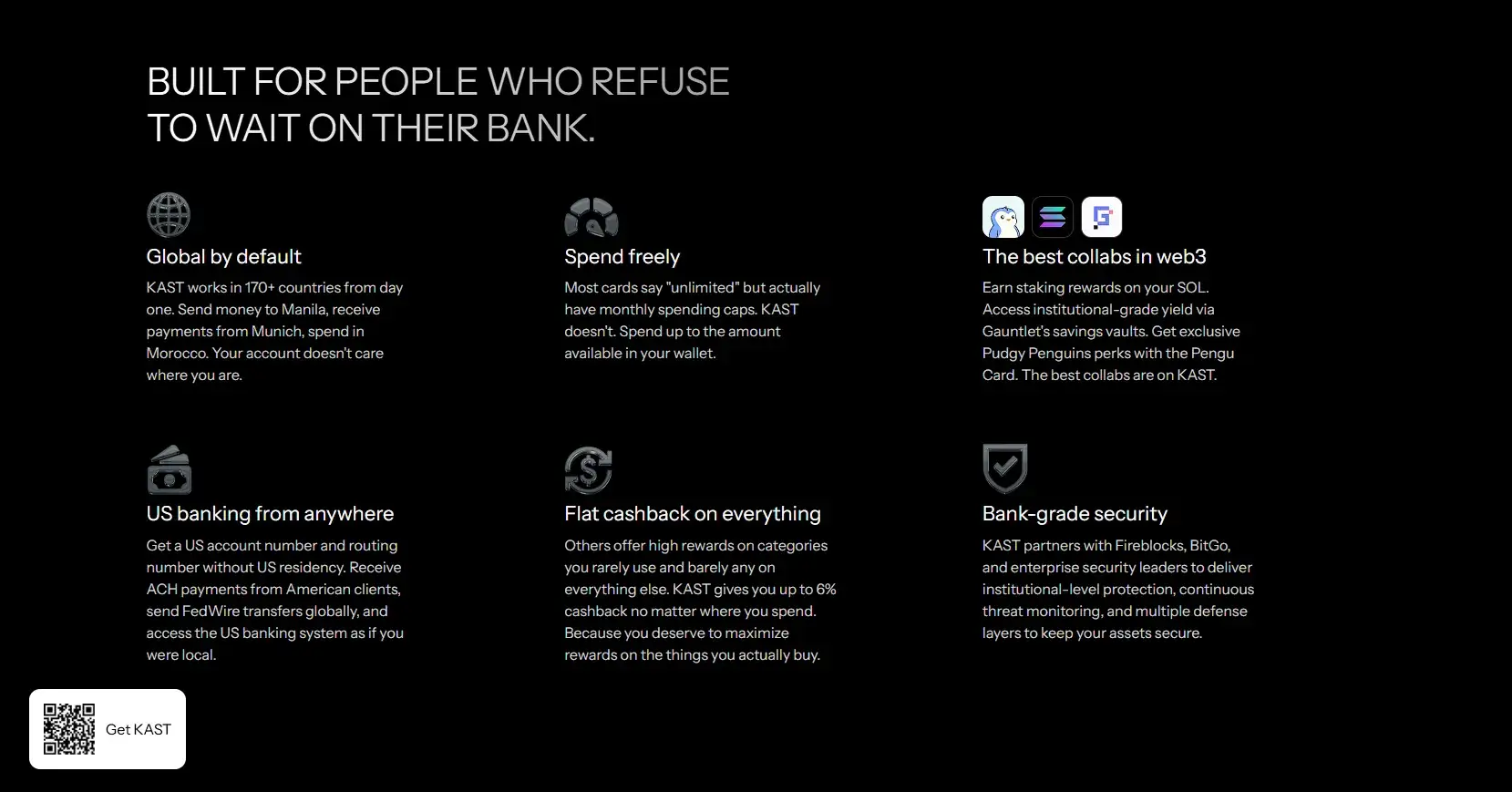
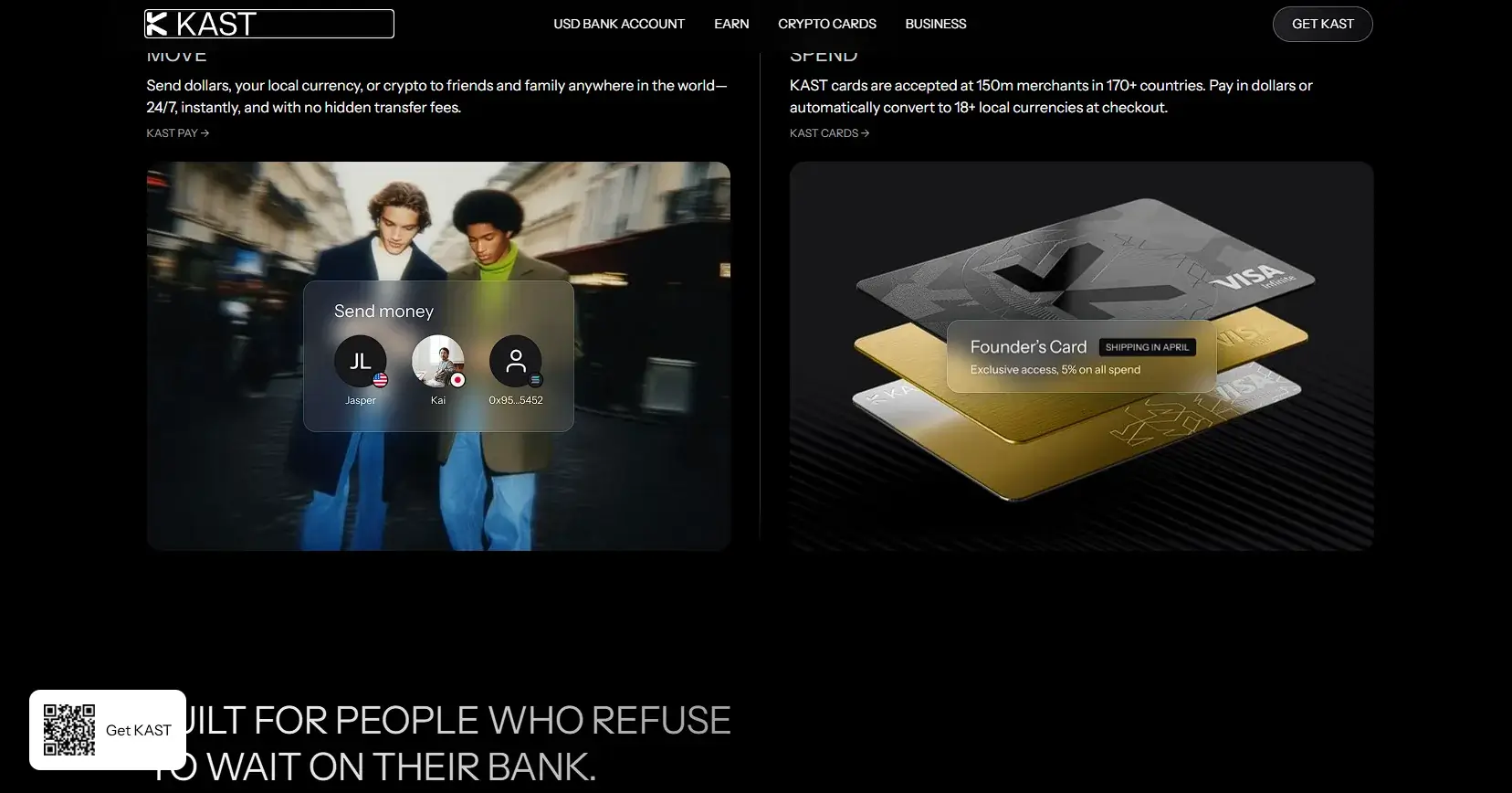
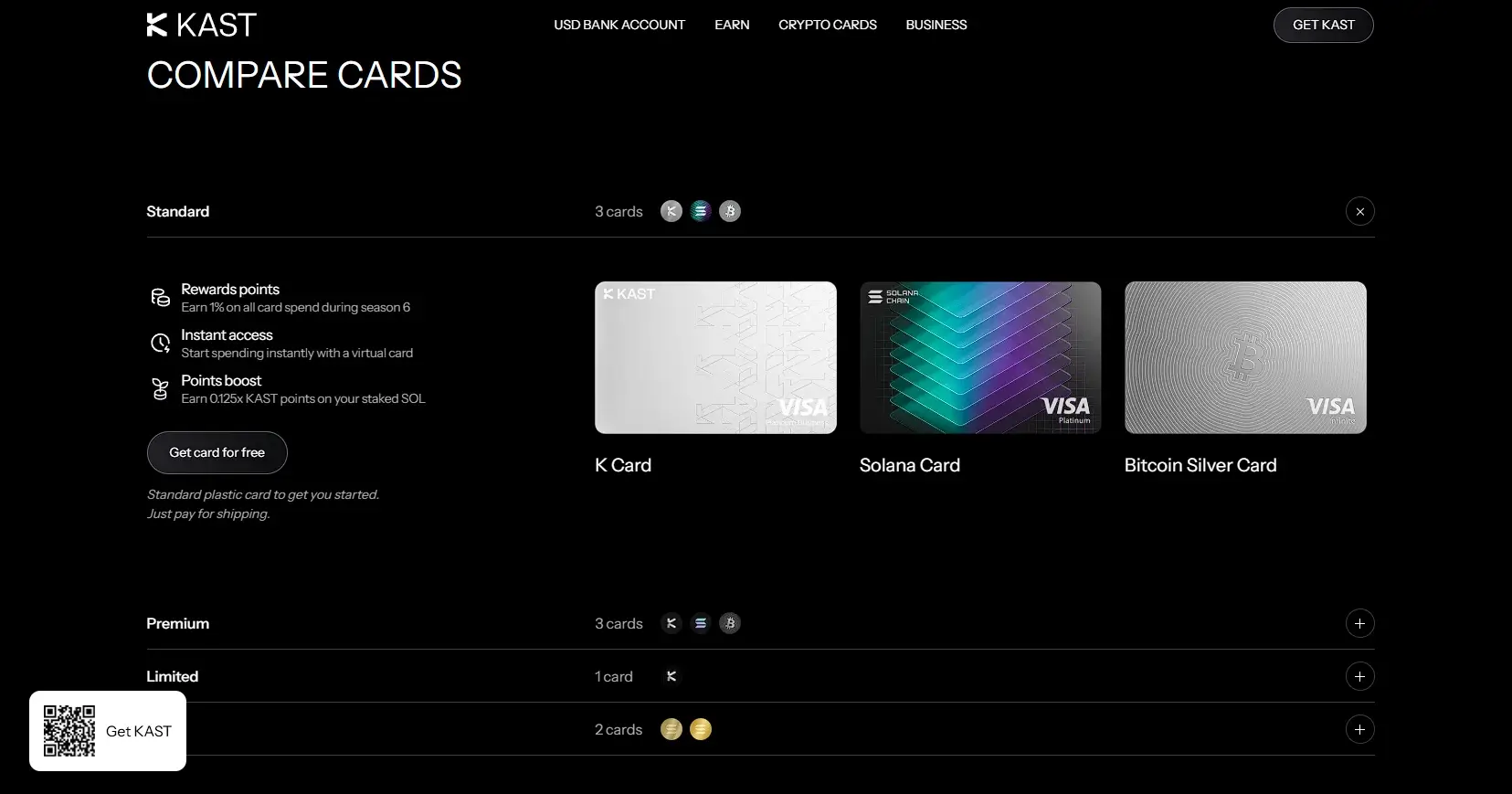
KAST Card is a custodial prepaid Visa card that lets you fund a USD-denominated balance with stablecoins and selected crypto. It offers a virtual card, Apple Pay and Google Pay support, and physical card delivery to 170+ countries. The catch is that deposited crypto is converted into KAST's internal balance instead of remaining under your control.
Not available in your region
Kast Card is unavailable in your region.
Kast Card Overview
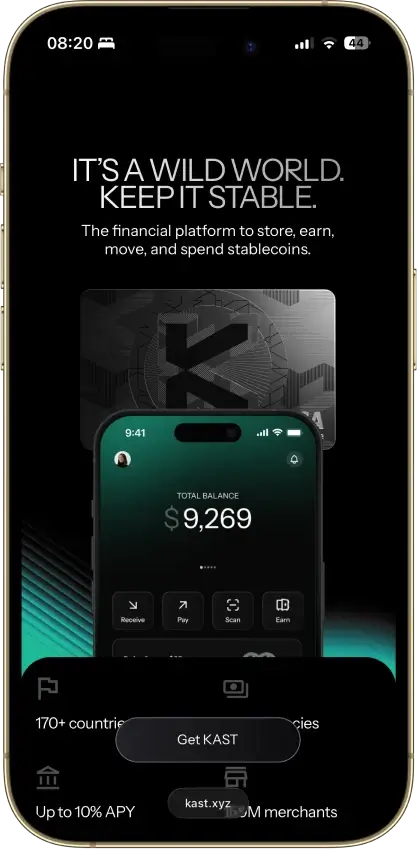
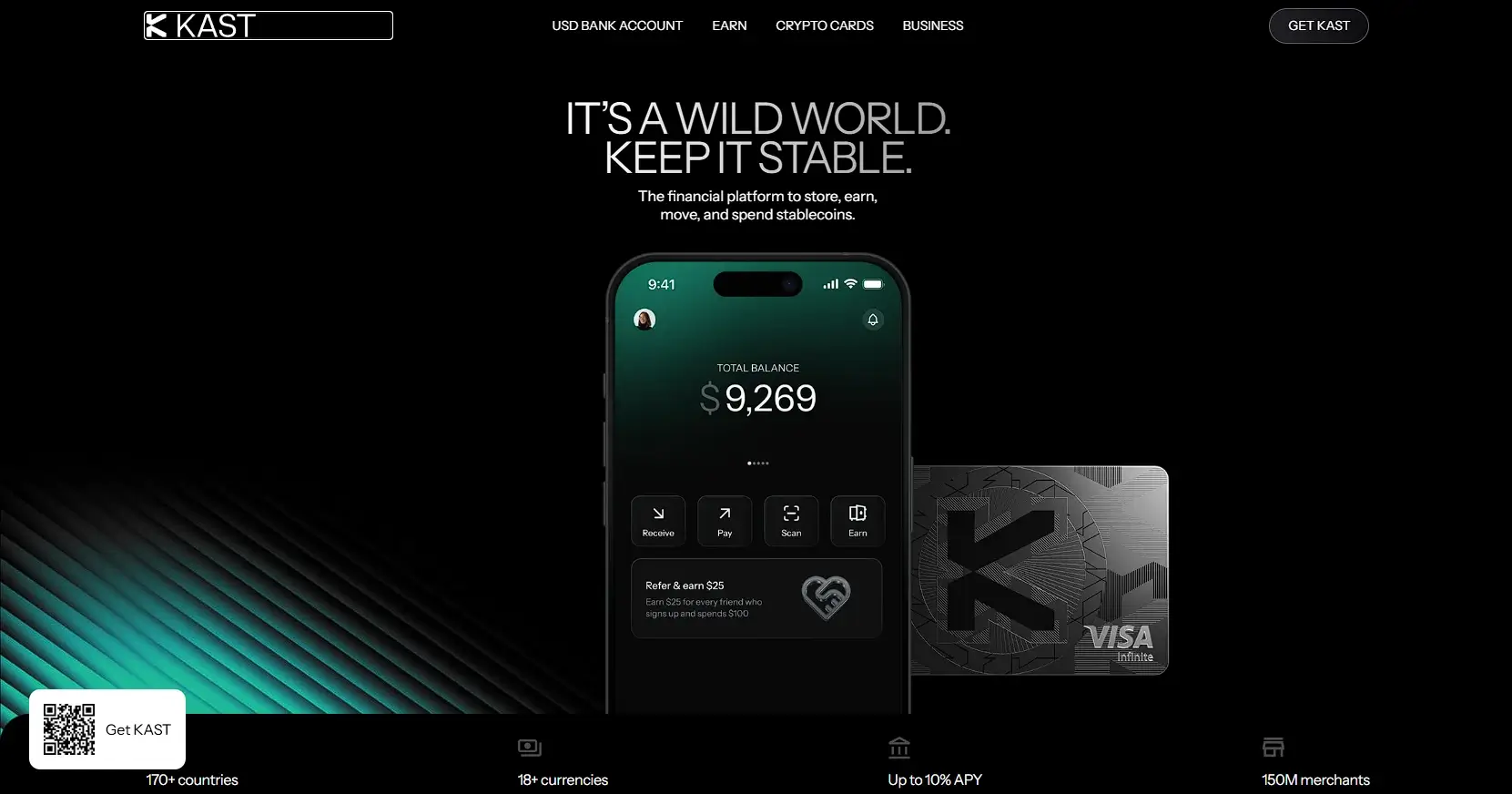
Kast Card Screenshots

Kast Card Pros and Cons
Pros
- Instant virtual card for fast setup
- Apple Pay and Google Pay work from the start
- Stablecoin deposits come in at 0% fee
- Broad network support for stablecoin and crypto funding
- Standard tier keeps entry cost low
Cons
- Deposited crypto is treated as sold to KAST
- Full KYC and partner approval can block access
- Non-USD spend adds a 0.5% to 1.75% FX fee
- ATM cash access needs a physical card and costs $3 plus 2%
- Premium tiers are expensive for what most users get
Who KAST Is Best For — And Who Should Skip It

KAST fits best when the goal is simple spending access rather than direct asset control.
| User Type | Fit | Why |
|---|---|---|
| Everyday Spender | Medium | Works well for daily purchases, but fees and custody trade-offs stay in the background |
| Traveler | High | Visa reach, multi-currency checkout, and physical ATM access make it more usable abroad than many crypto cards |
| Stablecoin User | High | Stablecoin deposits are the cleanest funding path and avoid the extra auto-conversion fee charged on non-stable tokens |
| Self-Custody Wallet User | Low | Funds move into a custodial model and no longer remain user-owned crypto inside the card flow |
| Cashback Hunter | Medium | Rewards can look strong, but upper tiers cost a lot and perks are tied to seasonal programs and internal rewards |
| Heavy Spender | High | KAST discloses no account balance, deposit, or card transaction cap across tiers |
| Low-KYC User | Low | Access to regulated services depends on identity checks and ongoing compliance review |
| User Who Wants Simple Taxes | Low | Deposits, conversions, and internal balance handling create more record-keeping than a plain fiat card |
KAST fits freelancers, remote workers, and crypto-native users who already keep significant capital in stablecoins. It also makes sense for those who want one app for card spend, mobile wallet use, payouts, and basic account-style money movement.
Those who want self-custody, simple tax treatment, or lower-cost rewards have better-fit alternatives.
What This Card Actually Is and How Spending Works
KAST behaves like a prepaid card, but it runs as credit at checkout because payment networks classify prepaid cards that way for merchant compatibility. You load value into the KAST ecosystem first, then spend against that balance through a Visa virtual or physical card.

The card comes in both virtual and physical form. Users fund KAST through crypto deposits, bank transfer, or payment link, then spend from the KAST-held balance rather than from a self-custody wallet.
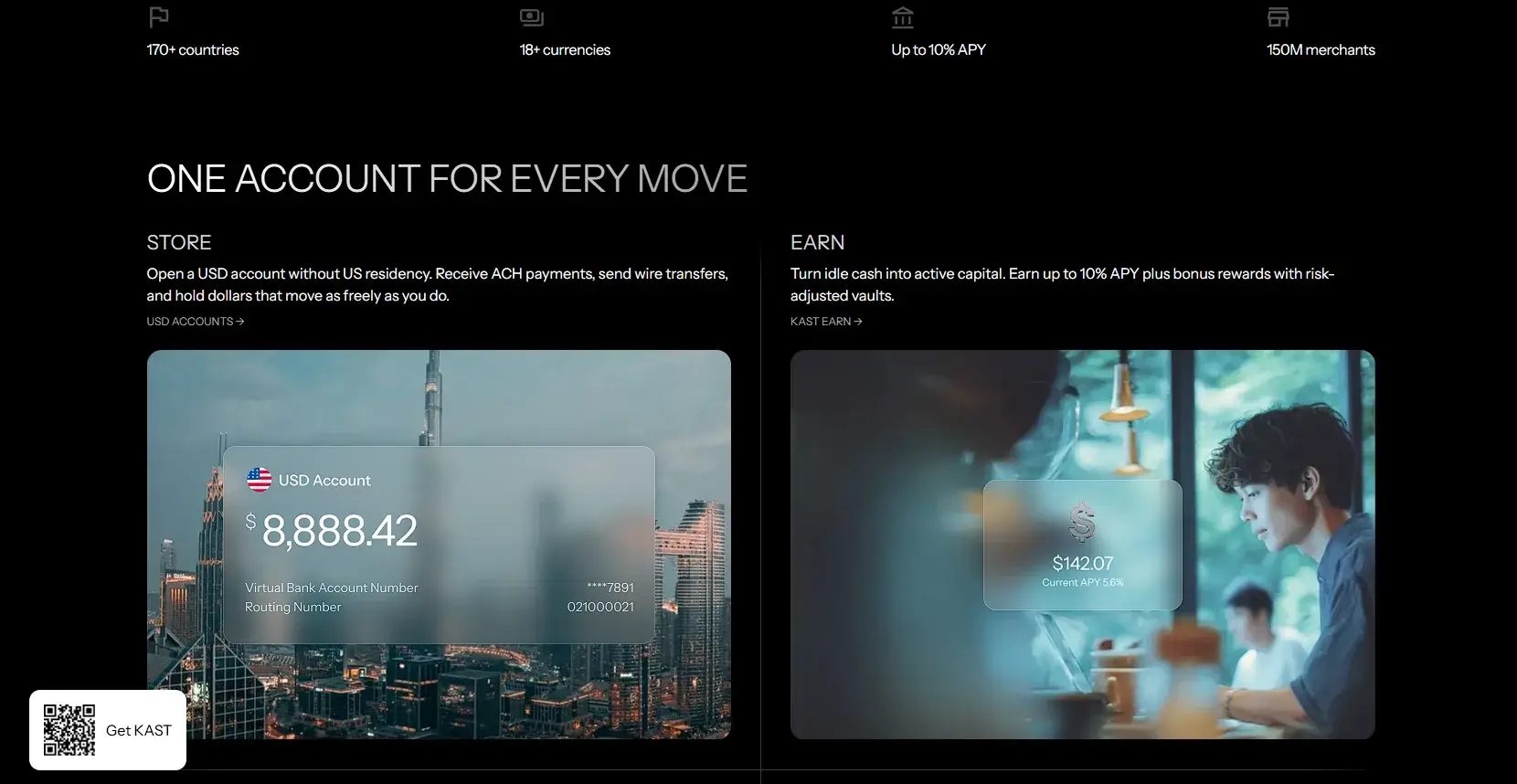
Stablecoin deposits are reflected as a USD-denominated balance inside the app. Non-stablecoin deposits are auto-converted and can carry a 2% to 5% fee.
The card works best for daily spend, travel, online checkout, and subscriptions rather than occasional one-off use.
KAST sits between your crypto and the merchant. You send assets in, KAST converts them into an internal USD balance, and the card draws from that balance when you spend.
Availability, KYC and Setup Friction

KAST Card setup depends on clearing country, partner, and identity checks. Your country, partner coverage, and identity check speed determine how fast card access opens.
The real drag comes from residency support, partner-level approval, and compliance checks that can push a fast virtual-card flow into a slower verification process.
Funding Rails, Supported Assets and Conversion Path

Token variety matters less than how much friction sits between the deposit and a spendable balance. The key factors are network support and conversion cost.
| Funding Rail | Supported Assets | Typical Speed | Main Friction |
|---|---|---|---|
| Bank Transfer | USD via bank transfer to the KAST USD account; local deposit/payout rails vary by country | Same day to 5 business days | Bank settlement times, partner coverage, and fiat routing rules |
| Debit Or Credit Top-Up | Not Supported | Not Applicable | No disclosed direct card top-up rail |
| Exchange Balance | Supported indirectly through exchange withdrawals to KAST-supported networks | Minutes to network dependent | Must withdraw the correct token on the correct chain |
| Onchain Stablecoins | USDT, USDC, USDe, PYUSD, and RLUSD on selected supported networks | Seconds to minutes, depending on chain | Network support differs by token and wrong-chain transfers can fail |
| Other Crypto Assets | BTC, ETH, SOL, XRP, BNB, and other supported crypto can be deposited, but non-stablecoin deposits auto-convert before spending | Minutes to confirmation dependent | Assets do not stay as like-for-like spend balances and may convert on entry |
| Fiat Wallet Or Cash Balance | KAST USD-denominated app balance | Instant once funds are already settled in KAST | Balance depends on prior funding, not direct cash loading |
For most crypto-native use, onchain stablecoins are the most practical rail because they keep the funding path short and predictable. Stablecoins reduce extra conversion drag, while the biggest friction sits in chain support, manual network matching, and the rules around how non-stable assets are converted once they enter the card flow.
Rewards, Perks and The Catch

The reward rates look good until you account for tier cost, promo conditions, and token exposure. KAST combines internal points, token rewards, and tier boosts. Real value depends on plan cost, promo timing, and comfort with token exposure.
| Reward Or Perk | Value | Unlock Condition | Catch |
|---|---|---|---|
| Base Cashback | 2% in KAST Points on Standard during Season 5 | Use the Standard card for eligible spend | Paid in internal points, not cash, and tied to a seasonal program |
| Boosted Cashback | 5% in KAST Points on Premium and Limited, 8% on Luxe; eligible spend may also earn 4% in $MOVE tokens | Pay for a higher-tier card and make eligible purchases | Higher tiers are expensive, token exposure stays with the user, and promo terms can change |
| Travel Perks | Not Supported | Not Applicable | No lounge, hotel, airline, or travel-credit package is disclosed |
| Subscription Perks | Not Supported | Not Applicable | No bundled streaming, software, or recurring-service credits are disclosed |
| Referral Or Welcome Offer | 200 KAST Points after first $100 spend; additional promos may apply | Complete the qualifying spend or referral action | Offer value, eligibility, and country coverage can change by campaign |
The free tier can still be worth it if you planned to use the card anyway and do not treat the points like cash. Premium, Limited, and Luxe are much harder to justify unless you spend a lot, want the extra status perks, and are fine getting value in KAST Points and tokens.

Fees and Total Cost
The Standard tier costs nothing to start, but fees add up once you use non-stablecoin funding or spend outside USD.
| Cost | What Users Pay | When It Hits | Notes |
|---|---|---|---|
| Monthly Or Annual Fee | Standard $0; Premium $1,000/year; Limited $5,000 one time; Luxe $10,000/year | On plan selection or renewal | Upper tiers raise reward rates but add heavy fixed cost |
| Issuance Or Replacement Fee | First two virtual cards free, then $2 each; Standard physical card free plus $40 shipping; additional physical cards cost more by tier; replacement fee not disclosed | When ordering cards | Entry is cheap on Standard, but premium card ownership is not |
| Conversion Or Spread Cost | Stablecoin deposits convert to USD at 1:1 with 0% spread; non-stablecoin deposits auto-convert with a 2% to 5% fee | When funding with crypto that is not a supported stablecoin | The biggest conversion drag shows up before spending, not at checkout |
| FX Fee | 0.5% to 1.75% | On non-USD purchases and non-USD ATM withdrawals | Exact rate depends on residence and transaction country |
| ATM Fee | $3 plus 2% per withdrawal, plus operator fees | Every ATM withdrawal | Cash access is one of the more expensive parts of the product |
| Top-Up Fee | 0% for supported stablecoin deposits; ACH deposit $2; FedWire deposit $15 | When funding the account | Card top-up looks cheap only on the right rail |
| Inactivity Fee | $1 per month after 12 months of dormancy | On dormant accounts with available balance | Easy to miss if you stop using the card |
| Network Or Gas Fee | Stablecoin withdrawals carry chain-based fees, such as $1 plus 0.1% on Solana, $0.20 plus 0.1% on Arbitrum, $6 plus 0.1% on Ethereum, and $5 plus 0.1% on Tron | When moving funds out onchain | Not a swipe fee, but part of the real enter-exit cost |
| Declined Transaction Fee | $0.50 | On declined transactions due to insufficient balance | Applies on all forms of transactions |
Ordinary USD card spend is the cheapest path. Costs rise with non-stable crypto funding, non-USD purchases, ATM withdrawals, or premium tiers.

Limits, Speed and Cash Access
KAST is fast when you stay inside its own app balance and use the virtual card. Speed drops once physical card shipping, bank settlement, merchant holds, or ATM withdrawals are involved.
Approval can be fast because the virtual card appears quickly once onboarding clears. Funding speed depends on the rail, spending can be fast once the balance is live, and cash access remains the slowest part because it depends on the physical card, ATM caps, and withdrawal fees.
Security, Custody and Trust
The main trust sits with KAST and its partners. Once assets enter the card flow, they are treated as sold to KAST, handled through partner custody and payment providers, and shown in the app as a USD-denominated obligation rather than a bank deposit or user-controlled crypto balance.
The main risk is custody and issuer dependence. Card-level risks like fraud or declines are secondary. Self-custody is not part of the spending setup, and if the account is restricted or flagged for compliance, KAST and its partners can freeze access, limit transactions, or require more checks before funds move. Device access, login security, and phishing remain relevant risks regardless of the custody model.
There is also a merchant-use risk that goes beyond an ordinary decline. KAST Card should not be used for banned or high-risk merchant categories such as weapons, firearms, ammunition, knives and related accessories, controlled substances, prescription drugs, steroids, counterfeit goods, fake IDs, darknet or Tor marketplaces, adult content, pseudo-pharmaceuticals, and businesses tied to fraud, money laundering, terrorism financing, pyramid schemes, or multi-level marketing programs. A payment can be flagged even when the merchant appears legitimate, if the merchant category or transaction pattern matches a restricted use case.
The risks are broader than a single failed payment. A flagged transaction can lead to a blocked purchase, extra KYC or source-of-funds checks, a temporary account freeze, card suspension, asset restrictions, forced review by a partner, chargeback complications, account closure, or a permanent ban from the service. If KAST or a partner believes the activity breaks card-network rules, sanctions controls, AML checks, or platform terms, they can also stop future transactions and keep the account limited until the review is complete.

Customer Support, Refunds and Chargebacks
KAST's help center covers most common questions well. Human resolution is slower and depends on the issue type. That gap shows up most when a deposit is missing, a card payment is disputed, or a merchant hold ties up usable balance.
- Help center coverage is solid on fees, limits, declines, funding, and wallet support.
- Human help runs through Concierge and email support.
- Support can help with card status, missing deposits, declines, KYC questions, and dispute intake.
- Chargebacks and card disputes must follow card-network rules and usually need receipts or other evidence.
- Users get a 90-day window to raise card disputes.
Support handles account guidance and standard card issues. Resolution slows when the block is on the merchant, card-network, blockchain, or partner compliance side.

Taxes, Statements and Record-Keeping
Record-keeping is manageable if you mostly fund with stablecoins, but it gets much more complex once you use volatile crypto, move funds across chains, and collect token-based rewards. Spending can create a taxable disposal in many jurisdictions, since assets are converted before the card is used. Stablecoin funding simplifies this but does not eliminate the need to track entries, conversions, and fees.
The reporting burden still sits mostly with the user. KAST provides Statements of Account that can be generated on demand and exported as PDF or CSV. KAST does not provide official tax reports, country-specific tax forms, dedicated tax CSVs, or automated capital-gains calculations.
Final Verdict
The card works well within a narrow lane. Fund it with stablecoins, spend in USD, and the experience is fast and low-friction: virtual card ready in minutes, Apple Pay and Google Pay from day one, broad Visa acceptance. Step outside that lane and costs start stacking. Non-stablecoin deposits get auto-converted at a fee, ATM withdrawals are expensive, and non-USD spend adds FX charges on top. The custody model is the bigger thing to absorb: deposited crypto is treated as sold to KAST, so there is no self-custody option once funds are in. Premium tiers exist but are hard to justify for most users. It suits stablecoin-heavy freelancers and remote workers who want straightforward global spend access.
Overall Score
7.5PROS
- Instant virtual card for fast setup
- Apple Pay and Google Pay work from the start
- Stablecoin deposits come in at 0% fee
- Broad network support for stablecoin and crypto funding
- Standard tier keeps entry cost low
CONS
- Deposited crypto is treated as sold to KAST
- Full KYC and partner approval can block access
- Non-USD spend adds a 0.5% to 1.75% FX fee
- ATM cash access needs a physical card and costs $3 plus 2%
- Premium tiers are expensive for what most users get

Disclaimer: CryptoSlate may receive a commission when you click links on our site and make a purchase or complete an action with a third party. This does not influence our editorial independence, reviews, or ratings, and we always aim to provide accurate, transparent information to our readers.
FAQ
Is KAST card a real credit card, a debit card, or a prepaid card?
KAST Card works like a prepaid card. You load value into KAST first, then spend from that balance through a Visa card. It does not work like a normal revolving credit card.
Is KAST card available in my country?
KAST markets the card in 170+ countries, but access still varies by jurisdiction. The real check happens during onboarding and KYC. If your country is unsupported or a partner cannot approve your account, card access may not go through.
Does KAST card let me spend USDC or other stablecoins?
Yes, stablecoins are one of the cleanest ways to fund KAST. Supported stablecoin deposits are converted into the app’s USD-denominated balance and then spent through the card. That is different from paying straight from a self-custody wallet.
Does using KAST card create a taxable event?
It can. In many jurisdictions, converting crypto or stablecoins into a spendable balance can count as a disposal or taxable conversion event. The exact treatment depends on where you file taxes and what asset you used to fund the card.
Does KAST card work with Apple Pay or Google Pay?
Yes. KAST supports Apple Pay and Google Pay. That makes the instant virtual card much more useful because you can start spending before a physical card arrives.
Can I use KAST card for travel, hotels, or ATM withdrawals?
It works well for ordinary travel spending and supports ATM withdrawals on the physical card. Hotels, fuel stations, and car rentals are less clean because prepaid cards can run into bigger pre-authorization holds or merchant restrictions. ATM access is also capped and carries extra fees.
What happens if a merchant refunds me or I need a chargeback?
Refunds usually depend on the merchant first, then the card-network process after that. KAST can take in a dispute or chargeback request, but users need to follow the card-network process and provide evidence when required. Timing can be slow, especially if the merchant or partner review is the bottleneck.
Do I need to stake or hold a token to get the best rewards?
You do not need staking to get the base Standard reward rate. But the best reward rates sit on paid tiers, and KAST also offers extra points tied to staked SOL. That means the top-end reward picture depends on both plan cost and token exposure.