Explore CryptoSlate’s Institutional Playbook, a 3-part guide series on exchange due diligence, crypto-as-a-service, and token listing strategy for institutional teams.
Explore CryptoSlate’s Institutional Playbook, a 3-part guide series on exchange due diligence, crypto-as-a-service, and token listing strategy for institutional teams.
The U.S. financial market is witnessing a unique phenomenon: the convergence of yields across three major asset classes.
Treasury yields, corporate bond yields, and the S&P 500 yield converged in a tight range around 5%.
This is a rare occurrence and a significant indicator of market sentiment. The effects of this convergence will not be confined to the U.S. financial market but will also permeate the crypto market, particularly Bitcoin (BTC).
In this report, CryptoSlate dives deep into this phenomenon, exploring its implications for the crypto market.
Treasury bills
U.S. Treasury bills, often called T-bills, are short-term debt obligations issued by the U.S. government. They’re a fundamental component of the financial market, serving as a benchmark for various types of credit and investment instruments. T-bills are backed by the full faith and credit of the U.S. government, making them one of the safest investments available on the market.
The yield of a Treasury bill is a measure of the return investors will receive by holding the bill until maturity. It’s calculated by comparing the purchase price of the bill to its face value. The yield serves as an essential market indicator, reflecting the cost of borrowing for the government and, by extension, the overall health of the economy.
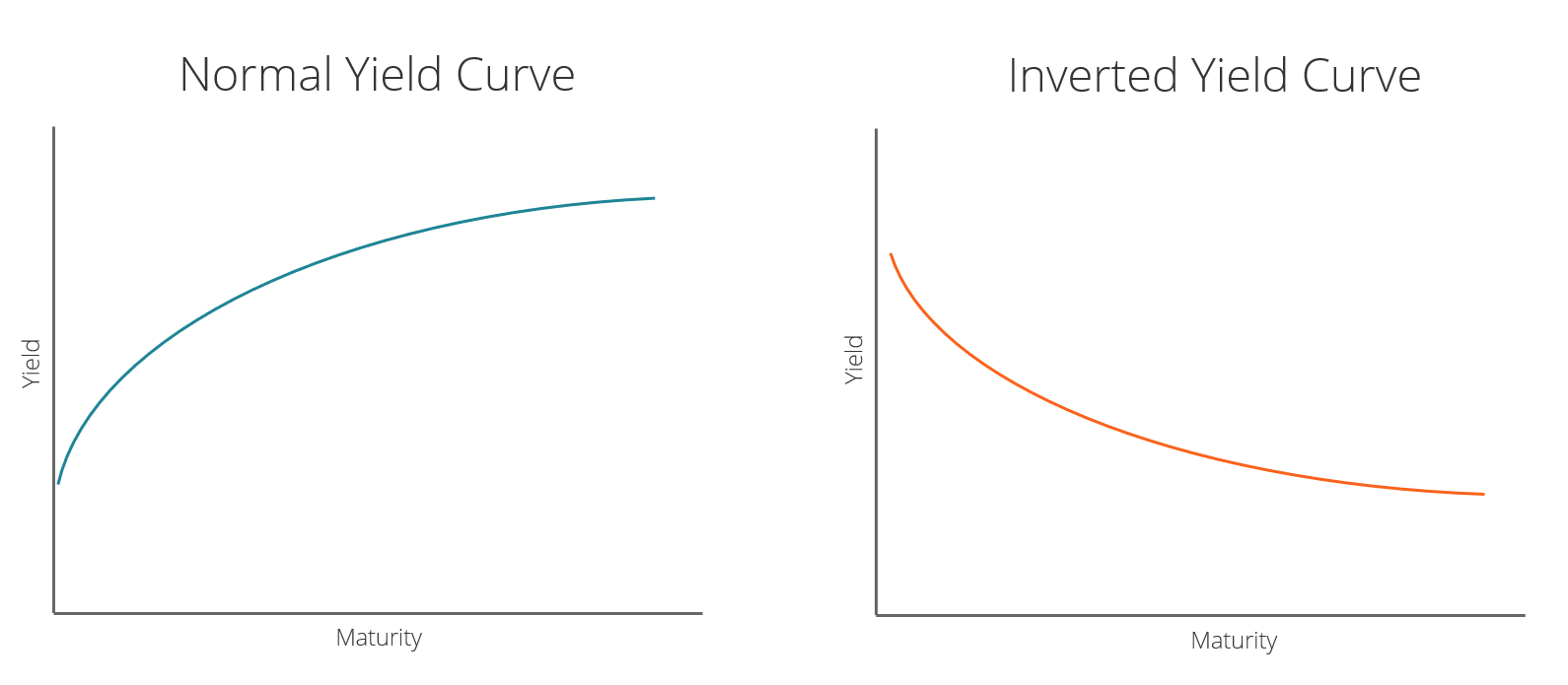
One of the most critical tools for interpreting Treasury yields is the yield curve, a graphical representation of the yields on debt for a range of maturities. It shows the relationship between the interest rate (or cost of borrowing) and the time to maturity of the debt for a given borrower.
Under normal circumstances, the yield curve is upward-sloping, meaning that longer-term Treasury bills have a higher yield than shorter-term ones. This is because investors demand a higher return for locking up their money for an extended period, compensating for the greater risk of inflation and other uncertainties over time. This is known as a normal or positive yield curve.
However, the yield curve can become inverted, with shorter-term yields becoming higher than longer-term ones. This is often seen as a warning sign in the economy, as lower demand for short-term bills indicates a lack of confidence among investors in the stability of the U.S. economy.
Graph showing an example of a normal and an inverted yield curve (Source: Corporate Finance Institute)
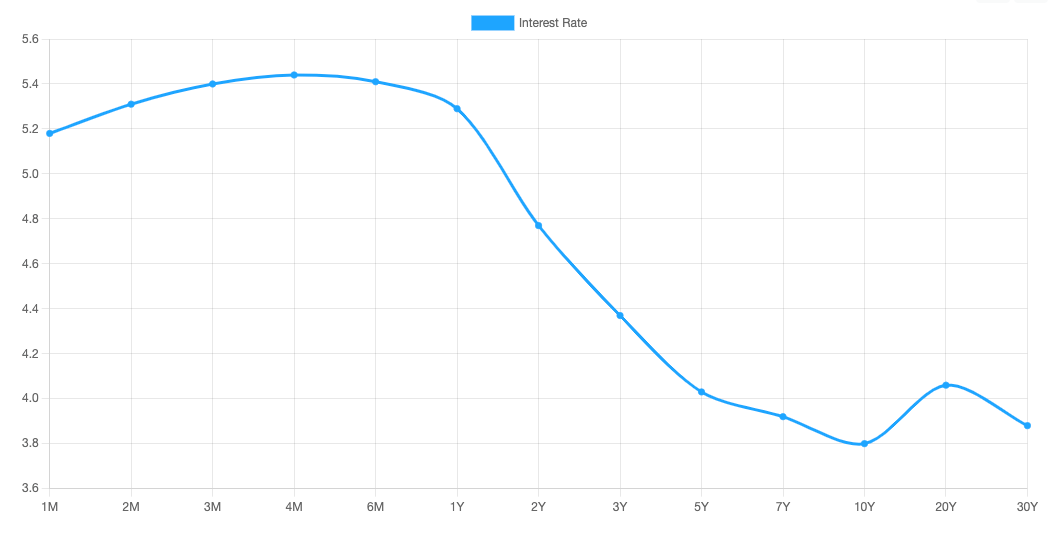
The Treasury bill yield curve currently stands inverted. The three-month Treasury bill yield is 5.4%, while the 12-month and 30-year yields are 5.29% and 3.8%, respectively. This inversion signals that investors see a higher risk in holding short-term bills than holding long-term bills.
Graph showing the U.S. Treasury yield curve on June 22, 2023 (Source: U.S. Treasury Yield Curve)
Corporate bonds
Corporate bonds are a type of debt security that corporations issue to raise capital. Corporate bonds are integral to the financial market, providing corporations with the necessary funds for various business activities.
However, the importance of corporate bonds extends beyond the corporations that issue them. They’re a vital indicator of the overall health of the market. The yields on corporate bonds reflect the risk associated with the issuing corporation and the overall economic environment. Higher yields typically indicate a higher perceived risk of default by the corporation, while lower yields suggest a lower risk.
Investors often turn to corporate bonds as they typically offer higher yields than government bonds, compensating for the additional risk associated with corporate solvency. The yield on a corporate bond is the return an investor can expect to earn if the bond is held to maturity. It is calculated based on the bond’s purchase price and its interest payments.
As of June 23, 2023, Moody’s Seasoned Baa Corporate Bond Yield, measuring the yield on relatively low-risk, investment-grade bonds, stood at 5.68%.
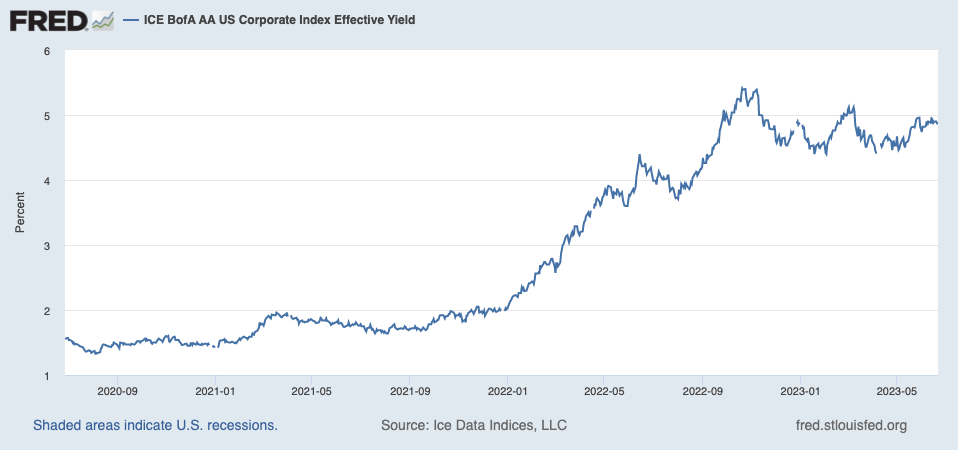
The ICE BofA A.A. U.S. Corporate Index, measuring the average yield on AA-rated corporate bonds, stands at 4.86%.
Graph showing the ICE BofA A.A. U.S. Corporate Index from June 2020 to June 2023 (Source: St. Louis Fed)
The current state of corporate bonds, with yields hovering around 5%, indicates robust demand for these securities. This demand reflects investors’ willingness to take on higher risk in exchange for higher returns.
S&P 500
The S&P 500 is a stock market index that measures the performance of 500 large companies listed on U.S. stock exchanges. It’s one of the most widely recognized indices globally and is a key benchmark for the overall U.S. stock market.
The importance of the S&P 500 extends beyond its role as a performance measure. It’s a critical economic indicator reflecting the health of the U.S. economy and investor sentiment and can influence financial markets worldwide.
The S&P 500 is market-cap-weighted, meaning that each company’s influence on the index’s value is proportional to its market value. Therefore, larger companies have a more significant impact on the index’s performance.
This weighting method makes the S&P 500 a reliable gauge of large-cap U.S. equities. In 2023, the S&P 500 has experienced substantial growth, driven mainly by a handful of tech giants. Tesla, NVIDIA, Apple, Microsoft, and Amazon contributed significantly to its performance, while the rest of the index experienced little to no growth.
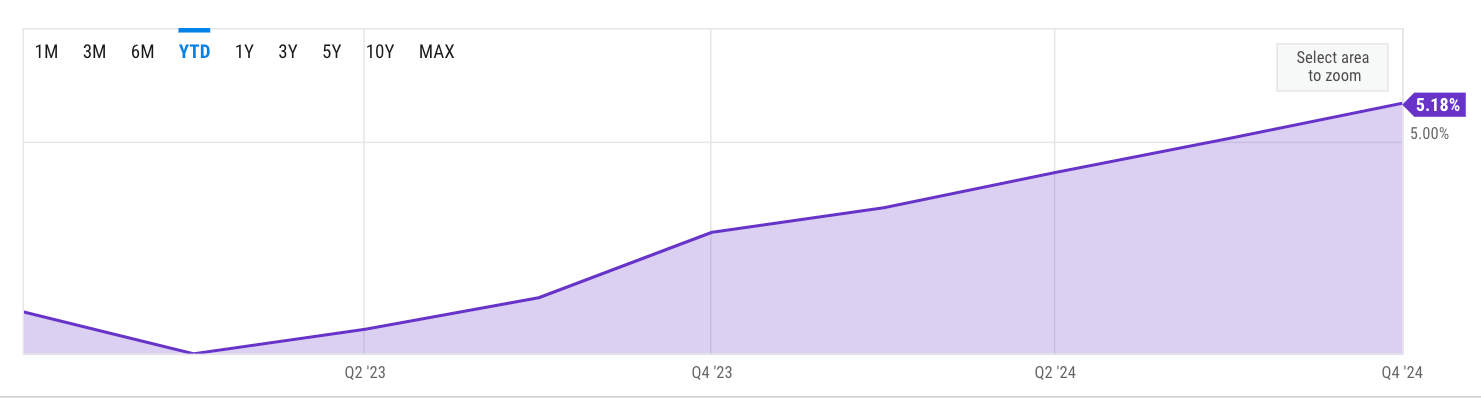
The 12-month forward earnings yield, which is the reciprocal of the price-to-earnings ratio, is another critical measure of the S&P 500’s value. It estimates the earnings investors can expect to receive for each dollar invested in the index over the next year and stands at approximately 5.18% as of June 23.
Data from YCharts showed that this is significantly higher than the long-term average of 4.41% and last quarter’s 5%.
This yield reflects the market’s expectations for corporate earnings growth and can influence investment decisions across various asset classes.
Yield convergence
Yield convergence is a term that describes a situation where the yields on different types of assets, such as corporate bonds, Treasury bills, and equity indices, move toward the same level. This phenomenon is significant because it represents a shift in market sentiment and risk perception.
Under normal circumstances, these asset classes offer varying yields to reflect their risk levels. B backed by the full faith and credit of the U.S. government, Treasury bills are considered the least risky and hence offer the lowest yields. Corporate bonds, which carry a higher risk due to the potential for corporate default, typically offer higher yields. The S&P 500, representing the equity market, has a different risk-reward profile, and its yield can vary significantly based on market conditions and earnings growth expectations.
The convergence of yields across these asset classes is a unique occurrence. It suggests that the market perceives the risk-reward trade-off across these different assets as similar. This could be due to various factors, such as changes in monetary policy, shifts in the economic outlook, or significant market events that impact all asset classes — all of which are currently troubling the market.
Graph showing the rate comparison of yields for the S&P 500, corporate bonds, and three-month Treasury bills from 2013 to 2023 (Source: Financial Times)
The implications of yield convergence can be far-reaching. It could signal a potential shift in market dynamics, with investors re-evaluating their risk-return expectations across different asset classes. This could lead to a reallocation of capital, impacting asset prices and creating more market volatility.
There have been two major instances of yield convergence in the past two decades.
During the global financial crisis of 2008-2009, yields on various asset classes converged as investors sought safety in government bonds, driving down their yields, while corporate bond and equity yields increased due to heightened risk perception.
In the early 2000s, the dot-com bubble burst led to a convergence of yields as equity valuations plummeted while bond yields remained relatively stable.
In the current scenario, the near-perfect convergence of the three-month treasury yield, the yield on corporate bonds, and the S&P 500 yield of around 5% is a significant market event. It suggests a shift in market sentiment and risk perception, warranting close attention from investors and market participants.
The potential implications of this yield convergence could be substantial, influencing investment decisions and market dynamics in the coming months.
The effect on Bitcoin
The ongoing yield convergence in the traditional market could have significant implications for Bitcoin’.
In times of market uncertainty or volatility, investors could turn to alternative assets like Bitcoin for potentially high returns or as a hedge against traditional market fluctuations. This increased demand could drive up Bitcoin’s price.
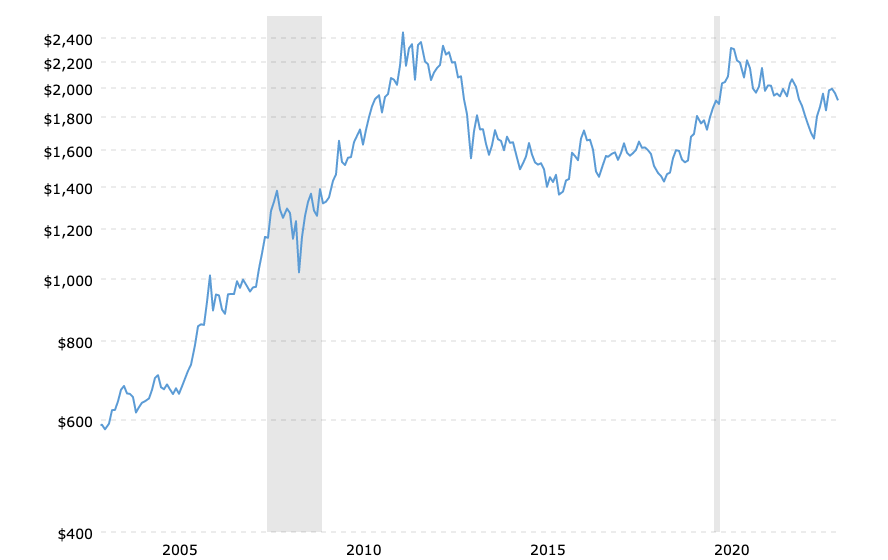
During the global financial crisis of 2008-2009, gold, a traditional safe-haven asset, saw its price increase significantly. Bitcoin, often called digital gold, could see similar price movements in response to market instability caused by yield convergence.
Graph showing the price of gold from June 2003 to June 2023 (Source: MacroTrends)
However, it’s important to note that many other factors, including regulatory news, technological advancements, and broader investor sentiment toward cryptocurrencies, influence Bitcoin’s price. Therefore, while yield convergence in traditional markets could drive more investors to Bitcoin, it could also lead to increased short-term volatility in Bitcoin’s price.
Moreover, as Bitcoin and other cryptocurrencies become more integrated with traditional financial markets, they have become increasingly sensitive to fluctuations in other asset classes. This means that while Bitcoin has the potential to act as a hedge, it could also be impacted by the same factors causing yield convergence, leading to potential price volatility.
Conclusion
The convergence of yields across major asset classes is a significant market event that warrants close attention. This phenomenon, which sees the yields on Treasury bills, corporate bonds, and the S&P 500 aligning, is a rare occurrence that signals a shift in market sentiment and risk perception. It underscores the interconnectedness of different asset classes and the potential for ripple effects across the financial landscape.
The implications of this yield convergence could be far-reaching, influencing investment decisions and market dynamics in both traditional and crypto markets. For Bitcoin, the largest and most well-known cryptocurrency, this could mean increased demand as a potential hedge against market instability but also potential price volatility due to its growing sensitivity to traditional market fluctuations.