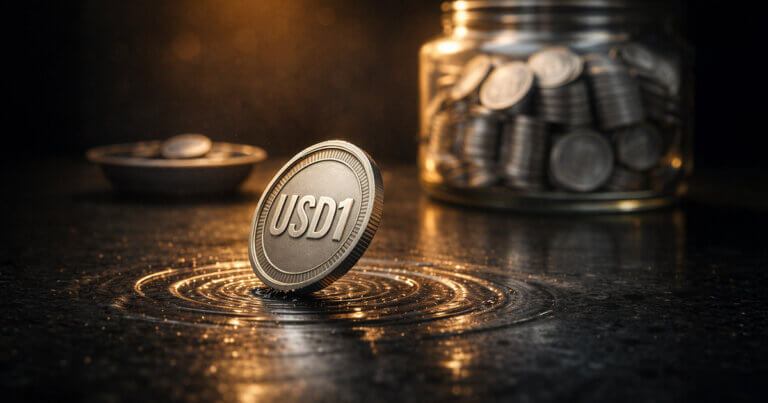
World Liberty Financial's stablecoin USD1 slipped to $0.994 on Feb. 23.
Update (March 2, 2026, 09:43): A new attestation expanded the public record on USD1’s reserves and supply, and a Senate Banking hearing added fresh scrutiny to the project’s trust-bank bid; the unresolved question is still how resilient redemption access is when trading turns one-sided.
The Feb. 23 wobble was brief, but it landed at an awkward moment: USD1 is now large enough that any mechanical weakness in the peg starts to look like market structure, not a one-off glitch.
What changed
March 2, 2026: Price trackers showed USD1 trading around $0.9995 with roughly 4.69 billion tokens circulating and about $1.74 billion in 24-hour volume on CoinGecko.
March 2, 2026: A second major tracker listed a similar token count and roughly $1.70 billion in 24-hour volume on CoinMarketCap.
February 26, 2026: BitGo’s custodian reserve report examined by Crowe stated that, as of Jan. 31 (23:59 UTC), USD1 had 5,066,501,777 redeemable tokens outstanding backed by $5,066,522,467 in redemption assets in its report.
February 26, 2026: In a Senate Banking exchange, OCC Comptroller Jonathan Gould said he would consider a request to share World Liberty Financial’s unredacted national trust bank application with committee leadership, according to the committee’s release.
None of those datapoints disproves the original thesis. They do, however, tighten the timeline around what the market can actually verify. The attestation report adds detail on the reserve mix and token accounting at specific cutoffs, while live market trackers and flow dashboards show how quickly secondary-market liquidity can change in between those cutoffs.
Note: “Redeemable tokens outstanding” in a reserve report is a point-in-time accounting measure and may not match “circulating supply” on price trackers at a later time.
USD1 stablecoin dropped to $0.994 before recovering to parity within minutes, illustrating a brief depeg within expected tweet-shock volatility range.
Two markets, one peg
The confusion starts with a simple but persistent category error: “backed one-to-one” is a balance-sheet statement, while “trades at $1.00 everywhere” is a market-structure claim. Stablecoins live in both worlds at once, and the gap between them is where discounts appear.
In the primary market, eligible participants mint USD1 by delivering dollars to the issuer’s banking and custody rails, or redeem USD1 for dollars at par. That’s where the backing matters and where arbitrage is supposed to pull a drifting price back toward $1.00.
In the secondary market, everyone else trades USD1 minute by minute on exchanges and in decentralized pools. That’s where USD1 hit $0.994 on Feb. 23. A seller who wants out now is not buying “one-to-one backing” in the abstract; they are buying immediate liquidity in a specific venue with a specific order book.
The missing piece is friction. Redemption is not instant, even when reserves are sound. Onboarding, KYC checks, banking cutoffs, operational capacity, and legal or compliance review all introduce delay. International Monetary Fund research has noted that “par redemption” can involve minimums, fees, or processing lags that weaken the arbitrage link during stress, making the secondary market do more of the price discovery in the moment (IMF).
That is why a small discount can be rational without implying fraud or insolvency. It is the price the market assigns to immediacy. The tighter and more predictable the redemption rails feel, the smaller the discount tends to be when a rumor hits. The more uncertain the rails feel, the more secondary liquidity becomes the only “exit,” and the more sensitive the peg becomes to venue-specific flows.
One way to think about it is as a short-dated conversion option. In calm conditions, that option is near risk-free and the secondary price hugs $1.00. In stressed conditions, the option’s “settlement time” becomes the story, and the market prices a small haircut for anyone who needs dollars immediately.
The Binance chokepoint
USD1’s liquidity is not evenly distributed. In the post’s original reporting, Arkham wallet tracking suggested Binance held roughly 93% of USD1’s circulating supply, making one venue the de facto place where the peg gets stress-tested first.
Binance holds 93% of USD1's circulating supply, approximately $4.5 billion, creating concentrated exchange risk for the stablecoin's peg stability.
Even without updating the wallet-share figure, the venue concentration still shows up in trading activity. CoinGecko listed Binance as the most active centralized venue for USD1 and pointed to the BTC/USD1 market as its top pair, with about $424 million in 24-hour volume in its listing as of March 2.
Concentration changes the shape of a wobble. When most holders and most liquidity are in one place, a fast-moving narrative can become an order-book problem before it becomes a redemption problem. If sellers flood a single venue faster than arbitrage capital can absorb and hedge that flow, the secondary price can gap down even while primary redemption remains open.
The Feb. 23 move fits a “tweet shock” pattern: a sharp burst of messaging creates a one-sided flow, and the discount reflects the market’s demand to exit immediately rather than wait out redemption frictions. The quick recovery suggests that once the first wave of selling cleared, buyers stepped in and the price mean-reverted toward $1.00.
But the risk is structural, not episodic. A rumor that is venue-specific (custody concerns, regulatory headlines, delisting risk) can hit harder when one venue is the dominant pool of liquidity. CoinGecko’s dashboard also showed net outflows from centralized exchanges in the last 24 hours for USD1 at the time of this update, a snapshot that can swing quickly but is worth tracking when sentiment turns (flows).
In other words, reserves can be sound and redemption can be open, and the peg can still wobble if most trading is forced through a bottleneck. That is what makes “where the token trades” as important as “what the token is backed by” when the market is stressed.
Reserve transparency and the information lag
USD1’s public reserve story has improved, but it still arrives in chunks. The latest reserve attestation examined by Crowe is dated Feb. 26 and covers two report dates in January. In the summary table, the report lists 5.066 billion redeemable tokens outstanding and $5.0665 billion in redemption assets as of Jan. 31 (23:59 UTC).
It also adds texture that matters during a wobble. The same report breaks reserves into cash and cash equivalents (including demand deposit accounts) and government money market funds, and identifies a specific money market fund CUSIP (31607A703) in its redemption-asset notes.
CryptoSlate Daily Brief
Daily signals, zero noise.
Market-moving headlines and context delivered every morning in one tight read.
5-minute digest 100k+ readers
Free. No spam. Unsubscribe any time.
Whoops, looks like there was a problem. Please try again.
You’re subscribed. Welcome aboard.
For comparison, the prior monthly report (dated Jan. 30) covered December and showed 3.313 billion redeemable tokens and $3.3135 billion in redemption assets at the Dec. 31 cutoff. Both reports also note that USD1 is minted and redeemed across multiple networks, reinforcing that “supply” is a multi-chain accounting problem, not a single number on one venue.
Yet a month-old “as of” can feel stale in stablecoin time. Market trackers were showing a circulating supply closer to 4.68–4.69 billion as of March 2, which illustrates the basic mismatch: the token’s outstanding balance can change materially between formal report dates, even when the peg holds near $1.00.
That mismatch is not automatically a red flag. It is, however, the kind of information gap that a rumor can exploit. When the market cannot quickly reconcile “how many tokens exist,” “where they sit,” and “how quickly they can be redeemed,” secondary-market liquidity absorbs the uncertainty.
Academic models often describe stablecoin discounts as a mix of redemption friction, disruption-risk premium, and liquidity imbalance. Recent work argues that peg restoration tends to run through primary-market arbitrage until frictions cross a nonlinear threshold; after that, secondary liquidity can amplify moves rather than dampen them. The practical takeaway is that disclosure cadence and operational convertibility can matter as much as asset backing once the market is stressed.
What to watch next
The Feb. 23 wobble closed quickly, but “fast recovery” is not the end of the story.
Three checks can keep this story grounded in data rather than narrative. First, monitor the intraday trading range on major trackers; CoinGecko’s 24-hour range at the time of this update was $0.9982 to $1.00, and sustained widening would be a measurable sign that secondary liquidity is thinning.
Second, track whether exchange net flows stay persistently negative or flip sharply positive, which can signal either a rush for the exits or a scramble for inventory.
Compare those real-time signals to the next attestation cutoffs to see whether transparency is keeping pace with growth and redemption activity.
Peg quality degrades through repetition, and the next catalyst is usually measurable rather than rhetorical: a change in redemption accessibility, a shift in venue concentration, or a new information vacuum.
Scenario
Trigger
Expected discount
Likely recovery
What to watch
Tweet shock
Rumor burst / hacked-account narrative / influencer FUD
0.2%–1.0% off-peg
Minutes → hours
Depth + frequency of wobbles; perception of redemption access
Binance chokepoint
Venue-specific fear (custody, regulatory headline, delisting risk)
1%–5% off-peg
Hours → days (if liquidity fragments)
Order-book depth; migration to other venues; spread widening
Redemption queues; any limits/suspensions; freshness of reserve reporting
Two near-term signals now matter more than slogans. First is the pace and specificity of monthly reporting. The Feb. 26 reserve report gave the market a clearer baseline for January; the next release will show whether the public record is narrowing the gap between report dates and live supply swings.
Second is how regulators treat the trust-bank application and related disclosures. In the Feb. 26 Senate Banking exchange, OCC Comptroller Jonathan Gould said he would consider sharing the unredacted application with committee leadership, a reminder that the “political backstop” narrative can cut both ways by pulling a stablecoin deeper into formal oversight.
For markets, the hinge is simple: not whether USD1 can print $1.00 after a wobble, but whether the next bout of fear produces a bigger discount or a slower recovery. In a stablecoin, that is the difference between a scare and a run.