CryptoSlate’s latest report dives deep into Bitcoin options to better understand how they affect market sentiment and predict future movements and investor expectations.
Bitcoin is the cornerstone of the crypto market, not just due to its market cap but also its incredible maturity and complexity. It has long captured the interest of institutional and sophisticated investors due to the abundance of financial derivatives products it offers.
Options, a derivative product in the Bitcoin market, have become a critical trading instrument for investors. These financial contracts offer buyers the right, but not the obligation, to buy or sell Bitcoin at a specified price before the contract expires.
This gives investors tremendous flexibility, as options serve as both a hedge against market volatility and a speculative tool to capitalize on price predictions. This ability has made options trading a sophisticated method for investors to manage risk and exposure in a market known for its volatility.
The derivatives market experienced a landmark event on Mar. 29 — the expiry of $9.5 billion in BTC options and $5.7 billion in ETH options. This was one of the largest expiry events in Deribit’s history. Such a significant expiry is not merely procedural; it had considerable influence over market sentiment and had the potential to trigger volatility and significantly influence investor behavior.
Given the impact they can have on the Bitcoin market and the broader crypto market, understanding options is crucial and transcends the immediate effects of a single expiry event. In this report, CryptoSlate dives deep into the world of Bitcoin options to better understand how they affect market sentiment and provide clues to future movements and investor expectations.
What are options?
Options are sophisticated instruments that provide traders with control over their investment strategies. These derivatives afford the holder the right, yet not the obligation, to buy (through call options) or sell (via put options) Bitcoin at a predetermined price, known as the strike price, within a specific timeframe leading up to the option’s expiration date.
The mechanics of Bitcoin options are grounded in the principles of conditional trading. A call option is typically pursued when traders anticipate a rise in Bitcoin’s price, allowing them to purchase Bitcoin at a price lower than the market value. Conversely, a put option is relevant for those forecasting a price decline, offering a way to sell Bitcoin at a higher price than the anticipated market rate. The strategic deployment of these options enables traders to hedge against price volatility or speculate on price movements without directly holding the underlying asset.
Buying and selling Bitcoin options involve paying a premium by the buyer to the option seller. This premium is the cost of acquiring the option, influenced by various factors, including the Bitcoin price, strike price, and the time remaining until expiration. The strike price signifies the agreed-upon price for the underlying asset transaction, while the expiration date marks the deadline by which the option must be exercised, or it becomes worthless.
Bitcoin options share foundational similarities with traditional financial options, adhering to the same basic principles of option rights, premiums, strike prices, and expiration dates. However, the volatility intrinsic to the Bitcoin market introduces a unique layer of complexity and potential profitability. The digital asset’s price fluctuations can significantly affect option premiums, making Bitcoin options a dynamic and potentially rewarding area for informed traders.
Aside from open interest, which represents the value of all outstanding options contracts at a given time, strike prices and expiration dates are the most important factors when analyzing options. The strike price sets the transactional benchmark, setting the option’s value and premium. The expiration date represents the time limit of the options’ validity, providing a clear timeline for potential volatility.
Why are options important?
Options enable traders to navigate market volatility with greater finesse and strategic depth. These derivatives allow them to employ sophisticated hedging and speculation tactics and a mature approach to risk management and profit maximization.
Hedging is the primary use for Bitcoin options. It offers traders a mechanism to shield their portfolios from adverse price swings. By purchasing put options, traders can set a floor on the potential losses they might incur from a downturn in Bitcoin’s price, effectively insuring their investment against a significant decline. Conversely, call options are used to hedge against missed opportunities in rising markets, enabling traders to capture upside potential without the full commitment of holding the underlying asset or trading it on spot markets.
Speculation is another significant application of Bitcoin options, appealing to investors aiming to leverage their market predictions. Speculators use call options to bet on price increases or put options to anticipate declines, with the potential for substantial profits if their predictions prove accurate. The leverage provided by options enables speculators to increase their exposure to price movements with a relatively small capital outlay but with the risk of losing the premium paid if the market moves against their position.
Open interest, the total number of outstanding option contracts that have not been settled, alongside trading volume, is a critical indicator of market sentiment towards Bitcoin. High open interest indicates a significant level of market participation and interest in Bitcoin’s future price movements, suggesting bullish or bearish trends based on the nature of the contracts (calls or puts). Analyzing shifts in open interest and volume can thus provide insights into investor sentiment and potential price directions.
Furthermore, options trading data, including strike prices and the distribution of call versus put options, can explain market expectations for future movements. A concentration of activity at specific strike prices may signal perceived support or resistance levels, while an imbalance between call and put options could indicate prevailing market sentiment.
Options vs. futures
Futures represent agreements to buy or sell Bitcoin at a predetermined price at a specific future date, regardless of the market price. These financial instruments are used by traders looking for exposure to Bitcoin’s price movements without holding the digital asset directly before the contract expires. Futures are traded on various exchanges, offering ample liquidity and the potential for leverage, amplifying both risks and returns for traders.
The fundamental distinction between Bitcoin options and futures lies in their obligations to buyers and sellers. Futures contracts carry a binding commitment to execute the trade at the contract’s maturity, locking both parties into the transaction irrespective of the prevailing market conditions.
This can lead to significant risk, especially in the volatile crypto market, as investors may be compelled to buy high or sell low based on the contract terms. In contrast, options grant the holder the right but not the obligation to buy or sell Bitcoin, offering flexibility and risk management that are not present in futures trading. This fundamental difference profoundly impacts the strategies investors might deploy when incorporating these instruments into their portfolios.
Futures are utilized by diverse investors, from institutional entities seeking to hedge against price volatility to individual traders speculating on price movements. Institutional investors, in particular, may employ futures for hedging purposes, protecting other investments or operations against adverse Bitcoin price fluctuations. On the other hand, speculative traders often leverage futures to amplify their exposure to potential gains, accepting the high risk of loss for the chance of significant profit.
Options and futures add considerable depth to the Bitcoin market, creating a more complex trading environment. Options provide investors with strategic flexibility, allowing for sophisticated risk management and speculative plays. Futures contribute liquidity and the ability to hedge or speculate with leverage, serving the needs of a wide range of market participants.
The interplay between these derivatives enhances market efficiency, enabling price discovery and offering mechanisms for investors to express diverse views on Bitcoin’s future price trajectory.
Options and their impact on the market
The expiration of large volumes of Bitcoin options plays a significant role in shaping the market, often serving as a catalyst for increased price volatility and shifts in trading volume and liquidity. These expiries are important events for the market, as they compel option holders to make decisive moves — either executing their options based on prevailing market prices or letting them expire worthless. This increase in activity can lead to sudden and sharp price movements as the market absorbs the impact of these decisions.
The larger the expiry events, the bigger their effect on Bitcoin’s price. Leading up to the expiry of a significant amount of contracts, traders sometimes attempt to maneuver the spot price towards favorable outcomes, a practice known as “pinning.”
This can result in heightened price volatility, especially as the expiry date approaches. Post-expiry, the market may experience a recalibration of prices as the temporary pressures exerted by the expiring options dissipate. Historically, significant expiry days have been associated with increased trading volumes, as both the execution of options contracts and position adjustments contribute to a surge in market activity. This elevated trading volume, in turn, affects market liquidity, with potential short-term liquidity squeezes occurring if the market is not adequately prepared to absorb the flurry of trades.
The anticipation of options expiries also affects short-term market sentiment and long-term investment strategies. Traders often adjust their positions before an expiry to mitigate potential risks or capitalize on expected price movements. This strategic realignment can further contribute to market volatility and cause fluctuations in trading volumes in the days preceding large expiries.
A historical perspective on options expiry dates shows their impact on market sentiment and investor behavior. Periods of pronounced price volatility often come with large expiries, reflecting the market’s sensitivity to the potential uncertainty associated with the expiration of many options contracts.
Comparing outcomes of past expiries, we see a pattern where expiries act as focal points for market activity and reflect investor sentiment, offering insights into the collective psyche of the market participants. The cyclic nature of these events allows for identifying trends, such as the tendency for volatility to spike in the lead-up to expiry and for the market to stabilize or reorient itself in the aftermath.
Deribit’s massive expiry
On Mar. 29, Deribit saw one of its most significant expiry events, with $9 billion in Bitcoin options contracts coming to maturity. A big chunk of the market was gearing up for intense volatility, as such a significant expiry has the potential to cause a huge impact on Bitcoin’s price.
However, the immediate impact on Bitcoin’s price was relatively muted. BTC only saw a modest adjustment, losing its footing at just above $70,600 and dropping to $69,900. While this price movement is psychologically significant, it didn’t match the volatility the market might have anticipated, given the scale of the expiry.
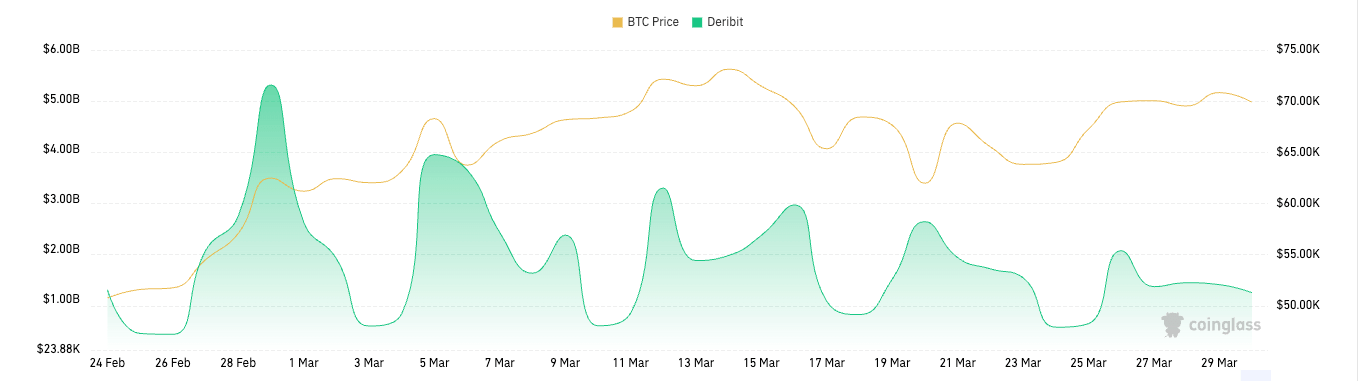
Data from CoinGlass put the trading activity on the expiry day at $1.31 billion in volume, significantly lower than any of the previous week’s days.
Graph showing the trading volume for Bitcoin options on Deribit from Feb. 24 to Mar. 29, 2024 (Source: CoinGlass)
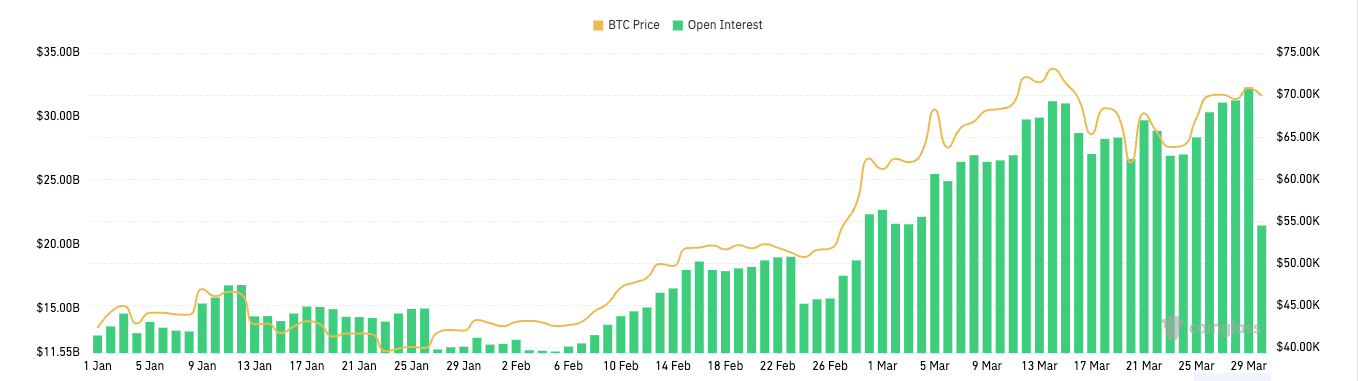
Moreover, the open interest in Bitcoin options dropped significantly after the expiry. The day before the expiry, on Mar. 28, the OI stood at just over $31.3 billion — the largest ever recorded. Following the expiry, this figure plummeted to $21.52 billion on Mar. 29. This sharp decline in open interest post-expiry shows the mass closure or settlement of positions, removing a substantial amount of speculative positions from the market.
Graph showing the open interest in Bitcoin options from Jan. 1 to Mar. 29, 2024 (Source: CoinGlass)
Despite the relatively modest immediate impact this expiry had on Bitcoin’s price, it’s important to recognize that the potential for volatility may not have been fully realized yet. The options expired on a Friday afternoon, just before traditional financial markets closed for the weekend. This is important as it means the broader financial ecosystem, including equity, foreign exchange markets, and ETFs, pauses its activity, delaying the full absorption and reaction to the expiry.
Over the weekend, the absence of tradfi market activity creates a vacuum where crypto markets operate in isolation, possibly leading to delayed or extended periods of volatility as crypto-exclusive factors play out without the moderating influence of larger, mixed-asset movements — especially spot Bitcoin ETFs.
Therefore, while the immediate aftermath of the expiry might appear to have had a minor effect on Bitcoin’s price, there remains a window for volatility to manifest, with the tradfi markets’ reopening potentially acting as a catalyst for delayed market reactions.